

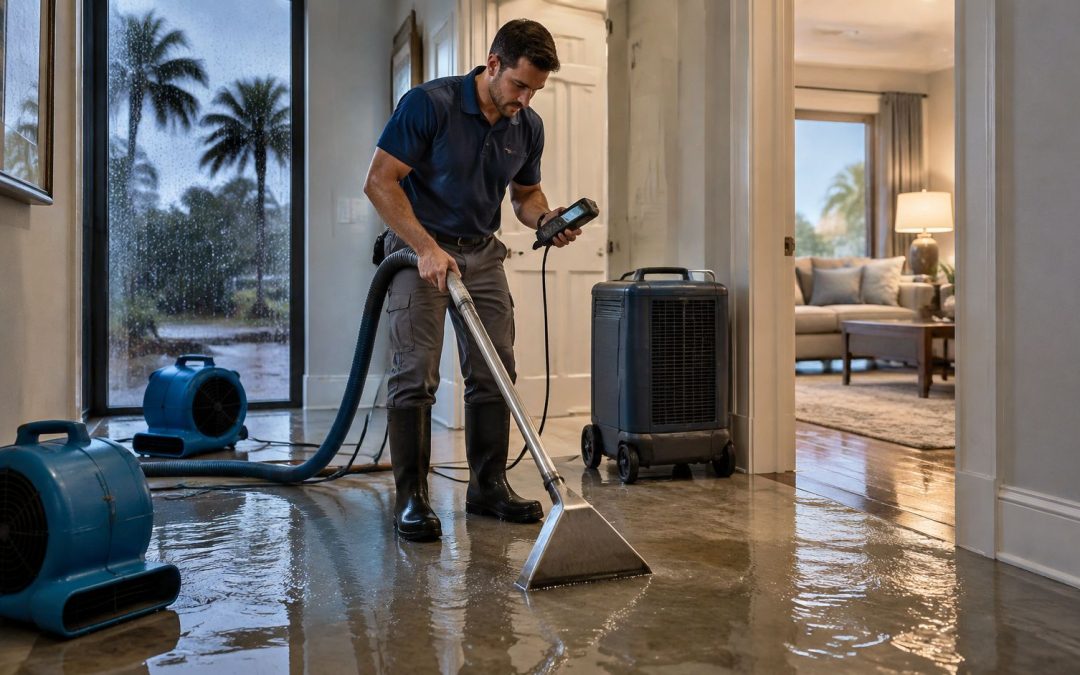
You get home after a summer storm and the hallway is already wet, with water pushing into the kitchen. The tile looks like something you can mop and forget. In a coastal house, that read is usually wrong. Water damage restoration in St. Petersburg has to account for what is still wet behind the baseboard, under the cabinet toe kick, and inside the wall cavity after the surface looks fine.
I would treat the next day and a half as the decision point, not the hour you first see the puddle. Supply-line breaks, backed-up drains, heavy rain, and tidal water all show up here. First Street estimates that 38,754 properties in the city, 44.9% of all properties, face some level of flood risk over the next 30 years. A floor that feels dry can still hide wet framing. The job is done when measured moisture matches dry parts of the same building, not when the shine leaves the floor.
Water Damage Restoration Stages and How Long Each Takes
A professional dry-out runs on four clocks, not one. Extraction can be fast while framing is still wet, and repair can drag after a clean-looking room is already dry. For St. Petersburg water damage restoration, the useful question is which stage is holding the job.
| Stage | What the Crew Does | Typical Timing |
|---|---|---|
| Emergency assessment | Moisture and hidden-water mapping, written plan | Same day, ideally within hours of the call |
| Water extraction | Pumps and vacuums remove standing water | Within hours of arrival |
| Drying and dehumidification | Air movers and dehumidifiers, daily moisture readings | Target dry within 24 to 48 hours of the water event |
| Cleanup, sanitizing and repair | Remove unsalvageable materials, sanitize, rebuild | Several days to several weeks, depending on scope |
Why the middle stage decides the rest
The 24 to 48 hour window is the fork in the road. The U.S. Environmental Protection Agency states that promptly drying wet or damp materials in that window will, in most cases, prevent mold growth. After that point, porous materials such as carpet, ceiling tile, insulation, and some upholstered contents may need disposal if they cannot be fully cleaned and dried. Residual moisture lets fungi germinate. High indoor humidity slows evaporation and leaves hidden growth in wall cavities, under flooring, and behind cabinets.
After the source is corrected, the EPA Brief Guide to Mold, Moisture and Your Home recommends indoor relative humidity below 60%, ideally 30–50%. Opening windows is not automatically helpful on the Gulf Coast. Outdoor air adds moisture when its dew point is higher than indoor conditions. I would rather run dehumidifiers and measure than trust a dry-looking floor, because the same surface can sit over wet framing or a damp cavity. Crews should compare wet materials with dry control areas, not guess from how the room smells.
Practical rule: Surface cleaning without source control, extraction, air movement, dehumidification, and measured verification is not a finished dry-out.
A proper job starts with a quick assessment that becomes a written plan for that property. You should get updates while equipment is running, then a clear closeout when readings show the assembly is dry and unsalvageable material is gone. Sanitizing and rebuild come after that confirmation, and they can run from several days to several weeks based on how much had to come out.
How to Respond in the First 24 Hours
Speed matters, but random activity does not. Work in this order so you stop new water, stay out of a shock hazard, and hand a crew a documented loss instead of a rearranged one.
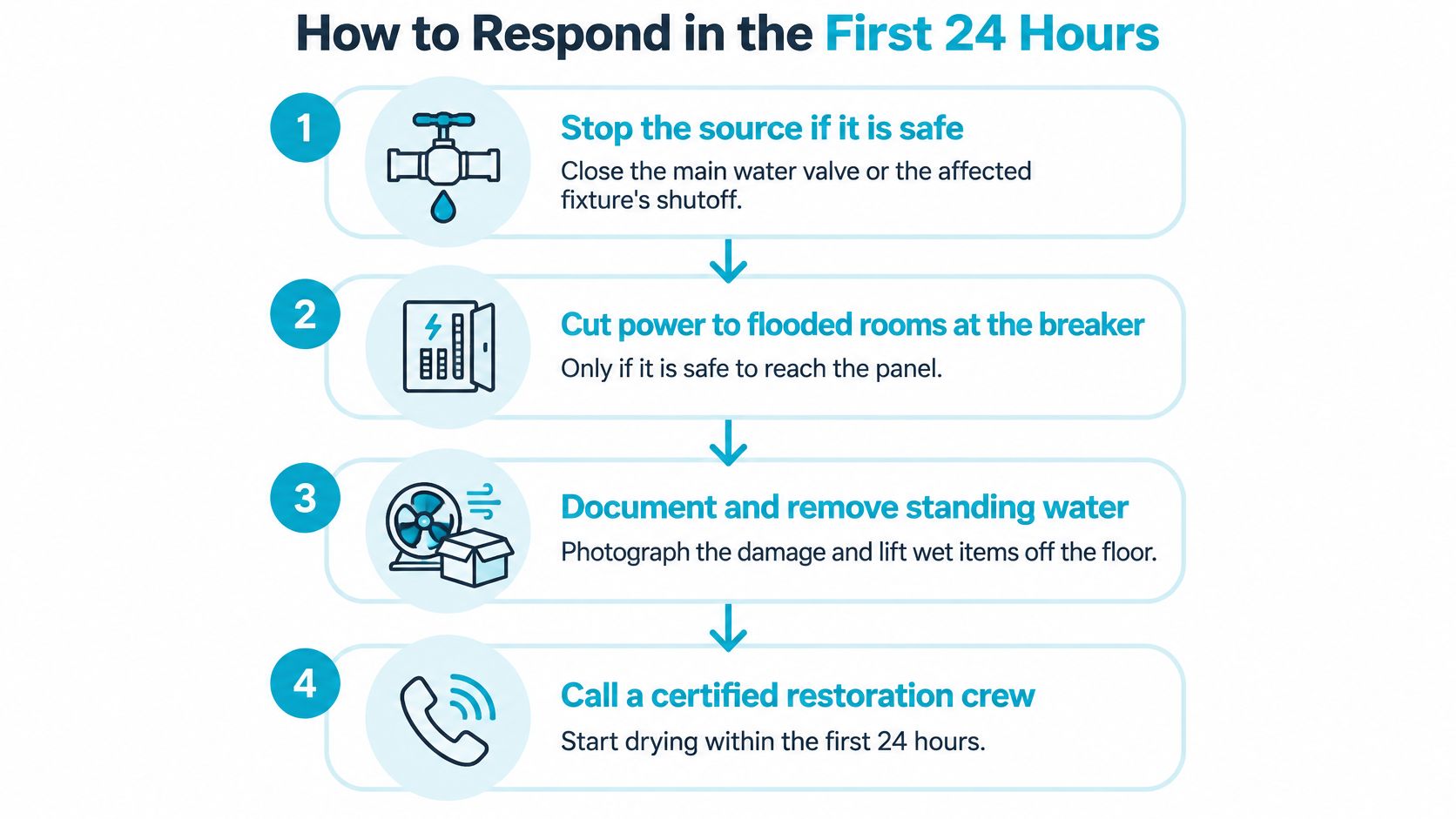
- Stop the source if it is safe. Close the main water valve or the fixture shutoff. A running supply keeps feeding the floor and the wall cavity while you look for towels.
- Cut power to flooded rooms at the breaker if water has reached outlets, cords, or the panel. If the water is deep, call the utility before you step in. A wet floor and a live circuit are a worse problem than a wet cabinet.
- Call for a same-day assessment and a written plan. AMPM Restoration is available 24/7 for water damage emergencies, and specialists arrive promptly to judge how far the water went. Ask for that written plan before demolition starts. Our guide to the first 24 hours of emergency water damage repair walks through the same sequence in more detail.
- Document before you move anything. Photograph and video each room, the ceilings, baseboards, appliances, and contents, with time stamps. Adjusters pay from a record, not from a memory of how bad it looked.
- Lift valuables, rugs, and furniture onto dry surfaces. Do not stack wet items on top of each other. That traps water and stains finishes that could have been saved.
- Open closet and cabinet doors so air can move. Do not aim a household fan into an open wall. That push can drive moisture deeper into the cavity instead of out of the room.
- If the water is floodwater or sewage, keep children and pets out. Wear gloves and boots before you touch anything. That water is not a clean supply-line leak, and skin contact is the wrong trade.
- Do not treat a household dehumidifier as the fix. It cannot pull standing water out of a subfloor. Extraction comes first. A small unit in a closed bedroom will not replace pumps and commercial drying.
What you should have by hour 24
By the end of the first day, the source should be stopped, the rooms documented, a crew booked, and wet contents off the floor. If one of those four is missing, the next day gets harder, not easier.
Leave the wall closed until someone maps it. Opening drywall at random dumps wet debris into a room you have not contained.
Drying Targets and How Crews Confirm the Job Is Done
A dry-looking floor is not a dry building. Three checks decide whether equipment can come out.
Psychrometry
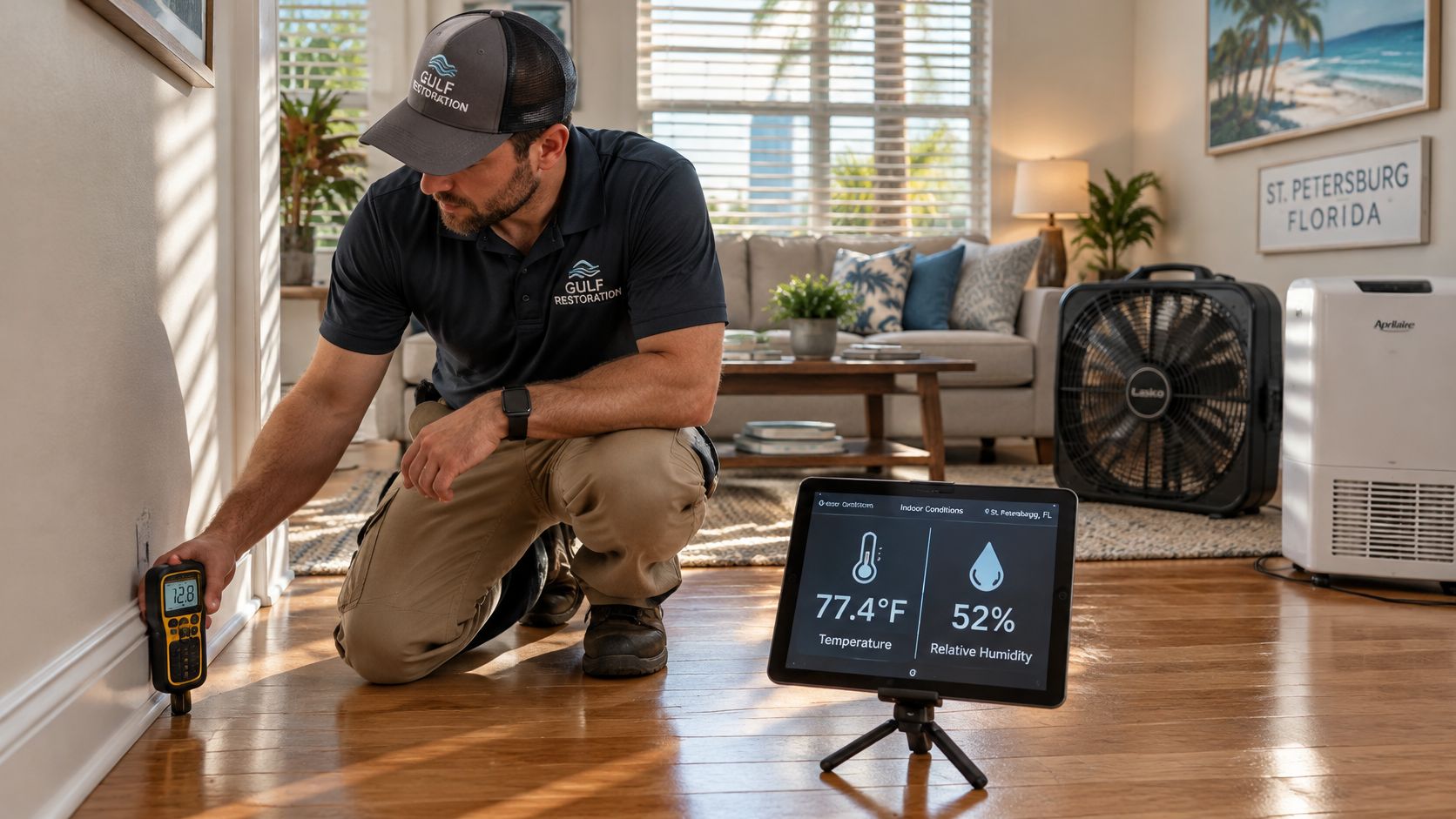
The IICRC S500 standard treats psychrometry and drying technology as core parts of professional restoration. Technicians track temperature, relative humidity, vapor pressure, and material moisture. Warm, moisture-laden summer air in St. Petersburg slows evaporation. Concealed wood can stay wet after the flooring looks done. If outdoor dew point is higher than indoor conditions, an open window feeds the problem. Drying is controlled air, not a breeze from the porch.
Material readings
Meters should hit drywall, subflooring, framing, cabinetry, and contents. Each reading gets compared with a dry standard from an unaffected area of the same building. A number without that comparison is just a number. Pin readings in the bottom plate tell you more than a hand on the paint.
Equilibrium, not a calendar
Monitoring continues until readings stabilize at an acceptable equilibrium. Stopping because three days have passed is how wet framing gets closed up. If the water was floodwater, sewage, or another contaminated source, porous materials carry extra health and handling concerns and should not be treated like a clean supply-line leak. The EPA also warns that mold cleanup is incomplete unless the moisture problem is corrected, or growth is likely to return.
Our structural drying methods page covers how air movers and dehumidifiers are set to those readings. Affected areas are sanitized, and mold-prevention treatments go on once the assembly is dry.
Ask for three things in writing:
- Daily moisture logs for the materials that were wet, not only the air in the room.
- The dry-standard comparison from unaffected areas of the same house.
- A final report that shows readings have stabilized, not a note that says the equipment ran for a set number of days.
If a crew wants to pull machines because the carpet feels firm, ask for the framing readings first. I would not sign off without them.
When Mold Testing Helps and When It Does Not
A negative air sample does not prove a wet wall, cabinet, or HVAC component is safe, and a positive sample rarely names the source or the right repair. CDC and NIOSH guidance states there are no health-based standards for indoor mold or other biological agents, and it does not recommend routine air sampling during a building-air evaluation. Visible mold, persistent moisture, musty odors, and the condition of the building should drive the work.
Moisture control is the strategy that holds, and sampling the air does not replace it.
| Situation | Best response | Why |
|---|---|---|
| Visible mold on porous material such as ceiling tile | Remove and replace | Contamination can penetrate material that cannot be fully cleaned and dried |
| Visible mold on hard surfaces up to 10 square feet | Clean with water and detergent, then dry completely | Hard surfaces can usually be restored once moisture is controlled |
| Mold covering more than 10 square feet | Professional remediation with containment | EPA guidance points to professional methods at this scale |
| Musty odor or stain with no visible growth | Map moisture, open the cavity, remove affected drywall | Persistent moisture is the main driver of growth |
| Negative air sample after water damage | Do not treat as clearance | Air sampling cannot prove a wall, cabinet or HVAC part is safe |
| Renter, school, office or medically vulnerable occupant | Document moisture and repair results, consider testing | Documentation matters more than species names |
The EPA says growth covering more than 10 square feet should move to professional remediation methods used for schools and commercial buildings. Painting over a stained, damp surface can make the problem worse by trapping moisture.
Here is the call a chart cannot make for you. Take a wall stud with a dark stain after a supply-line leak. If the pin meter reads dry against the dry standard, the wood gets cleaned and stays. The same stain on wood still reading wet gets cut back to dry material, because stain color tells you nothing about what is happening inside the framing.
Testing earns its place for renters, schools, offices, and medically vulnerable occupants, where a file of moisture readings and repair results matters more than a species name. For a bathroom wall with a stain and a musty smell, the useful move is to stop the leak, open the cavity, map the moisture, and remove the affected drywall. An assessment that covers both the water damage and the mold risk should start there. If you still want sampling after the source is fixed, professional mold testing belongs after the moisture map, not instead of it.
How Insurance Claims Work With Restoration Projects
Coverage follows the source of the water, and the paperwork has to match that story. Walk the claim in order so mitigation does not outrun the file.
- Notify the insurer promptly and get a claim number before major rebuild starts. Emergency extraction can begin so the loss does not grow, but a claim number gives every invoice a home.
- Keep receipts for emergency mitigation, including extraction and drying. Policies generally pay for reasonable steps that limit further damage. A cash receipt with no photos is a weak record.
- Have the restoration company send the adjuster the file. Photos, moisture logs, and a written scope are what an adjuster can price. We stay in contact through the job and coordinate directly with the carrier so you are not the messenger.
- Compare the adjuster's estimate with the contractor's line items before you sign. Ask about gaps in drywall, flooring, cabinetry, and contents. A lower number is not a savings if it leaves wet material in the wall.
- Check which policy applies. A standard homeowners policy generally excludes flood. A sudden pipe failure and rising floodwater are often treated as different causes, so the source you document on day one can decide the claim. Flood coverage, when you have it, is usually a separate policy such as one through the National Flood Insurance Program. Read the waiting-period and exclusion language on your own declarations page before you assume a storm loss is covered.
Our walkthrough on how to file an insurance claim for water damage lays out what to send and when. Financing options can sit beside the claim if you need to cover a deductible or work the carrier has not released yet. Do not spend the settlement on finishes while framing readings are still high.
A claim file without moisture logs is an argument about opinions. A claim file with logs is an argument about measurements.
Choosing a Qualified St. Petersburg Restoration Provider
The drying window runs about 24 to 48 hours before a wet wall becomes a mold problem, so most of the vetting has to happen on the phone before anyone sets foot inside. Certification is the first question, because the rest of the checklist is easy to fake on a call.
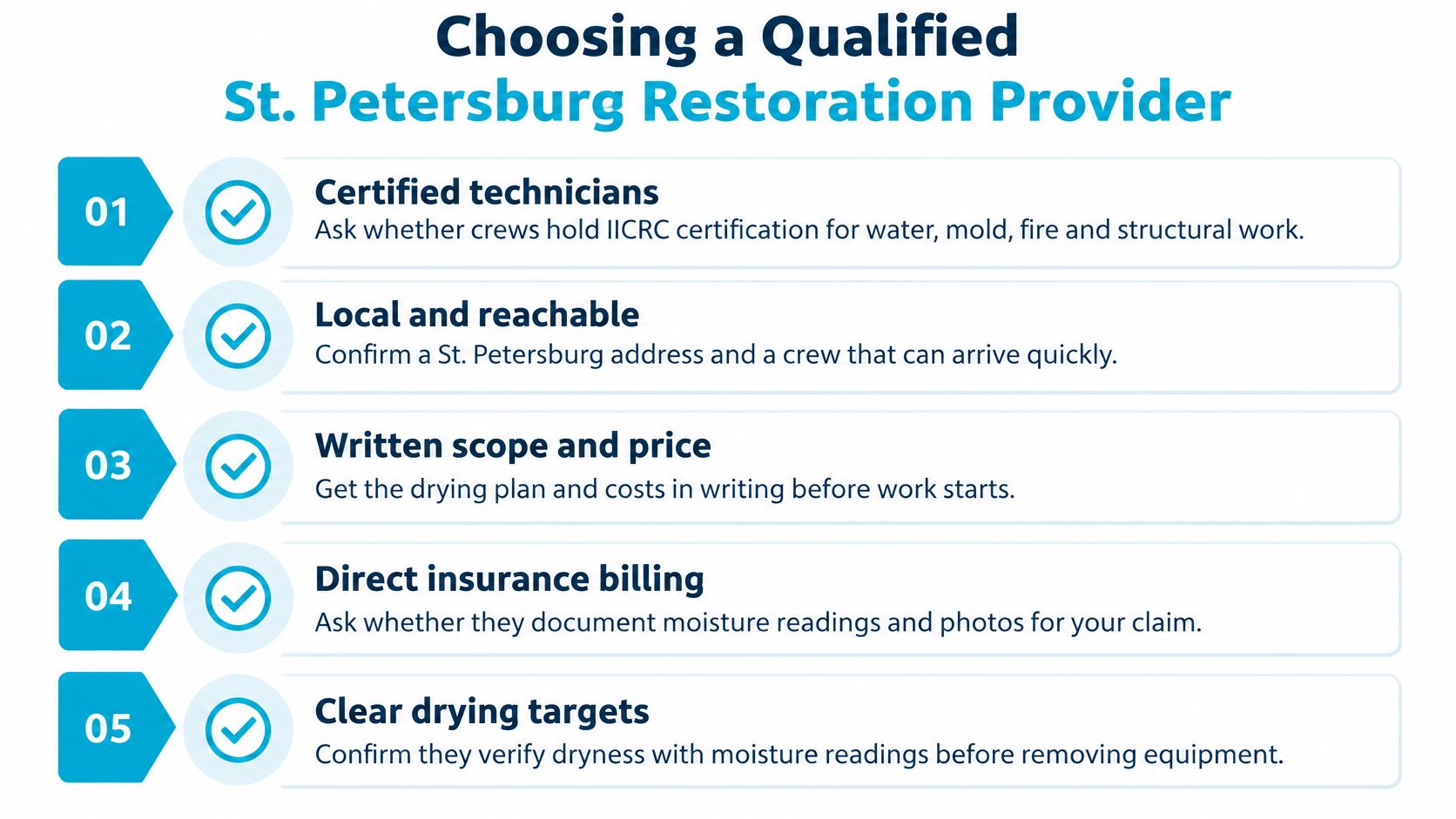
- Certified technicians. Ask whether the crews hold IICRC certification and whether their training covers water, mold, fire, and structural repair. Knowing what an IICRC-certified restoration company is trained to do gives you sharper follow-up questions.
- Real local response, day or night. Confirm the company serves St. Petersburg and Pinellas County, including Clearwater, Pinellas Park, and Largo, and that a person answers the phone at 2 a.m. A truck two counties away is not a same-day dry-out.
- A way to find water you cannot see. Ask how the crew checks inside wall cavities and under flooring, and what diagnostic equipment they use to map how far the water penetrated. A floor that looks dry can still hide wet framing.
- Licensed, bonded, and insured, confirmed in writing. A verbal "we're covered" is not a certificate.
- Storm and flood experience, not only supply-line leaks. Contaminated water changes what can be saved.
- A scope that runs through rebuild. Ask whether the same company handles repair and restoration of the damaged areas after drying, or whether you will be hiring a second contractor once the equipment leaves.
- A straight answer on mold. Ask when testing helps, when it does not, and whether the scope includes sanitizing affected areas and mold-prevention treatments.
- A free inspection and estimate with line items. A single lump sum hides what is being dried and what is being thrown away.
Red flags you can spot immediately
Pressure to sign before anyone inspects, no moisture readings on the first visit, a quote with no line items, and no verifiable license are each enough to end the call. The same list applies to every company you consider, including any name your insurer hands you. A smooth sales pitch does not dry a sill plate.
Frequently Asked Questions About St. Petersburg Water Damage
Can I stay in the home during drying?
Often yes on a small, clean loss if you can live around the equipment and the noise. Leave if demolition is heavy, the water is contaminated, or electrical gear and indoor air are in question. Sleeping next to open wet cavities is a poor trade for convenience.
What if the water was floodwater or sewage?
Keep children and pets out, and wear gloves and boots. Expect carpet, pad, and insulation to be removed rather than dried in place. Do not run the HVAC if the return was under water. That spreads contamination through the house.
How long does repair take after drying?
Rebuild starts after dry-standard readings are confirmed, not when the machines leave the driveway. Small finish repairs can take several days. Larger scope, including flooring and cabinets, often runs several weeks. Permit timing in Pinellas can add days you do not control.
How much does restoration cost?
Price tracks the affected area, the materials, and how fast extraction starts. A free written estimate with line items is the fair way to compare companies. A cheap bid that skips cavity readings usually shows up later as a second job.
Should I keep damaged materials as evidence?
Keep photographs and a labeled sample of removed material until the adjuster signs off. Ask the crew before anything is hauled away. Holding an entire wet carpet in the garage can create a new mold source, so a sample plus photos is the better record.
Does coastal flooding need a different plan than a burst pipe?
Yes. A pipe break is one event. NOAA's St. Petersburg tide-gauge inundation record, covering 1980 to 2026, documents recurring inundation, including scenarios where parts of the city and homes take several feet of water. Record pre-loss conditions, know your shutoffs, and plan for repeat wetting. Drying one storm does not fix a house that floods again next season.
Call 941-946-7807 for a Free Inspection and Estimate
Call now. The first 24 to 48 hours decide how much of the floor, the drywall, and the framing can stay. A floor that looks dry can still hold wet framing and soaked wall cavities underneath, so a moisture assessment matters even when the surface feels fine to the touch.
AMPM Restoration offers a free inspection and estimate, 24/7 emergency response with a one-hour response time, and direct coordination with your insurance carrier. Financing options are available, so you can plan payment next to the claim instead of waiting in a wet house.
Before you dial, gather the address, the source of the water if you know it, the rooms that are wet, the photos you already took, and the insurance company plus claim number if you have one. That information lets the dispatcher send the right equipment on the first truck. The team will map moisture and hidden water, give you a written plan, and keep you updated until the readings say the job is finished.
AMPM Restoration Services handles emergency water extraction, structural drying, mold removal, storm and flood cleanup, and repairs through final restoration for St. Petersburg, Pinellas County, and Tampa Bay homes and businesses. If water is in the house now, a same-day assessment is the step that protects framing you cannot see. Visit AMPM Restoration Services for a free inspection and estimate.