


Water Damage vs Mold Damage
You get home to Bradenton after a weekend away and find water beneath the kitchen sink. A storm passed through while you were gone, but the immediate culprit appears to be a leaking supply line. The cabinet feels damp, the floor looks mostly dry, and you’re searching water damage vs mold to figure out whether this needs towels, drying equipment, or a remediation crew.
Don’t make that decision by looking for black spots. The first question is whether moisture is still entering or remaining inside the structure. The second is whether affected materials also need contamination control. Those questions can have different answers in the same room.
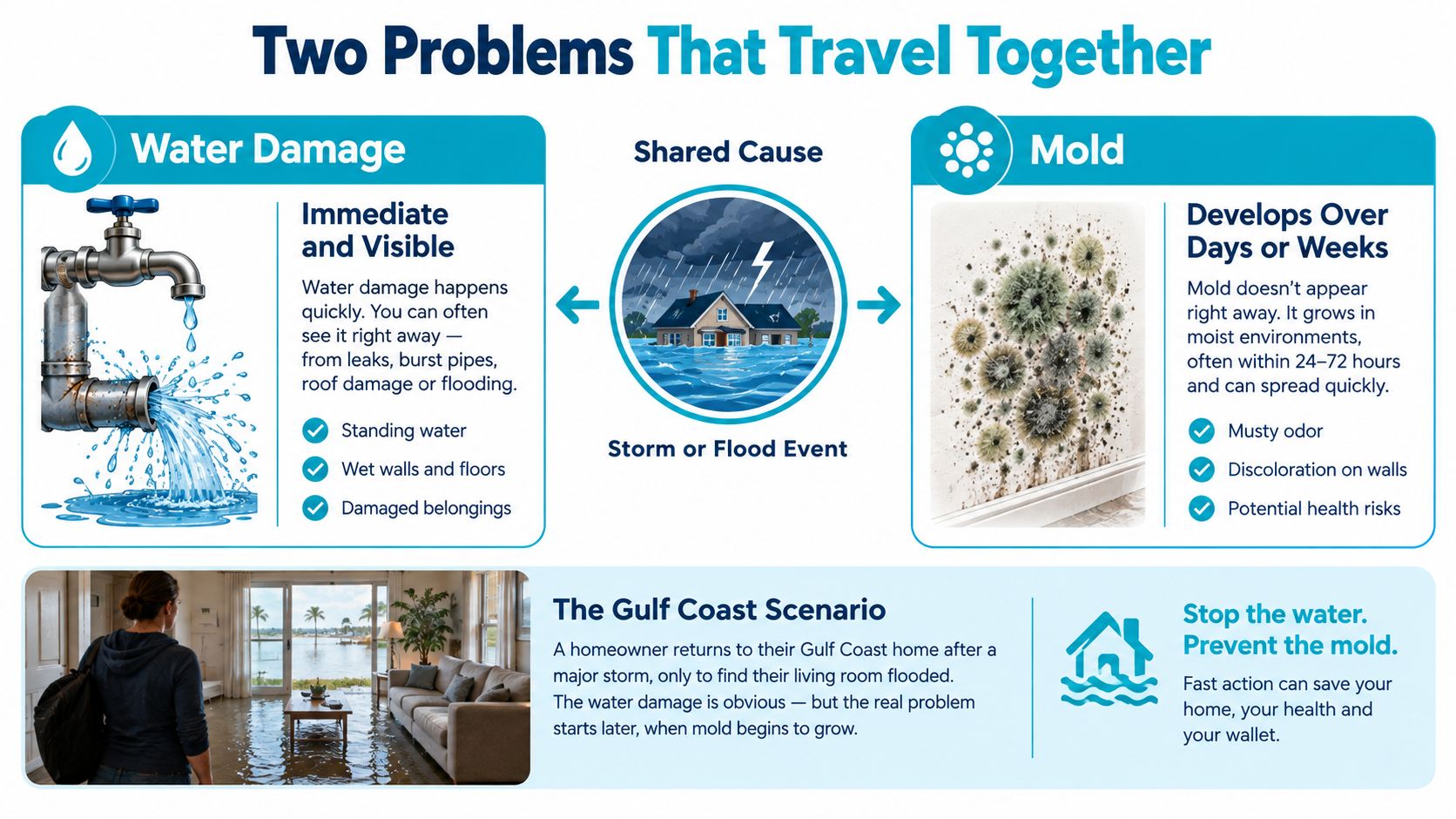
Two Problems That Travel Together
A slow supply-line leak after a Gulf Coast storm is a useful example because the weather and the plumbing problem can distract you from each other. You might check the roof while water continues collecting under the sink. Or you might tighten the connection and assume the cabinet, drywall, and flooring will dry on their own.
Treat the incident as two parallel risk tracks. Water damage concerns the moisture entering and remaining in building materials. Mold concerns biological growth in those materials when moisture remains unresolved.
Water Damage vs Mold at a Glance
| Attribute | Water Damage | Mold |
|---|---|---|
| Main problem | Unwanted moisture in the building | Biological growth associated with moisture |
| Starting point | A leak, intrusion, spill, or persistent dampness | Conditions that allow growth on suitable materials |
| What you may notice | Standing water, staining, swelling, damp finishes | Visible growth or persistent musty odor |
| What can remain hidden | Wet cavities, insulation, subfloor, cabinet bases | Growth behind finishes or inside affected assemblies |
| Immediate priority | Control the source and assess drying needs | Control the source and prevent contamination spread |
| Completion evidence | Documented drying verification | Appropriate cleaning or removal and post-remediation confirmation |
Water is the initiating condition; mold is a possible consequence, not an automatic result of every leak. CDC/NIOSH identifies roof leaks, plumbing leaks, water-damaged buildings, and high indoor humidity as environments associated with mold-related respiratory problems, so a small-looking incident deserves more than a cosmetic response.
Separate the Source From the Consequence
The practical mistake is treating stain removal as water restoration or treating mold removal as leak repair. Neither resolves the other task. A crew can remove affected drywall while an unresolved roof opening keeps admitting water.
For roof-related concerns, Aastro Roofing Company's resource on Mold on Roofing Shingles provides additional context for exterior roof observations. Don't use an exterior appearance alone to decide whether the interior is wet.
Your decisions should follow the evidence: identify the source, establish the moisture footprint, evaluate affected materials, and determine whether licensed mold work is needed. Keep water mitigation and mold remediation distinct in the scope, even when the same project requires both.
Causes and Timelines Compared
Discovery time isn't necessarily leak-start time. If you find a wet cabinet on Sunday, you don't know whether the connection began leaking that morning or before you left. Give the contractor the uncertainty rather than an optimistic estimate.
Water incidents can have an identifiable starting event: a pipe failure, roof intrusion, or storm pushing water indoors. Mold development depends on continued moisture and the affected materials. That means the response should consider both elapsed time and present conditions.

Use the Prevention Window Correctly
The EPA's moisture-prevention guidance recommends cleaning and drying damp materials within 24–48 hours, because mold generally won't grow when drying is completed promptly, and keeping indoor relative humidity below 60%, ideally 30–50%. Those are reasons to act immediately, not permission to wait.
The EPA's commercial-building remediation guidance also makes clear that 48 hours is a guideline, not a guarantee: mold may already be present even when materials are dried within that period. Don't treat a calendar deadline as proof that the structure is safe or dry.
Florida's high ambient humidity can slow evaporation. A Sarasota room with a dry-looking floor may still have moisture in carpet backing, insulation, or cabinet cavities. Cooler weather doesn't excuse delayed assessment, either; material condition matters more than assumptions about the season.
Practical rule: Use time to establish urgency. Use inspection and measurements to establish the scope.
Water Quality Changes the Response
Tell the responding crew where the water came from before anyone sets up airflow.
- Supply-line water: A known plumbing source helps the crew assess the incident, but the condition of materials still needs checking.
- Appliance discharge: Water from a washing machine or dishwasher needs its own contamination assessment. Don't assume it deserves the same treatment as a fresh supply-line leak.
- Sewage or floodwater: These require a different safety protocol, even when there's no visible mold. Leave equipment placement and material handling to qualified responders.
Don't assign contamination categories from appearance alone. Clear-looking water isn't an inspection result.
For a practical explanation of elapsed time and material conditions, use the mold growth timeline after water damage. The useful takeaway is urgency without false certainty.
Visible Signs and Hidden Indicators
A stain tells you where to investigate. It doesn't tell you how far the moisture traveled, whether the material remains wet, or whether mold is present behind it.
In water damage vs mold, visual inspection is a starting point, not a completion test. Look at the finish, then ask what sits underneath or behind it.

Check Assemblies, Not Just Surfaces
| Area | What to look for | What the inspection should address |
|---|---|---|
| Drywall edges and baseboards | Staining, peeling paint, swelling | Moisture at the wall base and possible cavity involvement |
| Flooring and subfloor | Warping, damp carpet, changed appearance | Conditions beneath the finish and in supporting materials |
| Cabinets and toe-kicks | Swollen panels, staining, odor | Concealed bases, adjacent walls, and trapped moisture |
| HVAC-adjacent areas | Condensate dripping or repeated dampness | The moisture source and affected surrounding materials |
| Ceiling corners and window frames | Spotting or recurring condensation | Whether moisture is active and growth needs assessment |
Ask the technician to explain the inspection locations and findings. Moisture-meter readings should be tied to specific materials, not reported as an unexplained number for the entire room. Where concealed spaces need investigation, agree on access before somebody starts opening walls.
HIBCO ROOF LLC's guide to where to look for water damage offers another starting point for checking visible warning areas. For interior concerns, the guide to signs of hidden water damage behind drywall focuses on the problem a freshly painted surface can conceal.
Let the Material Guide the Decision
The EPA's home mold-cleanup guidance distinguishes hard, nonporous surfaces, which can be cleaned with detergent and water and dried completely, from absorbent materials, including carpet, backing, ceiling tiles, and some wallboard, which may need removal when mold penetrates pores and cavities.
That distinction matters more than whether a stain looks dramatic. A washable surface and mold-affected carpet backing don't belong in the same cleanup plan.
Treat musty odor as an investigation trigger, not a laboratory diagnosis. Spotting also needs assessment rather than identification by color. Respiratory symptoms belong in a health conversation, not a contractor's attempt to diagnose exposure.
A visual-only visit isn't a moisture inspection. Moisture readings alone don't establish whether growth is present. You need an inspection scope that addresses both questions without pretending either tool answers everything.
Health Risks for Florida Households
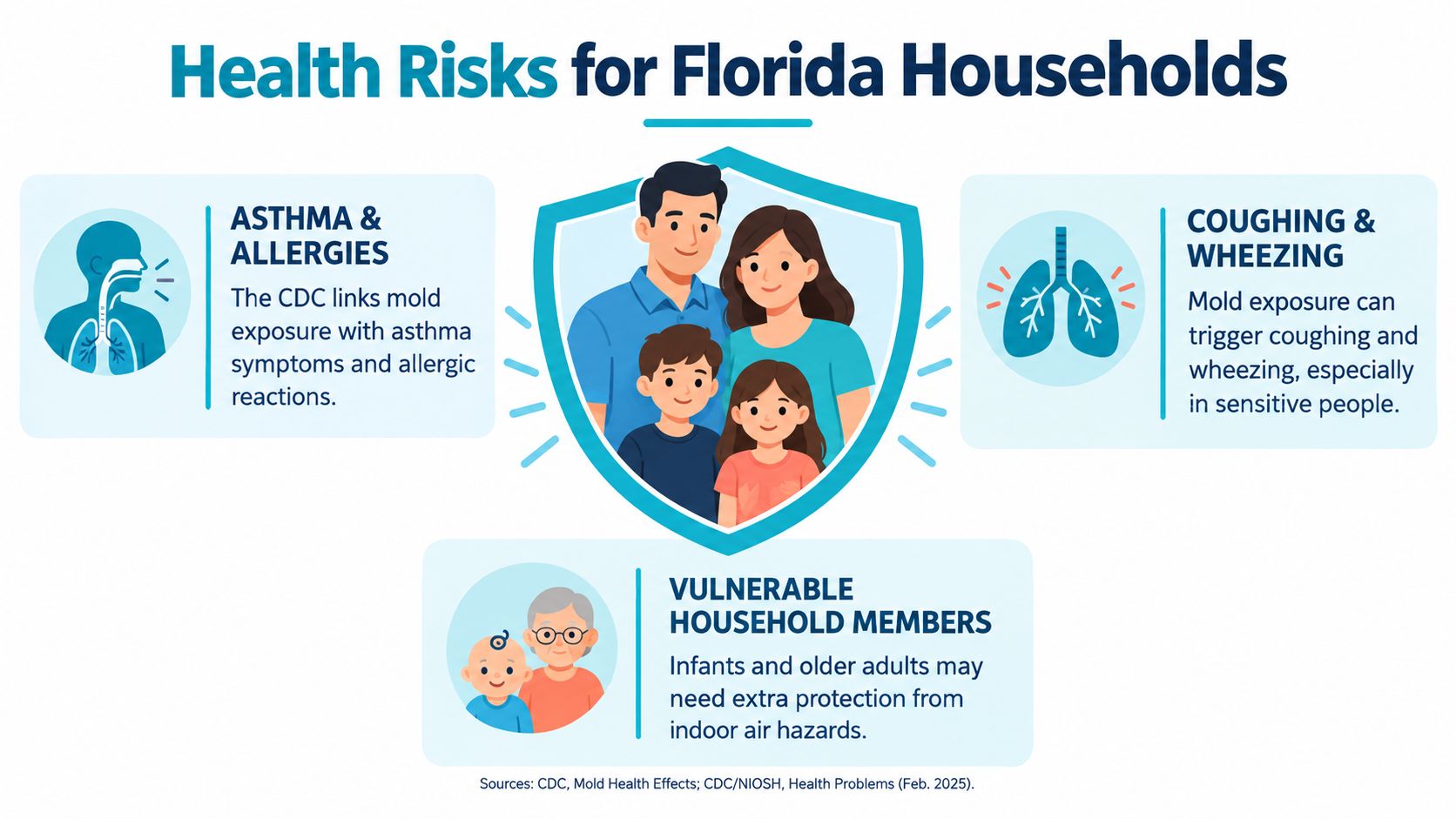
Don't dismiss a damp room because the damage looks minor. Don't assume every dark mark means a household medical emergency, either. The useful position is evidence-based: take dampness seriously, control the exposure situation, and get medical advice for symptoms.
A CDC/NIOSH review of damp buildings and health evidence describes associations with upper-respiratory symptoms, coughing, wheezing, and asthma symptoms. The evidence summary also reports that a 2007 meta-analysis of 33 studies estimated an approximately 30%–50% increase in risk across asthma-development, ever-diagnosed asthma, or current-asthma outcomes associated with home dampness and mold exposure.
Those findings describe population-level associations. They don't establish that a particular leak caused a particular person's symptoms, and they don't give a contractor grounds to make a medical diagnosis.
Make Occupant Needs Part of the Plan
Tell the restoration team about asthma, immune conditions, or other medical concerns before cleanup begins. If children or older adults use the affected room, discuss how to keep them away from the work area. Ask a clinician for individualized advice rather than relying on a generic risk label.
A useful household record includes:
- Symptoms: Note coughing, wheezing, irritation, or changes in asthma symptoms.
- Location: Record which rooms were used when symptoms occurred.
- Timing: Keep observations alongside the leak-discovery and cleanup timeline.
- Work conditions: Tell the contractor who needs access to the home and who can avoid the affected area.
Don't deliberately re-enter a damp room to see whether symptoms return. Seek medical attention for breathing problems instead of waiting for a restoration appointment.
The contractor's job is to correct building conditions and control the work area. The clinician's job is to evaluate symptoms.
Avoid the Toxic-Mold Shortcut
Color doesn't justify claims about toxicity, and a photograph doesn't establish an exposure dose. Reject sales pitches that jump from a wall stain to a diagnosis.
The practical concern is broader than a visible patch: unresolved indoor dampness deserves correction whether or not someone has named a mold species. Review symptoms of mold exposure in a home to organize observations, but keep medical decisions with a healthcare professional.
For a Tampa Bay household, the sensible recommendation is straightforward: don't occupy the work area unnecessarily, disclose health concerns early, and require a clear plan for controlling affected materials.
Remediation Priorities and the Right Order of Work
Don't put a fan in front of suspected growth and call it mitigation. Equipment has to match the water condition, materials, and contamination assessment.
The CDC's mold-cleanup guidance warns against using fans once mold has started growing because airflow can distribute spores. It recommends correcting the moisture source, cleaning appropriate surfaces with water and detergent, drying cleaned areas, avoiding painting or caulking over mold, and discarding flood-wetted materials that can't be completely cleaned and dried within 24–48 hours.
Establish the Work Sequence
- Control the source safely. Shut off the leaking supply when accessible. Don't enter an unsafe flooded area or take electrical risks to reach a valve.
- Assess the water and affected materials. The crew should establish contamination concerns before extraction, airflow, or demolition.
- Extract and make material decisions. Remove standing water and identify items that can't be appropriately restored.
- Dry under the right controls. Use drying equipment only where the assessment supports it. Suspected growth changes the setup.
- Verify and document. Track material readings, humidity, affected locations, and any cleaning or removal decisions before reconstruction.
Ask what each tool contributes. Extraction equipment removes liquid water; dehumidifiers manage moisture in the air; moisture meters support material checks. If the proposal lists low-grain refrigerant dehumidifiers, thermal imaging, or HEPA filtration, ask which finding justifies each item rather than judging the job by equipment count.
Decision Matrix for Water-Only Crews and Licensed Mold Remediators
Decision Matrix: Water-Only Crew vs Licensed Mold Remediator
| Situation | Call Water-Only Crew | Call Licensed Mold Remediator |
|---|---|---|
| Known clean leak with no growth identified | Appropriate starting option for mitigation | Seek assessment if inspection raises concerns |
| Unknown wetting duration or persistent concealed moisture | Start source control and moisture assessment | Include mold evaluation when conditions warrant |
| Visible growth on affected materials | Not sufficient as the sole response | Request a regulated-work assessment |
| Sewage or floodwater | Needs contamination-qualified response, not ordinary drying alone | Include mold expertise if growth is also involved |
| Mold-affected porous materials needing controlled removal | Don’t treat as a routine dry-out | Request a material-specific remediation plan |
Water mitigation needs documented drying evidence. Mold remediation also needs source correction, appropriate material treatment, and post-remediation confirmation.
The water damage restoration process should produce an understandable record, not just an equipment invoice. Keep photos, moisture logs, affected-area descriptions, material disposition, and containment decisions for the owner, insurer, and contractors.
When Mold Becomes Regulated Work in Florida
A contractor who can extract water isn't automatically qualified to perform regulated mold services. Florida treats mold assessment and mold remediation as licensed activities, and that distinction should affect whom you hire.
Under Chapter 468, Part XVI of the Florida Statutes, qualification pathways include examination, character, education, and experience requirements; one route includes an associate degree or equivalent, at least 30 semester hours of qualifying coursework, and at least one year of documented related field experience, along with electronic fingerprints submitted with the application. That's a specific licensing framework, not merely a claim that a crew has cleaned mold before.
Match Credentials to the Actual Scope
For an ordinary clean-water incident, ask about extraction, drying methods, and documentation. For a proposed mold assessment or remediation, ask who holds the applicable license and who is responsible for that portion of the work.
Don't invent your own legal threshold based on elapsed time or stain size. Passing the prevention window doesn't automatically establish mold, and floodwater alone doesn't prove a mold-remediation requirement. Those conditions call for assessment and the right safety controls.
- Visible growth: Request a written explanation of the proposed mold scope and applicable credentials.
- Concealed affected materials: Ask how the crew will investigate and control disturbance.
- Contaminated water: Confirm qualifications for the contamination response separately from mold licensing.
- Reconstruction: Establish what verification must happen before new finishes conceal the work.
Protect the Scope and Claim Record
A handyman's promise to “spray it and paint it” isn't a remediation plan. Require the contractor to distinguish source repair, drying, cleaning, removal, containment, and reconstruction.
For landlords and commercial owners in Bradenton or Saint Petersburg, that separation also makes occupant communication more useful. You can explain which spaces are affected, what work is underway, and what evidence is required before reopening them.
Don't accept blanket promises that a method will guarantee coverage or that hiring the wrong crew automatically voids a policy. Ask your insurer about policy terms, documentation, and authorization requirements. A clear record helps the carrier evaluate the claim, but the restoration contractor doesn't decide coverage.
Why Solving Water Problems Is the Only Durable Mold Prevention
A mold cleanup that leaves the leak unresolved is unfinished work. A dry-out that ignores affected growth is unfinished work, too. The durable approach addresses both risk tracks without confusing their completion criteria.
The first prevention investment should be the moisture source, not a fragrance, coating, or routine test. If water keeps entering behind a cabinet, the appearance of the repaired wall tells you very little about the next recurrence.
Fix the Route Water Takes
Think beyond the room where you noticed damage. Ask whether the problem began at a supply connection, roof opening, drainage defect, or HVAC condensation point. Repair the specific route rather than treating every incident as an indoor cleanup problem.
Exterior upkeep belongs in that conversation. SuperiorPRO's gutter system maintenance tips offer a useful maintenance resource when reviewing roof drainage. Use such resources to guide maintenance questions, not to replace an inspection of the actual intrusion.
For recurring indoor concerns, how to stop mold from coming back keeps the focus on unresolved moisture rather than repeated surface treatment.
Before rebuilding: Ask for the source-repair record, the drying record, and the applicable remediation-completion record. New drywall isn't evidence that the underlying work succeeded.
Make the Next Call Useful
When you contact a restoration company, give the dispatcher actionable information:
- Source status: Say whether water is still entering and whether you've shut off the supply.
- Affected locations: Identify rooms, flooring, cabinets, ceilings, and nearby HVAC components.
- Uncertainty: Explain when you discovered the incident without guessing when it started.
- Occupant concerns: Mention breathing conditions, access needs, and whether anyone remains in the affected space.
- Claim records: Have photos and insurer correspondence available.
AMPM Restoration is based at 4301 32nd St W b18, Bradenton, FL 34205, serving Bradenton, Sarasota, Tampa Bay, Saint Petersburg, Lakewood Ranch, and surrounding Gulf Coast communities. Its services include professional water damage restoration, mold inspection and mold removal, fire and smoke damage restoration, storm and flood damage restoration, commercial restoration services, and full reconstruction solutions.
For homeowners comparing water damage vs mold, the recommendation is simple: make the emergency call before cosmetic repairs. Choose a response that can establish the moisture condition, identify the appropriate scope, and keep the documentation organized.
Florida Homeowner Questions About Water and Mold
Should I Get Mold Testing First?
Usually, source control and inspection come first. CDC/NIOSH guidance on testing and remediation doesn't recommend routine air sampling because there are no health-based indoor mold concentration standards.
How Can I Tell Whether Drywall Is Dry Inside?
Ask for location-specific moisture readings and an explanation of any cavity checks. A dry painted face isn't enough.
Does a Musty Smell Prove Mold Is Present?
No. It warrants investigation, not automatic identification or deodorizing as the solution.
Will Insurance Cover Water Damage That Leads to Mold?
Ask the carrier to review your policy and circumstances. Keep the water and mold scopes documented separately.
Can I Paint Over the Stain After Cleanup?
Wait for completion evidence before refinishing. Paint shouldn't conceal unresolved moisture or growth.
Who Should I Call When the Leak Is Still Active?
Call an emergency restoration provider and explain the source, affected rooms, and any visible growth. Don't wait for a testing appointment.
For water damage vs mold, AMPM Restoration Services offers 24/7 emergency restoration, moisture assessment, water extraction and drying, mold services, and reconstruction across Florida's Suncoast. Call 941-946-7807 for a free inspection and estimate, and ask about insurance claim assistance and financing options so you can address the active problem with a documented recovery plan.
The comparison table and the idea of two parallel tracks really clarified this, since water is the initiating condition and mold is a possible consequence, not the same problem. I liked the reminder to check assemblies like cabinet toe-kicks and wall bases instead of just the surface stain. Porous materials that have been penetrated often cannot be cleaned the way hard surfaces can, so making that material call early matters.