


Professional Mold Testing
When a musty smell lingers in your Bradenton home after a heavy downpour or your allergies flare up in a specific room, it’s easy to suspect mold. Professional mold testing from a certified company like AMPM Restoration transforms those suspicions into actionable facts. It confirms whether mold is present, pinpoints the moisture source feeding it, and outlines the precise steps needed to stop the spread before it causes significant damage to your property and health. Think of it as a crucial diagnostic exam for your home, providing the clarity needed for effective treatment.
What Professional Mold Testing Actually Does
A comprehensive and reliable professional mold testing evaluation is built on three essential components:
- Visual Inspection: A thorough examination to document visible growth, water stains, discoloration, and any compromised building materials.
- Moisture Mapping: Utilizing advanced tools like moisture meters, hygrometers, and thermal imaging cameras to locate hidden pockets of water behind drywall, under flooring, or in other concealed spaces.
- Targeted Sampling: Collecting air, surface, or bulk samples that are sent to an accredited laboratory for species identification and spore concentration analysis.
It’s important to understand this isn’t a simple pass/fail test. Both the EPA and CDC caution against relying on a single lab number as a definitive “safe” or “unsafe” limit, as indoor fungal ecology varies with seasons, local weather, and property specifics. A spore count that seems high in winter might be normal for a humid Florida week in July.
For homeowners, landlords, and property managers across the Florida Suncoast, from Sarasota to Tampa Bay, this means a professional assessment will:
- Compare indoor air samples to an outdoor control sample taken at the same time to establish a normal baseline for your environment.
- Place a strong emphasis on identifying the moisture source, as high humidity and frequent storms are the primary drivers of mold growth in our region.
- Provide thorough documentation, including photos and reports, that is essential for insurance claims, ensuring tenant safety, and for real estate transactions.
Professional mold testing aims to answer three practical questions: Where is the moisture coming from? Is mold actually present? What evidence do we need to stop the spread and support proper remediation?
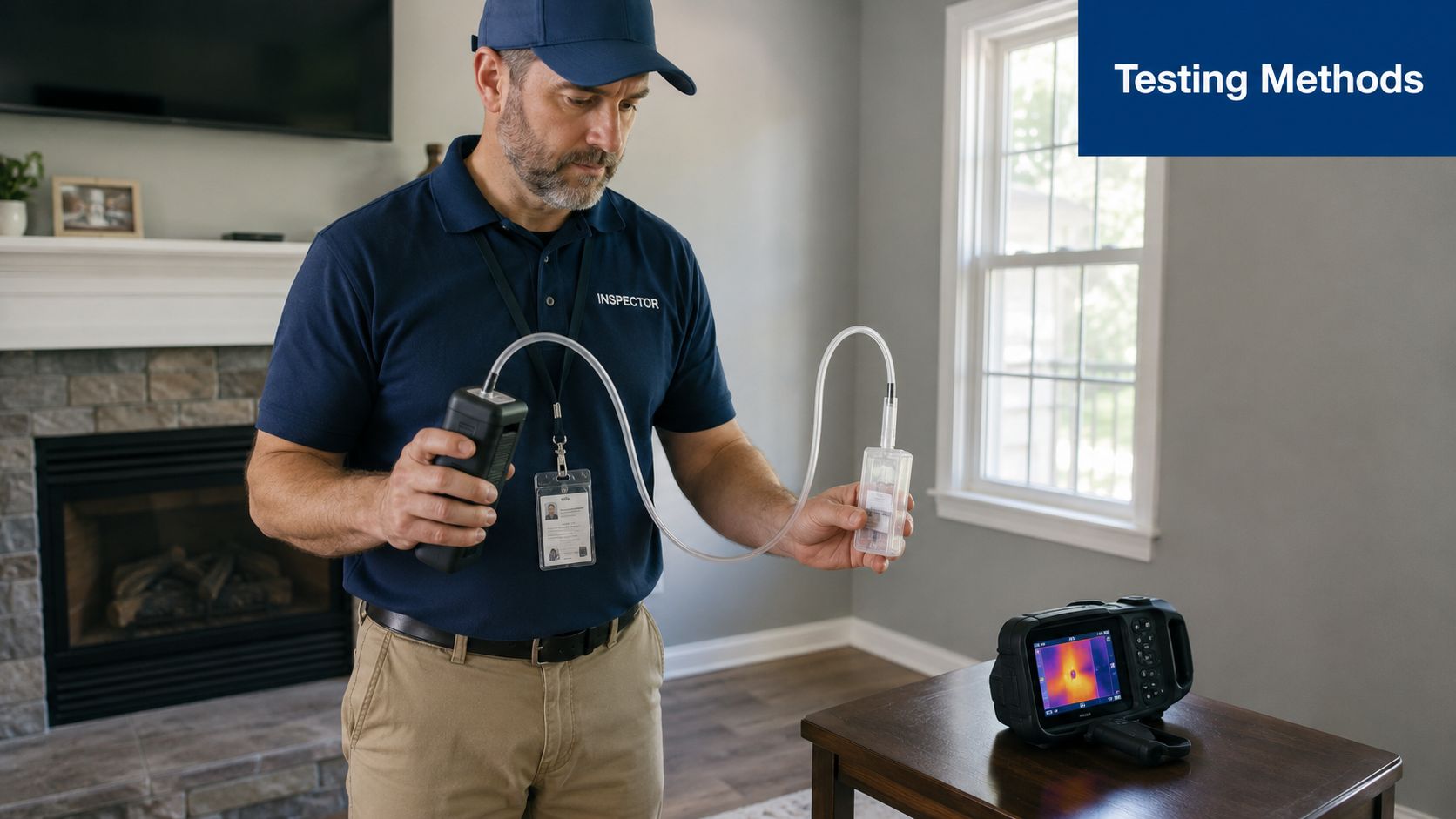
How an AMPM Restoration Inspector Works On Site
At AMPM Restoration, our certified inspectors begin with a detailed visual assessment and then use technology to uncover what’s hidden. We photograph all affected areas, measure humidity and moisture levels, and only use sampling when it’s necessary to clarify the scope and type of contamination. For instance, in a Sarasota condo with water intrusion behind a kitchen cabinet, our expert will focus on moisture mapping and targeted surface swabs in that specific area rather than conducting broad, unfocused testing that can be costly and less effective. This targeted approach ensures we gather the right data to solve the problem efficiently.
Why Lab Setup Matters
For labs handling professional mold testing, the physical workspace makes a real difference in result accuracy. SEFA 8 compliant casework explains how proper lab layout reduces cross-contamination and keeps results reliable.
Common Mold Testing Myths Versus Professional Reality
Homeowners often come in with assumptions about how mold testing works, and some of those assumptions can lead to wasted money or missed problems. Here’s what a certified inspector actually does compared to what most people expect.
| Common Mold Testing Myths Versus Professional Reality | |
|---|---|
| Common Assumption | What Professionals Actually Do |
| One test gives a pass/fail verdict | Professionals run a diagnostic sequence: inspection, moisture mapping, targeted sampling |
| Any black spot needs lab analysis | Inspectors confirm moisture source and visible growth before testing |
| A single number is a legal limit | Technicians compare indoor versus outdoor baselines per EPA/CDC guidance |
| Home test kits are as reliable as lab work | Certified testing uses calibrated tools, paired samples, and accredited labs |
Bottom line: professional mold testing is about understanding the full context of your indoor environment, not just getting a single number on a page.
Quick Facts Florida Homeowners Should Know
- Sampling without a moisture search often leads to misleading results.
- Visible mold may not require testing to start remediation, but tests are valuable for documentation and clearance.
- A certified inspector focuses on conditions and context, not a single "pass/fail" verdict.
If you're dealing with a musty smell, unexplained health symptoms, or recent water damage, the next step is getting a professional evaluation. AMPM Restoration's detailed service page on professional inspections offers more local context and clear next steps for Bradenton and the Suncoast area: Read also: Professional Mold Inspection Services in Bradenton and the Suncoast
3 Types of Mold Tests and When Each One Makes Sense
After a bad storm rolls through Sarasota and water sneaks into a condo, an experienced inspector doesn't just grab one tool off the shelf. They think about it the way a doctor picks tests for a patient—each one answers a different question. Professional mold testing works the same way. Air sampling, surface swabs, bulk sampling, moisture mapping, and thermal imaging all play a role, and together they tell you where mold is, how active it is, and what caused it in the first place.
Air sampling gives you a weather snapshot of your home. It captures whatever spores are floating around at that exact moment. Technicians pull paired samples—one inside and one outside—so they can compare your home's readings against the natural baseline outdoors. That comparison really matters here in humid Tampa Bay, where outdoor spore counts can skyrocket after heavy afternoon downpours.
Surface or tape-lift swabs work more like lifting fingerprints at a crime scene. A swab tells you what's actually growing on a wall, a piece of trim, or inside an HVAC return. Take a St. Petersburg landlord who spots a dark patch behind baseboard trim—a surface swab will confirm whether that patch is active mold that needs removal or just staining from an old leak.
Bulk material sampling takes it a step further. A technician removes a small piece of drywall or insulation and sends it to the lab. This comes into play when the building material itself might be compromised, like a Bradenton rental with drywall discoloration after a roof leak that went unnoticed for weeks.
Moisture meters and thermal imaging help you find the hidden pockets of dampness that feed mold growth in the first place. Thermal imaging acts like a satellite map, revealing cool, wet zones lurking behind walls or under floors that you'd never spot with the naked eye. In Gulf Coast homes, thermal scans routinely uncover moisture trapped in floor systems after prolonged stretches of high humidity or minor flooding events.
ERMI and dust-sample analysis offer a deeper look at long-term exposure. Dust sampling paints a historical picture of fungal types hanging around over time, which is especially useful during real estate transactions or complicated insurance claims where solid documentation makes all the difference.
3.1 When Each Test Pulls Its Weight
Different situations call for different tools. Here's how the pros decide what to use:
- Air Sampling — Catches airborne spores; your best bet when someone's dealing with respiratory symptoms or there's visible growth nearby.
- Surface Swabs — Pinpoints active growth on materials; ideal for visible spots or dust buildup inside HVAC systems.
- Bulk Sampling — Reveals contamination buried inside building materials; the right move when demolition or repairs are already on the table.
- Moisture and Thermal Imaging — Tracks down hidden leaks and wet cavities; absolutely essential after hurricanes and heavy rain events.
- ERMI/Dust Analysis — Delivers long-term exposure data; comes in handy for disputes, property sales, or stubborn complaint cases that won't go away.
Good inspectors pair visual inspection and moisture mapping with targeted sampling. They don't lean on any single result to build the full picture.
Real-world examples help make this click. A Sarasota condo with ceiling stains after a storm? That usually starts with moisture mapping and surface swabs. A Tampa rental where tenants complain of symptoms but nobody sees anything obvious? You'd likely begin with paired indoor and outdoor air sampling, then bring in ERMI dust testing if the results still don't add up.
3.2 Mold Test Types and Their Best-Fit Scenarios
Here's a quick-reference breakdown matching each method to what it finds and when it fits best in Florida conditions:
| Test Type | What It Detects | Best Florida Scenario |
|---|---|---|
| Air Sampling | Airborne spore levels and genera | Post-flood condo with new allergic symptoms |
| Surface Swabs | Active growth on surfaces | Visible black spot behind kitchen cabinet |
| Bulk Sampling | Mold within materials | Water-damaged drywall scheduled for replacement |
| Moisture/Thermal Imaging | Hidden wet pockets and leaks | Hurricane-affected home with damp floors |
| ERMI/Dust Analysis | Long-term fungal signature | Real estate sale or complex insurance claim |
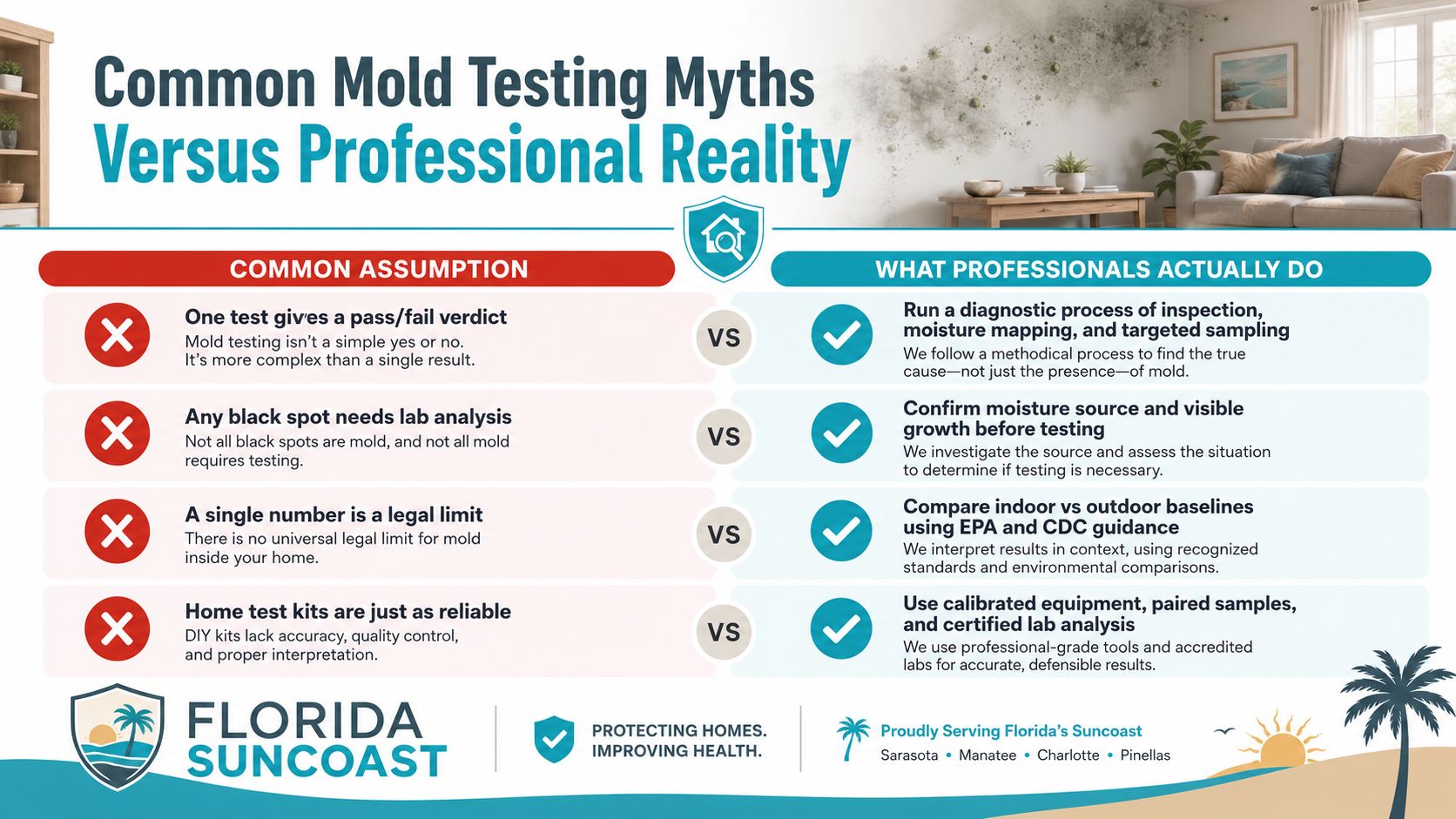
The infographic above breaks down common homeowner myths alongside professional realities—helping you figure out when testing actually adds real value. The big takeaway? Testing delivers the most useful information when it's paired with a thorough moisture investigation and backed up by clear documentation.
Want to dig deeper into how air testing actually works? Read our detailed guide on air quality testing for mold in Bradenton and the Suncoast.
Warning Signs That Mean You Should Schedule Testing
A St. Petersburg landlord spots a faint brown stain under baseboard trim after a summer thunderstorm and wonders if a test will actually prove anything. That small moment captures the question almost every property owner faces at some point: when does testing help, and when should you skip straight to removal?
Visible mold growth is the most obvious red flag, and in many cases, you can move directly into remediation without spending money on sampling. That said, professional mold testing still plays an important role—think insurance documentation, real estate closings, or confirming that remediation actually worked.
When Odors or Health Symptoms Point to Hidden Growth
A persistent musty smell, allergy flares that won't quit, or recurring respiratory issues all suggest hidden moisture might be feeding mold somewhere out of sight. This scenario plays out constantly after Gulf Coast storms, when water sneaks behind walls or under flooring and sits unnoticed for weeks.
- A musty smell that keeps coming back no matter how much you clean — that's usually active microbial growth doing its thing.
- Tenants complaining of coughs or headaches that seem tied to being indoors — worth setting up paired air samples to get answers.
- Condensation or visible dampness around your HVAC system — a sign the equipment itself could be distributing spores.
If multiple people in the building report symptoms that clear up once they leave, it's time to call for testing.
Recent Water Damage and Why It Matters
A roof failure, burst pipe, or storm flooding creates exactly the conditions mold needs to take hold—and it can start growing within 24–48 hours. Thermal imaging and moisture mapping pick up wet pockets hidden behind finishes that a quick walkthrough would never catch.
Here's how to decide your next move after water intrusion:
- Start with a free visual inspection to confirm any obviously wet materials.
- If moisture readings come back high or that damp smell sticks around, add targeted sampling to the plan.
- For insurance claims, document both the moisture readings and the lab results together.
Special Considerations for Gulf Coast Homes
Hidden moisture is a persistent headache in Bradenton, Sarasota, Tampa Bay, and the surrounding Suncoast communities. The combination of high humidity and tropical downpours keeps things damp in ways that aren't always obvious. After hurricanes or heavy storm seasons, prioritize moisture mapping and paired indoor versus outdoor air samples to establish a reliable baseline.
A few real scenarios that help clarify the decision:
- A small visible spot with zero odor or symptoms — you can likely handle direct remediation and document it with photos.
- A small spot combined with health complaints, strange smells, or recent flooding — book professional mold testing.
- Getting ready to sell a property or filing an insurance claim — testing gives you the clear, defensible evidence you need.
How Urgent Is Your Situation?
- Low urgency: An isolated stain, no smell, no symptoms — schedule a free visual inspection to start.
- Moderate urgency: Stain plus an odor or tenant complaints — set up targeted sampling.
- High urgency: Recent flooding, visible growth spreading across multiple areas, or people experiencing health effects — request a full sampling plan and get mitigation started right away.
Read also: Five Signs of Mold Damage in Homes
How Much Mold Testing Costs and How Long It Takes
Professional mold testing is a smart, affordable diagnostic step—especially when you compare it to the cost of a full water-damage claim. In most cases, it pays for itself just by clarifying what you're actually dealing with before anyone starts tearing out drywall.
A standalone visual mold inspection in the Suncoast region typically runs between $0 (free inspection) when a restoration company offers one and $200–$400 for a private inspection-only visit. That's a pretty reasonable first step, considering the average home water-damage insurance claim runs several thousand dollars.
Air and surface sampling packages usually land in the $250–$700 range. The final number depends on how many sampling points are needed and whether the inspector runs paired indoor and outdoor controls. Post-remediation clearance testing—which confirms the cleanup actually worked before reconstruction starts—generally runs $150–$450.
Testing costs come down to sample volume, lab fees, travel time, and how deep the moisture investigation needs to go.
Typical Timeframes Homeowners Should Expect
From the first phone call to the final report, here's what a realistic timeline looks like:
- Initial call to scheduling: Within 24 hours for emergency triage. Same-day responses are common with providers that operate around the clock.
- On-site inspection and sampling: Usually 1–3 hours for a single-family home, depending on property size and how many samples are collected.
- Lab turnaround: Standard accredited labs report results in 48–120 hours. Rush services can cut that to 24–48 hours, but you'll pay more for the speed.
- Final report and consultation: Expect 1–2 business days after lab results come back to review findings and map out next steps with your inspector.
For most routine cases, the full process—from first call to interpreted report—takes about 3–7 days. Complex samples or insurance documentation needs can push that to 1–2 weeks.
Cost Drivers and When Prices Rise
Not every job is the same, and several factors can nudge the price upward:
- Larger properties and more rooms mean more on-site time.
- Additional sampling points—like paired indoor/outdoor controls or ERMI dust tests—increase lab fees.
- Emergency visits, evening or weekend appointments, and rush lab analysis all carry premiums.
- Complex cases that require bulk sampling or multiple follow-ups will cost more overall.
Typical Mold Testing Costs and Turnaround Times
Here's a quick reference to help you budget and plan:
| Service | Typical Cost Range | Typical Turnaround |
|---|---|---|
| Visual Inspection | Free – $200–$400 | Same day to 48 hours |
| Air + Surface Sampling | $250–$700 | 48–120 hours |
| Post-Remediation Clearance | $150–$450 | 24–72 hours |
| ERMI / Dust Analysis | $300–$900 | 5–14 days |
Keep in mind these are general ranges. Your actual cost will depend on the specifics of your situation and where you’re located.
A Real-World Example
Say a Bradenton homeowner notices a musty smell rolling through the house after a storm. A free visual inspection can identify wet materials the same day. If the inspector recommends paired air samples, that adds roughly $300, and lab results typically come back within a week.
That small upfront investment does two things: it documents conditions for an insurance claim, and it gives remediation crews a clear target so they’re not guessing.
Read also: Learn more about Mold Inspection in Tampa Florida
AMPM Restoration offers free inspections and estimates, insurance claim assistance, and financing options to help Florida Suncoast homeowners manage costs without the stress. Call 941-946-7807 for a free inspection and estimate, and ask about insurance coordination and available financing.
How to Read Lab Results and Act on Them
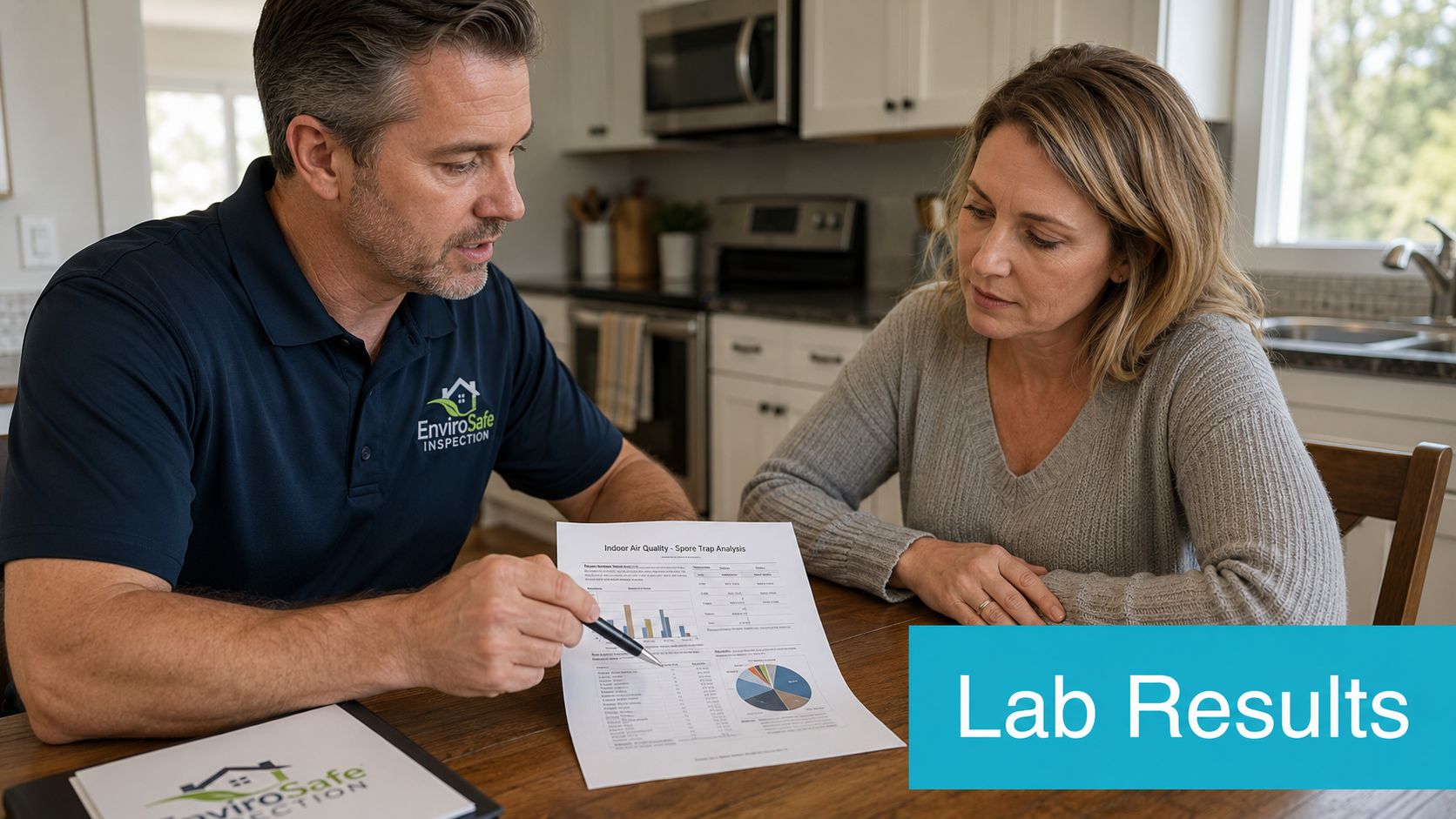
Lab reports can feel like a foreign language, but they follow a predictable structure that you can learn quickly. Start by locating the key elements: sample ID, sample type (air, surface, bulk), spore counts per cubic meter, genera identified, and any flagged species. This sets the stage for meaningful interpretation rather than panic or false reassurance.
Indoor versus outdoor comparison is really the key to understanding your report. If indoor spore counts are similar to outdoor control samples, that often points to normal background levels. However, when indoor counts or a specific genus dominate compared with outdoors, that suggests an indoor source and merits further action.
Think of lab variability like weather stations reporting temperature. Different stations sometimes give different readings for the same hour, but comparing trends across stations and using a trained meteorologist yields the real forecast.
That analogy matters because lab results do vary. In a study of seven accredited labs analyzing identical samples, only 75% consistently identified common environmental molds and only 50% correctly identified Aspergillus and Penicillium, with total spore counts differing by more than ten times across labs. Read the full research about these findings.
Reading Common Report Sections
- Spore count numbers — Look for absolute counts and how they compare to the outdoor control.
- Genera lists — Presence of a dominant indoor genus is a red flag; occasional outdoor fungi indoors is normal.
- Comments and recommendations — Labs often include notes about sample quality or limitations; treat these seriously.
Practical Steps After Reports Arrive
- Review the report with your inspector to translate numbers into action.
- Identify moisture sources using moisture mapping and thermal imaging if not already done.
- Prioritize containment for areas with elevated indoor counts or flagged species.
- Example: If Aspergillus shows up primarily in the laundry room and moisture mapping shows high RH, focus containment and drying there first.
- Example: If airborne counts are high throughout, suspect HVAC distribution and consider duct evaluation.
When to Plan Remediation and Clearance Testing
- Visible growth plus corroborating lab results — start remediation and document everything for insurance.
- Elevated indoor counts without visible growth — perform targeted exploratory openings and moisture checks before broad remediation.
- Post-remediation clearance — always verify that counts and genera return to acceptable baselines before reconstruction.
Expert interpretation turns a confusing lab sheet into an actionable plan and solid insurance documentation, especially for Florida storm claims where clear records matter.
Useful Checklist Before You Act
- Compare indoor vs outdoor controls
- Confirm sample integrity and chain of custody
- Correlate lab data with moisture readings and visible damage
- Discuss next steps with an IICRC‑certified inspector for remediation scope and clearance testing
For a deeper look at testing accuracy and what those numbers mean for Florida homes, check out our detailed guide on how accurate mold air quality testing is and what to expect from the lab results: Learn more about testing accuracy in our article.
Choosing an IICRC Certified Provider on the Suncoast
Finding the right company for professional mold testing comes down to two things: verified credentials and real local know-how. AMPM Restoration is a locally owned, licensed, bonded, and insured IICRC-certified provider based in Bradenton and serving Sarasota, Tampa Bay, Saint Petersburg, Lakewood Ranch and the surrounding Gulf Coast communities. We understand how this region’s unique climate impacts homes, and we bring that firsthand, community-driven knowledge to every inspection, helping restore both your property and your peace of mind.
What to Look for When You Call for an Inspection
Before you book an appointment, make sure the company checks these boxes:
- IICRC certification in plain English: This means technicians are trained in industry standards for inspection, moisture control, and remediation—no guesswork involved.
- Local storm and humidity experience: You need crews who understand how Florida humidity and hurricanes impact hidden wall cavities and HVAC systems.
- Lab partnerships: Look for in-house or partner accredited labs that maintain a clear chain of custody and provide transparent reporting.
- Insurance coordination: The right company documents conditions thoroughly and works directly with your carrier to smooth out the claims process.
- 24/7 emergency response: Look for a fast, reliable response time, like a one-hour arrival window for urgent jobs.
Picking a provider with certified training and local storm experience cuts out the guesswork and gets your remediation moving quickly.
How to Vet a Potential Provider Step by Step
- Ask for proof of IICRC credentials and the specific courses completed.
- Request examples of recent jobs on the Suncoast and ask for references.
- Confirm their lab partners and ask about sample handling procedures.
- Verify their licensing, bonding, and insurance coverage.
- Check if they offer mitigation services beyond testing, such as extraction, drying, and sanitization.
Full-Service vs. Inspection-Only Providers: A Comparison
| Service | Full-Service Restoration Partner | Inspection Only Company |
|---|---|---|
| Water Extraction | Included | Rarely provided |
| Structural Drying | Included | Referral only |
| Sanitization | Included | May not offer |
| Duct Cleaning | Often offered | Not typical |
| Full Reconstruction | Managed end-to-end | Not available |
| Insurance Coordination | In-house support | Limited help |
| 24/7 Response | Yes, emergency teams | Usually business hours |
A Real-World Scenario
Picture this: a Sarasota condo takes on moisture after a storm. The owner needs immediate drying, paired air sampling, and documentation for insurance claims. A full-service IICRC team handles the testing, mitigation, and reconstruction under one contract—saving valuable time and avoiding gaps in coverage or scope.
Ready to Take the Next Step?
For a free inspection and estimate with insurance claim assistance and financing options, call AMPM Restoration at 941-946-7807. We offer a one-hour response window, a 100% satisfaction guarantee, and the local expertise Suncoast homeowners rely on.
Frequently Asked Questions About Professional Mold Testing
What if I only see a small spot of mold? Do I still need testing?
If you see a small, isolated spot of mold with no associated odors or health symptoms, you may be able to proceed directly to cleanup. However, professional mold testing is highly recommended if you have underlying health concerns, notice a musty smell, or the spot appeared after recent water damage. For Bradenton and Sarasota homeowners, testing provides crucial documentation for potential insurance claims and peace of mind that there isn't a larger hidden problem.
How soon after water damage should I get a mold test?
You should act immediately. Mold can begin to grow within 24 to 48 hours of a water intrusion event. We recommend calling for a free visual inspection right away. If moisture is detected in hidden areas, targeted professional mold testing can then be performed to determine the extent of contamination before it spreads, which is critical for properties along Florida's Gulf Coast.
Will my homeowners insurance cover professional mold testing?
Many standard homeowners insurance policies in Florida do cover the cost of professional mold testing, but typically only when it is part of a covered water damage claim. To ensure coverage, it’s vital to have a professional restoration company like AMPM Restoration document the link between the water event and the need for testing. We offer expert insurance claim assistance to help you navigate this process.
How do I choose the right mold testing company in the Bradenton-Sarasota area?
Look for an IICRC-certified, licensed, and insured local company with proven experience in Florida's humid climate. A reputable provider should offer 24/7 emergency services, work with accredited labs, and provide clear, comprehensive reports. AMPM Restoration is a trusted, community-focused company serving Bradenton, Sarasota, Tampa Bay, and Saint Petersburg, dedicated to restoring both property and peace of mind.
Is a DIY mold test kit as good as professional testing?
No, DIY kits are not a reliable substitute for professional mold testing. These kits often provide inaccurate or misleading results because they cannot distinguish between normal background spore levels and an active indoor mold problem. Professionals use calibrated equipment, control samples, and accredited labs to provide a precise and actionable assessment of your home's air quality.
What happens after the mold testing is complete?
Once the lab results are in, your AMPM Restoration inspector will review the report with you, explain the findings in clear terms, and outline a detailed plan for mold removal and remediation if necessary. Our goal is to provide a complete solution, from initial testing and water extraction to full reconstruction, all while assisting with your insurance claim and offering financing options.
For reliable professional mold testing and a clear path to a safe, healthy home, turn to the local experts. AMPM Restoration is ready to help 24/7. Call us now at 941-946-7807 for your free, no-obligation inspection and estimate. We provide expert insurance claim assistance and flexible financing options to restore your property and your peace of mind quickly.