


Difference Between Black Mold and Mildew
“Black mold” and “mildew” aren’t scientific opposites, and a dark patch doesn’t automatically mean a dangerous mold problem. On Florida’s Suncoast, a dripping bathroom vent, a window air conditioner sweating in August, or a musty smell after a summer storm can all point to the same practical issue: moisture that’s allowing growth.
The useful difference between black mold and mildew is less about color than about where the moisture is, how far growth has spread, what materials are affected, and who lives or works in the space. Here’s how to assess the signs without dismissing a real problem or paying for testing that may not answer your question.
Why the Difference Between Black Mold and Mildew Matters Less Than You Think
A popular shortcut says black growth is dangerous and light growth is harmless. That shortcut isn’t reliable. The EPA explains that mold is a fungus sometimes also called mildew, while “black mold” isn’t a species or scientific category. The phrase commonly describes dark-colored growth or, more specifically, Stachybotrys chartarum, a greenish-black mold associated with persistently wet, cellulose-rich materials such as paper, gypsum board, and fiberboard (EPA explanation of mold and “black mold”).
| What Labels Actually Mean | Common Usage | Scientific Reality |
|---|---|---|
| Mildew | A pale, powdery patch on a bathroom or window surface | Often a common term for mold or surface discoloration, not a separate biological category |
| Black mold | A dark patch assumed to be a particular hazardous mold | A color-based label, sometimes used for Stachybotrys chartarum, but not a visual diagnosis |

A black mark might be a mold, another kind of growth, dirt, or a nonfungal stain. A light-colored growth can also cause irritation or allergies. Color alone can't tell you the species, toxicity, or level of risk.
In a Bradenton home, for example, mildew-like film on shower grout may be limited to a hard surface. A small stain on a ceiling, however, could sit below a roof leak or an overflowing air-conditioning condensate pan. The stain's shade doesn't show whether water has reached the drywall or insulation.
A more useful question: How long has the area been wet, where is the water coming from, and has growth reached porous material?
Defining Mold, Mildew, and “Black Mold” in Real Terms
Think of mold as the broad term and mildew as a common everyday label. People often use “mildew” for flat, powdery growth on exposed areas such as tile, grout, painted surfaces, or window frames. But the name doesn't prove that the growth is a separate organism or that it's safe.
The U.S. Department of Agriculture notes that “mildew” is often used as a common term for mold or for discoloration on unfinished wood. The terms can overlap, so a homeowner can't reliably identify a species just by looking at a patch (USDA discussion of mold and mildew terminology).
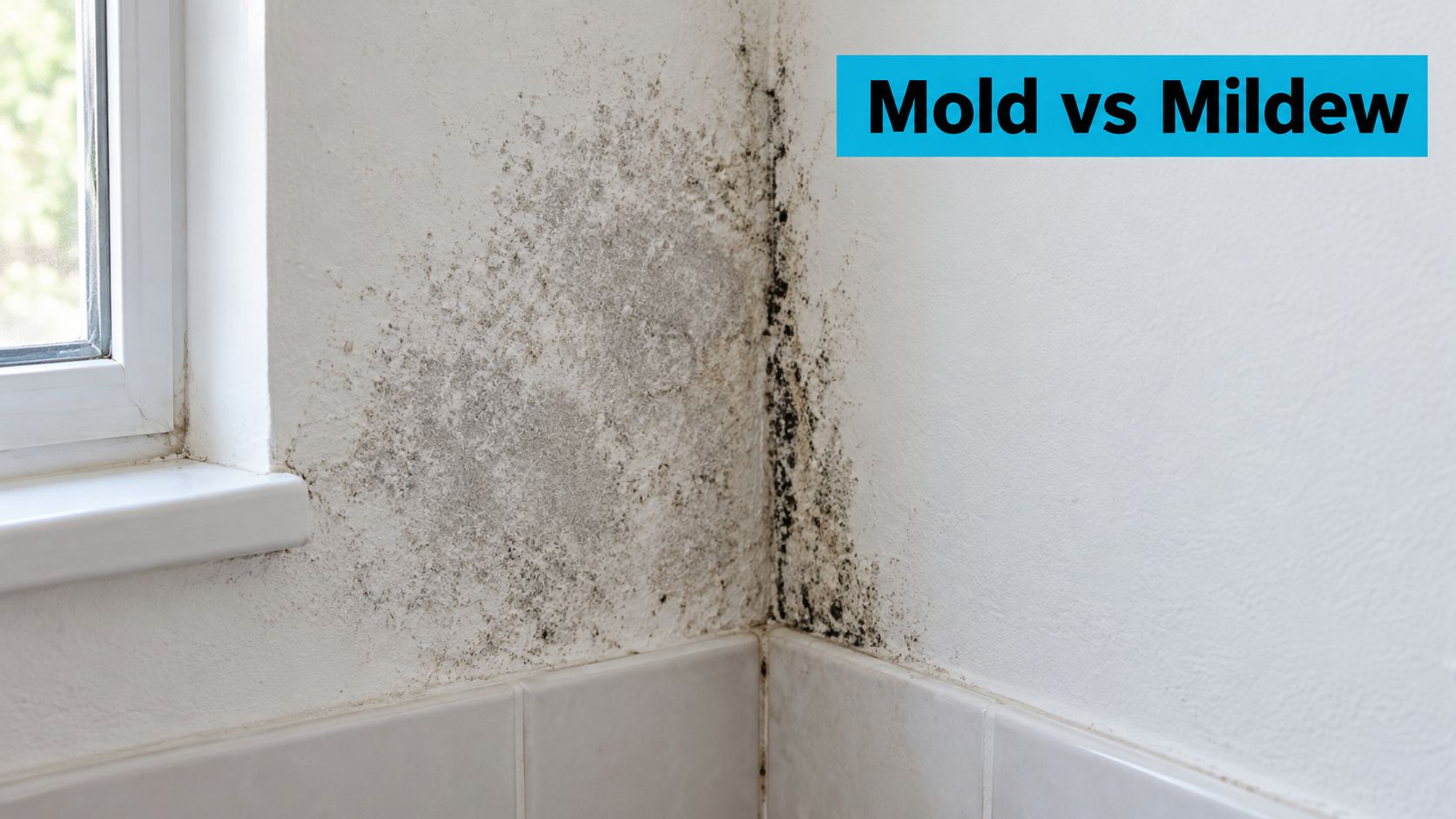
Use plain-language clues, not labels
A flat film on tile or glass is consistent with surface growth. Raised, fuzzy, or spreading growth on drywall, carpet, ceiling tile, insulation, or wood raises more concern that porous materials are affected. These are inspection clues, not a definitive species test.
The distinction matters because the material changes the cleanup. Nonporous surfaces can generally be cleaned with water or detergent and dried thoroughly. Porous materials may retain growth below the visible surface, so wiping can improve appearance without resolving what's inside.
Ask what the growth is attached to
In a Gulf Coast home, the same-looking patch can mean different things depending on its setting. Growth on shower tile after poor ventilation is different from staining on drywall beneath a slow plumbing leak. Consider the surface, signs of ongoing dampness, and whether the material feels soft, warped, or deteriorated.
Instead of trying to decide whether a patch “counts” as mildew or black mold, describe what you can observe: its location, appearance, surface, nearby water source, and whether it returns after cleaning. That gives a homeowner or restoration professional more useful information than a color-based guess.
Side-by-Side Comparison of Appearance, Location, and Behavior
For a practical comparison, ask four questions: Where is it growing? What does it look like? Does it appear to sit on the surface or affect the material? What happens after cleaning and drying? Each clue helps, but none identifies a species by itself.
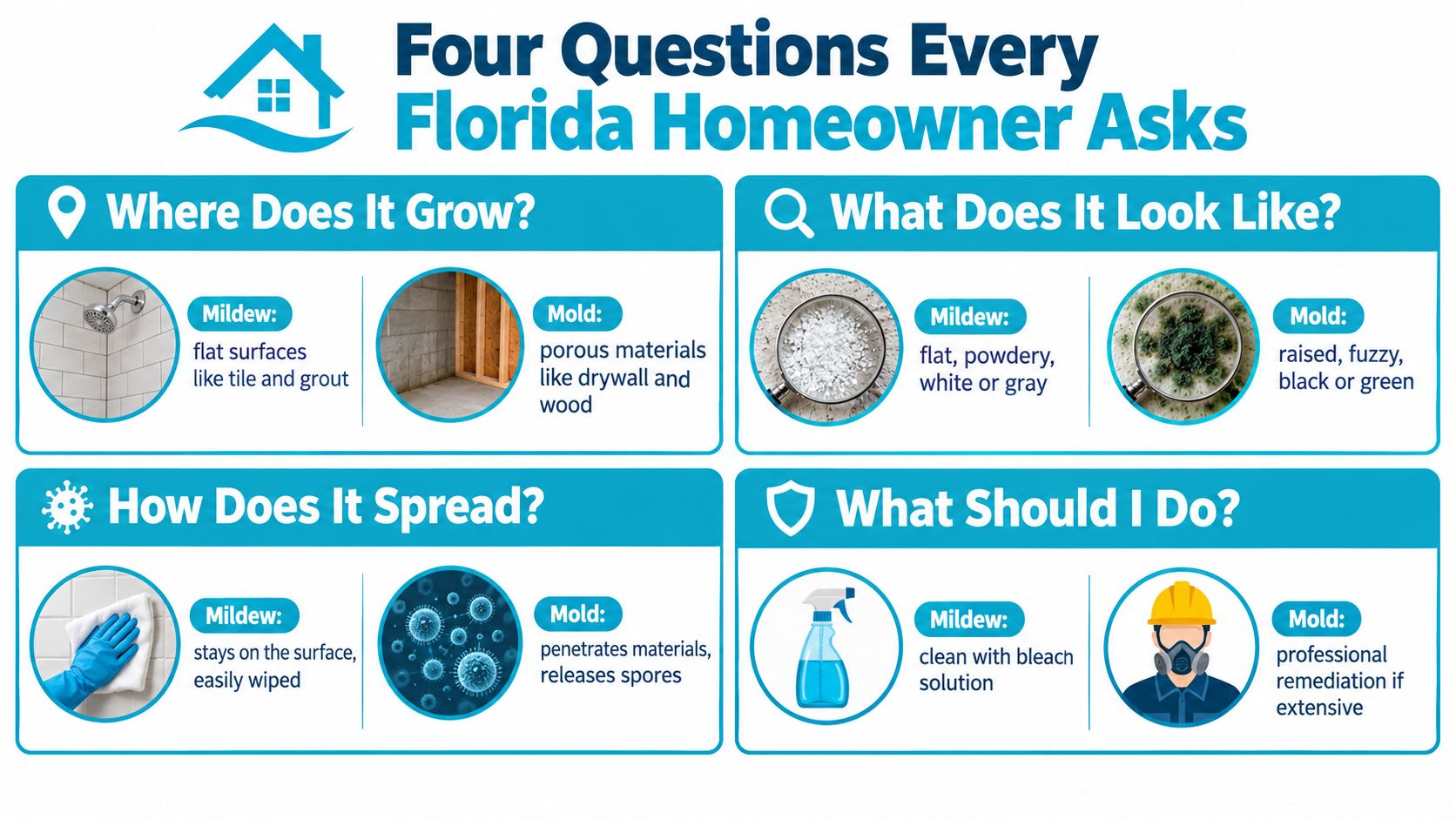
Compare the surface and substrate
A thin film on bathroom tile or a window frame is more consistent with growth on an exposed surface. In contrast, growth that's raised, fuzzy, spreading, or paired with soft drywall or damaged carpet suggests that the building material itself may be affected. A pale patch can reach porous material, and a dark patch can be a surface stain, so color remains a weak clue.
| Black Mold vs. Mildew at a Glance | Mildew | Black Mold Label |
|---|---|---|
| Typical use | Often describes flat, powdery surface growth | Usually describes dark-colored growth or suspected Stachybotrys chartarum |
| Possible location | Tile, grout, painted surfaces, or window frames | Any damp area, including porous materials |
| What appearance tells you | May suggest surface growth, but doesn’t confirm identity | Dark color doesn’t confirm species or toxicity |
| What to check next | Whether the hard surface cleans and dries fully | Whether moisture has affected porous materials or hidden spaces |
Cleaning can help show whether a hard surface is affected, but a cleaner-looking surface doesn't prove the moisture source is fixed. Porous drywall, carpet, insulation, or ceiling material may need professional assessment if growth has taken hold.
Surface behavior, material condition, and moisture history guide the response. Color doesn't.
Why Color and Species Tests Are Unreliable
A homeowner may wonder whether a swab or air sample can settle the question: “Is this the dangerous black mold?” Usually, sampling doesn't answer the decision that matters most: whether water is still entering, how much material is affected, and what needs to be cleaned or removed.
The Florida Department of Health says sampling is usually unnecessary when visible growth is present, and there are no health- or exposure-based standards for interpreting mold-sampling results (Florida Department of Health mold guidance). Sampling can identify organisms in a collected sample, but that result doesn't, by itself, establish how much growth is hidden elsewhere or predict how an individual will respond.
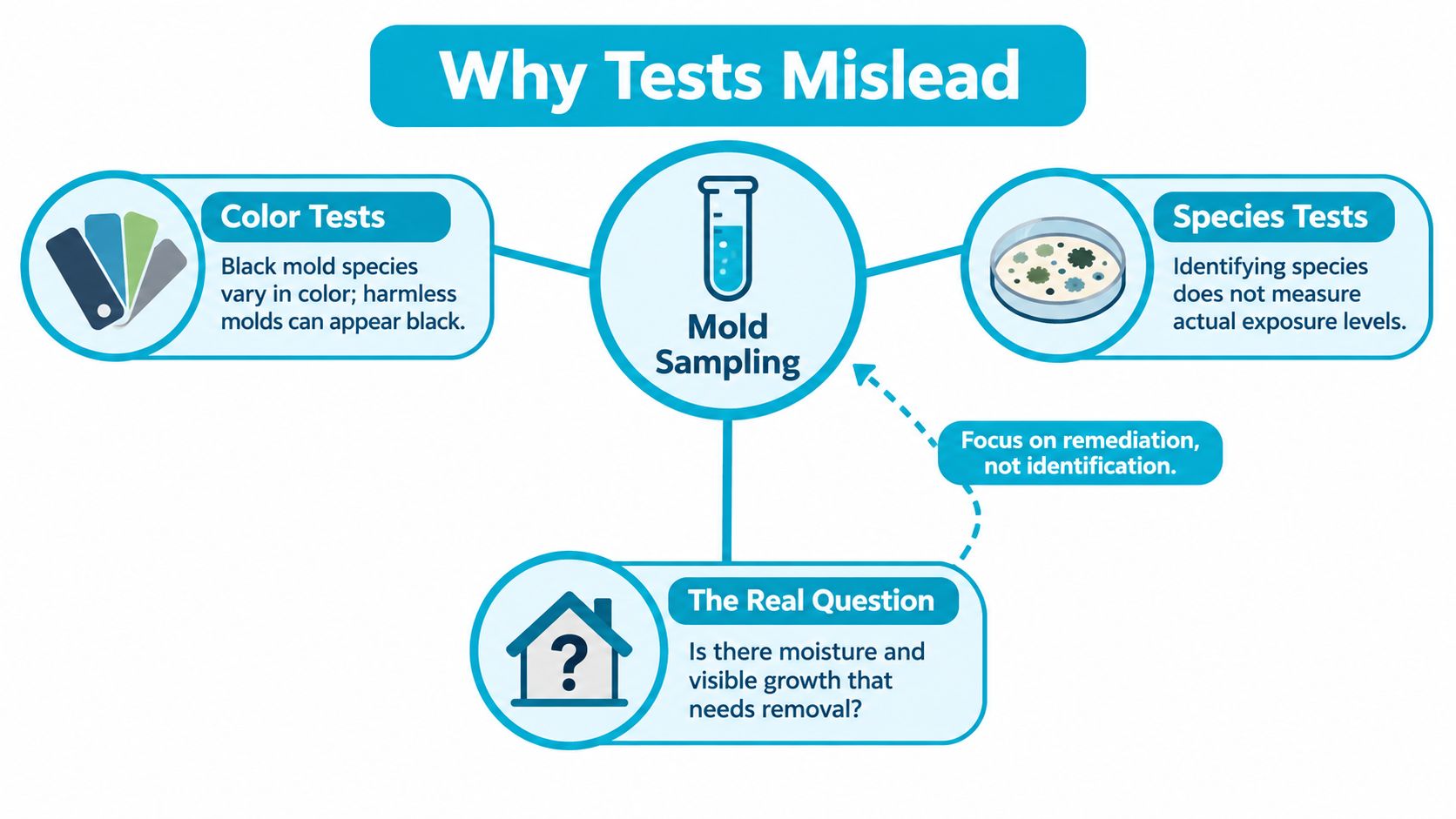
Spend effort on the question that changes the work
A small dark patch on a bathroom ceiling may be limited to the surface. Widespread light growth behind a baseboard could involve a much larger area of damp material. In both cases, the next steps depend on moisture, spread, building materials, and occupants, not just on a lab name.
There may be situations where sampling serves a specific purpose, such as a documented dispute or a medical evaluation directed by a clinician. But testing isn't a substitute for finding a leak, checking concealed dampness, or removing material that can't be adequately cleaned.
For a closer look at what air testing can and can't tell a homeowner, see this guide to mold air-quality testing accuracy. Keep the question practical: does visible growth or persistent dampness need action, and where should the work start?
Safe Homeowner Response for Small Surface Growth
For a small area on a hard, nonporous surface, the first move is to stop the moisture, not reach for a strong chemical. The EPA recommends drying wet or damp materials within 24–48 hours after a leak or spill because mold usually won't grow when materials dry within that period (EPA guidance on mold, moisture, and drying).
In humid Bradenton, Sarasota, and Tampa Bay homes, air-conditioning and dehumidification can help manage indoor moisture. EPA guidance recommends keeping indoor relative humidity below 60%, ideally between 30% and 50%. A small hygrometer can help you check whether a room stays damp after a shower, leak, or storm.
A measured cleanup sequence
- Stop the source. Repair the leak, improve ventilation, or address condensation. If moisture continues, the growth can return.
- Keep the work contained. Avoid brushing or scraping dry growth, which can spread particles. Wear gloves and eye protection, and avoid cleanup if you have asthma, allergies, chronic lung disease, or a weakened immune system.
- Clean the hard surface. Use water or water with detergent, then dry the area completely. Don't rely on bleach, ozone, or peroxide as a substitute for removing growth and fixing the water source.
- Check the surrounding material. If grout, tile, or a painted surface looks clean but the adjacent drywall is soft or stained, stop and get an assessment instead of treating only what you can see.
Don't use a fan to blow air across an area where mold is already present, since that may spread particles. Don't paint over a stain to hide it. For more detail on the limits of homeowner cleanup around drywall, see this guide to safely removing mold from drywall.
Do: fix the water source, clean suitable hard surfaces, and dry them thoroughly.
Don't: paint over growth, spread debris with a fan, or keep cleaning when porous material is damaged.
Florida Scenarios That Require Professional Inspection
A bathroom film on tile may wipe away, yet a similar-looking mark can be the visible edge of a hidden water problem. Consider an air-conditioning condensate pan that overflows into a ceiling cavity. The ceiling stain may appear small while dampness has spread through drywall or insulation above it.
After a storm, water can seep around a window in an older Sarasota bungalow and dampen trim or wall materials. In Lakewood Ranch, floodwater can saturate baseboards and the edges of flooring. In a St. Petersburg block home, a slow slab leak may announce itself through a musty odor before a visible stain appears.
Why a surface check may not be enough
A professional can look beyond the visible patch to locate moisture and check affected materials. Depending on the situation, an assessment may include moisture-meter readings, infrared equipment, inspection of cavities, and a plan to keep work contained and away from HVAC pathways.
Once growth is established, porous materials such as carpet, ceiling tile, and some drywall may be impossible to clean completely and may need disposal (EPA guidance on mold and moisture response). Wiping the visible side won't resolve contamination inside a material that can't be cleaned through its depth.
A professional inspection can also document the moisture source, visible conditions, and affected materials. That record may help when discussing an insurance claim, though coverage depends on the policy and the circumstances of the loss. AMPM Restoration provides mold inspection and remediation among its restoration services, with assessments focused on visible conditions and moisture sources.
Read about the difference between mold assessment and mold remediation before deciding which kind of help fits the situation.
Call for professional assessment when growth is widespread or keeps returning, porous materials are soft or damaged, water has entered a wall or ceiling, an HVAC system may be involved, or a medically vulnerable person may be exposed. A persistent musty odor with no visible source also deserves investigation rather than repeated surface cleaning.
Moisture Control, Materials, and Occupant Vulnerability as the Real Decision Path
Use three checks to decide what to do: the moisture source and timeline, the type and condition of the material, and the needs of the occupants. This framework is more useful than trying to settle the difference between black mold and mildew by appearance.
| Decision Matrix for Florida Property Owners | Response Level | Why |
|---|---|---|
| Small amount of surface growth on a hard, nonporous material, with the moisture source corrected | Careful homeowner cleaning may be reasonable | The growth appears limited to a cleanable surface |
| Growth on soft drywall, carpet, insulation, or ceiling tile | Professional assessment | Porous materials may retain growth beneath the visible area |
| Hidden water, extensive growth, suspected HVAC involvement, or a vulnerable occupant | Prompt professional evaluation; consider limiting exposure | The affected area or occupant risk may not be obvious from the visible patch |
Timing changes the right drying method. Fans and dehumidifiers may help remove water when it's safe and mold hasn't begun growing. If growth is already present, directing a fan at the area may spread particles; isolate the space and get advice on safe cleanup instead.
Leak clues can be easy to miss around plumbing and tiled areas. For another perspective on spotting water entry, see Tiling Services leak advice from Melbourne Tiling Services P/L. For Florida-specific context on damp air and recurring growth, review how humidity contributes to mold in Florida homes.
The practical decision isn't “Which label sounds worse?” It's “Can I stop the moisture, clean the surface safely, and protect the people using this space?” If the answer is uncertain because water is hidden or materials are damaged, a professional assessment is the safer next step.
Frequently Asked Questions and Next Steps
Does insurance cover mold remediation in Florida?
Coverage depends on the policy, the cause of the moisture, and the details of the loss. Contact your insurer, document visible damage and the suspected source, and avoid assuming that every mold-related repair is covered. A restoration professional can help organize damage documentation and coordinate with the carrier, but the insurer determines coverage.
Why does mildew return every summer?
Recurring growth usually means the conditions that supported it haven't changed. Check bathroom ventilation, window condensation, air-conditioning drainage, and damp materials, then track indoor humidity. Moisture-control ideas from other climates can still offer useful maintenance reminders, including these Greater Boston moisture control strategies from Aureli Construction.
Should a tenant or landlord pay?
Responsibility depends on the lease, the source of moisture, local requirements, and the facts of the situation. Tenants should report leaks and visible growth promptly in writing; landlords and property managers should investigate the source and document the response. Don't assume that surface cleaning alone resolves a continuing leak.
How quickly should a professional respond?
Act promptly when water is still entering, a ceiling or wall is wet, growth has spread to porous materials, or an HVAC system may be affected. A medical professional should evaluate persistent or serious symptoms. The 2004 Institute of Medicine review found sufficient evidence linking indoor mold or dampness exposure with upper-respiratory symptoms, coughing, and wheezing in otherwise healthy people, and asthma symptoms in people who already have asthma (summary of the Institute of Medicine review). For information relevant to children, read about the effects mold can have on children.
AMPM Restoration is a 24/7 emergency restoration company based at 4301 32nd St W b18, Bradenton, FL 34205, serving Bradenton, Sarasota, Tampa Bay, Saint Petersburg, Lakewood Ranch, and surrounding Gulf Coast communities. Its services include water damage restoration, mold inspection and removal, fire and smoke restoration, storm and flood restoration, commercial restoration, and reconstruction; the company also offers insurance claim assistance and financing options.
If moisture has reached drywall, flooring, or a ceiling cavity, call 941-946-7807 to request a free inspection and estimate from AMPM Restoration. The team can assess the affected materials, help document damage for an insurance claim, and discuss available financing options, so you can make a practical plan for restoring your property.
Good breakdown of why color is a poor guide here, since a dark patch is not automatically Stachybotrys and a pale film is not automatically harmless. The four questions about location, appearance, surface versus material, and moisture history are much more useful for deciding next steps. Keeping indoor humidity in that 30 to 50 percent range with a small hygrometer to verify is a simple habit that prevents a lot of these patches from starting.