


Water damage restoration Sarasota property owners need starts with stopping the source and drying affected materials within 24–48 hours whenever possible. With roughly $87.9 million in paid flood-insurance claims in the city and 62 flood events in Sarasota County since 1950, prompt, verified drying deserves particular attention in this humid Gulf Coast setting.
You might be standing beside a spreading puddle, checking a ceiling stain after a storm, or wondering whether the flooring is safe because it no longer feels wet. The first useful distinction is simple: where the water came from determines the safety and insurance response; where it traveled determines the restoration work.
Why Water Damage Restoration in Sarasota Is Rarely Routine
You wake in the middle of the night and find water creeping from the bathroom into the hallway. Or you return to your Sarasota rental after summer rain and notice a stain above the kitchen cabinets. Neither situation tells you, by appearance alone, how much material is wet or whether the water is sanitary.
A broken supply line and stormwater entering through a doorway can leave similar-looking floors. They don't call for identical cleanup. Older coastal properties also deserve a careful, assembly-by-assembly inspection rather than assumptions about what's behind the paint.
Sarasota's exposure isn't theoretical. The city's Floodplain Management Plan records 62 county flood events since 1950 and approximately $87.9 million paid across 1,620 city flood-insurance claims between 1978 and 2025, averaging roughly $54,300 per paid claim.
A wet floor is only the visible starting point
The practical job is to determine what happened, stabilize the property, and establish which materials can remain. That requires more than a mop, a household fan, and a promise that everything will dry eventually.
- Homeowners need a clear explanation of affected rooms, salvageable belongings, and repair decisions.
- Landlords and condominium owners need coordination around neighboring units, shared assemblies, and access.
- Commercial managers need a plan that accounts for occupants, inventory, mechanical systems, and usable workspace.
Practical rule: Judge a restoration plan by how the crew verifies conditions, not simply by how quickly the floor looks clean.
Coastal buyers should bring that same property-specific mindset to due diligence. If you're comparing Gulf Coast locations, Dream Destin Realty's waterfront listings in Destin offer another property-search resource, but waterfront appeal shouldn't replace questions about flood coverage and previous water intrusion.
AMPM Restoration provides 24/7 emergency assistance for Sarasota-area properties. A useful emergency call starts with your observations, then moves toward an inspection, a documented mitigation plan, and a clear explanation of what must happen before repairs.
How the Restoration Process Actually Works From First Call to Final Walkthrough
Think of restoration as medical triage: stabilize the situation, diagnose the problem, treat it, then restore function. Emergency dispatch begins that sequence, but the inspection determines the actual work.
The following workflow illustrates the main stages. Source identification and contamination assessment belong before equipment decisions.
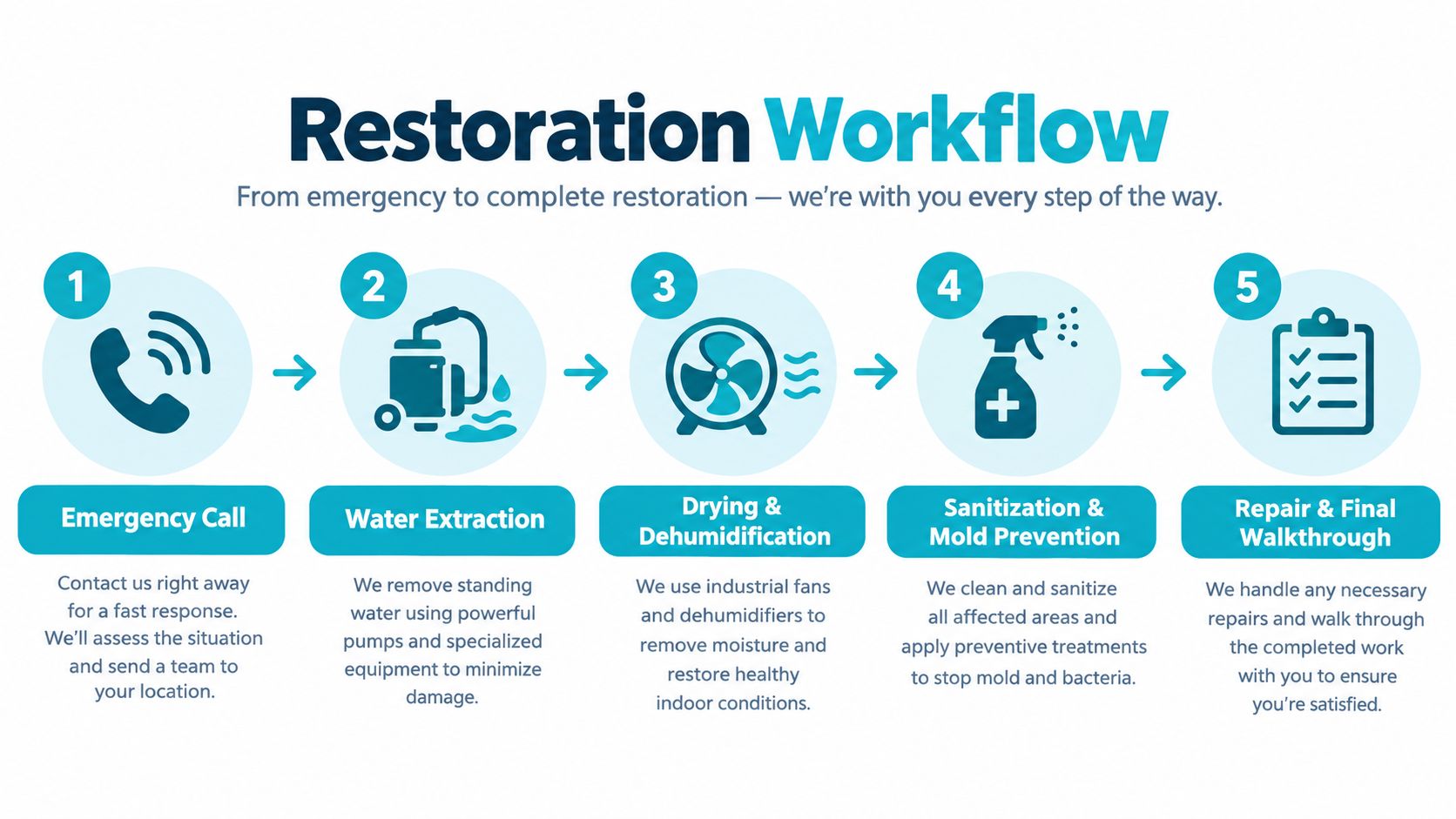
Stabilize and assess before drying
At the first call, describe the suspected source, affected rooms, whether water is still entering, and any electrical or ceiling concerns. On site, technicians inspect the affected assemblies, identify the water source, assess contamination, and establish initial moisture readings.
Extraction removes bulk water. Pumps and extraction equipment address standing water and accessible moisture, but they don't establish that walls or floors are ready for repair.
The ANSI/IICRC S500 restoration standard frames professional work around inspection, water categorization, psychrometry, drying technology, monitoring, and final inspection. That order matters because the safety controls must fit the incident.
Dry, verify, clean, and repair
- Structural drying: Air movers support evaporation when appropriate, while dehumidifiers remove moisture from the air. Think of humid air as a sponge that's already wet: it has less capacity to accept additional moisture.
- Monitoring: Technicians compare affected materials with suitable unaffected materials and record temperature and relative humidity. Equipment placement changes according to those measurements.
- Cleaning and reconstruction: Crews address contamination and material-specific cleaning, remove unsalvageable components, and complete repairs after the relevant drying and remediation work is verified.
The EPA's guide to mold and moisture recommends drying wet materials within 24–48 hours to help prevent mold and warns that porous materials may need removal if they can't be cleaned and completely dried. That window is a guideline, not a guarantee or a countdown to automatic mold growth.
You'll see extraction and equipment setup. You may not see the evaluation behind drywall or beneath flooring, which is why the daily record matters. AMPM's water damage restoration process provides a service-specific overview of the path from assessment through repairs.
What Actually Changes Recovery in Sarasota Homes and Buildings
A room can look better while its building materials remain wet. Sarasota's humid air, concealed assemblies, and differing water sources make dry to the touch an unreliable finish line.
These local recovery factors are prompts for inspection, not substitutes for measurements.

Contamination changes the equipment plan
The plain-language distinction is between clean water, gray water containing contaminants, and black water involving substantial contamination, such as sewage. These are commonly described as Category 1, Category 2, and Category 3 losses; technicians must assess the actual conditions rather than classify water by appearance.
The EPA's commercial-building cleanup guidance calls for containment, appropriate protective equipment, and qualified expertise for contaminated water. It also warns against using fans before determining that the water is sanitary, because uncontrolled airflow can spread contaminants.
Materials and indoor conditions determine the scope
Porcelain tile, hardwood, and carpet padding over a concrete slab require different evaluations. A clean-looking tile surface doesn't answer whether underlying components are wet; hardwood requires its own moisture assessment; absorbent carpet padding may not be salvageable.
Water can also remain inside cabinets, insulation, wall cavities, and HVAC components. Opening windows is not automatically helpful in Florida: outdoor air must be drier for ventilation to support drying.
- Humidity targets: EPA mold-and-moisture guidance recommends indoor relative humidity below 60%, ideally around 30–50%, and notes that mold-affected areas larger than about 10 square feet may warrant professional remediation.
- Hidden involvement: Visible area alone doesn't resolve questions about concealed mold, contaminated insulation, or affected HVAC pathways.
- Measured decisions: Equipment quantity, containment, removal, and repair readiness should follow the assessment, not a standard package.
A dry surface isn't permission to cover a wet assembly.
AMPM's structural drying methods explain the drying side of this work. Ask your crew which materials they're measuring and what conditions must be met before reconstruction begins.
The Flood Versus Leak Insurance Question Sarasota Owners Often Miss
Water damage isn't a single insurance category. The contractor's job is to document the incident and mitigate damage; the insurer determines coverage under the applicable policy.
A supply-line break inside a wall raises a different policy question from rising water entering a ground-level doorway. Wind-driven rain through a damaged roof introduces another distinction, while sewage backup may require separate coverage.
Water Source Versus Typical Insurance Treatment
| Water source | Likely policy type | What to document first |
|---|---|---|
| Sudden supply-line failure | Homeowners or property policy, subject to terms and exclusions | Failed component, origin, affected rooms |
| Rain through a damaged roof | Homeowners or property policy, depending on cause and terms | Roof damage, entry point, interior water path |
| Sewage backup | Sewer-backup endorsement or other applicable coverage | Backup location, affected surfaces, contamination |
| Rising groundwater or storm surge | Flood policy, including applicable NFIP coverage | Ground-level entry, waterline, exterior conditions |
| Water between condominium units | Potentially unit-owner, association, or other applicable policies | Originating unit, shared assemblies, damage boundaries |
These are starting points, not coverage promises. Don't decide which policy applies solely from the word “hurricane,” and don't assume that describing an incident as a leak establishes coverage.
Preserve evidence without delaying safe mitigation
Photograph the suspected origin, entry points, visible water paths, and affected contents. Keep dated communications, mitigation invoices, moisture records, and any explanation of why materials were removed.
For condominiums, notify the association or property manager alongside the relevant insurer. Tenants should notify the landlord and their contents insurer; commercial owners and occupants should identify their separate building and contents responsibilities.
The City of Sarasota's flood-insurance information states that federally backed coverage is available to eligible properties inside or outside designated floodplains, with separate contents coverage available to owners and renters. Sarasota's Community Rating System Class 5 designation may reduce premiums by up to 25% for qualifying policyholders.
AMPM's explanation of whether home insurance covers water damage can help organize your questions. Insurance claim assistance supports the documentation process; it doesn't override exclusions or guarantee payment.
Real Sarasota Scenarios From Burst Pipe to Hurricane Surge
The situations below are illustrative examples, not reported customer case studies. Each shows how a local restoration crew would adapt the response to the source, materials, and evidence.

A downtown condo with an upstairs supply-line failure
A resident returns from travel and finds ceiling stains beneath another unit's bathroom. The visible mark doesn't establish how far water traveled or whether insulation is affected.
An AMPM assessment would begin with source control and access coordination, then establish the drying and removal scope. The useful outcome would be a documented decision about what can remain, not an automatic promise to save every ceiling component.
A Siesta Key rental after surge intrusion
Floodwater enters a ground-level rental, wetting flooring, cabinets, and contents. The owner needs a contamination-focused response and a claim file that distinguishes this intrusion from any previous damage.
Sarasota County's storm update reports more than $1.1 billion in estimated residential and commercial damage in unincorporated areas after Helene struck the region on September 26, 2024. Milton followed with landfall near Siesta Key on October 9, 2024.
In this illustrative rental, AMPM's role would be to assess affected assemblies, establish safe mitigation, and preserve separate incident records. Closely spaced storms make that separation especially important.
A Bradenton home with mold after a small leak
A homeowner cleaned up a leak but later discovers visible mold near a cabinet. At that point, ordinary drying alone isn't the appropriate assumption.
The EPA's disaster-cleanup worker guidance distinguishes non-moldy drying work from remediation and material-removal decisions. AMPM's assessment would address the moisture source and affected materials before planning repairs.
For a related Sarasota service example, AMPM's page on water and mold mitigation after a water-heater leak offers additional context without making these illustrative situations claimed results.
When to Call for Help and What to Do Before the Crew Arrives
Call for professional assessment when there's standing water, sewage, storm surge, roof intrusion, suspected hidden moisture, or materials that haven't dried promptly. You don't need to identify the full scope before asking for help.
Use this checklist only where conditions are safe. Don't enter water to reach an electrical panel or stand beneath a sagging ceiling.
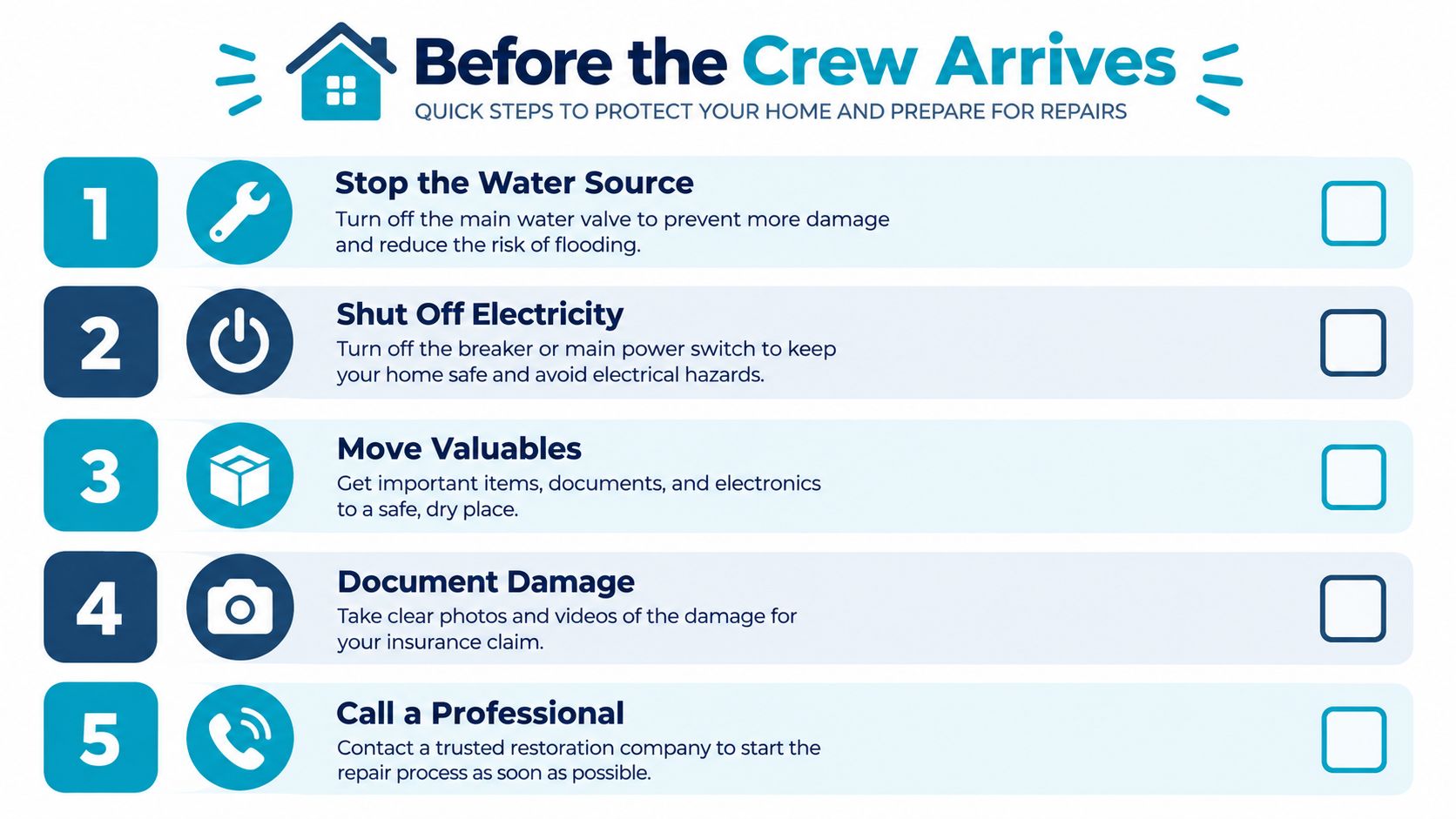
Make the site safer and preserve the record
- Stop the source safely: Close an accessible supply valve if doing so won't expose you to danger.
- Address electricity cautiously: Arrange isolation of affected circuits from a safe, dry location. If you're unsure, leave the area and seek qualified help.
- Protect accessible belongings: Move valuables only from safe areas, without carrying contaminated items into clean rooms.
- Record what you see: Photograph the source, water paths, contents, and damage. Save any existing meter readings rather than trying to perform your own invasive inspection.
For non-emergency leak awareness, the guide from Western Bathroom Renovations is an additional reading resource. During active damage, investigation shouldn't delay making the area safe or arranging mitigation.
Before repairs: Ask how the team will separate emergency work, remediation, and reconstruction in the estimate.
AMPM's steps to take after water damage in a Florida home provide further preparation guidance. AMPM offers free inspections and estimates, insurance claim assistance, and financing options when coverage falls short.
Call 941-946-7807 with the property address, suspected source, and current safety concerns. That gives the crew practical information for the response without requiring you to diagnose the building.
Call AMPM Restoration and Get Your Property Back
The right water damage restoration Sarasota response combines urgency with verification. You need someone to explain the scope, preserve the evidence, and confirm repair readiness rather than treating visible cleanup as completion.
AMPM Restoration is locally owned, licensed, bonded, and insured, with an IICRC-certified team and 24/7 emergency availability. Its Bradenton base is 4301 32nd St W b18, Bradenton, FL 34205, serving Bradenton, Sarasota, Palmetto, Lakewood Ranch, Saint Petersburg, Tampa Bay, and surrounding Gulf Coast communities.
Frequently Asked Questions About Water Damage Restoration in Sarasota
What does water damage restoration include?
It includes assessment, source identification, extraction, structural drying, monitoring, appropriate cleaning, and necessary repairs or reconstruction.
How long will my Sarasota property take to recover?
There isn't a reliable universal timeline. Material conditions, contamination, access, and repair scope determine completion.
Will my homeowners insurance cover the damage?
Coverage depends on the source, policy language, and endorsements. Ask the relevant insurer to confirm coverage rather than assuming all water incidents qualify.
Can I use household fans after a leak?
Don't start fans when contamination is possible. The water must be assessed before aggressive airflow is appropriate.
Do I need mold removal after every water incident?
Not necessarily. An assessment should distinguish preventive drying from existing mold that requires remediation.
Does AMPM help with claims and uncovered costs?
Yes. AMPM offers insurance claim assistance, free inspections and estimates, and financing options.
AMPM offers professional water damage restoration, mold inspection and mold removal, fire and smoke damage restoration, storm and flood damage restoration, commercial restoration services, and full reconstruction solutions. Visit AMPM Restoration Services to learn about recovery options, insurance claim assistance, and financing. For water damage restoration in Sarasota, call 941-946-7807 now for a free inspection and estimate and a clear plan for your property's next steps.