


IICRC Certified Restoration Company: AMPM Restoration Services
A pipe breaks in the middle of the night. A tropical storm pushes water through a garage and across the first floor. Or you notice a musty smell and dark growth behind a bathroom wall. In each situation, the first call can shape the entire recovery, from how quickly moisture is controlled to how clearly your insurance claim is documented.
Hiring an IICRC certified restoration company gives you more than a logo on a truck. It should mean trained technicians, documented procedures, measured drying, careful remediation, and records that show what happened inside your Bradenton, Sarasota, Tampa Bay, Saint Petersburg, or Lakewood Ranch property. The important question is whether a company can demonstrate those practices today, not merely display a credential.
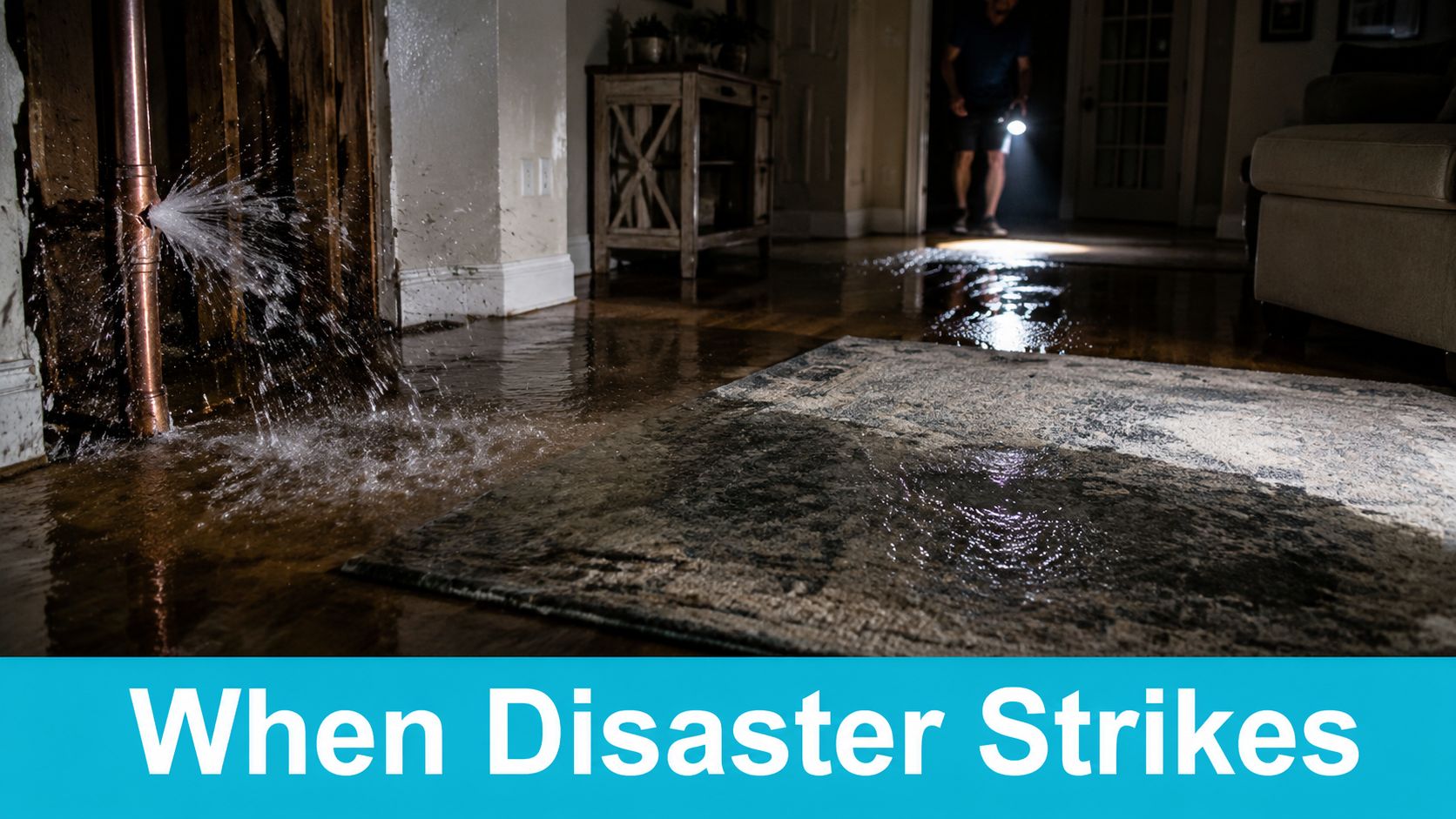
When Disaster Strikes Your Florida Home
At 2 AM, a burst supply line can leave water spreading under cabinets, across flooring, and into wall cavities before you’ve found the shutoff valve. After a Gulf Coast storm, wind-driven rain or flooding can create a different emergency, with soaked contents, contaminated water, and electrical hazards competing for your attention. A mold concern brings less visible urgency, but hidden moisture behind drywall can continue creating problems while the room appears mostly normal.
The natural reaction is to call whoever answers first. Speed matters, but the first available contractor isn’t automatically the right restoration partner. A crew that removes visible water without checking moisture inside walls, floors, and ceilings can leave conditions that later lead to swelling, odor, microbial growth, or avoidable reconstruction.
Practical rule: Choose the company that can explain how it will measure, document, dry, clean, and verify the property, not just how quickly it can place equipment.
AMPM Restoration Services serves Florida’s Suncoast with 24/7 emergency restoration from its Bradenton location at 4301 32nd St W b18, Bradenton, FL 34205. Its service area includes Bradenton, Sarasota, Tampa Bay, Saint Petersburg, Lakewood Ranch, Palmetto, and surrounding Gulf Coast communities. The company handles water damage restoration, mold inspection and removal, fire and smoke damage restoration, storm and flood cleanup, commercial restoration, and reconstruction.
Before signing paperwork, photograph the affected areas, preserve damaged materials when safe, and keep communication with the contractor and insurer organized. For practical guidance on documenting a property loss, review Awesim Building Consultants claim advice. You can also follow this Florida water damage response guide for immediate steps.
An IICRC certified restoration company matters because professional restoration isn’t the same as ordinary cleaning. The company should identify the source, assess the extent of moisture or contamination, control the affected area, and produce evidence that the property reached an appropriate condition before the job ends.
What IICRC Certification Actually Means for Restoration Work
The Institute of Inspection Cleaning and Restoration Certification, or IICRC, serves as both an ANSI-accredited standards body and a credentialing body. Its standards are internationally recognized, consensus-based guidelines for inspection, cleaning, and restoration work, as described by the IICRC standards organization.
For a homeowner, the useful distinction is simple. Certification should connect the people performing the work to recognized methods, while the applicable standard defines the work those methods are meant to govern. A badge alone doesn’t prove that a crew followed the process on your property, so you should ask how the company applies the standard to your specific loss.
S500 for water damage
The ANSI/IICRC S500 Standard for Professional Water Damage Restoration applies to residential, commercial, and institutional buildings. It addresses precautions, inspection and assessment, extraction, structural drying, and final verification before demobilization, as outlined by the IICRC S500 water damage standard.
The S500 has reached its fifth edition, published in 2021, with earlier editions published in 2015 and 2006. That history shows a technical framework revised across multiple major editions over more than 15 years, rather than an informal set of cleanup habits. The published S500 history supports why buyers should treat certification as alignment with an established and evolving body of practice.

S520 for mold remediation
Mold work requires its own framework. The ANSI/IICRC S520 Standard for Professional Mold Remediation covers procedures and precautions for residential, commercial, and institutional buildings, along with systems and personal property contents within those structures, according to the IICRC S520 mold remediation standard.
The S520 is paired with an R520 Reference Guide, which explains the procedures and methodologies in greater detail and adds supporting background, as described by the IICRC R520 reference guide. That distinction matters when a company proposes mold removal. Ask whether the scope addresses the moisture source, containment, removal, cleaning, and verification, rather than applying a product to visible growth.
For a plain-language explanation of how restoration firms operate, see what a restoration company does. If you’re researching other credentialed property professionals, you can also find a qualified arborist for storm-damaged trees and related hazards.
Why Standardized Restoration Practices Protect Your Property and Insurance Claim
Water damage is a recurring financial risk, not an unusual inconvenience. Water damage and freezing represented 22.6% of homeowners insurance losses in 2023, and the average U.S. homeowners water-damage-and-freezing claim was $15,400 over the 2019–2023 period. About 1 in 67 insured homes per year experienced this type of claim, according to water damage insurance loss data.
Those figures are national, but Florida homeowners face local conditions that make disciplined response especially important. Storms, heavy rain, humidity, plumbing failures, and flood exposure can all create moisture problems that spread beyond the area you can see. A rushed cleanup may remove standing water while leaving wet insulation, subflooring, drywall, cabinets, or framing behind.
The category and class decision
Professional water-loss assessment separates two questions. Category describes the contamination level of the water. Class describes the drying difficulty, based on how much water the structure absorbed and the resulting evaporation load, as explained in this water damage category and class guide.
That distinction affects the response. A company shouldn’t decide on demolition or drying equipment by guesswork. It should assess the affected materials, identify the conditions, and document why materials can be dried in place or why removal is necessary.

Documentation protects the claim
Insurance carriers need a clear record of the loss and the work performed. Useful records can include photographs, moisture readings, equipment placement, affected-room notes, extraction details, drying logs, daily updates, and final verification. Certification doesn’t guarantee claim approval, because coverage depends on the policy and circumstances, but a documented process gives the adjuster evidence to evaluate.
The same records protect you if questions arise about the scope. If a wall was opened, the contractor should be able to explain the moisture finding or contamination concern that justified it. If materials remained in place, the drying documentation should show why that decision was reasonable.
Claim protection starts at the first inspection. A verbal promise that the area is dry isn’t a substitute for readings, photographs, and a written scope.
Keep your own timeline, save invoices and messages, and notify the carrier according to your policy. For practical preparation, use these water damage insurance claim tips. An insurer-friendly restoration company should coordinate clearly, avoid unsupported promises, and make the file easier to understand.
How to Verify a Company’s IICRC Credentials Before You Hire
Don’t stop at the phrase “IICRC certified.” During a real loss, you need to know who is certified, what the company follows, and whether the process is current. The firm-level credential and the individual technician’s training answer different questions, so verify both.
Start with the firm
Ask the company to provide its current IICRC firm certificate and confirm that the business name matches the contract and insurance paperwork. Then ask which standards apply to your project, such as S500 for water damage or S520 for mold remediation.
The IICRC’s role as both an ANSI-accredited standards body and a credentialing body makes this two-part check important. The 2025 adoption of AS-IICRC S500 also shows that the standard continues to evolve internationally, as documented in the AS-IICRC S500 publication announcement. Treat “certified” as a workflow question, not a permanent badge.
Confirm the people on site
Ask for the names and certification details of the project manager, lead technician, and any specialist assigned to the work. The person who inspected the property may not be the person operating drying equipment or performing mold remediation, so match credentials to responsibilities.
Use this call checklist:
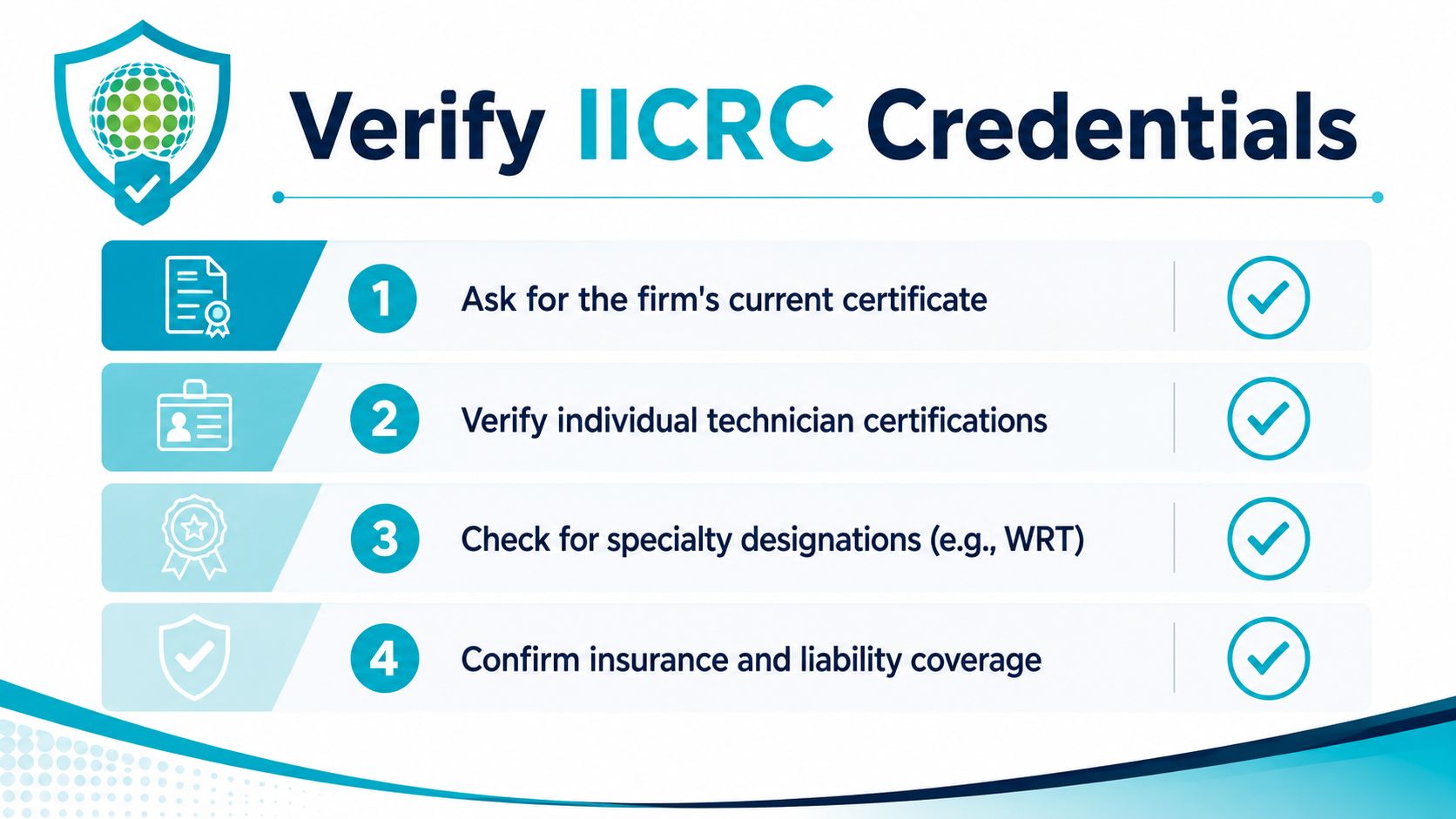
- Request the current firm certificate. Ask when it was issued and which business entity it covers.
- Verify individual technicians. Confirm the credentials of the people assigned to inspection, mitigation, drying, or remediation.
- Ask about relevant specialties. For water losses, ask about water restoration training such as WRT. For mold, ask about the technician’s mold-remediation qualifications.
- Request insurance information. Confirm that the company carries appropriate liability coverage and can provide documentation.
- Ask for sample records. Request an example of a moisture map, drying log, equipment record, final verification, or written scope with private customer information removed.
- Clarify claim coordination. Find out who communicates with your carrier and how the company separates emergency mitigation from repairs and reconstruction.
A local license and physical address still matter. You can review how to check a contractor license and compare the information with the company’s proposal. Before work begins, make sure the contract identifies the scope, communication process, pricing responsibilities, and any reconstruction work.
For another practical check, review the company’s information about a licensed restoration company. Don’t let a uniform, truck, or emergency sales pitch replace verification.
What to Expect During a Professional IICRC-Certified Restoration Process
Professional drying is not the same as running fans until the room feels comfortable. A certified team should establish what is wet, how contaminated the water may be, how difficult the structure will be to dry, and what evidence will show that the drying goal has been reached.
The first stage is assessment and control. Technicians should identify the source when possible, address safety concerns, inspect affected and potentially affected materials, and create a scope. They may use moisture meters and environmental instruments to understand conditions that aren’t visible from the surface.
Measurement creates the proof
Psychrometric control is the dividing line between equipment placement and managed drying. Industry guidance tied to S500 emphasizes measuring and logging temperature, relative humidity, dew point, specific humidity, and material moisture content at the start of the job and during daily monitoring, then comparing affected materials with dry-standard reference materials until they reach a defined drying goal. The psychrometrics guidance for water damage restoration explains why these readings matter.
A useful project record should show cause and effect. As dehumidification and airflow operate, moisture conditions in structural materials should move toward the target. If readings stop improving, the crew should reassess equipment, access, airflow, hidden moisture, or the scope itself.
An uncertified or poorly managed job often looks different:
| Managed restoration | Weak cleanup |
|---|---|
| Technicians record baseline conditions and monitor progress. | Workers rely on touch or room feel. |
| Moisture readings guide drying and removal decisions. | Equipment runs without a documented target. |
| The team compares materials with dry-standard references. | The crew removes equipment because the surface looks better. |
| The file includes photographs, readings, and a final check. | The homeowner receives little evidence of completion. |
Mold requires controlled remediation
When mold is involved, the S520 framework adds procedures and precautions for the building, systems, and contents. The team should address the moisture source, protect occupants and unaffected areas, control dust and spread, remove or clean affected materials appropriately, and document the work.
Ask for the final condition in writing. A professional company should be able to explain what was found, what was removed or cleaned, what conditions caused the growth, and what steps remain for repairs or prevention.
Why AMPM Restoration Is the Trusted IICRC-Certified Choice on Florida's Suncoast
On Florida's Suncoast, the practical choice is a restoration partner that can respond quickly, document the work, and stay involved through repairs. AMPM Restoration Services is based at 4301 32nd St W b18, Bradenton, FL 34205, and serves Bradenton, Sarasota, Tampa Bay, Saint Petersburg, Lakewood Ranch, Palmetto, and surrounding Gulf Coast communities.
The company describes itself as locally owned, licensed, bonded, and insured, with 24/7 emergency availability and a one-hour response time. Its IICRC-certified technicians handle water damage restoration, mold inspection and removal, fire and smoke damage, storm and flood cleanup, commercial restoration, leak detection, sanitization, and reconstruction.
One company can manage the full recovery
AMPM's service model covers emergency mitigation and drying, sanitization, repairs, and final restoration for homes, offices, commercial sites, schools, and government facilities. That continuity can simplify communication when the project moves from extraction into reconstruction, especially when walls, flooring, cabinets, or other finishes require repair.
The company also offers direct insurance claim coordination, free inspections and estimates, financing options, and a 100% satisfaction guarantee, according to its published business information. Its local restoration team and company background provide additional context for homeowners and property managers evaluating a nearby provider.
The right fit still depends on the loss. Ask AMPM to identify the affected materials, explain the proposed drying or remediation process, name the people assigned to the project, and show how daily monitoring will be recorded. Those questions connect the local service experience to the technical standard you should expect from any IICRC certified restoration company.
Your Next Steps to Protect Your Property and Peace of Mind
If water, smoke, storm damage, or mold has affected your property, take these steps:
- Make the area safe. Shut off water or power only when you can do so safely, and keep people away from contaminated or unstable areas.
- Document the condition. Photograph rooms, materials, contents, and visible sources before cleanup changes the scene.
- Call a qualified restoration company. Ask about IICRC credentials, the assigned technicians, moisture monitoring, containment, drying goals, and final verification.
- Notify your insurer. Keep records of every call, estimate, reading, photograph, invoice, and scope change.
- Reject vague promises. A professional should explain the work and provide documentation, not just leave equipment behind.
Certification matters because it connects restoration work to recognized standards. Verification matters because a badge doesn't prove that the current crew is applying those standards on your property. Choose a company that can demonstrate trained personnel, measured progress, clear communication, and insurance-ready records.
Call 941-946-7807 to schedule a free inspection and estimate with AMPM Restoration Services. The team provides 24/7 emergency restoration across Bradenton, Sarasota, Tampa Bay, Saint Petersburg, Lakewood Ranch, and surrounding Gulf Coast communities, with insurance claim assistance and financing options available.
AMPM Restoration Services provides IICRC-certified water, mold, fire, smoke, storm, flood, commercial restoration, and reconstruction support for Florida Suncoast properties. Call 941-946-7807 for a free inspection and estimate, or visit AMPM Restoration Services to request help with your restoration needs.