

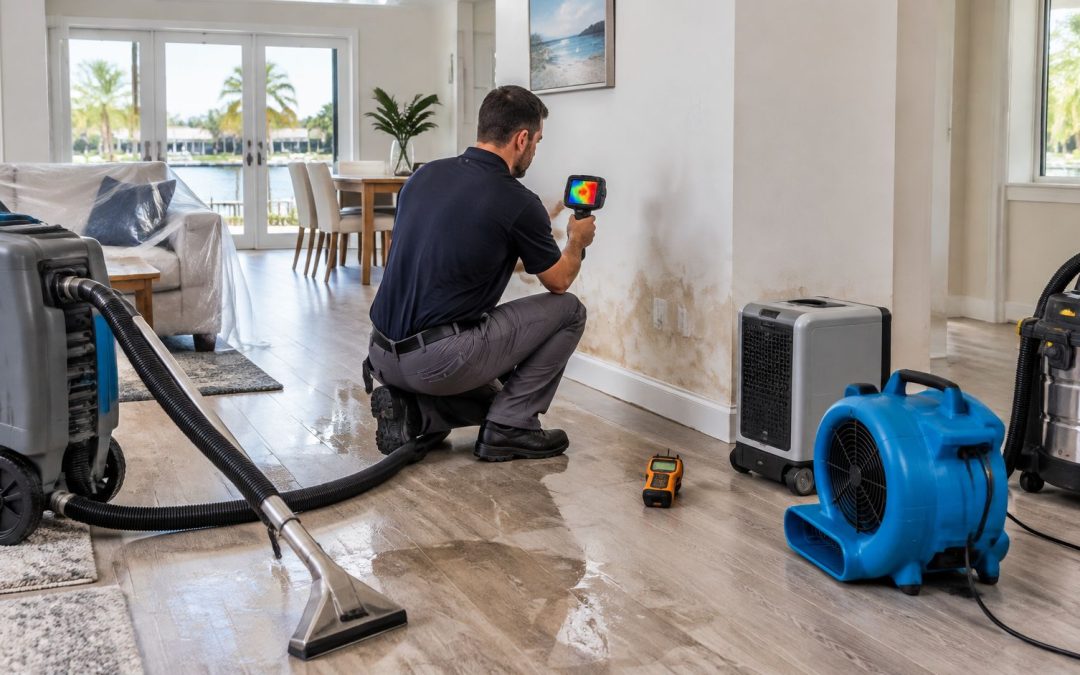
A burst supply line floods your Bradenton home at 2 a.m. Water spreads across the tile, soaks the bedroom carpet, and disappears beneath the baseboards. Your first question is which water damage restoration equipment belongs on site, and what should happen before anyone starts pointing fans at the floor.
A proper dry-out takes a sequence of tools, not a single machine. Extractors remove bulk water. Air movers help moisture evaporate. Dehumidifiers capture that moisture, while meters help technicians decide what still needs attention. In Florida's humid conditions, moving wet air around without removing its moisture can leave you with damp walls and a deceptively dry-looking floor.
AMPM Restoration's process starts with a quick assessment that shapes a customized drying plan. We identify the source, evaluate water penetration, and check the most affected materials before deciding what equipment belongs where. A clean supply-line leak in Lakewood Ranch needs a different approach from wind-driven rain entering a Sarasota exterior wall.
The practical priority is to stop the source safely, remove accessible water, and find where the rest went. Don't judge the job by how many machines are running.
These are the eight tools you're most likely to encounter, including what each can accomplish, where it falls short, and when renting equipment makes sense.
1. Truck-Mounted and Portable Water Extractors
Extract water before trying to evaporate it. High-powered vacuum systems pull water from hard floors, carpet, padding, and accessible subfloor surfaces. They reduce the water load that air movers and dehumidifiers must handle afterward.
Truck-mounted extractors connect to the building through hoses from a vehicle outside. They suit accessible commercial spaces and larger losses, but parking, hose routes, and building access affect their usefulness. Portable extractors travel into tighter interiors and upstairs rooms, although technicians must manage their recovery tanks and discharge arrangements.
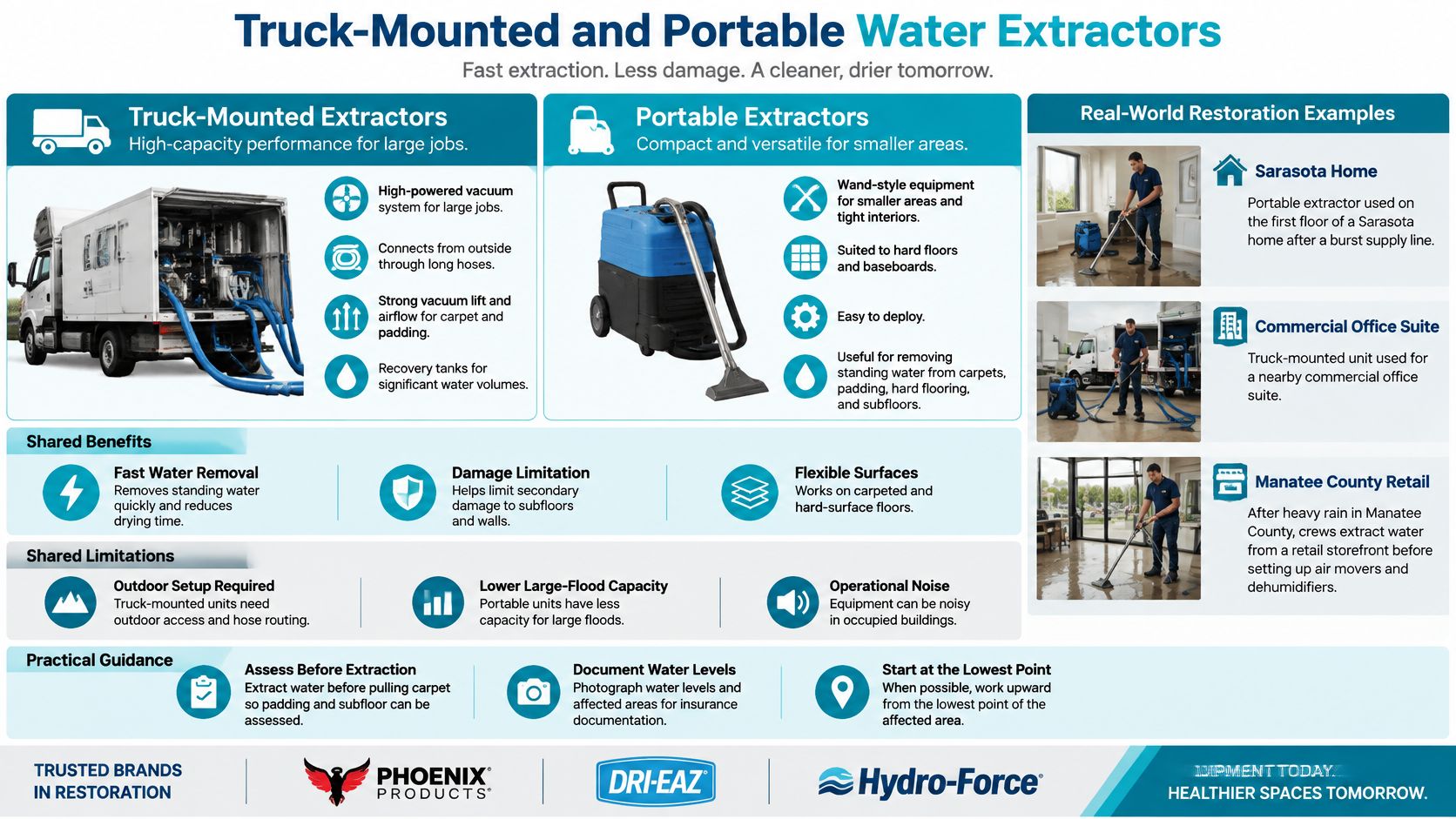
For a Sarasota supply-line leak, a technician might use a portable extractor inside the home. A flooded Manatee County storefront with convenient exterior access may favor truck-mounted extraction. Neither machine proves that flooring, wall cavities, or the slab beneath a floor covering is dry.
Extraction decisions that matter
- Assess carpet before removal. Extract accessible water before lifting salvageable carpet, then inspect the padding and underlying surface.
- Document the loss. Photograph affected rooms and visible water levels before cleanup, provided it's safe.
- Start low when practical. Remove pooled water from low areas without carrying contamination into unaffected rooms.
Renting a wet vacuum can be reasonable for a small, recent clean-water spill on an electrically safe surface. Hire a crew for extensive saturation, uncertain contamination, or water beneath flooring.
Our emergency water extraction guide explains the removal stage. Extraction isn't structural drying, especially in Florida slab-on-grade homes where water can remain beneath cabinets and floor coverings after the surface looks clear.
2. Air Movers for Structural Drying
In a Palmetto townhome, a dishwasher leak can wet the bottom of a wall without leaving much standing water. Once extraction and necessary cleaning are complete, an air mover directs fast-moving air across the wall-floor junction to encourage evaporation.
Air movers move moisture into the air. They don't remove it from the building. That distinction matters during humid Gulf Coast weather, when an open window can admit more moisture than the drying setup can manage.

The ANSI/IICRC S500 standard identifies psychrometry, drying technology, and equipment and instruments as core elements of professional water damage restoration. In practice, technicians coordinate airflow with dehumidification and moisture readings rather than guessing from room size.
Placement beats fan count
Aim airflow across wet surfaces and along walls, not into another fan. An angled position often works well at a wall-floor junction, but furniture, room geometry, and the wet-material map should determine placement. Recheck the same materials and reposition units as drying progresses.
After a St. Petersburg office roof leak, ceiling materials need assessment before anyone directs air toward them. Sagging finishes, wet insulation, and possible contamination can require controlled removal rather than stronger airflow.
Don't turn a fan onto suspected mold or contaminated flood debris. Air movement can spread particles beyond the affected room.
Rent an air mover only for a limited clean-water problem with accessible materials and a way to verify drying. For concealed moisture or multiple affected rooms, professional structural drying methods provide the missing coordination between airflow, moisture removal, and monitoring.
3. Commercial Dehumidifiers (LGR and Desiccant Models)
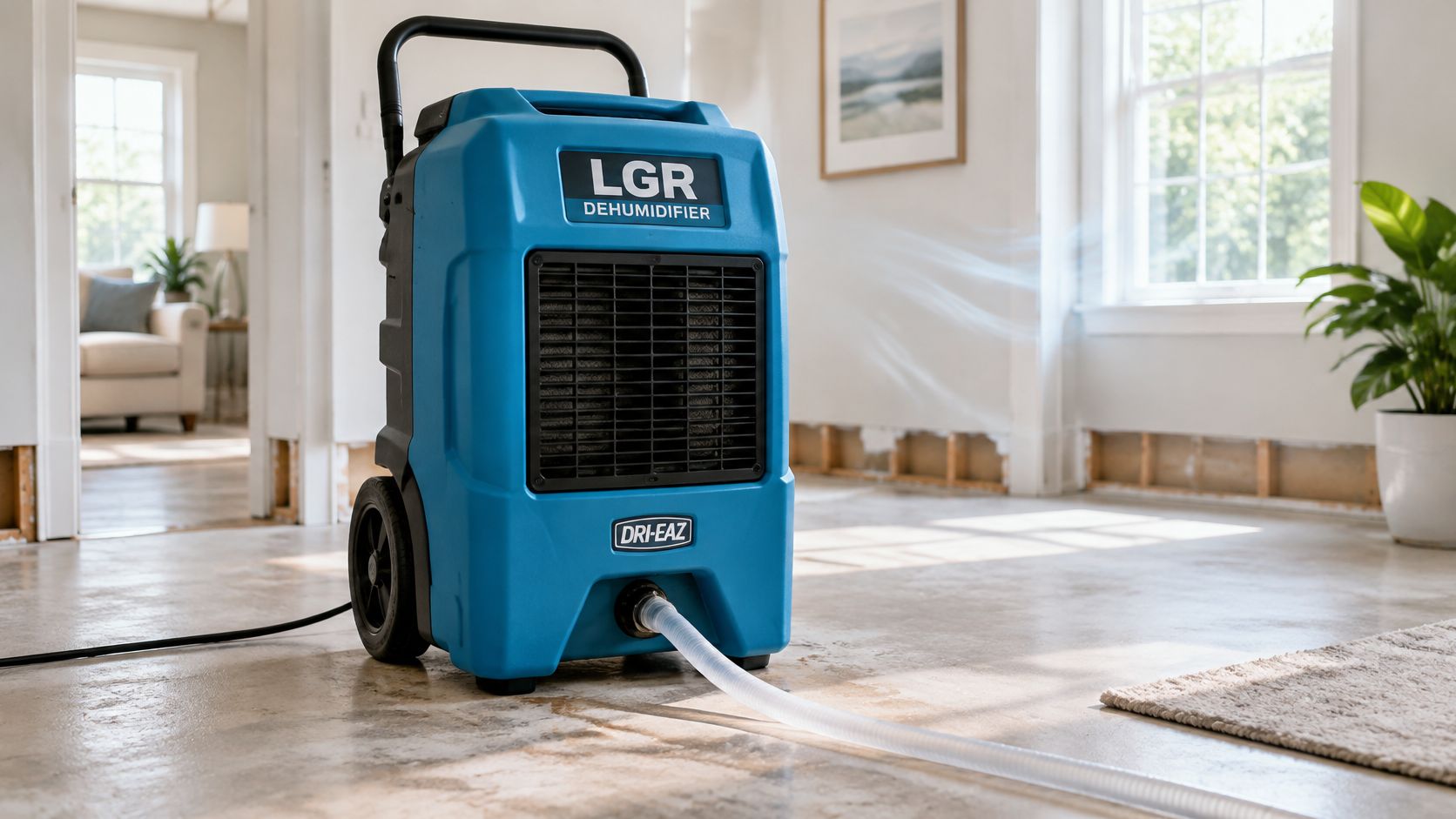
A dehumidifier gives evaporated water somewhere to go besides another wall, ceiling, or piece of furniture. Commercial dehumidification is especially important during a humid Sarasota summer, when opening the building may work against the dry-out.
Low-grain refrigerant, or LGR, machines cool air to condense water and discharge it through a drain hose or collection system. They're a common choice for residential drying under suitable operating temperatures. Desiccant machines use moisture-absorbing material and can be useful in cooler conditions or when the drying plan requires particularly dry air.
The EPA's mold remediation guidance recommends keeping indoor relative humidity below 60%, ideally between 30% and 50%. That's an environmental control target, not proof that a wet cabinet base or flooring assembly has dried.
Choose for conditions, not machine size
- Control the enclosure. Keep exterior doors and windows closed during a managed dry-out unless the drying plan specifically calls for ventilation.
- Check performance. Record temperature, relative humidity, and grains-per-pound readings to evaluate how the drying air changes.
- Secure drainage. Route hoses so discharge won't create another leak or a trip hazard.
A Tampa Bay restaurant might need a desiccant arrangement for a difficult floor assembly, but its exhaust and ducting requirements must suit the space. Limited ventilation alone doesn't make it the right choice.
A rental dehumidifier can help with a small, accessible clean-water loss. It can't extract pooled water, expose wet insulation, or confirm that moisture beneath flooring has reached an acceptable endpoint.
4. Moisture Meters (Pin and Pinless)
The meter helps decide when equipment can leave. A wall that feels dry may still contain moisture, and a cool floor isn't necessarily wet. Moisture mapping replaces those guesses with recorded observations.
Pin meters insert probes into a material to take readings. Pinless meters scan without puncturing the surface and help technicians locate areas needing closer investigation. Both require material-appropriate settings and interpretation.
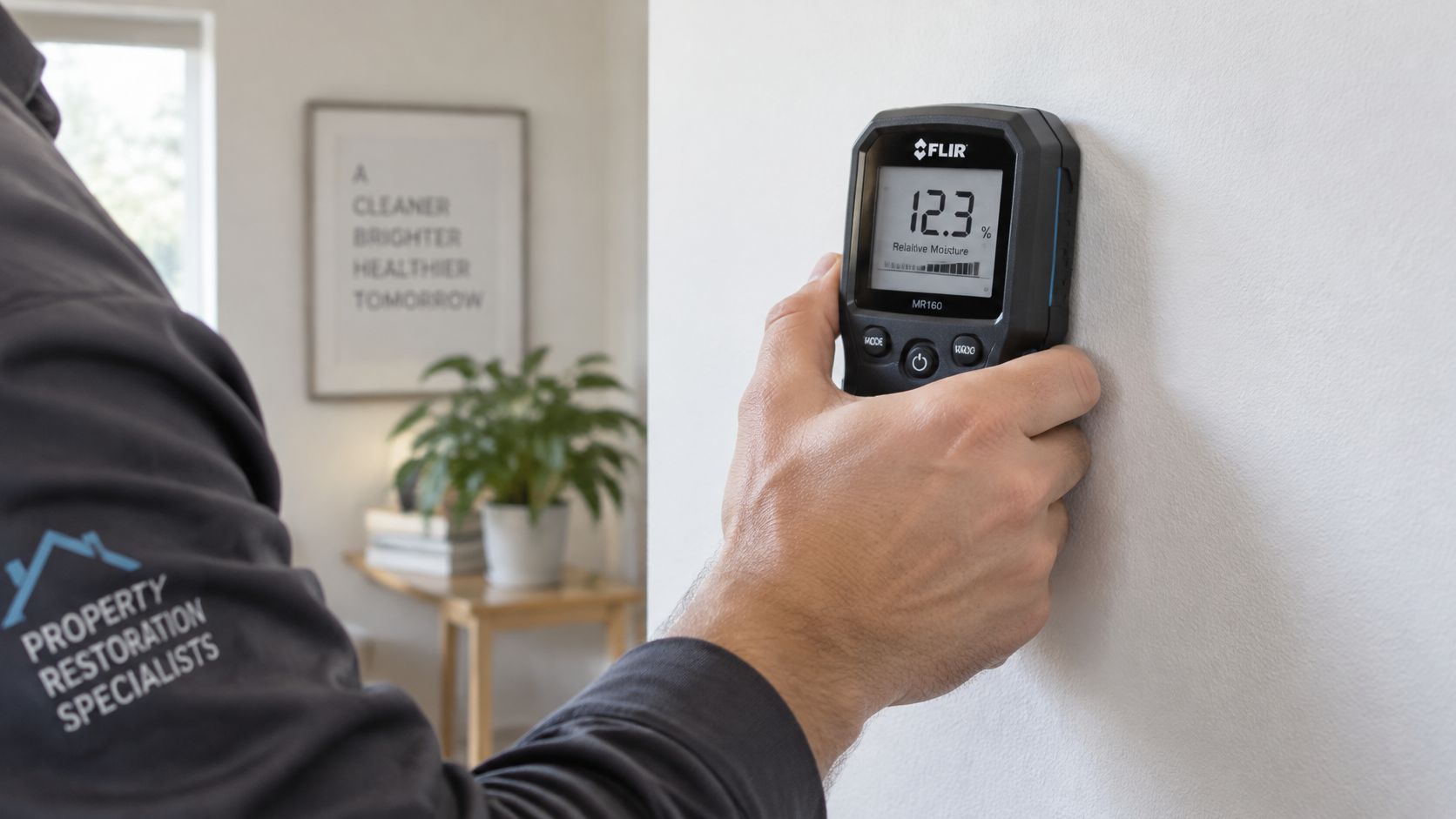
FEMA's flooded-building guidance recommends penetrating, pin-type meters and says wetted salvageable materials should generally be considered dry only when their moisture content is 15% or less, followed by rechecking before reconstruction. That guidance isn't a universal setting for every meter or material, particularly concrete and masonry.
Build a useful moisture map
Take comparison readings in unaffected areas of similar construction. Mark test locations on a floor plan, record the instrument and mode, and return to those locations during monitoring. Metal, material density, salts, and measurement depth can influence results.
In a Bradenton rental, a property manager should receive a drying record that identifies tested wall sections rather than an unexplained declaration that everything is dry. In a slab-on-grade Pinellas County kitchen, high readings beside cabinets may justify checking beneath the toe kick or floor covering.
A homeowner can use a meter to identify suspicious differences, but an unfamiliar percentage shouldn't become permission to close a wall. Our explanation of how long drywall takes to dry after a leak covers why material condition and moisture verification matter more than waiting a fixed number of days.
5. Thermal Imaging Cameras
A cool patch appears above a St. Petersburg condo bathroom. It could indicate evaporative cooling from moisture, but it could also reflect air-conditioning, insulation differences, or another temperature effect.
Thermal cameras show surface temperature patterns, not water itself. Technicians use them to narrow the inspection area, then confirm suspicious locations with moisture meters and, when necessary, controlled access.
A FLIR MR160 combines thermal imaging with moisture-measurement functions, but the interpretation still matters more than the screen colors. A dramatic image isn't a diagnosis.
Where thermal imaging earns its place
After wind-driven rain enters a Sarasota exterior wall, a thermal scan can help identify where to investigate insulation and framing. Scanning under different temperature conditions may make an anomaly clearer or reveal that it follows sunlight rather than moisture.
- Confirm before demolition. Meter-test suspicious areas before opening finishes.
- Consider building conditions. Sun exposure, cold supply ducts, and air leakage can resemble moisture patterns.
- Save meaningful images. Record the location and pair the image with material readings.
A useful limit is that a normal-looking thermal image doesn't clear a wall cavity. Hidden moisture may not create enough surface temperature difference to appear.
Renting a thermal camera can help a property manager investigate a recurring stain, but it shouldn't replace a moisture survey. Hire a trained operator when the findings will determine demolition, reconstruction, or whether an occupied unit can return to normal use.
The benefit is more targeted investigation. The risk is false confidence, either removing dry material because it looks cold or leaving wet material because the screen looks uniform.
6. Injectidry and Cavity Drying Systems
Injectidry and similar cavity drying systems reach spaces ordinary fans can't. Small hoses and access ports direct conditioned air into selected wall cavities, floor voids, and enclosed assemblies. Some configurations pull air through the assembly instead of pushing it in.
In a Lakewood Ranch home, water running down an exterior wall may leave concealed framing wet after the painted surface dries. Cavity drying can help preserve suitable materials when technicians establish that the assembly is clean, accessible, and salvageable.
The important word is suitable. Wet insulation, contaminated cavities, deteriorated drywall, or impermeable layers may make selective demolition the better choice.
Save finishes only when the assembly allows it
Technicians should map moisture before drilling, identify utilities, and plan ports around framing and cavity connections. After installation, they must verify that air reaches the wet area rather than escaping through the easiest opening.
- Inspect the cavity. Don't assume air will pass through insulation or blocking.
- Control the air supply. Feeding humid Gulf Coast air into a wall won't create a dependable drying environment.
- Verify completion. Check concealed material conditions before patching ports and repainting.
For a Gulf Coast office with a leak behind a finished wall, cavity drying may reduce unnecessary finish removal. It can also waste time if technicians try to save an assembly that needs opening for cleaning or removal.
This is generally crew-operated equipment, not a sensible first rental for a homeowner. Drilling blindly risks utilities, and forcing air into an unassessed cavity can spread contaminants.
Small access holes are useful only when the drying results justify them. Preserving the appearance of a wall shouldn't take priority over inspecting what remains inside it.
7. HEPA Air Scrubbers and Negative Air Machines
An air scrubber and a negative air machine may use similar filtration equipment, but they serve different job-site purposes. A recirculating HEPA scrubber filters room air. A negative air setup controls airflow through a contained work zone.
During mold removal in a Bradenton rental, technicians can seal the work area and exhaust filtered air outside through suitable ducting. That arrangement encourages air to move into containment rather than allowing work-zone air to drift into clean rooms.
In a Sarasota retail cleanup, a scrubber may help capture airborne dust during controlled material removal. It won't remove standing water, dry framing, or replace cleaning settled debris.
Containment must work as a system
- Seal the boundary. Address doorways, penetrations, and relevant ventilation openings before relying on pressure control.
- Verify airflow. Use a manometer or appropriate airflow indicator rather than assuming a running fan creates negative pressure.
- Maintain filtration. Inspect filters and replace them according to loading, job conditions, and manufacturer instructions.
Exhausting air also removes conditioned indoor air. In Florida, poorly planned replacement air can bring humidity into the building, so containment and drying plans must work together.
Permanent whole-home air purifiers serve a different purpose from temporary restoration containment. Neither approach replaces removal of contaminated material.
Renting a scrubber for ordinary renovation dust isn't the same as managing a mold or contaminated-water work zone. Hire trained operators when containment, exhaust routing, or occupant separation is necessary.
Our mold remediation clearance testing guide explains the role of verification after remediation. Filtered air alone doesn't establish that a property has been properly remediated.
8. Antimicrobial Foggers and ULV Sprayers
Fogging comes after the work that physically removes contamination. Antimicrobial foggers and ultra-low volume, or ULV, sprayers distribute a fine mist, but they don't extract water, remove damaged drywall, or clean dirt from a surface.
The EPA's mold and moisture guidance recommends drying wet materials and affected areas within 24–48 hours when possible to help prevent mold growth. A chemical application doesn't compensate for leaving a Gulf Coast home damp.
For a Tampa Bay restaurant flood, the sensible sequence is assessment, removal of unsuitable materials, cleaning, and appropriate drying before any label-authorized post-cleaning treatment. Food-contact surfaces, sensitive equipment, and reoccupancy requirements need particular attention.
The product label determines the application
Not every antimicrobial product permits fogging. Technicians must match the product to the surface, intended use, application method, and site conditions.
- Prepare the surface. Remove debris and contamination before treatment.
- Meet label directions. Follow dilution, wet contact time, ventilation, and reentry requirements.
- Protect occupants and workers. Select required respiratory, eye, and skin protection and keep unauthorized people outside the treatment area.
For a Palmetto home, a difficult-to-reach surface may benefit from an approved application method after cleaning. That doesn't justify misting every room or treating odor reduction as proof of sanitation.
Descriptions of home sanitizing and fogging services shouldn't be confused with complete flood or mold remediation. The underlying moisture source and affected materials still need attention.
Our decontamination services guide provides additional context. For restoration work, hire trained applicators rather than renting a fogger and improvising with a household disinfectant.
How the Eight Water Damage Restoration Equipment Types Compare by Job Role and Limits
Eight machines show up on a Gulf Coast drying job, and each one answers a different question. The table below pairs every tool with the decision that justifies running it, the Florida condition that changes how it behaves, and an honest rent-versus-hire verdict.
| Equipment | Primary Job | Main Limitation | Florida Factor | Rent or Hire |
|---|---|---|---|---|
| Truck-Mounted and Portable Water Extractors | Remove standing water from floors and carpets | Pick portable when a truck mount cannot reach the unit or room | Storm and flood volume on slab-on-grade homes pushes water under wall plates fast | Rent a portable for a small clean-water spill; hire a crew for flood depth |
| Air Movers for Structural Drying | Circulate air across wet building materials | Run only alongside dehumidification, or they just push wet air around | Ambient humidity stays high most of the year, so moved air must be dried continuously | Worth renting for one wet room if a dehumidifier runs with them |
| Commercial Dehumidifiers (LGR and Desiccant Models) | Remove moisture from indoor air | Switch to desiccant when LGR output stalls in deep or cool drying | Humidity is the bottleneck on most Florida jobs, so capacity planning matters | Rent an LGR for a contained job; desiccant setups belong to crews |
| Moisture Meters (Pin and Pinless) | Measure moisture in building materials | Readings only mean something against each material's dry baseline | High baseline humidity shifts what counts as dry for drywall and wood | Rent one for checking, but hire out the interpretation |
| Thermal Imaging Cameras | Detect surface temperature patterns that may indicate hidden moisture | Treat every anomaly as a suspect until a meter confirms it | Hot attics and cold AC interiors create misleading patterns in summer | Hire; the camera is cheap compared to misreading it |
| Injectidry and Cavity Drying Systems | Deliver dry air into enclosed cavities | Worthwhile only when cavities are wet but surfaces stay salvageable | Slab construction sends water under bottom plates and behind cabinet toe-kicks | Hire; setup and placement decide whether it works at all |
| HEPA Air Scrubbers and Negative Air Machines | Filter airborne particles and manage air pressure in contained areas | No benefit without sealed containment and maintained filters | Heat accelerates mold growth, so sewage or mold jobs need negative air quickly | Hire; containment design is the real job |
| Antimicrobial Foggers and ULV Sprayers | Apply sanitizing solutions as a fine mist | Last step only, after surfaces are cleaned and confirmed dry | Lingering humidity slows drying, so verify dryness before any treatment | Hire a trained applicator |
Read the table by decision, not by machine size. Extractors and air movers handle water you can see. Meters, thermal cameras, and cavity systems handle the hidden moisture that Florida humidity keeps wet longest, and the detection tools decide whether the drying tools are even pointed at the right place.
Choosing Between Renting Equipment and Hiring a Restoration Crew
One decision rule covers most Gulf Coast losses: rent when the source is stopped, the water is clean, and the wet area is small enough that you can reach every affected material. A promptly discovered refrigerator supply line on exposed tile in a Bradenton kitchen qualifies. Once water wicks under a Lakewood Ranch island cabinet or along a slab edge, the affected area is no longer accessible and a crew should take it.
Rental also demands three things you can confirm before signing: safe electrical power, appropriate drainage, and a way to check the affected materials. A rental receipt and a dry-looking floor aren't drying verification. Without moisture mapping, wet cabinet bases, wall bottom plates, and flooring over a concrete slab stay wet while the surface looks finished.
When professional operation matters
Hire a crew when water enters concealed assemblies, spreads across multiple rooms, carries possible contamination, or involves ceilings and electrical hazards. The same applies when the source is uncertain or arrives as wind-driven rain, since technicians trained to trace damage back to a burst pipe, heavy rain, or a malfunctioning appliance need to confirm the cause before drying starts.
Effective water damage restoration equipment has to match the materials, the moisture readings, the environmental conditions, and the containment needs. Adding more machines never corrects a missed moisture pocket or a wrong call to save damaged material.
AMPM Restoration's IICRC-certified team serves Bradenton, Sarasota, Palmetto, St. Petersburg, and the greater Tampa Bay area 24/7, with a one-hour response time for emergencies. The process runs assessment, extraction with high-powered pumps and industrial vacuums, drying and dehumidification, then restoration and repair, with moisture levels monitored throughout the drying phase. A free inspection and estimate, insurance claim assistance, and financing options are available, so you can weigh the equipment decision before committing to rentals or tear-out.
The questions below cover the calls a rental counter cannot make for you.
What water damage restoration equipment should arrive first?
Assessment instruments and extraction equipment lead once the site is safe and the source is controlled. Air movers and dehumidifiers follow a plan based on the affected materials and water conditions.
What does a free inspection and estimate actually cover?
A detailed assessment of the water damage and potential mold issues, using moisture detection tools to gauge how far water penetrated. You get a scope of work and a drying plan, which is the information a rental decision depends on.
Can I start cleanup myself and bring in a crew later?
Yes for immediate water removal on a clean loss, but set a threshold before you start: if readings remain high after the first day of drying, or you have no way to take readings at all, hand the job off. Wet drywall and cabinet bases in Florida humidity move from salvageable to tear-out while you wait.
How do technicians know when walls are dry?
They compare material readings against dry reference points and log the same locations through the drying phase. Surface appearance, touch, and a preset rental period are not dependable substitutes.
Does running the home AC replace a commercial dehumidifier?
No. Air conditioning pulls some moisture as a side effect of cooling, but it is not sized for structural drying and cannot hold the low humidity LGR or desiccant units maintain in humid Sarasota or Bradenton conditions.
What does waiting actually cost?
Drying that starts late in Gulf Coast humidity lets moisture migrate deeper into wall cavities and under flooring. Prompt response limits secondary damage; delay turns a drying job into demolition, mold remediation, and rebuild.
AMPM Restoration Services offers water damage restoration, emergency dry-out, mold removal and remediation, fire damage restoration, storm and flood damage restoration, leak detection, and commercial restoration for homes, offices, schools, and government facilities. Request a free inspection and estimate any hour of the day, with insurance claim coordination and financing options available, or visit AMPM Restoration Services to arrange an assessment and a drying plan matched to your Gulf Coast property.