

Emergency Water Extraction In Tampa Bay
Water is spreading across your floor, a baseboard is already darkening, and you’re trying to decide what matters most. Shut something off. Move furniture. Call insurance. Grab towels. In a Florida home, that confusion is normal, but emergency water extraction has to move to the top of the list immediately.
On the Gulf Coast, water damage rarely stays where it starts. A washing machine line in Bradenton, a roof leak after a Sarasota storm, or a slow pipe break behind a vanity can push water under cabinets, into drywall, beneath vinyl plank, and across adjacent rooms faster than most homeowners expect. In Florida’s high-humidity climate, mold can begin growing within 24 to 48 hours after water damage occurs if standing water isn’t removed promptly, which makes rapid extraction critical to preventing secondary damage and costly reconstruction.
AMPM Restoration is a 24/7 emergency restoration company based at 4301 32nd St W b18, Bradenton, FL 34205, serving Bradenton, Sarasota, Tampa Bay, Saint Petersburg, Lakewood Ranch, and surrounding Gulf Coast communities with professional water damage restoration, mold inspection and mold removal, fire and smoke damage restoration, storm and flood damage restoration, commercial restoration services, and full reconstruction solutions.
Water Damage in Florida Waits for No One
Emergency water extraction means removing standing and trapped water before drying equipment can do its job. That sounds simple. It isn’t. Water settles in low spots, wicks into drywall, follows framing, and hides under flooring where homeowners can’t see it.
That’s why the first hours matter so much in homes across Bradenton, Lakewood Ranch, Sarasota, and Saint Petersburg. The water you can see is only part of the problem. The bigger issue is where it’s already gone.
What makes Florida different
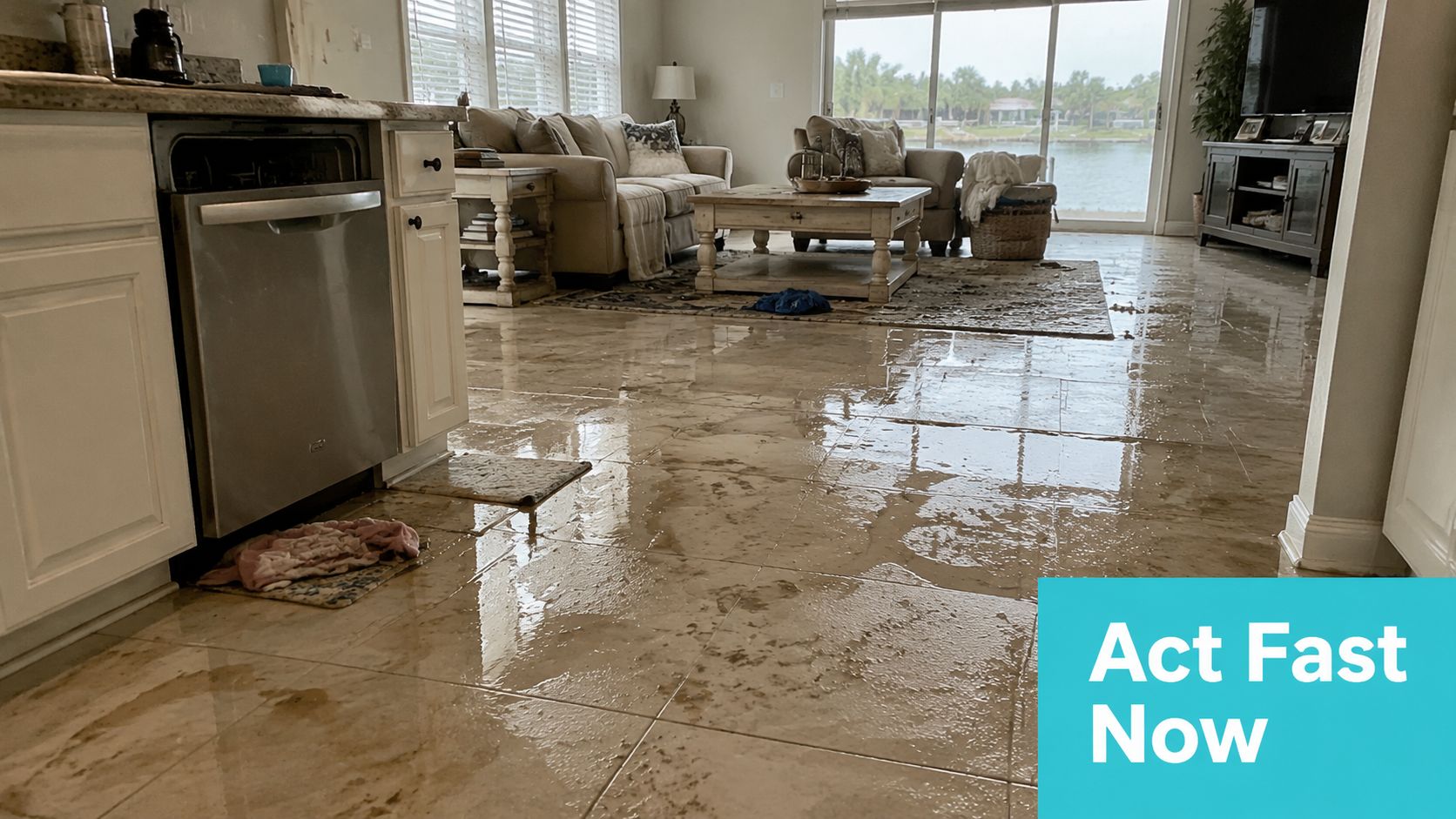
Florida homes face two problems at once. First, liquid water spreads quickly through porous building materials. Second, warm humid air slows natural drying and feeds microbial growth once materials stay wet.
If the source was a supply line, refrigerator line, water heater, or storm intrusion, the safest assumption is that the affected area is larger than it looks from the doorway. Tile may look fine while water is sitting under underlayment or inside wall cavities. Cabinets can still feel solid while toe-kicks and subfloor edges are already saturated.
Practical rule: If you can hear squishing, see cupping, smell a damp earthy odor, or notice swollen trim, the damage has moved beyond surface cleanup.
What helps right now
Fast, controlled action helps. Random DIY usually doesn’t. Homeowners can reduce loss by stopping the source, protecting people, documenting conditions, and removing limited standing water where it’s safe. But extraction alone isn’t the full job. The area still needs inspection, moisture mapping, and controlled drying.
If a storm made your home temporarily unlivable, practical housing logistics can become part of the emergency too. A useful resource is MCHA’s natural disaster assistance, especially when you need a short-term plan while repairs are being scoped.
For homeowners on the Suncoast, emergency water extraction isn’t a nice-to-have. It’s the first move that protects floors, walls, cabinetry, air quality, and claim documentation.
Your First Hour Checklist What to Do Before We Arrive
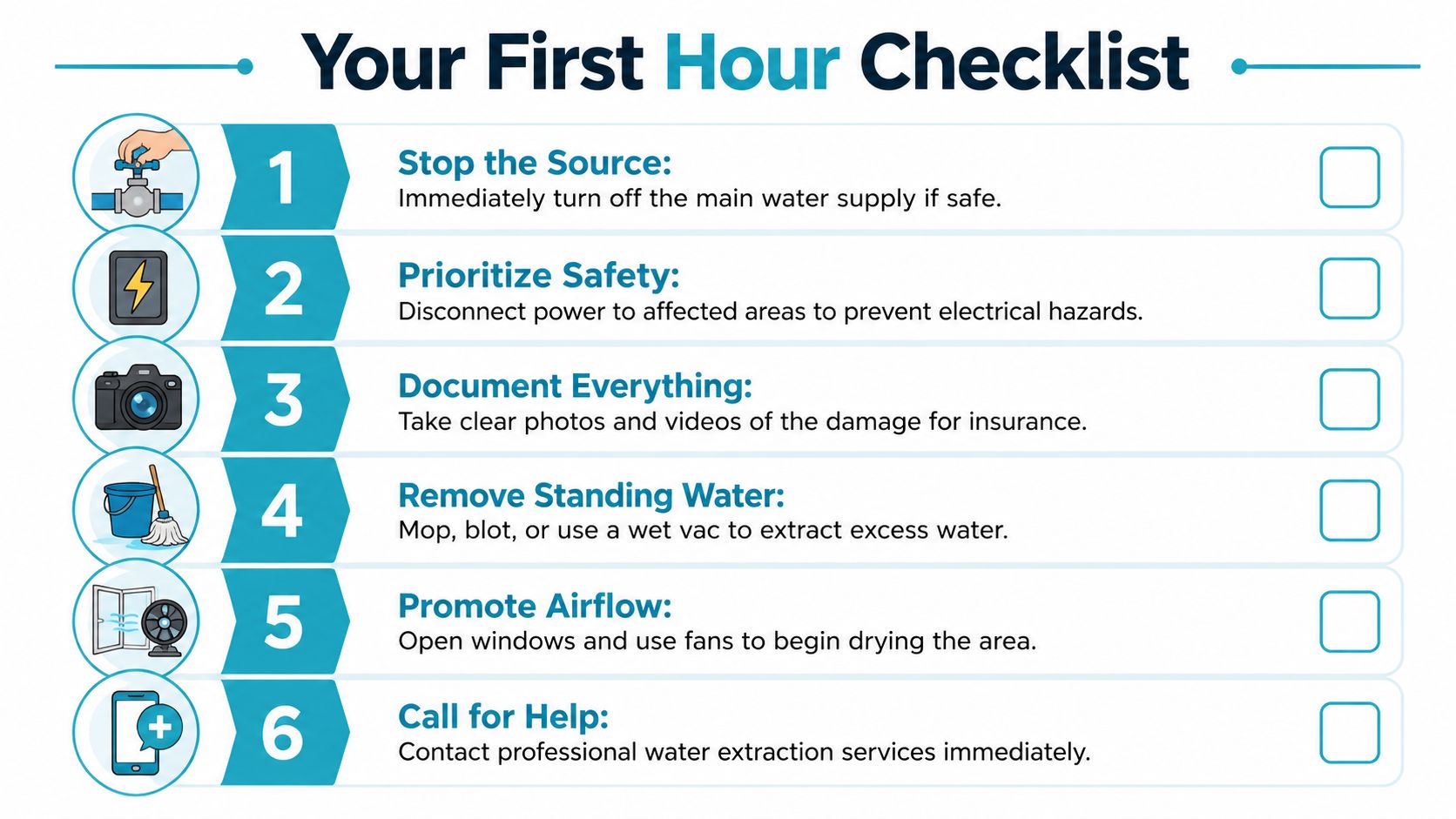
Panic causes bad decisions. The goal in the first hour is narrower than commonly assumed. Keep everyone safe, stop active water if you can, document damage, and limit spread without taking risks.
This is the window where homeowners often help themselves or hurt their claim and their house. Small, careful mitigation is useful. Unsafe cleanup, aggressive demolition, or partial drying without documentation usually creates new problems.
Do these first
-
Stop the source
If a supply line, toilet valve, sink line, or appliance line is leaking, shut off the nearest valve. If you can’t isolate it fast, shut off the main water supply. Don’t stay in a cramped cabinet or standing water trying to force a stuck valve. -
Cut power if the area may be energized
If water is near outlets, cords, appliances, or baseboard electrical runs, turn off power to the affected area only if you can do it safely from a dry location. If you can’t, stay out and wait for qualified help. -
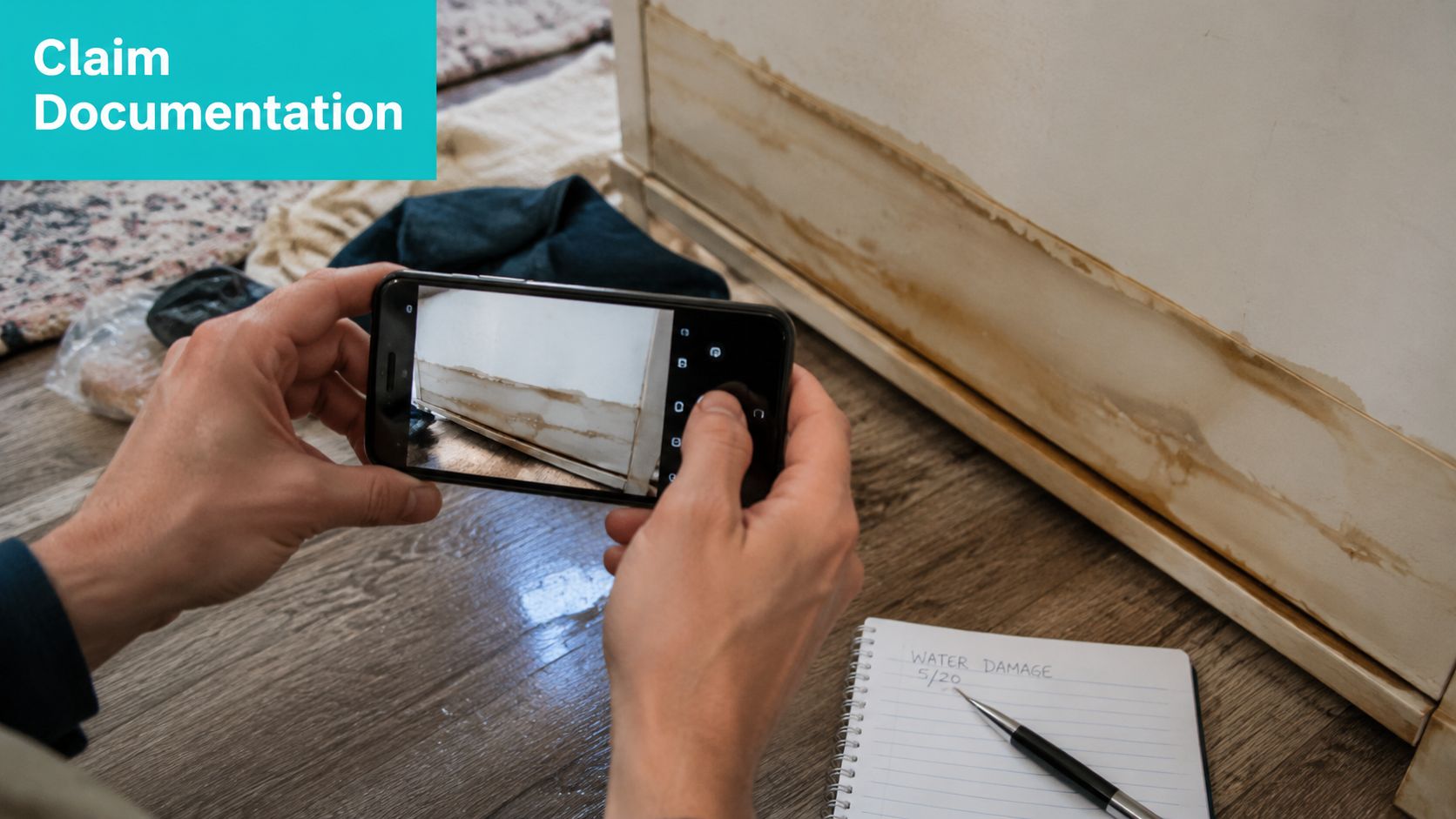
Take photos and video before moving much
Capture wide shots, then close-ups of wet floors, swollen trim, stained ceilings, damaged contents, and the source if visible. Open cabinet doors and photograph inside. Document the time. -
Move what’s easy and dry what’s reachable
Pick up rugs, books, electronics, paper items, and lightweight furniture. Put foil, plastic blocks, or clean barriers under furniture legs if you can’t move larger items.
Limited DIY that usually makes sense
A homeowner can often do basic mitigation in a clean-water situation if the area is small and safe to access.
- Use towels or mops for pooling water where footing is stable.
- Use a wet/dry vacuum on hard surfaces if the water is clean and the machine is rated for wet pickup.
- Create airflow with fans and open interior pathways if weather and conditions allow.
- Remove wet throw rugs and loose textiles and separate them so dyes don’t bleed further.
For an insurance-oriented overview from the carrier side, Florida All Risk’s flooded house guide is a helpful companion to your emergency response.
Don’t do these things
- Don’t use household fans on contaminated water from sewage, backups, or unknown sources. You can spread contamination.
- Don’t pull up flooring just to “see underneath.” That can damage restorable materials and complicate scope.
- Don’t use a regular household vacuum on standing water.
- Don’t paint, caulk, or cover wet areas to make them look better before inspection.
- Don’t throw damaged items away yet unless they create a clear health hazard. Photograph first.
If you’re unsure whether your cleanup steps are helping or crossing a line, use a conservative approach and review what to do in the first 24 hours after water damage before you touch more of the structure.
The best homeowner response is controlled, documented, and limited. You’re not trying to finish the job. You’re trying to prevent the loss from getting worse while the truck is on the way.
The Professional Water Extraction and Inspection Process
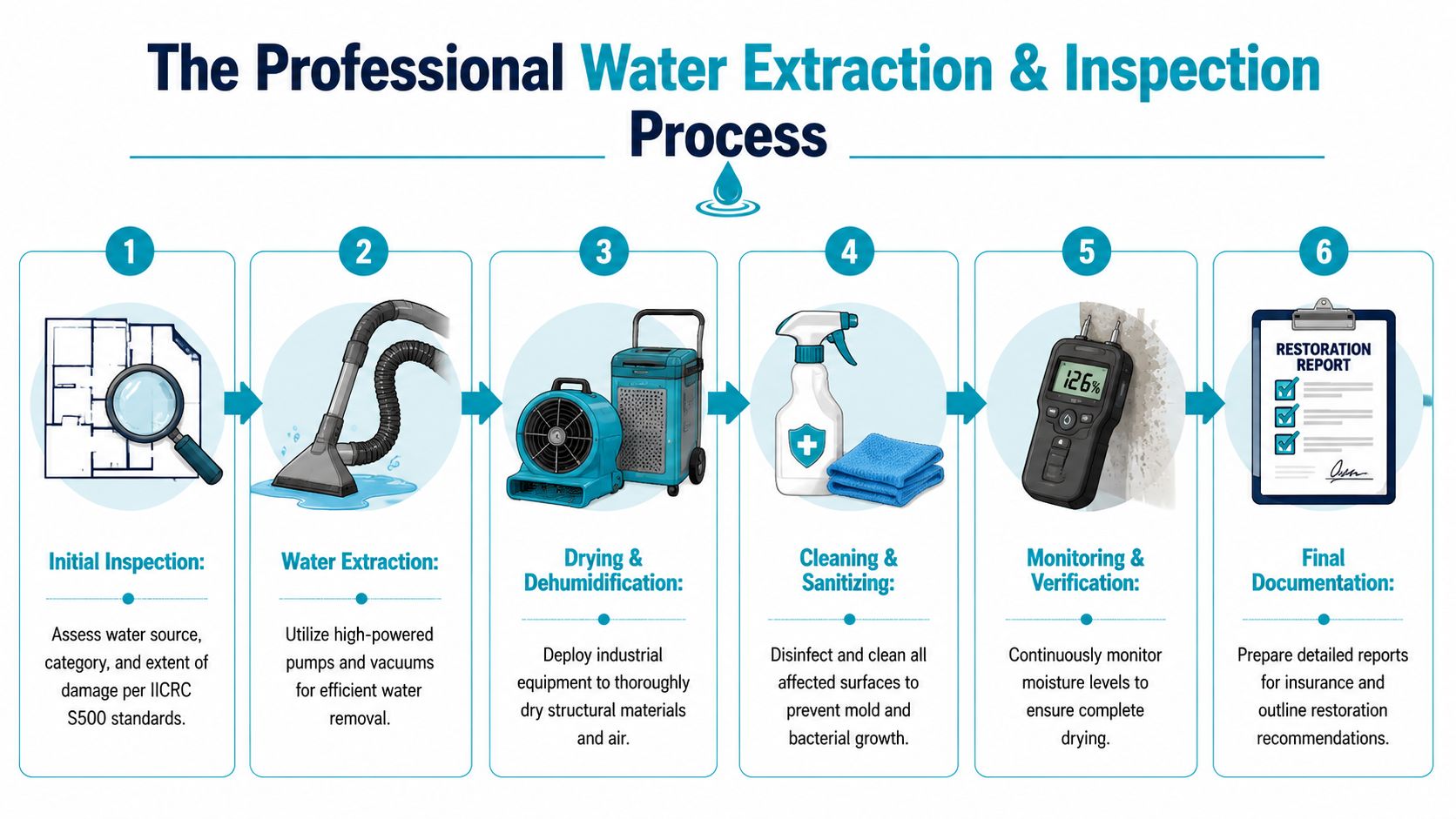
Professional emergency water extraction starts with classification, not with fans. That sequence matters because the cleanup method depends on what kind of water entered the home and where it migrated.
Under the IICRC S500 approach, technicians first determine whether the loss involves Category 1 clean water, Category 2 gray water, or Category 3 black water, then select extraction tools and safety measures to match. That isn’t jargon for its own sake. It decides what can be dried, what must be removed, and how the site must be handled.
Why extraction comes before drying
In professional water damage restoration adhering to the IICRC S500 Standard, emergency water extraction is a mandatory prerequisite phase that must be completed within 2–4 hours for residential-scale pipe bursts before any drying systems are applied, because residual standing water imposes an evaporative load that exceeds the evaporative capacity of standard dehumidifiers, rendering them ineffective if not removed first, as outlined in this overview of IICRC S500 emergency water extraction procedures.
That’s the part many homeowners don’t hear clearly enough. Dehumidifiers don’t replace extraction. Air movers don’t replace extraction either. If standing water remains, drying equipment spends too much of its capacity trying to chase open water instead of drying the structure.
The floor can look “mostly dry” and still hold enough moisture below the surface to keep the assembly wet for days.
What technicians actually do on site
A proper response is methodical. It usually includes:
| Step | What happens | Why it matters |
|---|---|---|
| Initial inspection | The technician identifies the source, category, affected rooms, and likely migration paths. | This sets the safety plan and drying strategy. |
| Extraction pass | High-capacity extractors, wands, and pumps remove standing water with overlapping passes from perimeter to center or from the farthest point back toward access. | It reduces saturation quickly and improves drying efficiency. |
| Moisture mapping | Moisture meters and thermal imaging help locate hidden water in drywall, subfloors, and adjoining rooms. | Visible water is rarely the full extent of damage. |
| Baseline documentation | Readings are recorded before and after extraction. | That creates a measurable starting point for drying and supports claim records. |
Hidden moisture is the real trap
The hardest losses aren't always dramatic. A supply line under a sink can soak cabinet bases, toe-kicks, drywall bottoms, and subfloor seams without producing deep standing water in the main room. Homeowners dry the surface, think they won, then discover buckling, odor, or mold later.
That's where structural drying takes over after extraction. Controlled equipment placement, monitored moisture reduction, and verification are what separate a dry-looking room from a dry building assembly. If you want to understand that part in more detail, this guide to structural drying services in Tampa Bay is worth reviewing.
AMPM Restoration Services is one local option for this process. Their scope includes water extraction with pumps and vacuums, drying, sanitization, repairs, and insurance coordination for residential and commercial losses.
Documenting for a Smooth Insurance Claim
Insurance stress starts almost as fast as the water. Homeowners worry about saying the wrong thing, doing too much, doing too little, or losing coverage because they tried to help themselves.
That fear isn't irrational. The hard part is that basic mitigation is usually expected, but undocumented mitigation can become a problem later if the carrier asks what happened between the initial loss and the inspection.
Where DIY gets tricky
Recent industry data suggests extraction is the “most critical phase” for preventing structural decay, but homeowners are often unclear whether their own attempts to mitigate damage will be recorded as a failure to mitigate if mold appears later, or whether it strengthens their claim by showing proactive effort. The unresolved gap is the legal and insurance documentation required during DIY extraction, as discussed in this analysis of emergency water damage actions and claim concerns.
That's why I tell homeowners to think like an adjuster while they're thinking like a homeowner. Every action should leave a record.
What to document before, during, and after cleanup
Use a simple evidence chain.
- Capture the source if visible. Photograph the failed line, overflowing appliance, roof leak point, or stained ceiling area.
- Record the spread room by room. Include flooring transitions, baseboards, cabinets, furniture legs, and contents.
- Keep a time log with short notes such as when you noticed the loss, when you shut off water, when you removed rugs, and when professionals were called.
- Save receipts for emergency supplies, temporary lodging if applicable, and protective materials.
- Don't discard major items too quickly unless they create an immediate health risk.
Claim-safe habit: If you move it, dry it, or throw it away, photograph it first.
Why professional records matter
Carrier conversations are easier when the file includes more than homeowner photos. Moisture readings, room-by-room notes, category assessment, extraction records, and drying logs create a cleaner story of cause, response, and scope.
That's one reason many homeowners prefer a restoration company that can coordinate the documentation side as well as the physical work. If you need a clearer picture of the paperwork flow, this guide on how to file an insurance claim for water damage lays out the process in practical terms.
The safest approach is simple. Do reasonable mitigation. Document every step. Don't let DIY outrun your proof.
Choosing the Right Restoration Partner in the Tampa Bay Area
During a water emergency, it's common to call the first company that answers. Speed matters, but so does fit. A truck and a few fans don't equal a proper emergency water extraction response.
The right restoration partner in Bradenton, Sarasota, Tampa Bay, Saint Petersburg, or Lakewood Ranch should be able to do more than remove visible water. They should classify the loss correctly, inspect for hidden migration, document the job for insurance, and carry the work through drying, cleaning, repairs, and reconstruction if needed.
What to verify before you say yes
Use this short screening list when you're making calls:
-
Real emergency availability
Ask whether they respond after hours, weekends, and storm periods, and whether they have local crews serving the Gulf Coast. -
IICRC-certified water damage capability
You want a team that follows accepted restoration standards, not a carpet cleaner improvising on a wet structure. -
Licensing, insurance, and scope depth
Confirm they can handle mitigation and what comes after it. Some firms extract water but leave you hunting for separate drying, mold, or rebuild contractors. -
Insurance coordination experience
Documentation quality matters almost as much as extraction speed when the claim starts moving.
Older homes need a different mindset
Historic cottages, older ranch homes, and aging Florida properties create a special challenge. Most content states that older structures should be dried “more slowly and naturally” to prevent splitting and cracking, yet it rarely explains how to do that without inviting mold growth. The challenge lies in balancing the rapid-drying expectations of modern restoration work with the preservation needs of older materials, as discussed in this article on water damage drying in older structures.
That nuance matters in older neighborhoods where original wood trim, plaster, millwork, or legacy flooring can react badly to aggressive heat or airflow. The company you choose should understand when to slow material stress without losing control of moisture.
A practical local benchmark is whether the contractor can handle both standard residential losses and more complex structural cases across the region. If you're comparing providers, this page on water damage restoration in Tampa gives a useful picture of what a full-service restoration scope should include.
Emergency Water Extraction FAQs
Can I stay in my house during emergency water extraction
Sometimes yes, sometimes no. If the affected area is limited, the water is clean, and electricity and access remain safe, many homeowners can stay in unaffected portions of the home. If the loss involves contamination, widespread saturation, unsafe flooring, or significant equipment and demolition needs, temporary relocation may be the better call.
Should I try to remove water myself before help arrives
For a small clean-water loss, limited mitigation usually makes sense. Towels, mopping, lifting rugs, moving contents, and careful wet-vac use can reduce damage if it's safe. If the water is from sewage, storm contamination, or an unknown source, don't treat it like a normal spill.
How long does emergency water extraction take
The extraction phase depends on the size of the affected area, how much water is present, where it migrated, and what materials are involved. Pulling visible water may be fast. Inspection, moisture mapping, and setting up a proper drying plan take longer. What matters most is that extraction starts quickly and the structure is monitored until dry.
Will my insurance cover emergency water extraction
Coverage depends on the cause of loss and your policy language. Sudden accidental water events are often treated differently from long-term leaks, neglected maintenance issues, or certain flood-related events. Good documentation helps either way, and having a restoration team that can assist with claim records usually makes the process smoother.
Do you handle commercial water losses too
Yes. Offices, retail spaces, hospitality properties, schools, and other commercial sites often need extraction, drying, sanitization, and phased recovery that keeps business interruption in mind. Commercial losses also tend to involve more documentation, more contents, and more coordination with property management and insurers.
Do you offer free inspections, estimates, financing, and more homeowner guidance
Yes. AMPM Restoration offers free inspections and estimates, insurance claim assistance, financing options, and full restoration support from emergency mitigation through reconstruction. If you want additional quick answers before you call, review these water damage frequently asked questions.
Emergency water extraction is the first move that gives you a chance to protect the structure, protect your claim, and avoid avoidable mold trouble in Florida's climate. Stay safe, keep your mitigation limited and documented, and get professional eyes on the loss quickly.
If you need emergency water extraction in Bradenton, Sarasota, Tampa Bay, Saint Petersburg, Lakewood Ranch, or nearby Gulf Coast communities, contact AMPM Restoration Services now. Call 941-946-7807 for a free inspection and estimate. We provide insurance claim assistance, financing options, and 24/7 help for residential and commercial water damage, mold, storm, fire, smoke, and reconstruction needs.