


How Long for Drywall to Dry After Leak?
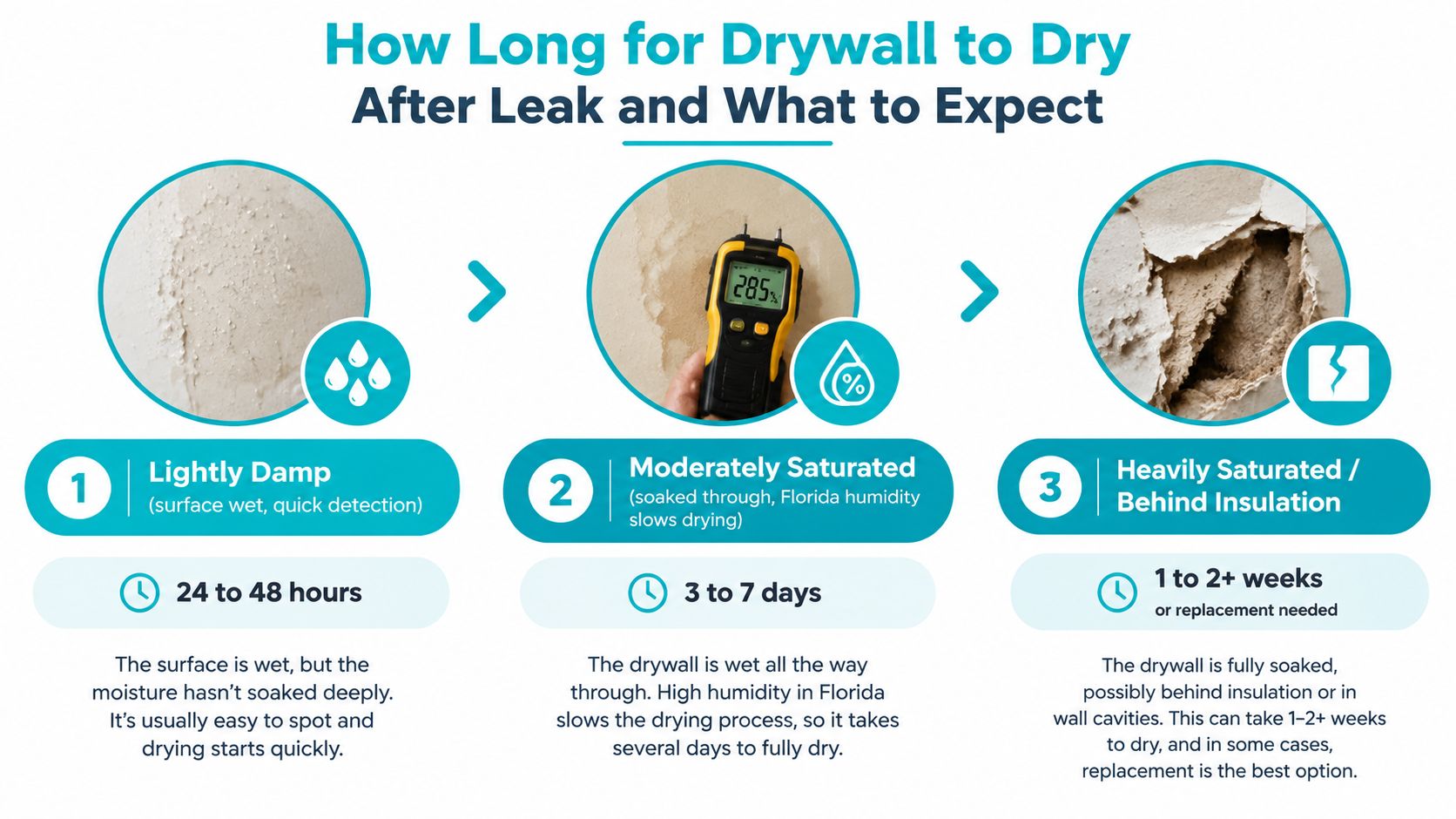
Lightly saturated drywall can dry in 24 to 72 hours, moderately saturated drywall usually takes 3 to 5 days, and heavily soaked drywall may need 7 to 14 days to dry completely if it can be saved. If drying extends beyond 48 hours, mold growth and drywall replacement risks rise sharply.
You may be standing in a Florida room right now, touching a wall that feels dry while a damp smell lingers near the baseboard. After a burst supply line in Bradenton, a roof leak in Sarasota, or storm-driven rain around Tampa Bay, the visible surface can improve before the gypsum core, insulation, and wall cavity have released their moisture. That hidden gap is why the answer to how long for drywall to dry after leak can’t come from touch alone.
The practical timeline ranges from 24 hours to 14 days, depending on saturation, water type, construction, airflow, dehumidification, and how quickly drying begins. The EPA’s guidance for drying water-damaged materials recommends action within 24 to 48 hours to help prevent mold, while also warning that mold may already have developed even when materials dry within that period.
How Long for Drywall to Dry After Leak and What to Expect
A small clean-water leak found quickly may leave only the paper facing and shallow gypsum damp. Under professional drying conditions, lightly saturated drywall can dry in 24 to 72 hours, according to NuBilt’s drywall drying timeline. Moderately saturated drywall generally needs 3 to 5 days, while heavily soaked drywall may require 7 to 14 days, provided the material remains structurally sound enough to save.
A refrigerator line may wet only the lower wall. A failed washing-machine hose can saturate drywall, baseboards, flooring, framing, and insulation together. The second loss contains more moisture and fewer open paths for evaporation, so paint that looks normal cannot set the drying schedule.
The first 48 hours affect the repair decision
According to the IICRC S500 discussion of water-damaged drywall, drywall exposed to water for less than 24 hours has the strongest salvage chance. After 48 hours, in-place drying becomes less reliable because mold can begin, the paper facing can delaminate, and the gypsum core can lose structural integrity. The EPA wallboard guidance flags wallboard that remains wet beyond 48 hours for professional evaluation.
A surface can feel dry in 1 to 3 days under forced-air drying, while the core and cavity remain wet. Field guidance places full structural drying closer to 3 to 7 days, with enclosed wall cavities potentially requiring 5 to 10 days. In Florida, warm air with high moisture content can extend that hidden-cavity risk even after the face feels dry.
What “dry” means in restoration work
Technicians do not declare a wall dry because it feels cool and firm. They compare affected drywall with unaffected drywall in the same structure, since the building establishes the appropriate baseline. Guidance commonly describes fully dried gypsum as roughly equal to ambient equilibrium and often around 0.5% to 1% on a gypsum-calibrated pin meter, although the correct benchmark remains building-specific. The restoration standards overview also describes documented psychrometric readings and moisture logs at least every 24 hours until materials stabilize near baseline.
For homeowners in Bradenton, Sarasota, Saint Petersburg, Lakewood Ranch, and nearby Gulf Coast communities, elapsed time is only part of the answer. The wall assembly needs verified readings, including the cavity where possible. For broader restoration scheduling, AMPM Restoration’s guide explains how long water damage restoration takes.
What Changes Your Drywall Drying Time in Florida Homes
Two walls can carry similar stains yet follow very different drying schedules. A shallow clean-water exposure in an open partition may dry faster than a wall that absorbed water behind insulation, under cabinets, or inside a ceiling assembly. The visible stain does not show how far moisture traveled.
Saturation depth controls the workload
Light surface dampness is different from water that has entered the gypsum core. The deeper the saturation, the more material must release moisture before the wall meets its dry standard. Restoration guidance notes that soaked drywall can wick moisture upward or sideways beyond the visible stain, so moisture mapping should extend past the obvious damage.
Water quality also changes the decision. In-place drying under the IICRC S500 approach is permitted for Category 1 clean-water losses when drying starts within 48 hours, according to water-damaged drywall field guidance. Contaminated water may require removal, containment, cleaning, and replacement instead of preserving the sheet in place.
Wall construction traps moisture
An exposed interior partition allows more airflow than a tiled bathroom wall, ceiling, or cabinet-backed section. Fiberglass insulation can hold water inside the cavity, leaving the drywall face dry while the space behind it remains wet. Multiple drywall layers, thick sheetrock, vapor-resistant coatings, and built-ins further reduce evaporation paths.
That hidden cavity explains why homeowners often underestimate how long for drywall to dry after leak. The surface may feel dry in 1 to 3 days, while the cavity can need 5 to 10 days to reach dry-standard moisture content under suitable conditions. Independent mold and water-damage guidance explains that drywall and its paper facing can retain moisture inside the cavity after the exterior appears normal.
Humidity changes what airflow can accomplish
Fans move air, but humid air crossing a wet wall does not remove enough moisture on its own. Professional drying pairs air movers with dehumidifiers and air-conditioning control, allowing evaporated water to leave the room rather than raising indoor humidity and slowing evaporation.
Florida storm conditions make this trade-off especially important. Opening windows after rain can bring already-moist outdoor air indoors. In a sealed room, controlled mechanical dehumidification usually provides better drying conditions than relying on outdoor airflow.
Equipment and access determine the pace
A household fan can improve surface circulation, but it cannot verify moisture inside the gypsum or wall cavity. Commercial air movers create targeted airflow, while low-grain refrigerant dehumidifiers remove water from the room air. Technicians may create controlled openings or use cavity-focused methods when the wall design blocks drying from the room side.
A slow or stalled moisture reading needs investigation. It may point to trapped water, wet insulation, an ongoing leak, or an assembly that needs selective removal instead of more unattended fan time.

What to Do Right After You Find a Wet Wall
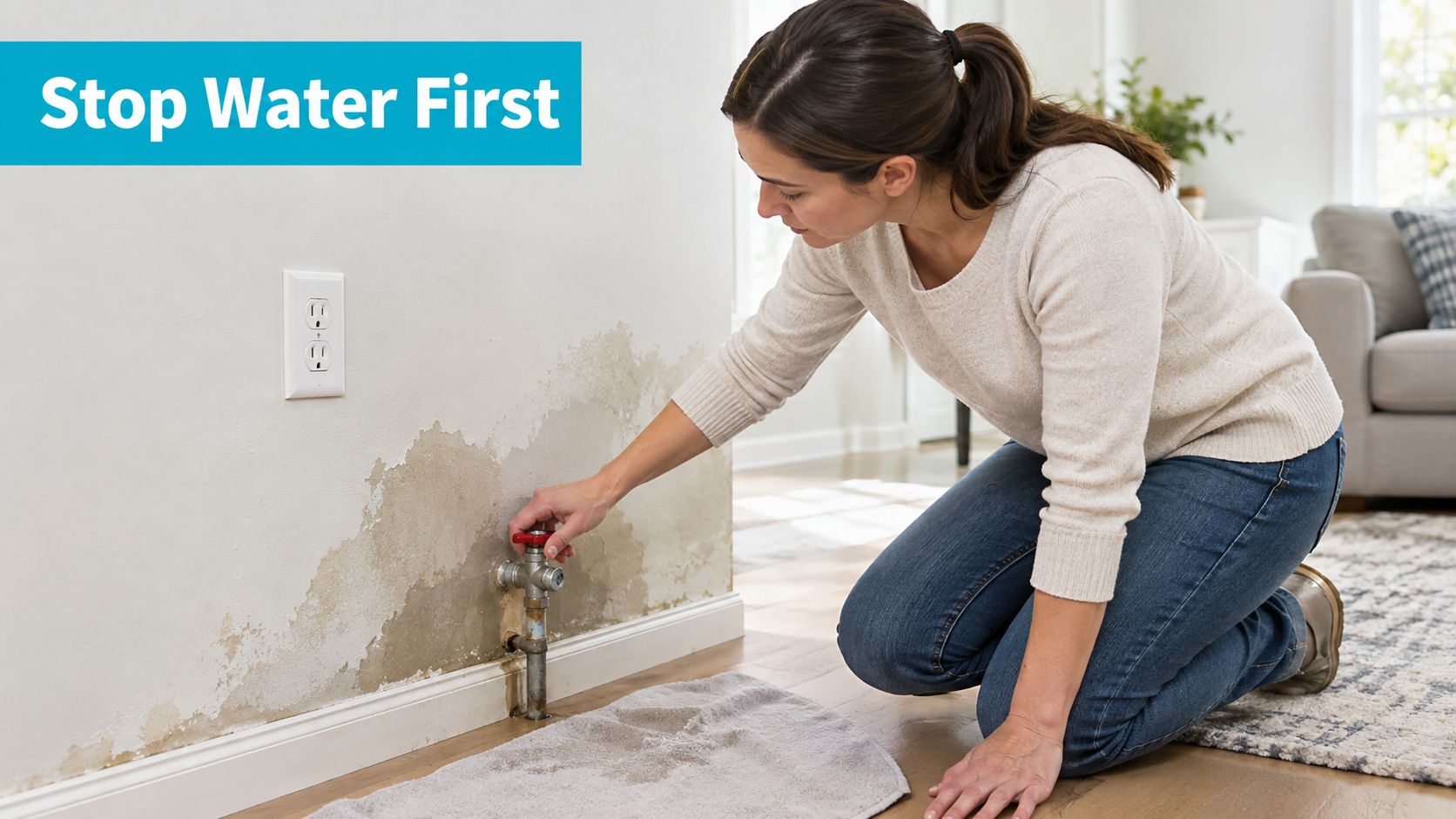
Water may still be entering the assembly even when the stain looks small. Shut off the local supply valve or the home’s main water supply if you can do so safely. For a ceiling leak, the source may be plumbing, roofing, or an upstairs fixture. Use this guide to stop water from ceiling leak while arranging qualified assistance.
Electricity changes the response. Do not walk through standing water near outlets, appliances, extension cords, or electrical panels. If you can reach the breaker without entering a wet area, turn off power to the affected zone. Keep clear of sagging ceilings and bulging walls, since saturated drywall can lose stability.
Document before the scene changes
Photograph the room from wide angles, then capture close views of stains, bubbling paint, damaged baseboards, wet flooring, and the suspected source. Record when you found the damage, what caused it if known, and which areas feel wet. Keep any moisture-meter readings with their room locations and the rest of the loss documentation.
Move furniture, boxes, rugs, and electronics away from the wet area only when you can do so without crossing unsafe water. Put protective material under movable items only if it will not trap moisture against the floor or wall. Do not discard damaged components before photographing them unless they create a health or safety hazard.
Start controlled drying
After the source and electrical risks are controlled, open interior doors to support circulation through unaffected spaces. Keep the air-conditioning system operating if it is safe and functioning. In Florida, exterior air can be humid after rain or a storm, so opening windows may add moisture instead of removing it. A drywall surface can feel dry while the paper layer, insulation, or wall cavity remains wet.
Avoid painting, caulking, wallpapering, or sealing the wall during evaluation. Coatings can hide the moisture path and restrict drying from the room side. Do not drill or cut into the wall without checking for wiring and plumbing, and do not direct air into a contaminated area without controlling where that air travels.
Practical rule: The first 24 to 48 hours often preserve the best salvage options. Stop the source, protect people, document the loss, and begin controlled drying promptly.
For a detailed response sequence, see AMPM Restoration’s resource on emergency water damage repair during the first 24 hours. Arrange an inspection when the leak is concealed, the wall is insulated, the ceiling is involved, or the water may not be clean. These conditions can leave hidden moisture behind even after the visible surface improves.
How Professionals Dry Drywall and When Replacement Is Safer
A wall may feel dry by evening while its insulation and cavity remain wet. Professional drying addresses that hidden gap, rather than relying on surface feel or one fan pointed at the damage. The technician identifies the wet materials, traces how far moisture traveled, considers the water category, and decides whether the assembly can be dried safely in place.
Measurement replaces guesswork
A restoration crew maps affected drywall with pin or pinless moisture meters and may use infrared imaging to locate temperature patterns linked to concealed dampness. Readings are compared with unaffected materials in the same home. That building-specific baseline is more useful than applying one universal number, especially in Florida homes where construction, air-conditioning, and humidity conditions vary.
The crew removes standing water, protects clean areas, and sets containment when demolition or contaminated materials make it necessary. Air movers direct airflow across wet surfaces, while commercial dehumidifiers remove moisture from the room air. Equipment must be arranged to support evaporation without carrying contamination into unaffected rooms.
Monitoring determines whether the plan works
Drying equipment should be checked and adjusted, not left running without verification. Technicians document psychrometric conditions and material readings at regular intervals until affected materials stabilize near the building’s baseline. Florida’s humid air can slow the final stage, so a falling surface reading does not prove that the cavity has dried.
Steady improvement may allow equipment repositioning and continued in-place drying. Stalled or rebounding readings can indicate wet insulation, framing, or an inaccessible cavity. Selective demolition may then expose the assembly and reduce the time moisture remains trapped. Cavity injection, controlled access openings, and flood cuts each suit different wall designs and water categories.

When removal protects the property
In-place drying is not automatically the least expensive or safest choice. Drying drywall in place is generally limited to clean Category 1 water when drying starts promptly, rather than applying that approach to every leak.
Per IICRC guidance, delaminated paper facing, soft or crumbling gypsum, a sagging wall, or material that stays persistently wet typically supports replacement. Damaged paper loses its bond, weakened gypsum may not regain its original integrity, and trapped moisture can continue affecting framing or insulation.
The structural drying methods used in water restoration explain why ordinary room airflow may not reach insulated cavities. Removing wet drywall can also provide access to compromised insulation and framing. If the water is contaminated, retaining porous wallboard may leave contamination inside the building.
AMPM Restoration Services is one local option for Suncoast property owners. Its services include extraction, drying, dehumidification, mold services, repairs, and reconstruction in Bradenton, Sarasota, Tampa Bay, Saint Petersburg, Lakewood Ranch, and surrounding Gulf Coast communities.
How to Tell If Drywall Is Truly Dry or Hiding Mold Risk
A wall can look dry while the cavity behind it remains wet. Paint may lose its dark appearance even though moisture is still held in the gypsum core, insulation, or framing. Florida’s indoor humidity can slow the final stage of drying, and moisture may move back toward the drywall after equipment is removed.
Moisture meters are useful screening tools, but one reading does not establish that the entire assembly is dry. Field guidance on drying wet drywall and replacement decisions uses approximately 12% to 16% as a practical drying target. Readings around 16% to 20% may support considering replacement, especially when the drywall remained wet beyond 48 hours. A technician should compare those readings with unaffected drywall and evaluate water category, material condition, and wall construction.
Watch for rebound instead of relying on one reading
A surface may read lower while air movers and dehumidifiers are operating because active drying is drawing moisture toward the face. Once the equipment is removed, moisture from the cavity can migrate back into the gypsum and raise the reading. That rebound indicates the wall may not have reached stable moisture conditions throughout its depth.
Warning signs include soft or spongy drywall, bubbling or peeling paint, swelling, discoloration, musty odor, and readings that stay high or increase after apparent improvement. Mold may begin developing within 24 to 48 hours when wet materials are not adequately dried, as explained in this mold growth timeline after water damage. A clean-looking face does not rule out concealed moisture or mold risk.
| Indicator | What It Means | Next Action |
|---|---|---|
| Firm surface and stable readings near unaffected drywall | The visible and measured material may have reached the building’s dry standard | Keep the documentation and complete a final inspection |
| Dry surface with elevated readings | Moisture may remain in the core or cavity | Continue monitoring and arrange professional moisture mapping |
| Readings rebound after equipment removal | Hidden moisture is migrating back into the wall | Restart controlled drying and investigate the cavity |
| Soft, crumbling, sagging, or delaminated drywall | The sheet may have lost structural integrity | Discuss selective removal and replacement |
| Musty odor or visible discoloration | Mold or trapped contamination may be present | Arrange mold inspection and source correction |
Touch, color, and odor provide useful clues, but none confirms structural dryness alone. A sound decision combines material condition, repeat readings, cavity evaluation, and proof that the leak source has been corrected. In humid Florida homes, verification after equipment removal matters because the cavity can stay wet for days after the surface appears normal.
Getting Help Documenting Damage and Restoring With Confidence
The answer to how long for drywall to dry after leak depends on what happened inside the wall, not only how the surface feels. A prompt clean-water loss may be dried in place. Hidden moisture, contaminated water, or weakened gypsum can make removal safer. Document the source, affected rooms, moisture readings, humidity control, and the condition of nearby unaffected materials.
AMPM Restoration is a 24/7 emergency restoration company at 4301 32nd St W b18, Bradenton, FL 34205, serving Bradenton, Sarasota, Tampa Bay, Saint Petersburg, Lakewood Ranch, and nearby Gulf Coast communities. Services include water damage restoration, mold inspection and removal, fire and smoke restoration, storm and flood cleanup, commercial restoration, and reconstruction.
For an insurance file, save photos, the leak timeline, invoices, moisture readings, equipment records, and repair details. AMPM provides water damage insurance claim tips and can coordinate with your carrier while the property is stabilized. The company offers a free inspection and estimate, insurance claim assistance, financing options, and professional drying for residential and commercial properties.
Florida humidity can keep a wall cavity wet after the face looks normal, so verification after equipment removal matters. If drywall is wet now, call 941-946-7807 to determine whether drying in place or replacement better protects the structure and indoor environment.
AMPM Restoration Services provides 24/7 water damage response, moisture assessment, structural drying, mold inspection, repairs, and reconstruction for Florida Suncoast properties. Visit AMPM Restoration Services or call 941-946-7807 for a free inspection and estimate, with insurance claim assistance and financing options available.