

Mold Remediation Clearance Testing: What to Expect
You’ve just finished mold cleanup in your Bradenton or Sarasota home. The walls look fresh, the equipment is gone, and you’re ready to put furniture back. Then one question stops you: does a clean-looking room mean the home is ready to occupy? Mold remediation clearance testing helps answer that question, but the strongest evaluation looks beyond a laboratory result. It checks whether visible contamination is gone, moisture is controlled, and the work area hasn’t spread contamination before containment comes down and reconstruction begins.

Florida’s humid Gulf Coast climate makes that sequence especially important. A hidden leak, damp wall cavity, wet insulation, or incompletely dried framing can support recurring growth even after visible mold has been removed. The U.S. Environmental Protection Agency explains that, in most cases, visible mold growth makes sampling unnecessary, and it also states that there are no EPA or other federal limits, standards, or regulations for airborne mold contaminants or mold spores. You can review the agency’s explanation of mold testing and sampling for the federal context.
That doesn’t make testing useless. It means clearance is a professional, evidence-based decision rather than a universal federal certification. A qualified team evaluates the specific project, confirms conditions, and documents whether the area is ready for the next stage.
AMPM Restoration serves Bradenton, Sarasota, Lakewood Ranch, Saint Petersburg, Tampa Bay, and surrounding Gulf Coast communities with mold inspection, removal, water damage restoration, and reconstruction coordination. If a wet rug or floor covering contributed to the problem, a practical wet rug mold prevention plan can also help reduce the chance of moisture being trapped again. For information about the local remediation and testing process, see AMPM’s mold remediation and testing service.
Introduction to Mold Remediation Clearance Testing in Florida Homes
A Sarasota homeowner may hear that remediation is complete, enter the contained area, and see no visible mold. Relief is understandable. Before plastic barriers come down and drywall, flooring, or trim is rebuilt, the area still needs verification that it is clean, dry, and unlikely to support renewed growth.
Mold remediation clearance testing provides that verification after cleanup. It is not a laboratory charge. Depending on the project, an assessor may combine visual inspection, moisture readings, odor observations, air sampling, and surface sampling. The findings must match the original scope of work and the condition of the building.
Why Florida conditions deserve careful verification
In Bradenton, Palmetto, and the greater Tampa Bay area, moisture can come from plumbing leaks, roof damage, storm water, air-conditioning condensation, windows, or high indoor humidity. Water may remain behind cabinets, beneath flooring, or inside wall assemblies, leaving a room looking finished while materials stay damp.
Florida’s humidity makes moisture verification especially important after cleanup. Before reconstruction closes the area, the assessor should confirm that the water source was corrected and affected materials dried. A passed air sample cannot prove that a roof leak, plumbing failure, or hidden damp cavity has been resolved.
Practical rule: A laboratory result can support clearance, but it cannot replace inspection of the space and confirmation that moisture conditions are resolved.
AMPM Restoration coordinates remediation, water damage restoration, and reconstruction services in Bradenton, Sarasota, Lakewood Ranch, Saint Petersburg, Tampa Bay, and surrounding Gulf Coast communities. Its mold remediation and testing service can coordinate third-party verification before reconstruction, so the work is reviewed while affected areas remain accessible.
If a wet rug or floor covering contributed to the problem, a wet rug mold prevention plan can help reduce the chance of moisture becoming trapped again. Clearance is strongest when laboratory findings, visible conditions, and moisture status agree.
What Mold Remediation Clearance Testing Really Means
A room can look finished and still fail clearance. Post-remediation verification checks whether the agreed work was completed, the area is clean, and moisture conditions support safe reconstruction. A laboratory result is one piece of that review, not a substitute for checking the building itself.
Post-remediation verification, often called clearance testing, generally combines:
- Visual inspection, looking for remaining mold, dust, debris, staining, or incomplete cleaning.
- Moisture confirmation, using suitable tools to evaluate affected building materials.
- Comparison sampling, when sampling is warranted, often with indoor and outdoor control samples.
- Professional assessment, weighing the observations together instead of treating one result as a universal safety certificate.

Why there isn’t one federal pass or fail number
A mold report cannot be judged by one federal score that applies identically to every home, office, condominium, or school. Assessors instead consider the remediation scope, site conditions, visible findings, moisture information, and comparison-based sampling procedures.
ANSI/IICRC S520-based guidance commonly places post-remediation verification after remediation and before containment is removed. The purpose is to confirm that the work area is clean and dry, mold-impacted materials were properly remediated, and contamination did not spread, as described in this ANSI/IICRC clearance checklist.
That sequence explains why moisture and condition verification come first. If a hidden leak or damp material remains, a favorable air result can still coexist with an unfinished remediation. In Florida’s humid conditions, closing walls or reinstalling flooring before those conditions are resolved can conceal the problem again.
AMPM Restoration coordinates remediation, water damage restoration, and reconstruction services in Bradenton, Sarasota, Lakewood Ranch, Saint Petersburg, Tampa Bay, and surrounding Gulf Coast communities. Its mold remediation and testing service can coordinate third-party verification before reconstruction, while affected areas remain accessible.
Initial testing versus clearance
Initial testing helps characterize conditions before work begins. It may identify affected areas, moisture patterns, or airborne and surface conditions that inform the remediation plan. Clearance testing occurs after the defined work is finished and evaluates completion.
Mold spores occur indoors and outdoors, so the goal is not to prove that a building contains absolutely none. The goal is to determine whether the remediated area meets the agreed project criteria and is ready for reconstruction or reoccupancy.
Clearance Testing Methods Explained From Air to Surface Sampling
A proposal may list several sampling methods, and each one answers a different question. Air samples can help compare airborne conditions inside and outside. Surface samples can investigate a particular material or location. Dust-based tools may provide broader information about settled particles, but they shouldn’t be treated as interchangeable with a clearance inspection.
Industry guidance commonly divides remediation work by contaminated area size, using the categories less than 10 square feet, 10 to 100 square feet, and greater than 100 square feet, as summarized in this remediation and clearance testing framework. The project size and location influence which evaluation methods are appropriate.
Clearance Testing Methods at a Glance
| Method | What It Measures | Best Used When | Limitation |
|---|---|---|---|
| Spore trap air sampling | Airborne fungal particles collected for laboratory analysis | Indoor conditions need comparison with outdoor controls | It’s a snapshot and can’t prove that hidden moisture is absent |
| Outdoor control sample | Background airborne conditions outside the building | Indoor results need environmental context | Outdoor conditions can vary with weather and local surroundings |
| Tape lift | Material collected from a surface for microscopic identification | A visible or suspect area needs closer evaluation | It samples the selected spot, not the entire room |
| Swab sampling | Material transferred from a targeted surface | The surface is irregular, damp, or difficult to sample with tape | Results depend on the sampled location and collection technique |
| ERMI dust analysis | DNA-based information from settled dust | A broader dust history or exposure question is being considered | It doesn’t replace visual inspection, moisture assessment, or project clearance criteria |
How assessors choose among methods
Spore trap sampling is often useful when the question involves airborne conditions in a contained work area. An outdoor control can provide context, but the comparison still needs to account for the building, weather, ventilation, and sampling conditions.
Tape lifts and swabs are more targeted. If a dark mark remains on a beam or a questionable residue appears inside a cavity, a surface method may help determine what is present at that location. A negative sample from one spot doesn't certify every concealed area.
ERMI analysis is different because it evaluates settled dust rather than a short air sample. It may have a role in a broader investigation, but it shouldn't be used alone to declare a project complete. For a plain-language overview of indoor air evaluations, see AMPM's air quality testing for mold information.
How Pre and Post Remediation Testing Work Step by Step
A well-managed project follows a sequence. Testing before cleanup establishes context, containment limits disturbance, remediation addresses the defined source and materials, and verification occurs while the work area is still accessible.
The pre-remediation phase
The first visit should identify visible conditions, moisture sources, affected materials, and areas that may require containment. An assessor or restoration professional may use a moisture meter, infrared imaging as appropriate, visual inspection, and targeted sampling when the project calls for it.
Baseline samples can help document conditions before work begins. They're most useful when the collection method, locations, environmental conditions, and laboratory analysis are clearly recorded. A baseline report also gives the project team a reference for later comparison.
Containment and remediation
Containment separates the work area from occupied portions of the building. The remediation team then removes, cleans, or treats affected materials according to the project scope. The team should also address the water source, whether that involves extraction, leak repair coordination, drying, HVAC-related moisture control, or reconstruction planning.
The timing of clearance matters. Verification generally occurs after the remediation work is finished but before containment is removed and before new finishes conceal the work. Homeowners coordinating several trades can use this mold remediation timeline to understand why drying and documentation should happen before reconstruction.
The post-remediation sequence
A qualified evaluator checks the area in a logical order:
- Visual condition: The evaluator looks for remaining mold, dust, debris, staining, and incomplete cleaning.
- Moisture condition: A calibrated moisture meter checks relevant materials and structural components.
- Odor condition: A persistent musty odor can signal remaining contamination or unresolved dampness.
- Work completion: The findings are compared with the defined remediation scope.
- Sampling: Air or surface samples are collected when they're appropriate for the project.
- Documentation: Photos, readings, sample locations, laboratory results, and corrective actions are recorded for the owner, insurer, and reconstruction team.
One cited clearance benchmark uses wood moisture content at or below 16%, measured with a calibrated moisture meter on structural timber. The same guidance pairs that measurement with no visible mold and no musty odor, reinforcing that clearance depends on both inspection and measurement, not a laboratory number alone. See the wood moisture and clearance guidance for that benchmark.
How to Read Lab Reports and Understand Pass Fail Criteria
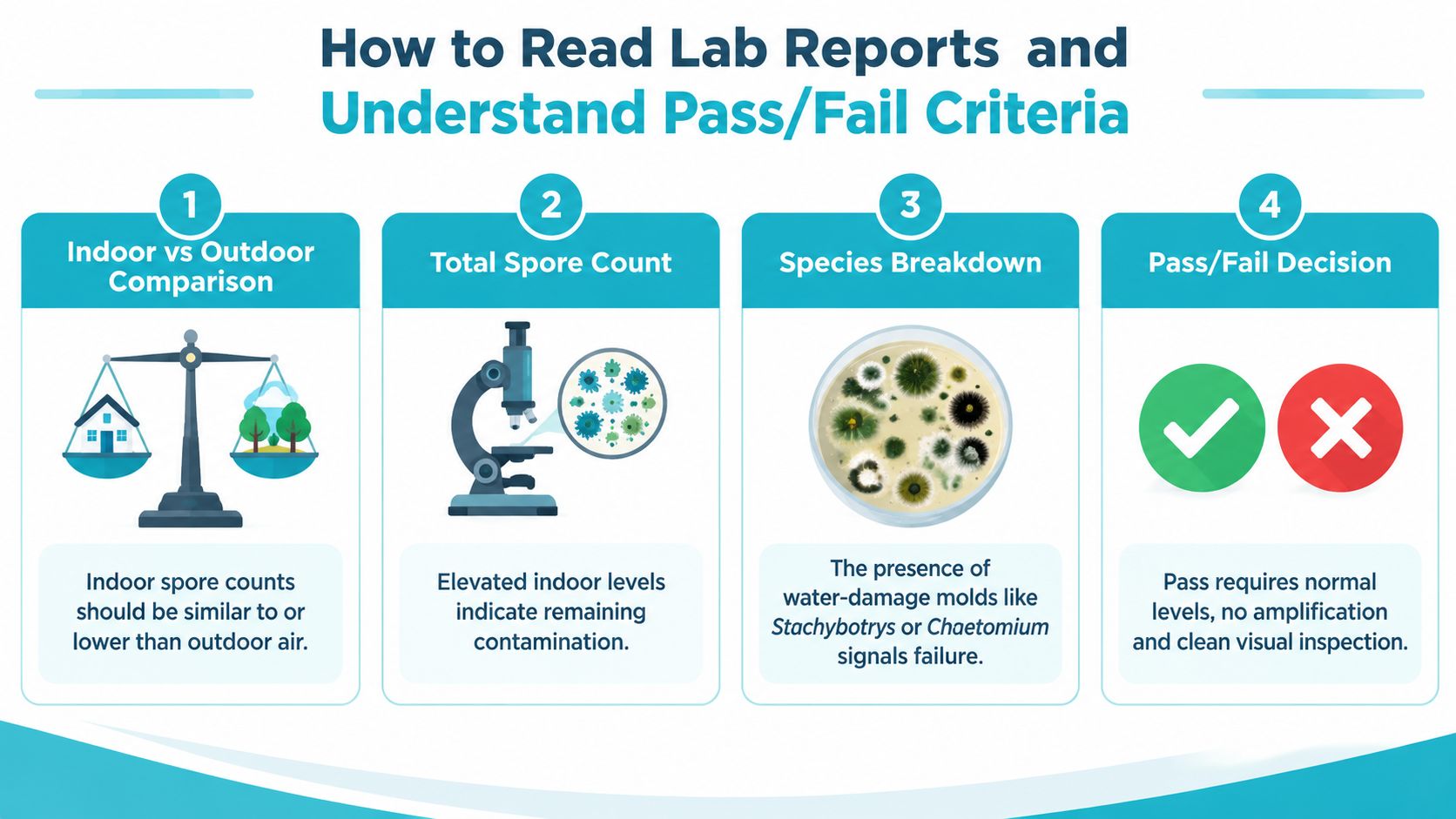
A mold laboratory report combines genus names, particle counts, sample locations, and comparison data, but the numbers alone do not tell the full story. Read the sample location first, then confirm whether it came from indoors or outdoors, which laboratory method was used, and whether it represents the contained work area. Compare the report with moisture and physical conditions. A passed air test cannot make a wet wall safe for reconstruction.
Start with indoor and outdoor context
Outdoor control samples show the fungal background present when samples were collected. Indoor results can be reviewed against that background, although weather, ventilation, nearby vegetation, construction activity, and other conditions can change the snapshot. A higher indoor result may call for further investigation. A lower result still does not replace inspection of concealed materials or confirmation that the water source has been corrected.
Review the total fungal particle count together with the groups identified. The total provides context, while the types and distribution can indicate whether cleaning was incomplete or dust moved beyond the work area.
Benchmark numbers are not health standards
One independent criteria set reports these clearance benchmarks:
- Total fungal particles under 2,000 particles/m3
- Cladosporium-like spores under 666
- Aspergillus/Penicillium-like spores under 666
- Mixed other genera under 666, with no single component over 33% of that group
- Stachybotrys/Memnoniella-like spores under 22
These figures belong to a specific technical criteria set. They are not a federal regulation or universal health standard. Use the published mold clearance criteria as benchmarking guidance within that evaluation framework, not as a stand-alone health determination.
What a higher-than-expected result can indicate
A group outside the expected range may point to incomplete cleaning, a hidden reservoir, disturbed dust, or cross-contamination beyond containment. The result cannot identify the cause by itself. The evaluator compares it with visual conditions, moisture findings, sample locations, containment conditions, and the original remediation scope.
A practical report review asks:
- Sample location: Was the sample inside the remediated area, outdoors, or in an adjacent space?
- Collection conditions: Are the location and collection conditions documented clearly?
- Species pattern: Do the identified groups fit the building history and suspected moisture source?
- Physical findings: Were visible mold, dust, odor, and moisture reviewed alongside the laboratory result?
- Next action: Does the report state whether more cleaning, drying, or retesting is needed?
AMPM Restoration can explain report terminology and arrange a free inspection. Its team can also coordinate third-party verification before reconstruction, helping confirm that the moisture problem and physical conditions are addressed before new materials cover the work. For related documentation guidance, review AMPM's mold remediation report resource.
Choosing a Third Party Tester Versus Contractor Testing in Florida
Many Florida property owners ask whether the company that performs remediation should also perform the final test. The answer depends on the project, the insurer, the property transaction, and the level of independence the parties require.
An independent third-party assessor offers separation between the company performing corrective work and the professional evaluating the finished area. That separation can be especially valuable for a large loss, a disputed claim, a real estate transaction, or a home with occupants who are unusually sensitive to environmental conditions.
A qualified remediation contractor may also coordinate clearance efficiently, especially when the project scope is straightforward and the owner understands who collects samples, who analyzes them, and who makes the clearance decision. AMPM Restoration is qualified to perform remediation work and the final test, while also coordinating third-party verification before reconstruction when the project calls for that arrangement.
Decision factors for Florida property owners
| Situation | Practical priority | Why it matters |
|---|---|---|
| Small, clearly defined residential area | Clear scope and documented inspection | The owner needs to know what was cleaned and what conditions were verified |
| Large or complex contamination | Independent verification | Multiple areas and trades create more opportunities for missed moisture or cross-contamination |
| Insurance claim | Insurer and policy requirements | The carrier may request specific documentation or an independent report |
| Property sale or purchase | Neutral documentation | Buyers and sellers may prefer a report from a separate evaluator |
| Sensitive occupants | Thorough protocol and communication | The decision should account for physical conditions, moisture, and documented findings |
| Inconclusive report | Retesting plan | A single snapshot may not resolve uncertainty |
There's no universal numeric threshold that applies to every building. Clearance decisions rely on visual inspection, moisture readings, and laboratory analysis when used, so an inconclusive result should lead to questions rather than panic. Ask whether the issue was sampling variability, outdoor background conditions, unresolved moisture, visible residue, or incomplete documentation. The Florida mold inspection company guide can help you evaluate qualifications and reporting practices.
A professional clearance decision should tell you what was inspected, what was measured, what was sampled, and what still needs attention.
Costs Timelines Common Mistakes and Your Next Steps With AMPM Restoration
Clearance testing costs and timing vary with the size of the affected area, the number of locations, the selected methods, laboratory analysis, project documentation, and whether corrective work is needed. A small contained area may be simpler to evaluate than a multi-room loss involving flooring, drywall, HVAC concerns, or concealed cavities.
Results can also take longer when samples need laboratory analysis or when the first inspection identifies damp materials, residual dust, odor, or possible cross-contamination. The most common mistake is treating clearance as the final lab number instead of confirming the source of water and the condition of the building.
A passed air test can still be misleading if the property remains vulnerable to re-wetting. Clearance usually occurs before containment is removed and reconstruction begins, so unresolved moisture, hidden cavities, or incomplete drying can create recurring growth after a clean report, as explained in this discussion of mold clearance and moisture control.
AMPM Restoration is a 24/7 emergency restoration company based at 4301 32nd St W b18, Bradenton, FL 34205, serving Bradenton, Sarasota, Tampa Bay, Saint Petersburg, Lakewood Ranch, and nearby Gulf Coast communities. The team handles water damage restoration, mold inspection and removal, fire and smoke damage, storm and flood cleanup, commercial restoration, reconstruction coordination, insurance claim assistance, and financing options.
If you have a mold report, call 941-946-7807 for a free inspection and estimate, and AMPM can explain the report, assess moisture conditions, and help coordinate qualified final verification before reconstruction.
Call AMPM Restoration Services at 941-946-7807 for a free inspection and estimate focused on moisture control, mold remediation clearance testing, and the condition of your property before reconstruction. Visit AMPM Restoration Services to learn about insurance claim assistance, financing options, and 24/7 restoration support across Bradenton, Sarasota, Saint Petersburg, Tampa Bay, and surrounding Gulf Coast communities.
Frequently Asked Questions
What is mold remediation clearance testing?
Mold remediation clearance testing is a post-remediation verification process that checks whether the defined work area is clean, dry, and free from conditions indicating remaining contamination or cross-contamination. It may include visual inspection, moisture readings, air sampling, surface sampling, and professional interpretation.
Does a passed air test prove that mold is gone?
No. An air test is only one part of the evaluation. A passed result can still be misleading if a leak remains active, materials are damp, hidden cavities weren't addressed, or re-wetting occurs after testing.
Is there a federal safe mold spore limit?
No. The U.S. EPA states that there are no EPA or other federal limits, standards, or regulations for airborne mold contaminants or mold spores. Clearance therefore depends on project criteria, professional judgment, visual findings, moisture confirmation, and comparison-based sampling when appropriate.
What happens if clearance testing is inconclusive?
The evaluator should review the sampling conditions, indoor and outdoor comparisons, moisture readings, visual observations, and project scope. Additional drying, cleaning, investigation, or retesting may be appropriate rather than assuming that one unclear result proves either success or failure.
Should a third party perform the final mold test?
Independent verification may be strongly preferred for large contamination, real estate transactions, disputed insurance claims, or sensitive occupants. Contractor-coordinated testing can also be appropriate when roles, methods, laboratory analysis, and decision criteria are clearly documented.
Can AMPM explain an existing mold report?
Yes. If you have a mold report, call AMPM Restoration at 941-946-7807. The team can explain the report, provide a free inspection and estimate, evaluate moisture conditions, and discuss remediation and final testing options before reconstruction.