


You notice it first in the hallway, then again when the air conditioner starts. The house smells damp, faintly smoky, and stale, even after you clean the floors and wash the curtains. In Florida, those odors often point to one connected contamination problem, not three unrelated housekeeping issues. Moisture can support mold, while smoke particles settle into the same porous materials and keep odors trapped.
Professional decontamination services address that chain in the right order. The work may involve mold inspection, source removal, cleaning, disinfection, deodorization, drying, and documentation for your insurance claim. For homeowners across Bradenton, Sarasota, Tampa Bay, Saint Petersburg, Lakewood Ranch, and the surrounding Gulf Coast, choosing the right local crew matters because humidity keeps adding pressure after the original event.
When a Musty Smell Means More Than a Stuffy Room
A Bradenton homeowner might remember the problem as a small leak under the kitchen sink. The cabinet dried on the surface, the plumbing was repaired, and life went back to normal. Months later, a musty odor still hangs around the kitchen, smoke from a neighbor’s yard fire drifts indoors, and the air conditioner pulls that smell through the rest of the house.
Then a child’s asthma starts flaring up more often. The family may treat each symptom separately, washing fabrics, buying an air freshener, and running the AC longer. That approach misses the connection. Moisture may have affected the cabinet backing, drywall, insulation, or flooring, while smoke particles settled into fabrics and porous surfaces that weren’t visibly dirty.
Florida’s heat and humidity make this combination especially stubborn. A damp material can keep supporting mold-related odors, and smoke residue can remain embedded after surface wiping removes only what’s easiest to reach. Spraying fragrance over the room doesn’t solve either source. It only makes the inspection harder by covering the warning signs.
A homeowner searching for decontamination services usually wants a fast answer to a simple question: can this house be made safe and comfortable again without tearing everything apart? The answer depends on finding the source, identifying affected materials, controlling the work area, and matching the cleaning method to the contamination.
The practical rule: If a musty or smoky odor returns after cleaning, stop treating the smell as the problem. Treat it as evidence.
Use this guide to five signs of mold damage in homes to compare what you’re seeing with common warning signs. A qualified inspection should then determine whether the job requires targeted cleaning, material removal, structural drying, odor treatment, or a combination.
What Decontamination Services Actually Cover
Routine cleaning removes ordinary dirt from surfaces. Deep cleaning reaches neglected areas, such as behind appliances, inside cabinets, or within upholstery. Decontamination services go further by reducing or removing a health-related contaminant through a controlled process that identifies the source, limits spread, treats affected materials, and verifies the result.
That distinction matters because a homeowner can clean a visible stain without addressing contamination below it. A disinfectant may also fail if dirt blocks the chemistry or if the treated surface dries before the label-specified contact time.

The problems homeowners usually face
Mold and mildew commonly follow leaks, roof damage, plumbing failures, condensation, and flooding. The work starts with moisture control and affected-material assessment. If porous materials hold contamination, wiping alone may not be enough.
Smoke and odor contamination includes visible soot, invisible residue, and odor compounds that settle into drywall, flooring, insulation, cabinetry, furniture, clothing, and HVAC-related areas. Deodorization is not a cosmetic add-on. It must follow source removal and detailed cleaning, or the smell often returns.
Biohazard and infectious contamination requires controlled handling, appropriate personal protective equipment, containment, and an EPA-registered disinfectant selected for the target organism and surface. Blood and body-fluid cleanup shouldn’t be handled like ordinary household cleaning.
Sewage and chemical contamination require special judgment because the contaminant may carry pathogens, corrosive compounds, or hazardous residues. Some materials can be cleaned safely, while others need removal and disposal.
The difference between a restoration contractor and a casual cleaning service is the ability to manage the whole sequence, from inspection through repairs. AMPM’s overview of what a restoration company does explains why restoration work often includes mitigation, drying, sanitization, and reconstruction rather than one isolated cleaning visit.
The market reflects that professional shift. The global home decontamination services market was estimated at USD 4,979.4 million in 2024 and is projected to reach USD 8,561.3 million by 2030, with a projected 9.5% CAGR from 2025 to 2030, according to Grand View Research’s home decontamination services market report. That growth supports a straightforward conclusion: decontamination is now a defined service category, not merely an improvised emergency response.
Inside the Decontamination Process Step by Step
A proper job follows a sequence because every stage protects the next one. The crew shouldn’t start by fogging the room or spraying deodorizer. They should first determine what happened, where contamination traveled, and which materials can be restored.
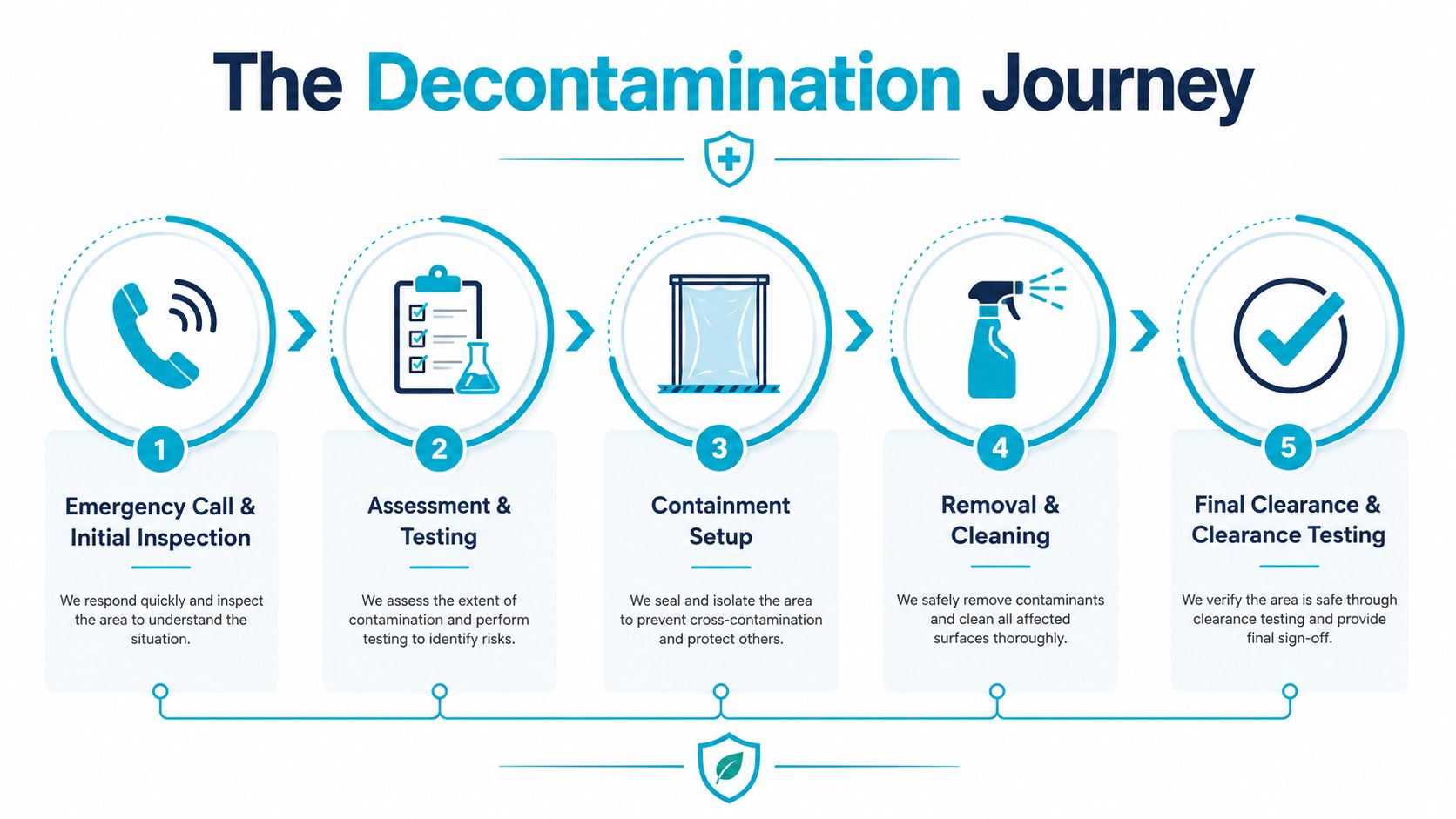
1. Emergency contact and inspection
The first call establishes the event, affected rooms, visible damage, odors, health concerns, and any continuing water source. During inspection, technicians may use moisture meters and infrared tools to locate damp areas that aren’t obvious to the eye.
They should document conditions with photographs, readings, and a written scope. This record helps the homeowner understand the work and gives an insurance adjuster something more useful than a vague description of “bad smell.”
2. Assessment and containment
The crew identifies affected materials, air movement, and possible cross-contamination paths. Containment may include plastic barriers, controlled entry, negative air equipment, and protection for unaffected areas.
Containment isn’t theatrics. It keeps dust, spores, soot, and contaminated debris from moving into clean rooms through foot traffic or the HVAC system.
3. Removal, cleaning, and disinfection
Porous materials that cannot be reliably cleaned may need removal. Depending on the situation, that can include sections of drywall, insulation, carpet pad, upholstered contents, or heavily affected cabinetry.
Hard surfaces receive detailed cleaning before disinfection. The EPA explains that a treated surface must remain visibly wet for the full label-specified period, and if it dries early, the disinfectant may need to be reapplied through its selected EPA-registered disinfectants guidance. Many EPA-registered hospital disinfectants list contact times of 10 minutes, while CDC guidance notes that studies support efficacy for many products at contact times of at least 1 minute. The product label, surface, spray volume, and target organism control the decision.
4. Drying and deodorization
Structural drying uses commercial air movers and dehumidifiers to remove remaining moisture. Odor treatment may involve hydroxyl equipment or ozone equipment, but those tools don’t replace cleaning or source removal. Ozone also requires careful controls because occupants and pets shouldn’t remain in a treatment area unless the equipment and procedure specifically permit it.
Technicians may use HEPA filtration to capture airborne particles and antimicrobial products when the material and contamination call for them.
5. Verification and restoration
The final stage checks whether affected materials are dry, cleaned, and ready for repair or reoccupancy. Depending on the project, verification can include visual review, moisture readings, and third-party air or surface testing.
A detailed mold remediation and testing service should explain what testing can and cannot prove. Skipping inspection, containment, contact time, or drying is how homeowners end up paying for the same odor twice.
Why Mold, Smoke, and Musty Odors Travel Together
Moisture creates the opening. Mold growth can develop in damp building materials, while smoke residue settles into nearby porous surfaces. Once the air conditioner circulates air through the affected area, odors can spread beyond the original room.
The EPA explains that molds can produce volatile compounds known as microbial volatile organic compounds, or mVOCs. Those compounds can release quickly into the air and create the familiar musty odor associated with active mold growth. The same EPA material links inhalation of mVOCs with symptoms such as headaches, nasal irritation, dizziness, fatigue, and nausea, so a musty smell deserves investigation rather than perfume.
Humidity control remains central after cleanup. The CDC advises keeping home humidity at no higher than 50% all day long, as described in its mold control guidance. The EPA also states that there are no federal limits for mold or mold spores. That means an air test isn’t a substitute for finding moisture, inspecting materials, and evaluating visible conditions and persistent odors.
What the odor can tell you
| Contamination Source | Smell or Sign | Typical Location |
|---|---|---|
| Hidden moisture and mold | Musty, earthy odor | Under sinks, behind walls, near HVAC areas |
| Smoke residue | Acrid, stale, burnt odor | Fabrics, curtains, cabinets, drywall |
| Sewage contamination | Strong foul odor with visible soiling | Bathrooms, floors, lower walls |
| Damp building materials | Stale, humid smell | Crawl spaces, closets, carpet padding |
Smoke behaves differently from mold, but the cleanup problem overlaps. Smoke particles can cling to and penetrate fabrics, furniture, contents, and structural surfaces, as outlined in the EPA’s brief guide to mold, moisture, and your home. Surface wiping may remove residue from a table while leaving odor inside upholstery, insulation, or wall materials. That’s why source removal, detailed cleaning, and selective replacement often matter more than a single deodorizing treatment.
For another practical perspective on handling musty odors in buildings, look for guidance that treats odor as a building-condition clue instead of a fragrance problem. The same principle applies in a Florida home.
Certifications, Equipment, and Safety Standards That Matter
A qualified crew should be able to explain its training, products, safety procedures, and documentation without dodging the question. You don’t need to memorize every certification, but you should know what to ask before workers enter your home.

Credentials and job controls
IICRC certification indicates training in recognized restoration practices. Ask which technician is supervising the project and whether the credentials match the work, especially for mold, odor, water, and fire restoration.
EPA-registered disinfectants matter because product labels define approved uses, target organisms, dilution, application method, and contact time. “Hospital grade” is not enough by itself. The crew should tell you the product name and show how the label applies to your surfaces.
OSHA bloodborne pathogen protocols are essential for blood and body-fluid cleanup. The team should use appropriate PPE, containment, waste handling, and worker-protection procedures rather than treating the event as ordinary housekeeping.
HEPA filtration and negative air machines help manage airborne particles during removal and cleaning. Commercial dehumidifiers, air movers, moisture meters, infrared cameras, hydroxyl generators, and carefully controlled ozone equipment each serve a different purpose. A truck full of machines doesn’t prove competence, but a crew without the right tools usually can’t control the full process.
Chemistry has to match the contamination
CDC guidance recommends an EPA-registered hospital disinfectant with a non-enveloped-virus label claim for environmental surfaces in relevant healthcare-style cleaning. For blood or body-fluid spills, CDC guidance calls for chlorine-based decontamination at a 1:100 dilution for ordinary nonporous surfaces and a 1:10 dilution for large spills or laboratory culture spills, as detailed in its disinfection and sterilization recommendations.
Those are not interchangeable recipes for a household. Organic material, surface porosity, spill size, and product instructions control the protocol.
Ask this before work begins: “What’s your contact time, and what’s your dilution protocol?”
For mold-related indoor concerns, ask whether the contractor can explain the limits of air quality testing for mold and how results will affect the scope. Testing should answer a practical question, not become a substitute for correcting moisture.
Costs, Insurance, and Financing for Florida Homeowners
There is no honest universal price for decontamination services. A localized mold problem after a contained plumbing leak is a different project from smoke and odor treatment throughout a fire-damaged home. The cost depends on affected square footage, material removal, access, drying time, cleaning complexity, contents, testing, repairs, and whether the contamination has spread through the HVAC system.
A low bid often looks attractive because it leaves out the difficult parts. It may cover visible wiping but exclude demolition, containment, drying, contents cleaning, deodorization, or reconstruction. That is how a homeowner gets a clean-looking room with a returning odor.

What insurance documentation should show
Coverage depends on the policy, cause of loss, exclusions, deductibles, endorsements, and the facts of the event. Your contractor should document the source, affected materials, moisture readings, photographs, emergency actions, contents, proposed work, and communications with the carrier.
Insurance claim assistance can make the process easier, but it doesn’t guarantee coverage. An adjuster still needs a defensible connection between the event and the requested work. Keep invoices, receipts, photographs, reports, and any plumber or fire-service documentation. For restoration work, the same basic lesson applies: clear documentation helps every party understand what happened and what must be done.
Review what homeowners should know about insurance restoration services before signing a scope. Ask what the estimate includes, what remains your responsibility, and whether the contractor will communicate directly with your carrier.
Financing can help when a loss is partly covered, the deductible strains the household budget, or necessary work exceeds the approved amount. Compare terms carefully, and don’t postpone moisture control while waiting for a claim decision.
How to Choose the Right Local Decontamination Contractor
Start with the address. A local provider serving Bradenton, Sarasota, Palmetto, Lakewood Ranch, Saint Petersburg, and Tampa Bay can respond faster and understands the humidity, storm exposure, older construction, and coastal air conditions that affect drying and odor control.
Use this buyer checklist
- Verify the business: Confirm the local address, Florida licensing information where applicable, insurance coverage, and written contact details.
- Check credentials: Ask for IICRC qualifications and the experience of the person supervising mold, smoke, or biohazard work.
- Demand readings: A serious inspection should include moisture readings and a clear explanation of affected areas, not just a phone quote.
- Review containment: The proposal should state how the crew will isolate the work zone and protect unaffected rooms.
- Get the scope in writing: It should identify removal, cleaning, disinfection, drying, deodorization, testing, repairs, and exclusions.
- Ask about claims: Choose a contractor that can provide organized reports and communicate with your insurance carrier.
Be cautious with anyone who says deodorization means “spraying something nice.” Also question contractors who offer a firm price without seeing the property, skip moisture measurements, avoid discussing contact time, or promise that one machine will solve every odor.
Get Fast Local Help and What to Expect Next
Return to that Bradenton kitchen. The leak, musty cabinet, smoke odor, and recurring respiratory concern shouldn’t be handled as unrelated annoyances. A professional inspection can determine which materials are affected, whether moisture remains, how far odors traveled, and whether targeted decontamination is enough or a broader cleanup is justified.
Florida humidity rewards speed. The longer damp materials and trapped residues remain, the more likely the job becomes complicated by additional cleaning, removal, or repair needs.
AMPM Restoration is a 24/7 emergency restoration company based at 4301 32nd St W b18, Bradenton, FL 34205. Its local team provides a one-hour response, mold inspection and removal, smoke and fire damage restoration, water damage restoration, storm and flood cleanup, commercial restoration, sanitization, and reconstruction for Bradenton, Sarasota, Tampa Bay, Saint Petersburg, Lakewood Ranch, and nearby Gulf Coast communities.
Call 941-946-7807 for a free inspection and estimate. AMPM also offers insurance claim assistance and financing options, so you can discuss the contamination, the documentation, and the practical path forward in one conversation.
Call AMPM Restoration Services at 941-946-7807 for 24/7 help with mold, smoke residue, musty odors, water damage, and related reconstruction across Florida’s Gulf Coast. Visit AMPM Restoration Services to request your free inspection and estimate, ask about insurance claim assistance, and review available financing options.