

Mold Remediation Cost Florida Explained
A slow shower leak leaves a tea-colored stain on the ceiling. Two contractors send bids that do not agree, and the first number you need to assess is not just the cleanup price. Published consumer cost benchmarks put mold remediation at about $10 to $25 per affected square foot, with many ordinary projects clustering around $2,500 to $3,900 and a reported range of $1,500 to $9,500 (mold remediation cost benchmarks). These are general benchmarks, not Florida-specific prices. The affected area means the moldy section, not the house’s total square footage.
For a Bradenton homeowner, the true cost is the contractor’s quote plus whatever insurance will not pay. A low bid may leave out testing, containment, or clearance, while a policy’s mold coverage limit may be below the job total. Compare each bid line with the coverage that applies before drywall is removed.
What Mold Remediation Costs in Florida, by Scope
A bid for a small patch can look simple until the contractor separates removal, containment, testing, and repairs. Mold remediation cost benchmarks put professional work at $10 to $25 per affected square foot, with many ordinary projects around $2,500 to $3,900 and a reported range of $1,500 to $9,500. The square-foot rate is a starting point, not a promise of the final invoice.
The 2025 restoration cost notes include national cost figures, but do not establish those figures as Angi estimates.
The rate applies to the contaminated area, not the home’s total floor space. At the cited unit rates, a 100-square-foot affected zone works out to about $1,000 to $2,500 before unusual access, demolition, drying, reconstruction, or testing. A 300-square-foot zone works out to about $3,000 to $7,500 on the same basis. Don’t multiply the whole house.
The EPA’s Mold Remediation in Schools and Commercial Buildings, Chapter 3: Mold Remediation, gives size thresholds as guidance for choosing a remediation approach, not as a price list or a health claim. Under 10 square feet, roughly a 3-by-3-foot patch, is a small cleanup. 10 to 100 square feet is an intermediate area, while over 100 square feet calls for more judgment, protective gear, and containment.
| Scope | Affected area | Containment | Typical cost range |
|---|---|---|---|
| Small patch | Under 10 sq ft (about 3 by 3 ft) | Basic, limited | Under $250 at unit rates, plus any service minimum |
| Intermediate | 10 to 100 sq ft | Single 6-mil poly layer | $100 to $2,500 |
| Large | 100 to 300 sq ft | Full containment with double poly | $1,000 to $7,500 |
| Extensive | Over 300 sq ft, or hidden growth in HVAC and cavities | Full containment plus demolition | Quoted after inspection; no single published range |
How to use the table on a bid
Measure the visible area, then ask whether the estimate includes suspected growth behind the finish. Apply the unit rate to the affected footprint. Keep testing, demolition, and reconstruction on separate lines so you can see whether the quote covers the full job or only removal.
A single per-square-foot number without an itemized scope is a starting point, not a contract.
Florida licenses mold remediators. Compare bids from Tampa Bay, Sarasota, Bradenton, and St. Petersburg against the same written scope, and check that the estimate spells out containment, testing, and clearance. The lowest removal price can leave costs outside the quote, or outside what the policy pays.
Why Two Mold Jobs of the Same Size Cost Different Amounts
Two mold patches can cover the same visible area and still produce very different bids. The difference is often what lies behind the finish, and which parts of the work the insurance policy will pay for.
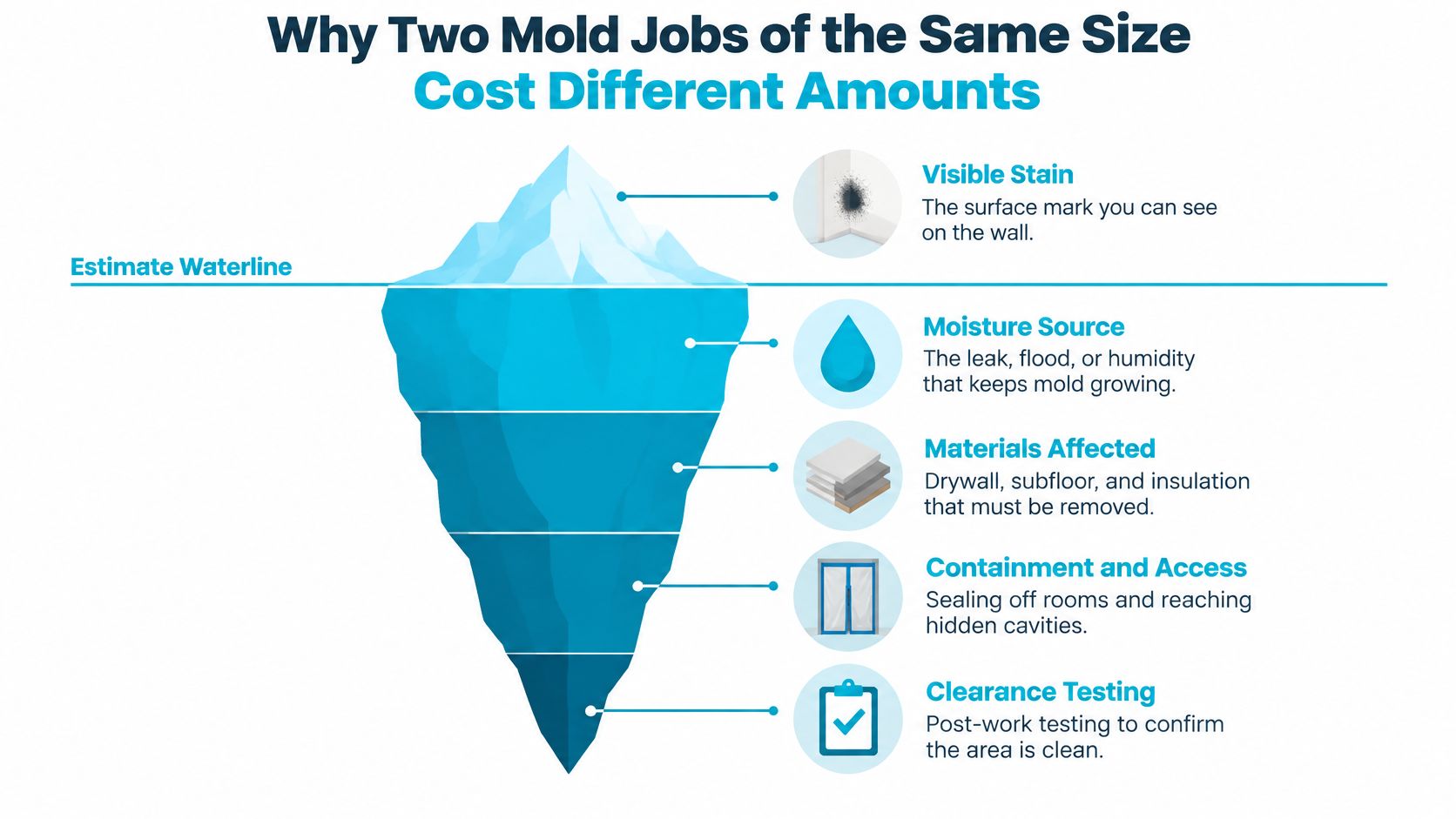
What actually moves the number
The EPA recommends limited containment for areas of about 10 to 100 square feet, using a single layer of 6-mil fire-retardant polyethylene. Areas over 100 square feet generally call for full containment with double polyethylene barriers (EPA containment guidance). Larger containment takes more labor and equipment for setup, negative air, teardown, cleaning, and verification. Whether those expenses are covered depends on the policy and its mold limit.
Porosity is a common cost driver. Drywall, carpet, insulation, and ceiling tile often need removal when mold has grown into them. Sealed tile, metal, and sealed wood can usually be cleaned. A ceiling with soaked, softened paper facing generally needs to be cut out, not wiped down.
Hidden growth can expand the work area. Wet insulation or framing often extends past the visible stain. Opening a wall or floor to check the cavity adds demolition, disposal, and repair costs, even when the surface patch looked small.
Containment follows the spread. A single poly barrier may isolate a closet. Larger or scattered contamination can require double barriers and negative air to limit dust from leaving the work area. The extra protection raises the bid but helps keep the work zone controlled.
HVAC is a separate scope. The EPA advises checking air ducts, air-handling units, and other areas where mold may be hidden. Duct cleaning, filter changes, or replacing a damaged component may not be included in a wall-only estimate.
A live leak adds another expense. The moisture source needs repair, and drying alone does not address existing mold. Confirm whether plumbing or roof repairs are part of the contractor's scope or billed separately.
Clearance testing adds a cost and a record. A clear explanation of mold assessment and mold remediation helps distinguish evaluation and testing from the physical removal work. The lowest bid may omit testing, containment, or clearance, while a policy's mold sublimit may fall short of the total job cost.
If a quote gives a square-foot figure but leaves out these scope items, ask for an itemized estimate before comparing bids.
Sample Florida Job Costs, Scenario by Scenario
Four Gulf Coast jobs show why the trigger changes the invoice. Bathroom and closet dollars below are derived from the per-square-foot benchmark, not from a published room price. The storm-flood total has no single published figure, so that row stays open.
A Bradenton bath ceiling
A shower leak stained the ceiling. Opening it showed about 40 square feet of growth. The job became limited containment and drywall replacement, not a full bath gut. At unit rates the removal footprint is modest. The new drywall is the line that people forget to ask about.
A Pinellas closet behind a supply vent
The closet only smelled musty. The cavity behind the vent and the duct were the actual job. About 120 square feet called for full containment, and duct cleaning sat on top of the unit-rate removal. The spot you could see was the small part of the cost.
A Sarasota kitchen after a burst pipe
Water ran under the cabinets, so drying came before any cut. About 300 square feet of affected material, plus cabinet removal, lands in the large band at roughly $3,000 to $7,500 before cabinet repairs. The cabinets moved the bid, not the color of the growth.
A whole floor after a Gulf storm
Water sat in walls and ducts across a floor. Demolition and HVAC cleaning push this into the extensive band. Nobody should invent a total for that mix from a doorway photo. The estimate waits on moisture mapping.
| Scenario | Trigger and location | Scope | Estimated cost |
|---|---|---|---|
| Bathroom ceiling | Shower leak in a Bradenton home | About 40 sq ft, limited containment, drywall replacement | $400 to $1,000 at unit rates, plus drywall replacement |
| Closet behind a supply vent | Musty smell in a Pinellas County home, hidden growth in cavity and duct | About 120 sq ft, full containment, duct cleaning | $1,200 to $3,000 at unit rates, plus duct cleaning |
| Kitchen after a burst pipe | Sarasota home, water under cabinets | 300 sq ft, cabinet removal, drying first | $3,000 to $7,500 plus cabinet repairs |
| Storm-flooded whole floor | Gulf Coast home, water in walls and ducts | Over 300 sq ft, demolition, HVAC cleaning | Not published as a single range |
Pick the row closest to your house. Ask which of those lines the bid includes, and which it leaves for a change order.
How Insurance Pays for Mold Remediation Claims
A mold claim's total cost is the contractor's quote plus any work the policy will not pay for. Florida's Department of Financial Services says mold caused by a covered peril, such as a sudden burst pipe, is typically covered, while insurers commonly restrict mold testing and mitigation. Its toolkit identifies $10,000 as the most common mold-coverage limit. Some insurers exclude mold claims, while others offer higher limits for an added premium (Florida homeowners insurance toolkit).
A mold endorsement may raise the limit to $25,000 or $50,000, though carriers can offer other amounts. Depending on the policy, it may cover testing, removal, and cleaning, and may add liability coverage if someone alleges illness or property damage from mold in the home. The endorsement must be in place before the loss (Florida policy endorsements).
Mold tied to humidity, condensation, or deferred maintenance may be excluded. Insurers can assess the covered event, such as a burst pipe or storm-related building damage, separately. An extensive job can exceed a $10,000 mold sublimit. Whether a higher limit of $25,000 or $50,000 applies depends on the policy, and the actual estimate depends on the written scope. Water-damaged drywall, flooring, or cabinetry may still be claimable under separate coverage (Florida mold insurance coverage).
Where each line usually lands
| Expense | Usually paid under | Watch for |
|---|---|---|
| Emergency water extraction and drying | Water loss from a covered peril | Delays can weaken the claim and expand drying work |
| Mold testing and removal | Mold sublimit, often $10,000 | The limit may run out before the job ends |
| Containment and demolition of wet drywall | Water-loss coverage when the cause is covered | Document moisture readings before cutting |
| Clearance testing | Confirm with carrier; sublimit terms decide | Ask whether it counts toward the limit |
| Rebuilding floors and cabinets | Dwelling coverage | May be separate from the mold sublimit when water caused the damage |
| Contents | Personal property coverage | Photograph items before moving them |
| Temporary housing | Loss of use coverage | Keep receipts and displacement dates |
The deductible, named cause of loss, and treatment of clearance testing all affect your out-of-pocket cost. Compare your declarations page with this guide to whether mold remediation is covered by insurance, rather than relying on a neighbor's payout.
Before demolition, keep dated photos, moisture readings, the written scope, containment plan, disposal records, and clearance results. AMPM Restoration can coordinate with the carrier and help assemble those records. The policy wording determines what gets paid.
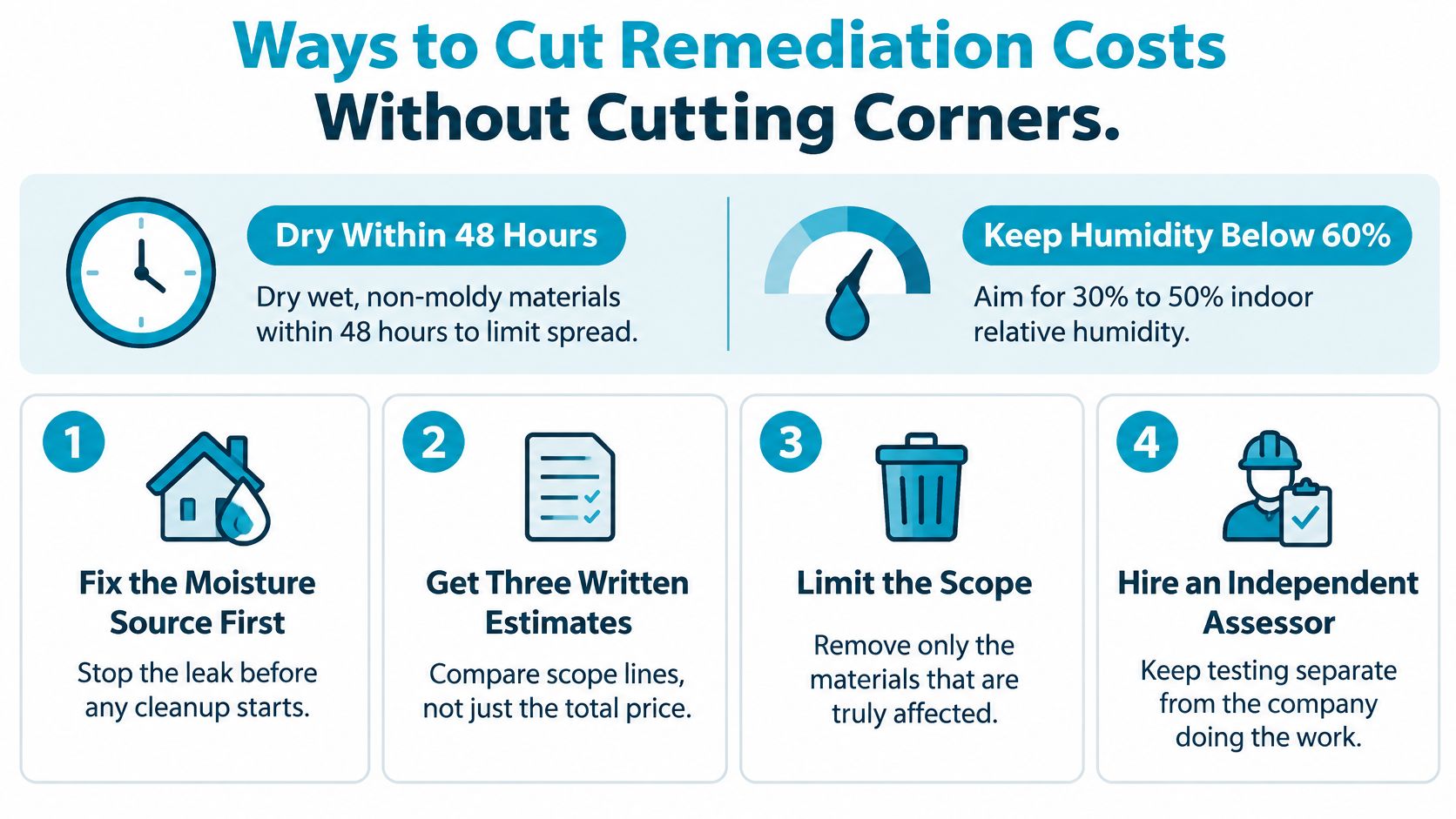
Ways to Cut Remediation Costs Without Cutting Corners
Response time is the cost lever you still control. EPA recommends drying wet, non-moldy materials within 48 hours, and holding indoor relative humidity below 60%, ideally 30 to 50% (EPA drying guidance). Material wet longer than 48 hours should be judged under mold procedures even if it looks dry later.
Moves that shrink the invoice
Call the first day and date your photos. Extraction, dehumidifiers, air movement, and source repair can keep a water loss from becoming demolition. A higher after-hours charge can still beat a second mold phase.
Stop the leak before you open walls. Drying a room that still drips only resets the clock. A defensible proposal names the water source, moisture readings, affected assemblies, drying targets, containment, and how you'll verify dry.
Hold the 30 to 50% band. Don't blow fans from a suspect wall into a clean room. Separate emergency mitigation from remediation on the estimate so drying isn't buried inside a mold lump sum.
Compare line items, not totals. Testing, containment, and clearance have to be visible. The cheapest bid doesn't lower your cost if those lines show up later.
Review a mold endorsement while you have no loss. Buying it after the stain appears doesn't help this claim. If the bid is larger than cash on hand, financing can keep dry-out from waiting. AMPM Restoration offers financing options with the written scope.
Shortcuts that backfire
Bleach on porous drywall doesn't reach growth inside the paper. Skipping containment to save a day can seed the next room. A bid with no verification step leaves you without proof.
A careful cleanup can fit a small surface you can reach and a source you've already fixed. Walls, cavities, and ducts are a different job. The practical line is in whether you should remove mold yourself or hire a professional.
How Long a Mold Remediation Project Takes
Durations below are typical field estimates, not guarantees. Insurance review often runs beside the work and can add weeks at the approval stage, which is why you open the claim early.
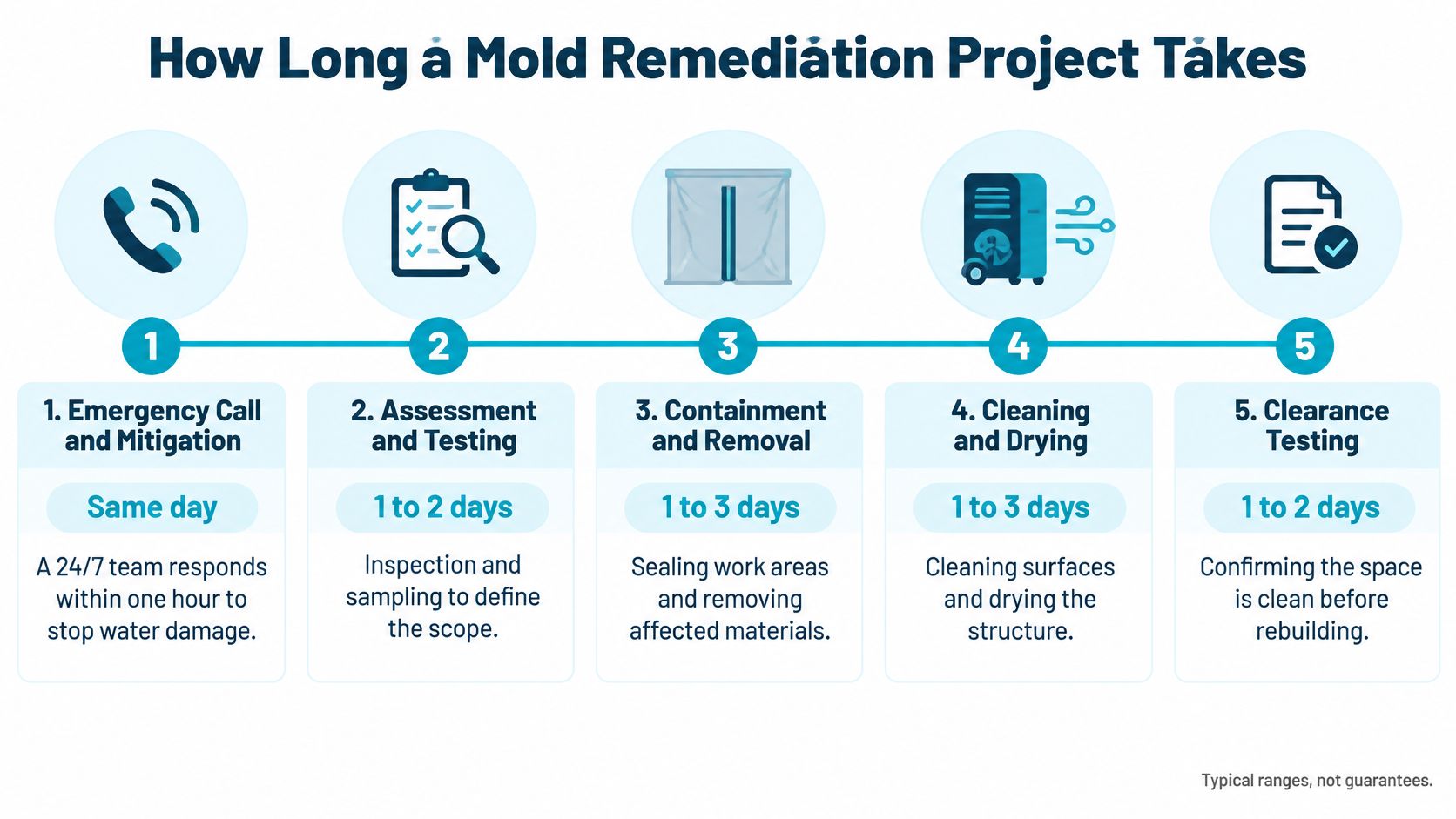
Emergency call and mitigation is often the same day. A 24/7 crew stops the water, extracts what it can, and starts drying before the colony gets a head start.
Inspection and a written scope usually land the same day or the next. Moisture readings and photos are what the price is built on. A phone guess isn't.
Containment, removal, and cleaning often take one to three days for a small room. Open walls and cavities run longer because bagging and passes take time.
Drying verification commonly takes three to five days on soaked materials. Meters decide, not a hand on the stud. Closing early traps moisture.
Clearance testing comes after cleanup and before the wall is closed, often one to two days. Rebuild on a failed clearance and you buy the opening twice.
Rebuilding of drywall, flooring, and cabinets often takes one to two weeks, mostly on material lead times.
A small single-room job often runs about two to five days. A mid-size job with rebuilding often runs two to three weeks. An extensive whole-floor job can run four to eight weeks. A fuller phase breakdown sits on the mold remediation timeline.
Start the claim while the meters are still out. Payment waits on paperwork more often than it waits on the crew.
Common Mold Remediation Cost Questions Answered
Does homeowners insurance cover mold removal in Florida?
It usually responds when mold follows a covered water event, and testing plus removal often sit under a mold sublimit. The split between that cap and the water-loss lines is in the insurance section above. Read your declarations before you treat the invoice as reimbursed.
What does mold remediation cost for a 200-square-foot area?
At $10 to $25 per affected square foot, the rate-based range is $2,000 to $5,000. That is removal math only. Demolition, reconstruction, and testing are extra lines.
Is a mold test enough without remediation?
No. A test is a snapshot. Stopping the moisture and removing what can't be cleaned are what keep it from coming back. Don't pay for a lab report and leave the wet drywall in place.
Does black mold cost more to remove than other mold?
Not by color. Cost follows affected area, how porous the material is, and whether growth is hidden. A black spot on tile can be a cleaning job. Pale growth in insulation can be a rebuild.
How much does a mold inspection cost in Florida?
AMPM's inspection and estimate are free, so start there and ask for a written scope. Lab testing is its own line and depends on how many samples the scope needs. Don't accept a bundled number that hides that fee.
How fast can I get a mold remediation estimate?
Most inspections and written estimates are done the same day or the next day once someone is on site. Ask for itemized testing, containment, and clearance before you compare totals.
Verify the Contractor and Book Your Free Estimate
Price shopping without a license check is how a low bid becomes your problem. Use this list before you schedule demolition.
Confirm both licenses. The remediator should hold a Florida mold-remediation license, and the assessor should be licensed too. Titles alone don't prove it.
Require the insurance the statute names. A mold assessor must carry at least $1 million in general-liability and errors-and-omissions coverage for preliminary and post-remediation assessments. A remediator must carry at least $1 million in general liability that specifically covers mold-related claims (Florida Statutes §468.8421). A general contractor's everyday policy isn't the same thing.
Keep assessment and removal apart. Florida Statutes §468.8419 bars a mold assessor, or that assessor's company, from performing or offering remediation on a structure where that assessor or company did the assessment in the previous 12 months. The remediator also needs documented training in water, mold, and respiratory protection (Florida Statutes §468.8419). Ask who assessed, and whether that firm is financially tied to the crew.
Read the scope line by line. Testing, containment, disposal, reconstruction, and clearance should each appear. Ask for an IICRC-certified restoration company on the crew, not a verbal promise.

AMPM Restoration is a locally owned, licensed, bonded, and insured team in Bradenton, serving Sarasota, Palmetto, St. Petersburg, Tampa Bay, and Lakewood Ranch. The office is at 4301 32nd St W b18, Bradenton, FL 34205. The crew is available 24/7 with a one-hour response time, a free inspection and estimate, insurance claim assistance, financing options, and a 100% satisfaction guarantee. Call 941-946-7807 for a free mold inspection and an itemized scope before any demolition starts, so the mold remediation cost in Florida on your bid matches the work and the coverage.
AMPM Restoration Services handles emergency water mitigation, mold inspection and removal, and the rebuild that follows, and the team will help you line each cost up with your claim. If you're weighing a Suncoast bid and want the scope in writing first, visit AMPM Restoration Services and call 941-946-7807 for a free inspection and estimate.