

Licensed Restoration Company: AMPM Restoration Services
At 2 a.m., a Bradenton homeowner hears water rushing through the ceiling. An upstairs supply line has ruptured, the hallway is flooding, and every minute adds moisture to drywall, flooring, insulation, and personal belongings. The first phone call shouldn’t go to the cheapest cleanup crew. It should go to a licensed restoration company that can stop the spread, document the loss, coordinate with the insurer, and legally carry the project from emergency mitigation through repairs.
Florida’s Suncoast brings its own complications. High humidity slows drying, storms create sudden demand, and mold work has licensing requirements that many homeowners don’t know exist. Use this guide to separate a company that merely holds paperwork from one that can perform technically sound water, mold, fire, and reconstruction work.
What a Licensed Restoration Company Really Does
When that Bradenton homeowner calls a licensed restoration company, the first response should be organized, not improvised. The team identifies the water source, checks for electrical and structural hazards, extracts standing water, protects unaffected rooms, and establishes a drying plan. Technicians then use moisture readings and environmental observations to decide what can be dried, what requires controlled removal, and what must be documented for the insurance carrier.
In plain English, a licensed restoration company is a properly credentialed contractor that handles emergency property damage and the work that follows. That can include water extraction, structural drying, mold remediation, fire and smoke cleaning, storm cleanup, contents handling, repairs, and reconstruction. The company should also maintain a clear record of photographs, readings, authorizations, estimates, daily activity, and completed work. A useful overview of the role appears in what a restoration company does.
A handyman or cleaning crew may be able to remove surface water or wipe soot from a wall. That doesn’t mean the crew knows how to identify moisture inside a wall cavity, maintain mold containment, clean smoke residue from contents, or rebuild to local requirements. Surface appearance is a poor test of whether a structure is safe and dry.
The Florida meaning of licensed
Florida licensing can involve a general contractor, building contractor, specialty contractor, or mold-related license issued through the Department of Business and Professional Regulation. The correct license depends on the work being performed. A contractor who can rebuild may not automatically be licensed to perform mold assessment or mold remediation, and a cleaning company isn’t automatically authorized to perform regulated construction.
Industry credentials add another layer. The Institute of Inspection Cleaning and Restoration Certification, commonly called IICRC, publishes the methods restoration technicians use for water, mold, and other specialized losses. Licensing establishes legal authority. IICRC training and certification address technical practice.
Practical rule: Treat licensing as the entry requirement, not the final proof of competence.
The rest of this guide is designed to protect you during the worst week of a homeowner’s year. Verify the license, ask how the company will control the work, and demand documentation before equipment arrives. A fast response matters, but an unqualified response can leave you with hidden moisture, disputed claims, or unfinished repairs.
Why Licensing, Bonding, Insurance, and IICRC Credentials Matter
These credentials aren’t interchangeable. Each one protects you from a different failure.
A Florida state license indicates that the contractor has met the state’s requirements for the relevant trade. It also gives regulators a pathway to investigate complaints and take action when a contractor violates applicable rules. That doesn’t guarantee perfect workmanship, but it gives you a meaningful verification point that an informal operator can’t provide.
Bonding addresses completion and payment risk. If a contractor abandons a reconstruction project, leaves drywall unfinished, or creates a dispute involving unpaid subcontractors, a bond may provide a route for financial recovery, subject to its terms. Ask what type of bond the company carries and request documentation rather than accepting a verbal assurance.
Four layers of protection
| Credential | Risk it addresses | What to verify |
|---|---|---|
| State license | Unauthorized or improperly supervised work | License number, status, and scope |
| Bond | Abandonment, completion disputes, or certain payment claims | Bonding company and active documentation |
| General liability insurance | Property damage or third-party injury claims | Certificate and policy status |
| Workers’ compensation | Worker injury exposure on your property | Certificate issued by the insurer |
| IICRC credentials | Improvised or technically weak restoration methods | Firm and technician registry records |
General liability coverage matters if a technician damages another part of your home or a piece of equipment causes damage beyond the original loss. Workers' compensation coverage helps reduce the risk that an injured worker turns your property into the center of a liability dispute. You should request certificates of insurance and confirm that coverage is active with the insurer.
IICRC credentials focus on methodology. The S500 water damage standard addresses assessment, psychrometrics, moisture mapping, and drying verification. The S520 mold remediation standard addresses containment and remediation procedures. A company that lacks relevant technical credentials may still offer a low price, but you won't know whether its drying or containment decisions are defensible.

A cheaper quote often excludes documentation, monitoring, protection, or proper disposal. Compare the scope, not just the total. For a broader explanation of insurance-related restoration decisions, review insurance restoration services and what homeowners should know.
Florida Licensing and Certification Requirements Explained
Florida restoration work sits on a layered regulatory structure. A contractor may need the appropriate DBPR-issued construction license to pull permits and perform rebuilding, while mold-related services can require a separate credential under Florida's mold licensing law. Don't assume a general contractor license authorizes every form of mold inspection or treatment.
Florida Statute 468.8413 sets licensing criteria for mold remediators. One route includes a two-year associate degree, at least 30 semester hours in science-related subjects, and one year of documented mold-remediation field experience. The statute also provides an alternative education and experience pathway. Florida's rules require training related to water intrusion, mold, and respiratory protection for licensure. Check the current requirements directly through the Florida mold remediator statute.
License first, procedure second
A Florida mold remediator license establishes legal eligibility. It doesn't replace a written remediation plan or prove that a crew will maintain proper containment. The IICRC S520 is the procedural standard for mold remediation, and the IICRC Mold Remediation Specialist credential requires at least one year of verifiable field experience, not just classroom completion. That distinction is the gap many homeowners miss.
For water losses, IICRC S500 calls for documented assessment, psychrometric monitoring, moisture mapping, and verification that affected materials reach a moisture condition close to unaffected reference materials before demobilization. In humid Manatee and Sarasota County conditions, drying based on feel or calendar time is not enough. The technician needs readings that show whether the structure is responding.
Local permitting can add another practical layer. Manatee County, Sarasota County, and individual municipalities may require permits for portions of demolition, reconstruction, or structural work. Ask who will pull permits and whether the license holder will remain responsible for the work.
If you're also dealing with roof damage after a storm, a separate Florida roofing contractor guide from Audit Genius can help you understand roofing-specific contractor questions. For flood-related restoration, see residential flood restoration services and ask the restoration company how it will separate flood cleanup from covered interior damage.
Core Services a Licensed Restoration Company Provides
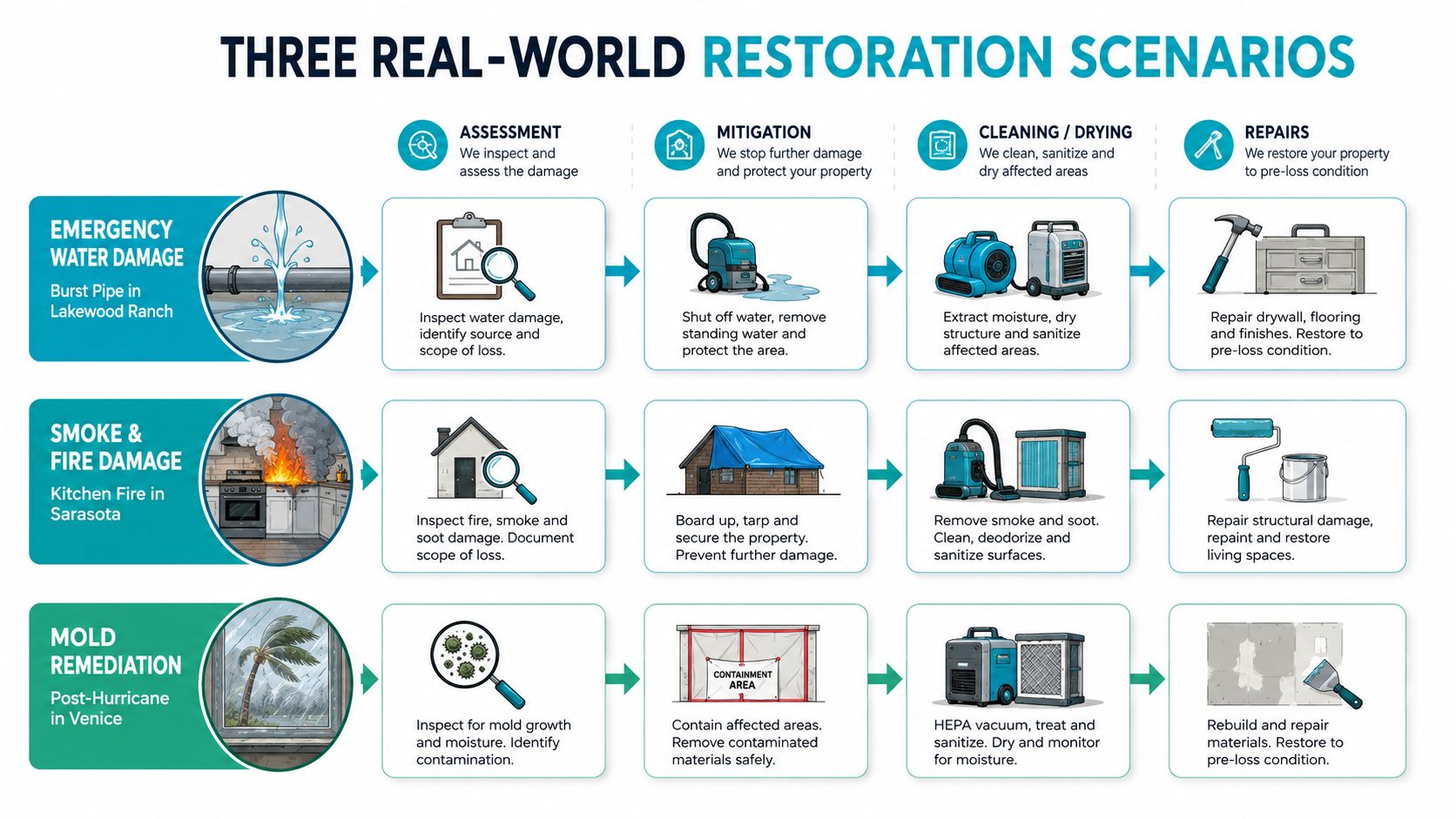
A burst pipe in a Lakewood Ranch home shows the difference between cleanup and restoration. The crew should extract water, identify affected materials, establish drying zones, deploy air movers and dehumidifiers, map moisture, and remove only materials that can't be salvaged. Technicians should photograph conditions before demolition and continue recording readings while the structure dries.
The work doesn't end when the floor looks dry. A qualified team checks concealed areas, documents equipment placement, and verifies drying before removing the equipment. If damaged drywall or flooring must come out, a properly licensed contractor can manage the repair phase rather than leaving the homeowner to find a second company.
Three Suncoast losses, three technical responses
After a Bradenton storm, a homeowner may discover mold growth in an attic or behind previously wet materials. The response should include containment, pressure control, HEPA air scrubbing, controlled removal, antimicrobial treatment where appropriate, and post-remediation verification. A mold crew that sprays and paints over visible growth hasn't addressed the source or the affected building materials.
A Sarasota kitchen fire creates a different problem. Smoke and soot can spread beyond the room, settle on contents, and leave odors in porous materials. Restoration may involve emergency board-up, content pack-out, itemized inventory, specialized cleaning, deodorization, selective removal, and reconstruction.
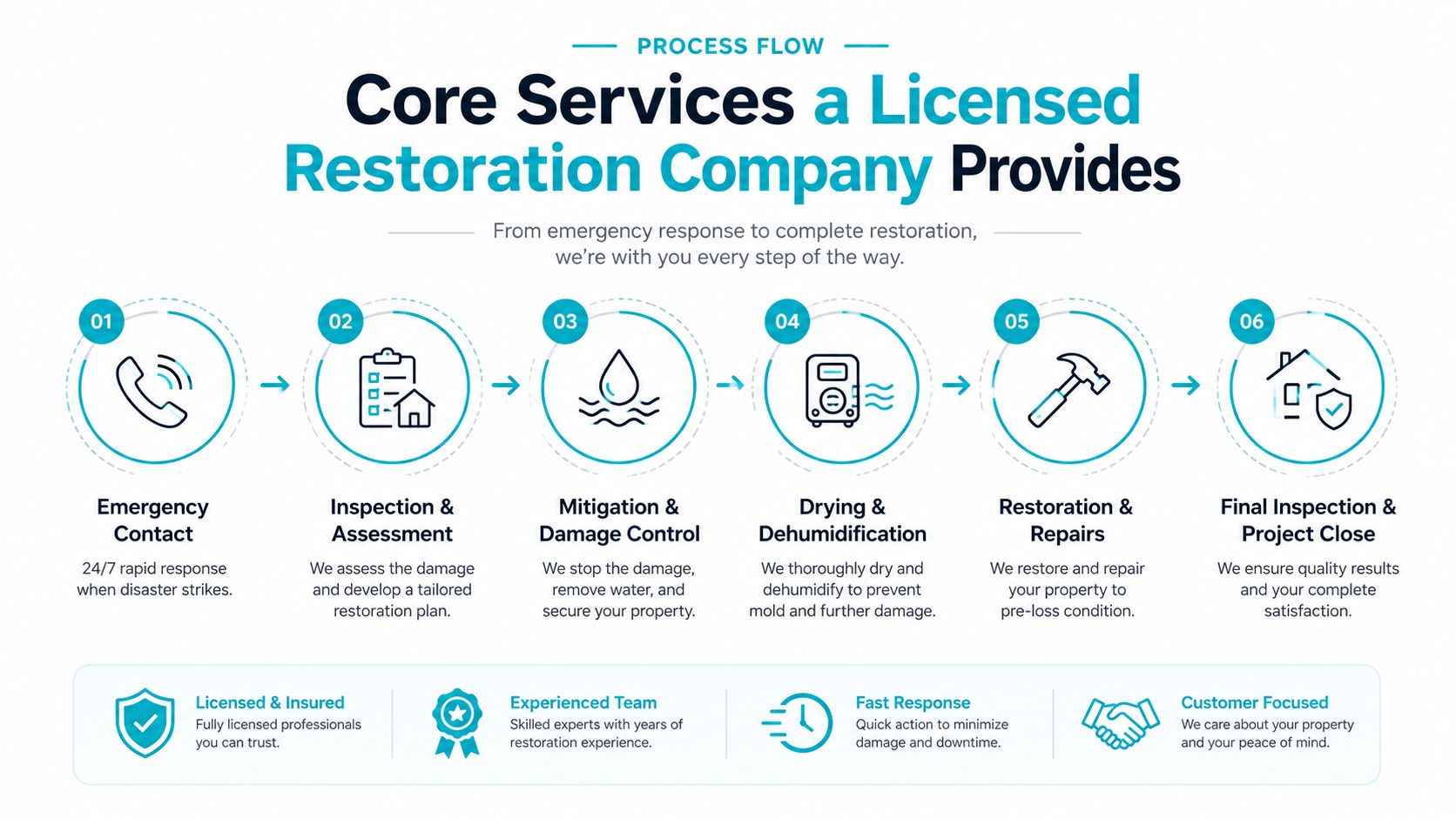
The right licensed restoration company coordinates mitigation, remediation, and rebuilding under one roof. That closes the common gap between drying a building and putting it back together.
Look for these operational basics:
- 24/7 response: Emergency water and storm losses don't follow office hours.
- Photographic documentation: Conditions should be recorded before, during, and after work.
- Permit capability: The company should explain which Suncoast jurisdiction handles required permits.
- Commercial capacity: Offices, schools, retail spaces, and managed properties need communication and scheduling controls beyond a residential cleanup.
- Reconstruction coordination: The same project manager should track the transition from mitigation to repairs.
AMPM Restoration Services describes services across water, mold, fire, storm, flood, commercial restoration, and reconstruction, with emergency availability for Suncoast properties. Treat those listed capabilities as a starting point for verification, then confirm the specific license and credentials that apply to your loss.
How to Verify a Restoration Company's Credentials
Don't sign the first work authorization because a truck arrived quickly. Run a short verification routine while the company prepares its scope.
Start with the Florida DBPR licensing portal. Search the business or qualifying individual and confirm the license is active and appropriate for the work. For mold, look specifically for the relevant Mold Remediator or Mold Assessor credential. Then check the applicable Manatee or Sarasota County licensing office for local requirements and permit questions.
Documents to request before work begins
- License details: Copy the license number, status, qualifier, and trade classification.
- Insurance certificates: Request general liability and workers' compensation certificates, then call the insurer using contact information you obtain independently.
- IICRC records: Check the IICRC directory for the firm and ask which technicians hold relevant credentials such as WRT, ASD, or AMRT.
- Written scope: Require rooms, materials, equipment, monitoring, demolition limits, cleaning methods, and repair responsibilities in writing.
- Business identity: Confirm the physical office address, legal business name, phone number, and the person authorized to sign.
- Local references: Ask for recent Suncoast projects similar to yours and review independent customer feedback.
The IICRC registry matters because a company can advertise restoration without showing who is technically responsible for the work. For mold-specific decisions, use a resource covering mold inspection companies and separate assessment from remediation when the situation requires it.
Keep a folder on your phone and in cloud storage. Save screenshots of license searches, copies of insurance certificates, the estimate, signed authorizations, technician names, photographs, daily logs, and every email or text message. Homeowners evaluating larger repair projects can also consult these Jacksonville renovation contractor tips for broader questions about contractor documentation and scope.
Before the first machine is plugged in, you should know who is legally responsible, who is insured, what work is authorized, and how the company will prove completion.
Red Flags and Pressure Tactics to Watch For
Storms bring legitimate emergency demand, but they also attract unlicensed operators. In Bradenton and Sarasota, be cautious when someone appears at your door immediately after a hurricane, promises a free inspection, and asks you to sign before you've had time to read the paperwork.
The most serious warning signs are easy to recognize:
- Full payment upfront: A company that demands the entire job cost before documenting the scope is shifting its risk to you.
- Cash-only discounts: Avoid arrangements that leave no reliable payment record or formal contract.
- One-page estimates: A vague total doesn't tell you what gets dried, removed, cleaned, tested, repaired, or excluded.
- AOB pressure: Don't sign an Assignment of Benefits before understanding what rights you're transferring and how the insurer will be involved.
- Inflated insurance invoices: A reputable contractor documents real work. It doesn't pad charges or invent line items for a carrier.
- Missing local presence: Out-of-state plates, a toll-free number, and no verifiable Suncoast office should make you stop.
- Credential refusal: If the operator won't show a license, insurance certificate, or technician credentials, don't hand over your property.
Pressure and speed are the tools unreliable contractors use most effectively. Emergency work requires fast action, but it doesn't require blind trust. You can authorize immediate steps to stop active damage while reserving decisions about reconstruction until you receive a complete scope and understand your insurance position.
A contractor who can't produce basic documentation within minutes probably won't produce dependable drying records later. Walk away if the representative becomes hostile when you ask ordinary questions. Your home is too valuable for a company that treats verification as an inconvenience.
How Restoration Companies Coordinate With Insurance Carriers
A licensed restoration company should act as the working bridge between you and the insurance carrier, not as a substitute for your coverage decision. From the first visit, the team should preserve evidence and explain what it knows, what it doesn't know, and what still requires adjuster review.
That record typically includes time-stamped photographs, moisture maps, psychrometric readings, damaged-content inventories, equipment logs, daily notes, and a written scope. For water work, the contractor should be able to explain how its documentation follows the S500 framework. For mold work, ask how the scope reflects S520 procedures and the applicable Florida license.
What the claim file should contain
The estimate should identify affected rooms, quantities, labor, equipment, demolition, cleaning, repairs, and exclusions. Many restoration companies prepare estimates in Xactimate or a comparable estimating platform, but the software doesn't make an incomplete scope accurate. The photos, measurements, readings, and narrative must support the charges.
FEMA's NFIP claims guidance says policyholders should notify the adjuster or insurance company as soon as possible and provide documentation such as a Proof of Loss, detailed contractor estimate, repair records, bills, receipts, and photographs. For flood cleanup, tear-out, treatment, and building dry-out, submit those records to the insurer as well.
FEMA's NFIP claims manuals also advise policyholders to give prompt notice of loss even when coverage or the amount above the deductible isn't yet clear. That makes early documentation and drying especially important.
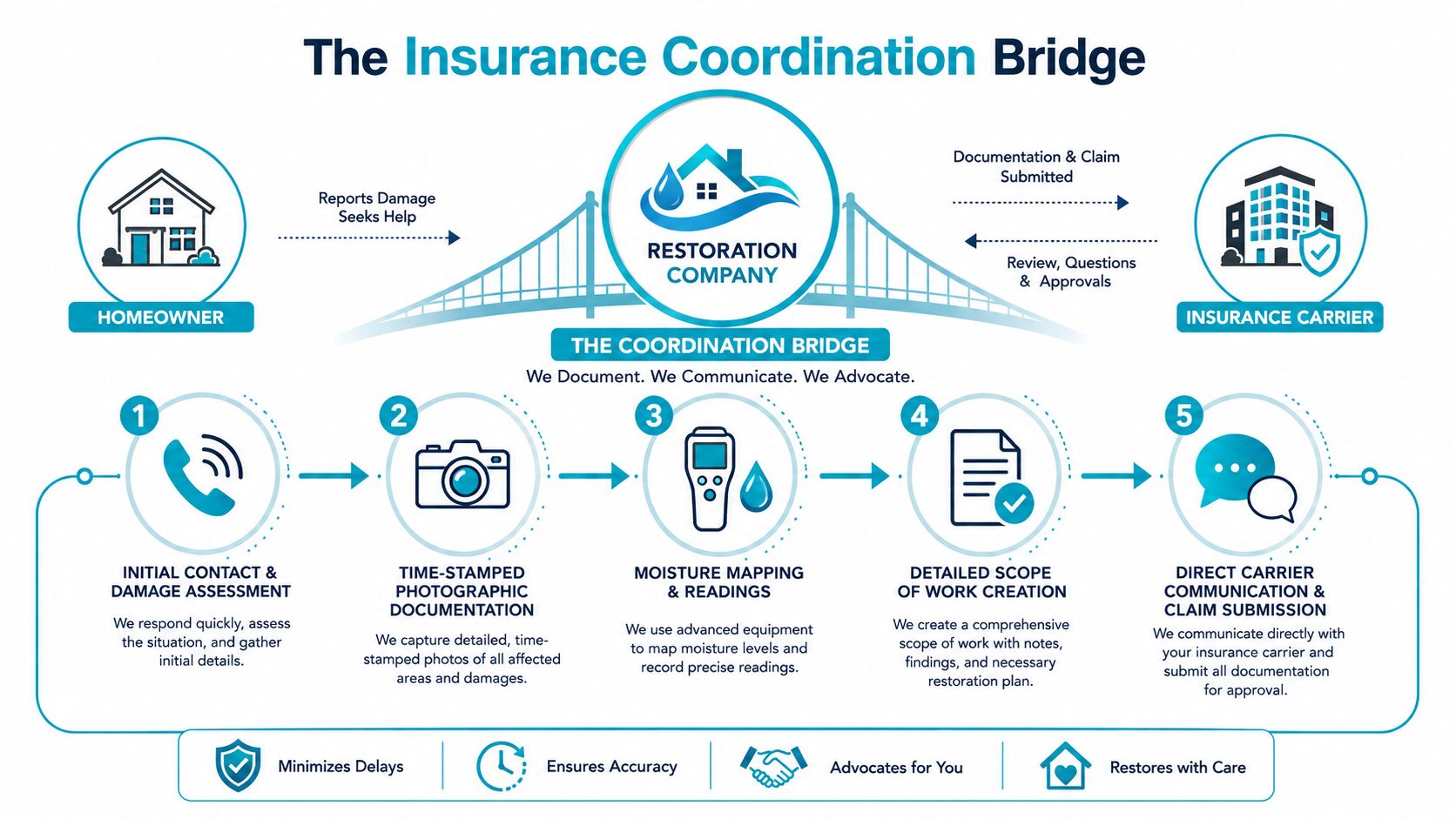
Preferred-vendor status and direct billing can simplify communication, but neither guarantees coverage. Out-of-network work may require you to pay first and seek reimbursement. The contractor should never fabricate a scope, waive your deductible, or promise that the carrier will approve every line item. If hidden damage appears during authorized demolition, the company should photograph it, explain it, and submit a supplemental request instead of expanding the invoice.
For roof-related losses, this overview of roofing professionals and insurance claims provides useful questions to ask a separate roofing contractor. For water-loss preparation, review how to file an insurance claim for water damage.
Suncoast Homeowner Checklist and Next Steps
Save this checklist before a pipe bursts or the next storm reaches the Gulf Coast. It applies whether you own a Bradenton bungalow, a Sarasota condo, a Lakewood Ranch home, or a commercial property near Tampa Bay.
Verify the company before hiring
- Confirm mold licensing: Search DBPR for the Mold Remediator or Mold Assessor license that matches the proposed work.
- Verify contractor licensing: Copy the contractor license number and confirm its current status and classification.
- Check insurance directly: Request general liability and workers' compensation certificates, then confirm active coverage with the insurer.
- Review IICRC credentials: Check the firm and the technicians who will perform water or mold work.
- Read independent reviews: Compare recent Google and BBB feedback, looking for comments about communication, documentation, and completed repairs.
- Confirm the address: Make sure the business has a verifiable Suncoast location, not only a toll-free number.
Florida mold-related licenses have a specific renewal cycle. Mold Assessor and Mold Remediator licenses renew on an even-year cycle by July 31, and each requires 14 hours of approved continuing education plus a $105 renewal fee, as explained by Florida's mold-related services licensing information. That gives you another reason to check license status rather than relying on an old certificate.
Protect the property immediately
Shut off the water or other source if you can do so safely. Photograph rooms, materials, contents, and visible damage before cleanup, and keep a written record of every call, text, visit, authorization, and expense. Contact a licensed restorer before hiring a demolition crew, because premature removal can destroy evidence and spread contamination.
For a documented, licensed, and IICRC-certified response on the Suncoast, contact AMPM Restoration Services and ask for a clear inspection, estimate, mitigation plan, and insurance communication process.
AMPM Restoration Services provides 24/7 water damage restoration, mold inspection and remediation, fire and smoke cleanup, storm and flood recovery, commercial restoration, and reconstruction across Bradenton, Sarasota, Tampa Bay, Saint Petersburg, Lakewood Ranch, and surrounding Gulf Coast communities. Call 941-946-7807 for a free inspection and estimate, and ask about insurance claim assistance and financing options, or visit AMPM Restoration Services to start the response.