

Mold in HVAC System? Causes, Risks, and Remedies
You notice a musty smell when the AC starts after a leak in your Bradenton home. There’s discoloration near a vent, and you’re wondering whether wiping it away will solve the problem. Mold in an HVAC system is a moisture and airflow concern, not just a dirty-vent problem, so the safest response starts with understanding where the water went and which components may be affected.
Why Suspected HVAC Mold Needs Immediate Attention
Consider a Sarasota homeowner who discovers a ceiling stain after heavy rain, then notices an unusual odor near a supply register. It’s reasonable to suspect that the trouble is confined to that room. But the visible register doesn’t reveal the condition of the air handler, return path, filter, cooling coil, drain pan, or internal duct insulation.
The immediate concern is operating equipment that may connect the affected area to other occupied spaces. EPA advises against running an HVAC system known or suspected to contain mold, because operation can distribute mold and mold-contaminated particles throughout the building, according to its commercial-building mold remediation guidance.
A warning sign isn’t a complete diagnosis
A musty odor or dark mark warrants investigation, but neither establishes the full scope of contamination. An inspection needs to connect what occupants notice with the property’s water history and the system’s condition.
Before calling a professional, record what you can observe without opening equipment:
- Water history: Note recent plumbing leaks, roof intrusion, flooding, or prolonged condensation.
- Location: Photograph visible staining and identify which rooms or registers seem affected.
- Timing: Explain whether the concern appeared after a storm, shutdown, or maintenance visit.
- Occupancy: Identify anyone whose health needs may affect temporary arrangements.
Practical rule: Don’t run a suspected contaminated system simply to see whether the smell returns.
The purpose of early assessment isn’t to assume every duct needs replacement. It’s to distinguish a localized moisture issue from a broader problem, then establish appropriate occupant precautions, inspection boundaries, and professional treatment options. That approach avoids both an incomplete wipe-down and unnecessary demolition.
How Mold in HVAC Systems Grows and Spreads
An HVAC system has two roles that matter here: it manages moisture and moves air. When those functions intersect with persistent dampness, a problem that starts around one component may require a wider investigation.
Moisture is the central condition that permits mold growth. ASHRAE’s position document on indoor mold and dampness identifies moisture accumulation as the principal limiting factor and emphasizes water management during HVAC design, operation, and maintenance.
From a wet component to an airflow concern
The air-conditioning equipment doesn’t have to be the original water source. A nearby leak can wet insulation, while condensation or inadequate drainage can leave a drain pan, filter, coil assembly, or duct surface persistently damp.
Think of the duct network as connected hallways. Return pathways bring air toward the equipment, and supply ducts carry conditioned air toward occupied rooms. If contamination enters those pathways, looking only at the nearest register misses the connections that matter.
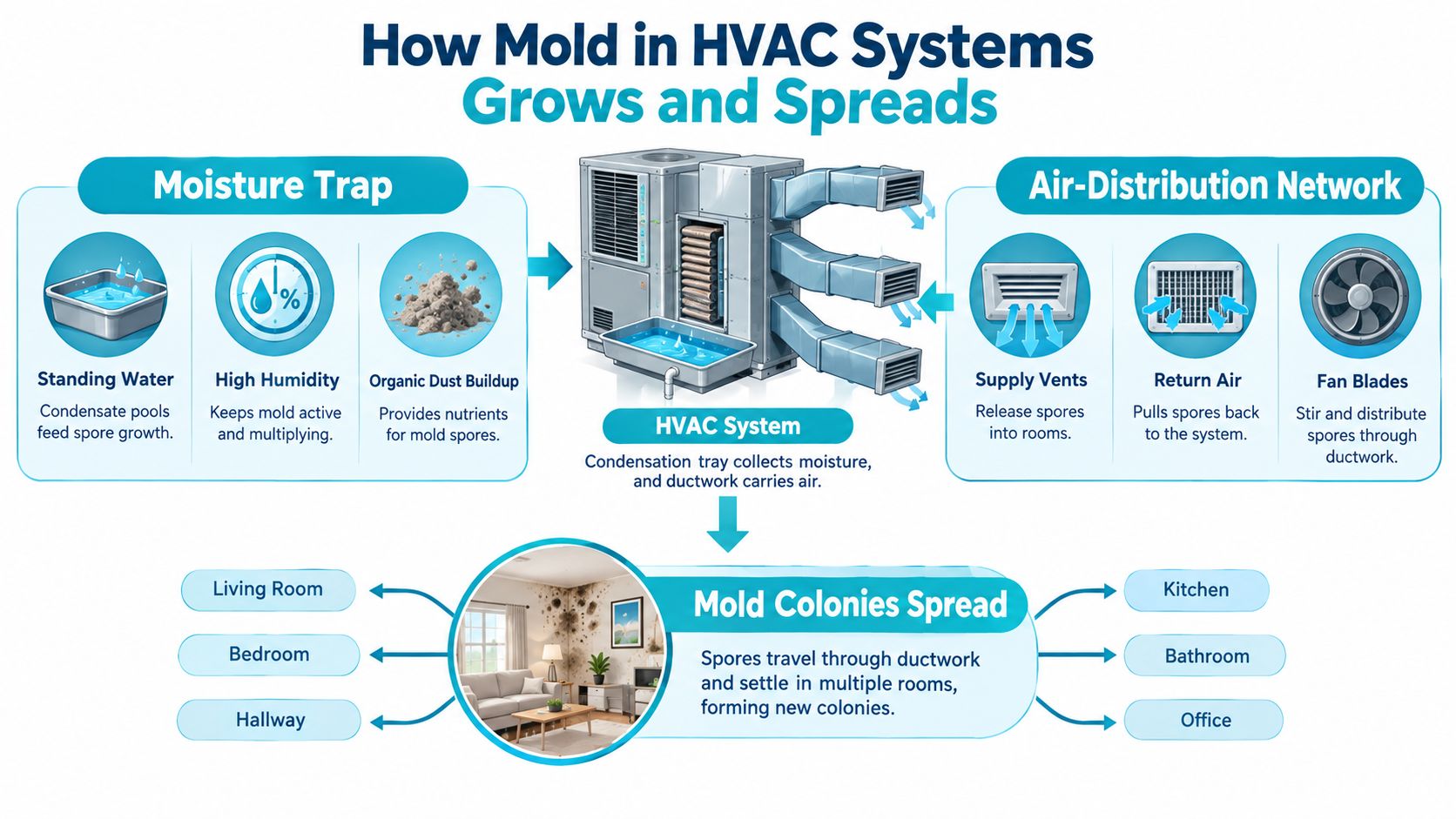
The distinction between ordinary cooling and a moisture problem is important. A cooling coil can produce condensation as part of normal operation. The concern is water remaining where it shouldn’t, escaping its intended drainage route, or keeping surrounding materials damp.
A useful assessment therefore separates two questions:
- Where is moisture accumulating? This identifies the conditions supporting growth.
- Which air pathways connect affected components to occupied areas? This helps define inspection and containment needs.
Florida owners also need to consider the surrounding building, not just the cabinet containing the equipment. The explanation of how humidity causes mold in Florida homes provides context for that broader moisture investigation.
Cleaning visible growth without resolving these conditions leaves the underlying problem unfinished. A clean-looking register doesn’t establish that the connected equipment is dry, and a repaired leak doesn’t establish that previously affected materials are suitable to keep.
Common Causes and Early Warning Signs
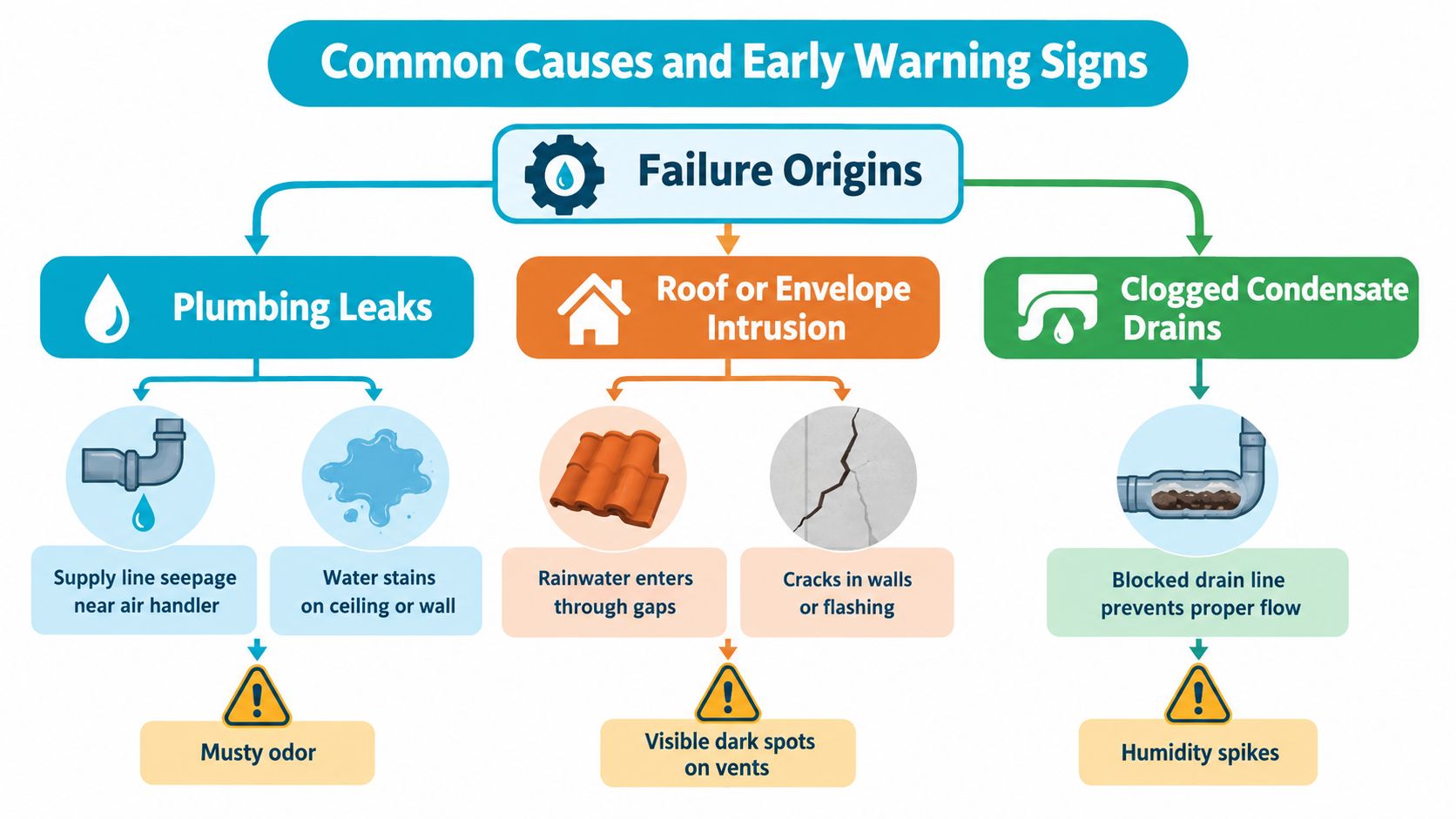
Start with the water source, then follow its route. EPA identifies condensate-management failures, leaking drain pans, standing water beneath cooling coils, poorly insulated or unsealed ducts, and water intrusion as pathways for mold growth in its guidance on moisture and mold prevention.
Florida’s humid outdoor air and cooling-system condensation make that distinction especially useful. A stain near an air handler might originate inside the equipment, above it, or in an adjacent wall.
Trace leaks separately from condensation
A plumbing leak or roof opening can wet the surrounding building before anyone notices a problem at a vent. For background on recognizing concealed water concerns, Axis Meter Solutions offers wall leak warning signs for owners. Treat those observations as clues for a moisture investigation, not proof of HVAC contamination.
Condensation requires a different line of questioning. When humid air contacts a sufficiently cold surface, moisture can collect. Discontinuous duct insulation, drainage problems, and wet surrounding materials deserve separate attention rather than being grouped under “the AC is leaking.”
Match observations to inspection questions
| Observation | Question for the professional |
|---|---|
| Water around the air handler | Is the source a condensate failure or nearby intrusion? |
| Persistent moisture on duct exteriors | Is insulation continuous, and where is condensation occurring? |
| A wet filter or darkened insulation | Which materials were wetted, and are they salvageable? |
| Musty odor near a return | Which upstream surfaces and connected pathways need inspection? |
| Staining after flooding or shutdown | What remained wet, and was drainage restored? |
A blocked condensate drain and an incorrectly sloped pan can both leave water where it shouldn't remain, but they require different corrections. Likewise, replacing a filter won't repair a leak above the equipment.
For owners trying to distinguish these situations, water damage from AC units in Florida homes offers related guidance. Warning signs help identify where to look; they don't establish the extent of mold or determine the final repair scope.
Health Risks for Occupants and Vulnerable Groups
Finding mold doesn't mean everyone in the building will become ill. It also doesn't justify dismissing occupants' concerns because only a small area is visible.
The CDC's mold and health guidance summarizes associations between damp buildings and mold and respiratory symptoms and infections, worsened or newly developed asthma, allergic rhinitis, eczema, and hypersensitivity pneumonitis. Possible responses include congestion, sore throat, coughing, wheezing, burning eyes, and skin rash.
Symptoms aren't a building test
These symptoms aren't unique to mold exposure, and individual responses vary. A clinician evaluates a person's health; a qualified building professional evaluates moisture, materials, and the HVAC system.
An occupant feeling better away from the property may provide useful history, but that observation doesn't identify a particular contaminated component. Similarly, an inspection report can't establish the cause of someone's medical condition.
A building investigation and a medical evaluation answer different questions. Neither should substitute for the other.
Plan around occupants' needs
Give particular attention to children, older adults, and people with asthma, allergies, or weakened immune systems when discussing temporary arrangements. The appropriate plan depends on the person, the affected spaces, and the proposed work.
- Persistent or concerning symptoms: Seek medical advice rather than relying on an online symptom list.
- Sensitive occupants: Discuss whether they should stay elsewhere during investigation or material removal.
- Shared ventilation: Ask how the professional will prevent exposure through connected pathways.
- Commercial occupancy: Coordinate access and work scheduling before remediation begins.
AMPM's explanation of possible symptoms of mold exposure in a home can help owners organize questions, but it isn't a medical diagnosis.
Visible mold in a bathroom or wall cavity also doesn't prove that the HVAC system is unaffected. That conclusion requires attention to the water history and air connections, not the distance between the stain and the nearest vent.
How Professionals Detect HVAC Mold
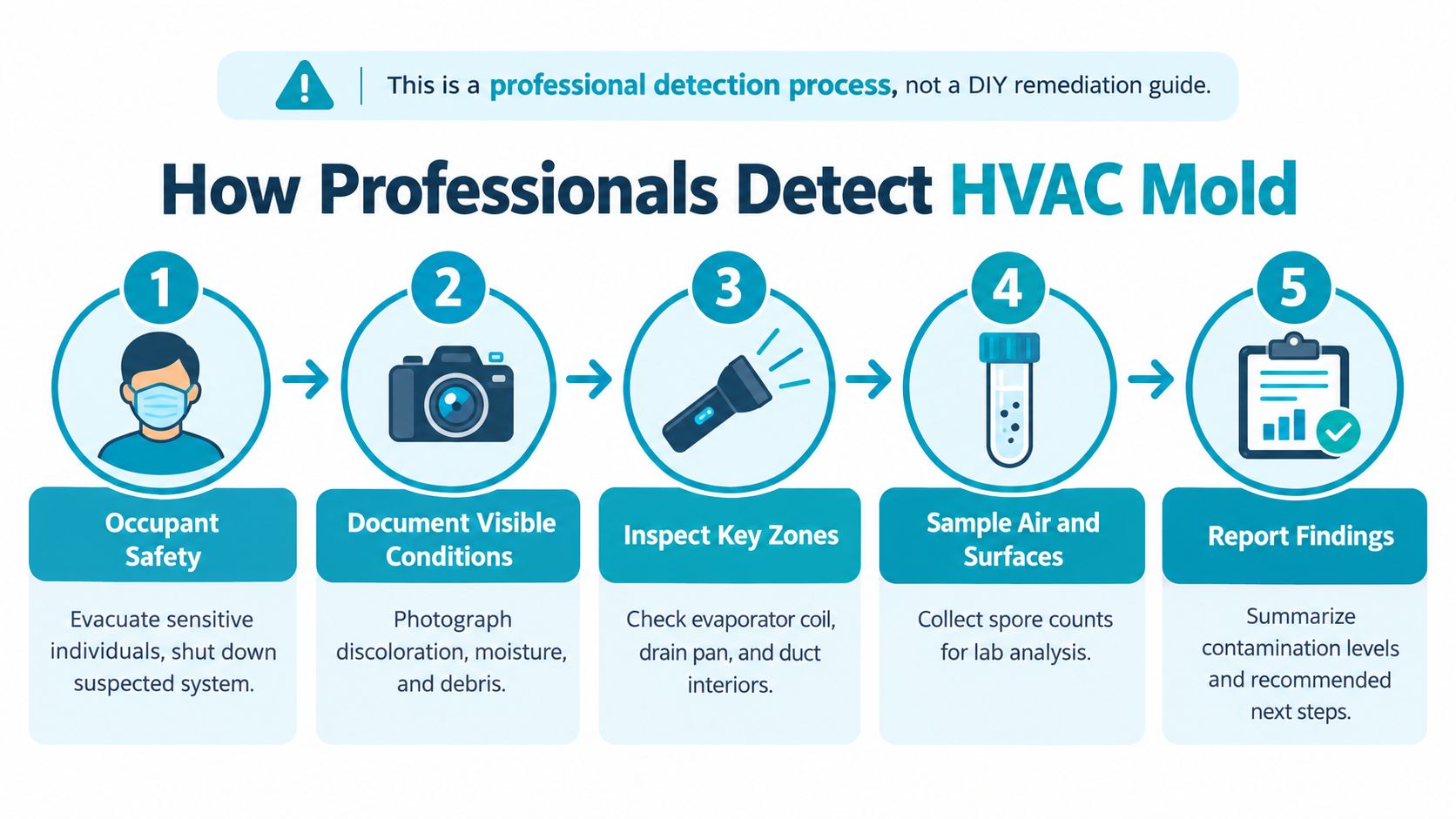
A useful inspection produces more than a photograph of discoloration. It should explain the suspected water source, affected components, material conditions, and information needed to plan the work.
CDC's post-water-damage guidance calls for inspection of fans, blowers, ductwork, filters, insulation, and other HVAC components, along with discarding wet or damaged filters and addressing contaminated surfaces before restart, as outlined in its facility reopening checklist.
Safety and documentation come first
The professional begins with the operating status and occupant arrangements, then reviews the event history. This helps distinguish a recent roof leak from recurring condensate overflow or floodwater exposure.
Useful owner-provided records include:
- Affected locations: Rooms, equipment closets, ceiling cavities, and visible water paths.
- System information: Which equipment serves which spaces, where known.
- Event records: Leak reports, maintenance notes, and the sequence of observations.
- Photographs: Undisturbed conditions before cleaning or repairs.
Inspection and sampling answer different questions
Visual inspection documents accessible conditions, including staining, deterioration, debris, and apparent growth. Moisture measurement helps investigate whether materials remain damp and where further examination may be useful.
Sampling is a separate decision. Depending on the property and assessment question, a professional may consider surface, component, or air samples with laboratory interpretation. The sampling stage shown above isn't a requirement for every property, and a sample result doesn't replace investigating the water source.
For example, identifying material collected from a duct surface doesn't explain why the insulation became wet. The assessment still needs to connect the result with the component's condition and the building history.
Owners arranging professional mold inspection services should ask what the report will document and how the findings will support remediation decisions. Property managers should also request clearly identified locations and photographs that can help contractors, occupants, and insurance representatives discuss the same conditions.
The inspection boundary should follow evidence. It shouldn't automatically stop at a room doorway or expand to every duct without a reason.
Professional Remediation and Safe System Restart
HVAC mold remediation is a controlled removal and moisture-correction process, not a general cleaning appointment. EPA recommends professionals experienced with HVAC systems, with work practices that include sealing intakes and supply vents, maintaining negative pressure in the work area, removing contaminated porous materials, and cleaning salvageable surfaces, as described in its mold remediation course.
Contain the work and correct the source
The work plan should identify how crews will separate affected areas from clean spaces and use appropriate respiratory, eye, and skin protection. Negative pressure means directing airflow into the contained work area rather than allowing contaminated air to escape toward occupied areas.
Source correction belongs in the same plan. Depending on the findings, that may involve repairing a leak, restoring continuous condensate drainage, correcting duct leakage, or replacing missing insulation.
For additional commercial-cleaning context, the WipesBlog.com sanitation blog is a supplementary resource. General sanitation information shouldn't replace a component-specific HVAC remediation plan.
HVAC Mold Component Decisions
| Component | Moisture Concern | Typical Professional Response |
|---|---|---|
| Filters | Wetness, damage, or contamination | Discard affected filters and install clean replacements |
| Drain pan and drain assembly | Standing water, leakage, or inadequate drainage | Correct drainage defects and clean suitable surfaces |
| Coils, fans, and blower surfaces | Damp contamination on accessible components | Use suitable professional cleaning methods and dry promptly |
| Porous internal duct insulation | Moisture and embedded contamination | Remove and replace affected insulation |
| Other duct surfaces | Contamination and material damage | Assess cleanability and replace components that can't be adequately cleaned |
Mold-contaminated porous internal duct insulation generally can't be cleaned effectively. Surface disinfectant alone isn't a substitute for removal and replacement.
Cleanable components may require HEPA vacuuming or damp cleaning with detergent, with disinfection where appropriate to the component and remediation plan. Professionals must also dry materials promptly rather than leaving cleaned assemblies wet.
Verify qualifications and restart conditions
Florida Statutes section 468.8414 establishes licensing requirements for mold assessment and remediation, including applicable qualifications, an examination, and documented training in water, mold, and respiratory protection. Verify the appropriate Florida license rather than assuming ordinary cleaning credentials cover regulated mold work.
Before normal operation resumes, the professional should confirm:
- Source control: The moisture defect has been corrected.
- Component decisions: Affected materials have been cleaned or replaced as appropriate.
- Dry condition: The system is dry and free of visible contamination.
- Completion: Clean filters are installed and applicable professional oversight is complete.
Restart checkpoint: A better smell alone isn't a sufficient reason to turn the system back on.
The mold remediation timeline depends on findings, access, drying, and repairs, not just the cleaning appointment.
Florida Scenarios That Change the Remediation Plan
Different water events can leave similar-looking marks near a vent. These representative situations show why professionals shouldn't prescribe the same treatment from a photograph.
Condensation in an occupied Lakewood Ranch home
An owner notices moisture near the air handler and discoloration at a nearby register. The professional needs to distinguish drainage trouble from wet surrounding materials and inspect the connected components.
Changing filters alone won't resolve an active drain blockage. But the visible mark also doesn't establish that every duct requires replacement.
Storm water in a Saint Petersburg property
Roof intrusion wets insulation near ductwork. The key questions concern where water traveled, which porous materials were affected, and whether those materials can be retained.
A surface wipe doesn't change the condition of contaminated internal insulation. The inspection boundary should follow the wet materials, including concealed areas where access is justified.
Shared airflow in a Tampa Bay commercial building
Several tenant spaces use connected HVAC pathways. Here, occupant scheduling and separation from the work area become central planning decisions.
The containment practices described earlier, including off-hours work when possible, are particularly relevant. A closed office door doesn't establish that an occupied suite is isolated from the remediation area.
| Property condition | What changes in the plan |
|---|---|
| Occupants remain nearby | Temporary arrangements and access controls |
| Porous insulation is affected | Removal and replacement decisions |
| Multiple spaces share equipment | Investigation of connected airflow pathways |
| The water source remains active | Repair coordination before completion |
Scope follows water history, material condition, system design, occupancy, and professional findings. It shouldn't follow a standard “duct cleaning” package or stop at whichever vent looks worst.
Take Action Before Mold Spreads Further
For a homeowner, landlord, or commercial operator, the next step is a documented professional assessment, not exploratory spraying or pulling out duct insulation. Keep photographs and maintenance records, identify the suspected water event, and explain any occupant concerns when arranging help.
Indoor conditions deserve attention: Americans spend approximately 90% of their time indoors, and concentrations of some indoor pollutants are commonly 2 to 5 times higher indoors than outdoors, according to EPA's indoor air quality overview. Those figures provide context, not a measurement of mold in your property.
Frequently Asked Questions About Mold in HVAC Systems
Can I run the AC if mold is only near one vent?
Don't assume that location defines the problem. Follow the shutdown guidance above until a qualified professional evaluates the connected system.
Does HVAC mold mean all my ducts need replacement?
No. Component decisions depend on material condition and cleanability, with affected porous internal insulation treated differently from salvageable hard surfaces.
Can I spray cleaner into a moldy air vent?
A vent spray isn't a whole-system assessment or remediation plan. Avoid disturbing suspected contamination while arranging professional help.
Does every HVAC mold inspection require air testing?
No. Ask the assessor what question sampling would answer and how the result would affect the recommended work.
How long does HVAC mold remediation take?
The schedule depends on access, affected materials, source repairs, drying, and verification. An inspection is needed before setting a property-specific timeline.
Will insurance pay for HVAC mold removal?
Don't assume coverage. Document the conditions and ask your insurer to review the loss against your policy.
AMPM Restoration serves Bradenton, Sarasota, Tampa Bay, Saint Petersburg, Lakewood Ranch, and surrounding Gulf Coast communities from 4301 32nd St W b18, Bradenton, FL 34205. Its locally focused restoration team helps owners address property damage and coordinate recovery.
For suspected mold in an HVAC system, AMPM Restoration Services offers professional water damage restoration, mold inspection and mold removal, fire and smoke damage restoration, storm and flood damage restoration, commercial restoration services, and full reconstruction solutions. Call 941-946-7807 for a free inspection and estimate, with 24/7 emergency availability, insurance claim assistance, and financing options to help you move from uncertainty toward a clear restoration plan.
The opening scenario is so common, a musty smell when the AC kicks on after a leak, and I liked that you treat it as a moisture and airflow issue rather than just a dirty vent. The warning not to run a system suspected of containing mold makes sense because it can spread particles to other rooms. Checking the condensate drain and drain pan first, and remembering that porous duct insulation usually needs replacement rather than cleaning, are practical takeaways.