

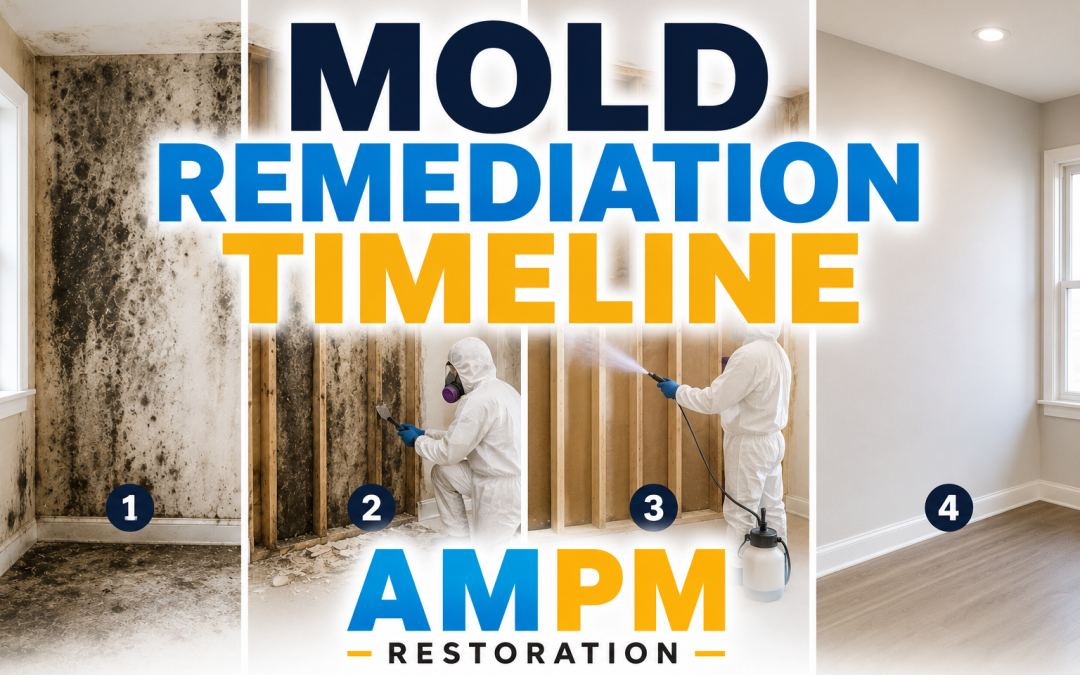
Mold Remediation Timeline: What to Expect Step by Step
You walk into a spare bedroom on Florida’s Suncoast and notice the smell first. A slow dishwasher leak has dampened the kitchen wall, darkened the baseboards, and allowed mold to creep toward the closet. The 24 to 48 hour moisture window is already the first scheduling concern, because the EPA advises drying wet, non-moldy materials within that period to help prevent mold growth, and materials wet longer than 48 hours may require remediation rather than simple cleanup. See the EPA guidance on water, mold, and moisture.
The right mold remediation timeline separates urgent fieldwork from the slower parts of the project. Crews may complete removal and drying in a few days, while testing, insurance coordination, repairs, and reconstruction keep the room unavailable for considerably longer. That distinction matters when you’re arranging school, work, temporary housing, contractor access, and a realistic return date.
Why a Mold Remediation Timeline Matters in Florida Homes
A Florida home doesn’t follow the same calendar as a dry inland property. Coastal humidity, storm-driven moisture, and damp indoor air can keep wet materials from drying efficiently, especially when a leak affects cabinetry, wall cavities, flooring, or insulation. The EPA says wet areas and items should be dried within 24 to 48 hours, and notes that mold won’t grow in most cases when damp materials are dried within that window. The EPA mold remediation checklist also puts the moisture source first, followed by rapid drying.
That sequence changes the homeowner’s first decisions. Stopping the dishwasher leak, repairing the supply line, or covering an active roof intrusion matters more than wiping visible discoloration from a baseboard. Surface cleaning without moisture control may make the room look better while leaving damp materials behind the wall.
Practical rule: The visible mold is only one part of the schedule. The moisture source and the condition of hidden materials determine when remediation can actually finish.
A homeowner who expects a one-day cleanup may be surprised when the active work takes several days and the full project continues through clearance and rebuilding. The distinction helps you plan whether a bedroom can be used, whether children should stay away from a containment zone, and whether a business needs phased access.
Florida homeowners should also understand why a calendar measured in days and weeks is more useful than a single promise. A small contained problem may move quickly after the source is fixed. A leak that has reached multiple rooms, the HVAC system, or structural materials creates more inspection, containment, drying, and verification work. The moisture conditions that contributed to mold must be corrected before the project has a defensible finish line.
For a practical explanation of why warm, humid indoor conditions can support mold problems, review this guide to how humidity causes mold in Florida homes. In Bradenton, Sarasota, Lakewood Ranch, Tampa Bay, Saint Petersburg, and nearby Gulf Coast communities, a prompt inspection gives you a better basis for deciding whether the property needs limited cleaning, controlled removal, or a wider restoration plan.
The Six Stages of Mold Remediation Explained
A professional mold remediation timeline follows a sequence because each stage protects the next one. The EPA’s commercial and school guidance emphasizes moisture correction and drying, while IICRC-aligned practice uses containment, removal, drying, and verification to control spread and confirm that the area is ready for the next phase. The EPA guide for schools and commercial buildings says carpet and backing that can’t be dried within the critical window may already have mold growth and should be handled under remediation guidance when wet for longer than 48 hours.
| Stage | Typical Duration | Key Activities | Stage Output |
|---|---|---|---|
| Inspection and moisture mapping | 1 to 4 hours on site | Moisture readings, visual inspection, source tracing, scope development | Written scope, affected-area map, source-control plan |
| Containment and negative pressure | 2 to 6 hours | Polyethylene barriers, HEPA air scrubbers, decontamination setup | Controlled work zone and reduced cross-contamination risk |
| Contaminated-material removal | 1 to 3 days | Removal of affected drywall, carpet, and cellulose insulation | Bagged debris and exposed structural materials |
| Structural drying and dehumidification | 3 to 5 days of equipment run time | Air movement, dehumidification, repeated moisture readings | Materials reach acceptable dry targets |
| Repairs and reconstruction | 2 to 10 days | Patching, painting, cabinet and flooring replacement | Repaired building finishes |
| Clearance testing and verification | 3 to 7 days | Independent sampling, laboratory review, post-remediation verification | Documentation supporting reoccupancy |
Inspection and containment
The first visit identifies both the extent of contamination and the cause of moisture. Technicians use moisture meters, hygrometers, and visual inspection to determine whether the problem is limited to a surface or extends into walls, flooring, ceilings, or mechanical areas. A written scope may follow the same day or the next day.
Containment usually takes 2 to 6 hours in a contained area. Polyethylene barriers separate the work zone, HEPA scrubbers filter airborne particles, and a decontamination area controls movement between contaminated and clean spaces. Skipping containment because the mold appears localized can spread debris and spores during demolition.
Removal and drying
Removal commonly takes 1 to 3 days, depending on the affected area and material. Drywall, carpet, and cellulose insulation are porous and often require removal when contamination has penetrated them. Non-porous surfaces may be cleaned, but the technician still has to inspect adjacent materials and cavities.
Drying is not a visual judgment. Equipment may run for 3 to 5 days while technicians check moisture levels and stabilize the structure. Neutral industry guidance aligned with IICRC practice describes reconstruction as beginning only after acceptable targets are reached, such as wood moisture content below 16%, as summarized in this mold remediation timeline resource.
Repairs follow drying, not the other way around. Patching or installing new flooring over damp framing traps moisture and can lead to recurrence. For additional context on the difference between evaluating a problem and physically correcting it, see mold assessment versus mold remediation. Homeowners comparing treatment approaches can also review these mold remediation solutions as background before authorizing work.
Active Remediation Window Versus Full Project Duration
The phrase mold remediation timeline often hides two different schedules. The active remediation window is the period when crews are physically inspecting, containing, cutting, removing, drying, cleaning, and HEPA-vacuuming the affected structure. The full project includes the waiting and coordination periods that determine when the room is repaired and ready for normal use.
A common residential estimate places active remediation at 1 to 5 days, according to the timeline guidance summarized by Mold Remediation Authority. That doesn't mean the homeowner can move back in at the end of day five. Clearance testing, laboratory review, material procurement, painting, and insurance inspections may continue after equipment leaves.
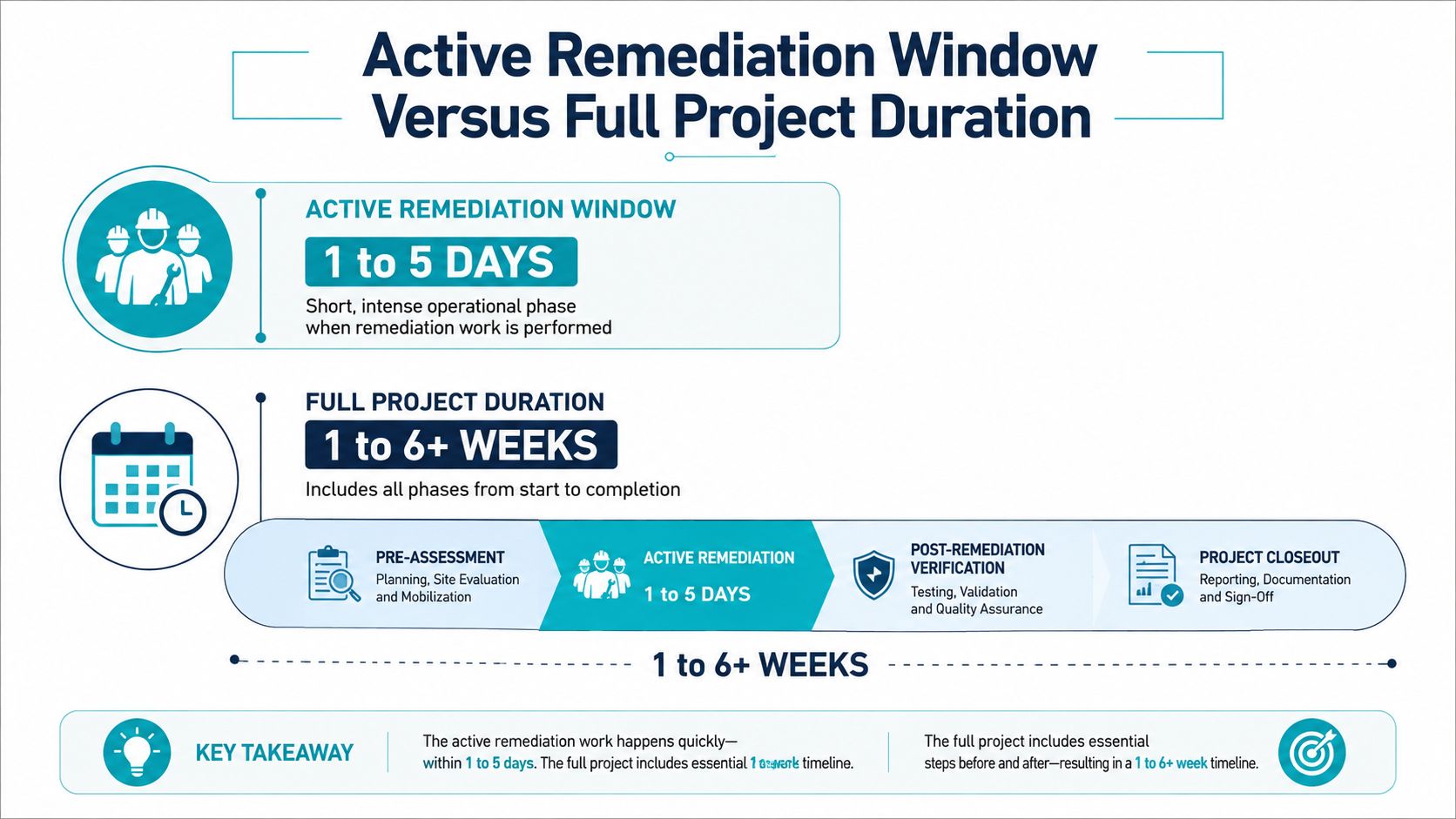
For a moderate single-room Florida job, active work may occupy 2 to 3 days, while the full project can extend to 1 to 3 weeks once repairs, paint curing, clearance, and insurance coordination are included. Larger multi-room cases, especially those involving HVAC or extensive structural drying, can reach 2 to 4 or more weeks from first inspection through final clearance. The broader timeline guidance from RestorePros distinguishes the removal window from the time required to return a property to usable condition.
Third-party laboratory turnaround may take 2 to 5 business days, and drywall or paint curing can consume 3 to 7 days. An adjuster's re-inspection can pause work even when the remediation crew is ready, particularly if the scope changes after demolition reveals concealed damage.
A sensible planning rule is to budget two weeks for a moderate project and a month for an extensive one. That isn't a promise of duration. It's a way to plan re-entry, furniture storage, temporary lodging, and contractor availability without assuming that demolition day marks the finish line. The mold growth timeline after water damage offers further context on why moisture history affects the schedule.
Factors That Speed Up or Delay the Process
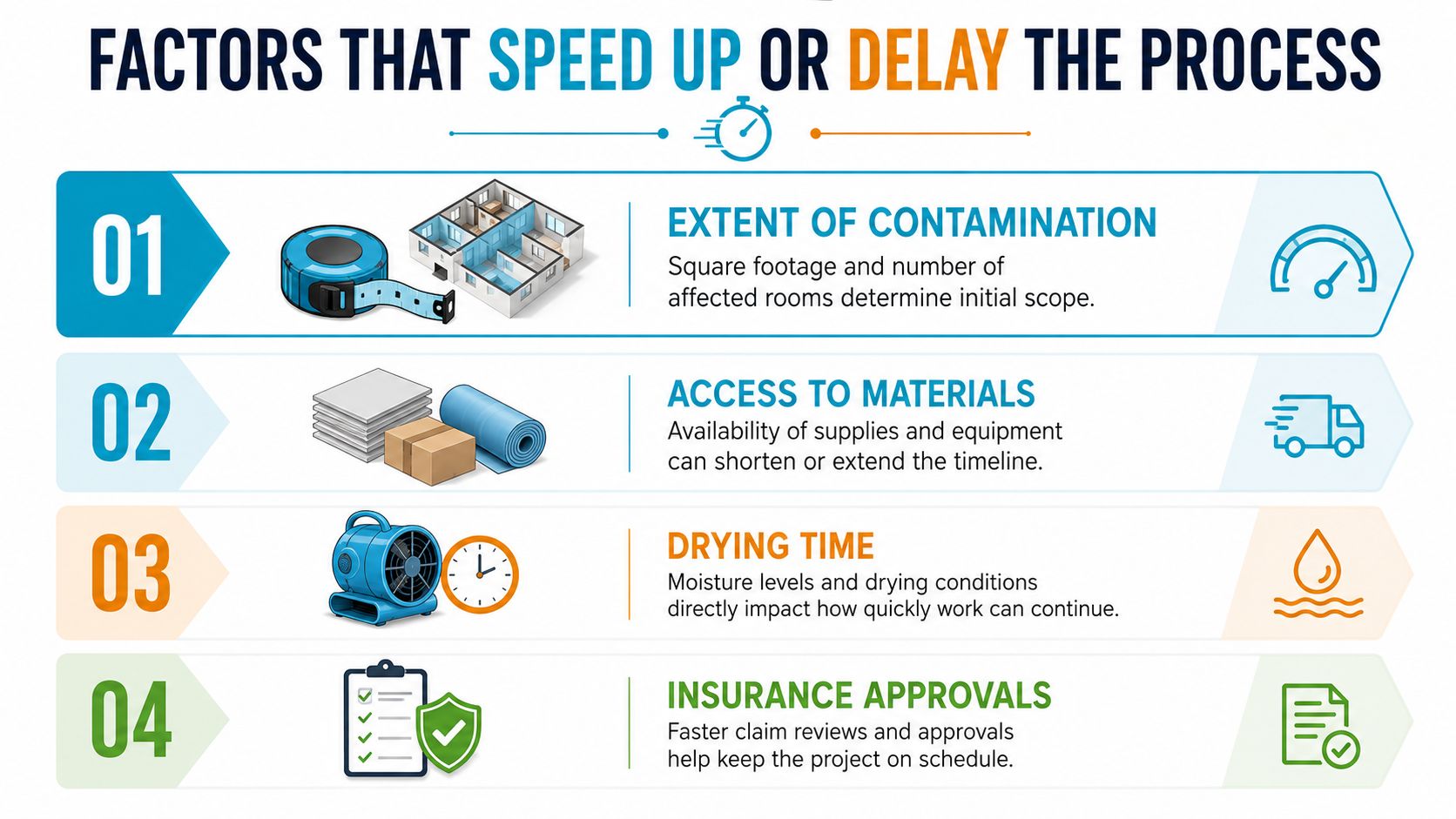
The strongest schedule driver is the extent of contamination. Square footage, the number of affected rooms, and whether mold has entered wall cavities determine crew size, containment layout, equipment needs, debris volume, and time on site. A small visible patch can require more work than expected if inspection finds moisture behind cabinets or under flooring.
Material type comes next. Porous drywall, carpet padding, and ceiling tiles absorb moisture and contamination, so removal and disposal may be more appropriate than surface cleaning. A clean supply-line leak generally creates a simpler drying and cleaning problem than sewage backup or a chronic roof intrusion, which introduces sanitation concerns and may involve repeated moisture entry.
Florida's outdoor humidity and dew points can slow drying. Storm weather may also delay roof repairs, access, deliveries, or exterior work. A dehumidifier can lower moisture inside a containment zone, but it can't compensate for an unresolved leak or unrestricted humid air entering the structure.
Schedule variables that deserve early attention
- Extent of contamination: Multiple rooms, HVAC involvement, and concealed damage expand the scope.
- Material condition: Porous materials often need controlled removal, disposal, and replacement.
- Water source: The source must be corrected before drying and reconstruction can be trusted.
- Physical access: Attics, crawl spaces, tight chases, and multi-story layouts make containment and removal slower.
- Approvals and testing: Permits, HOA requirements, asbestos testing, and lead testing can add administrative time.
- Insurance coordination: Adjuster scheduling and documentation rounds commonly add 48 to 72 hours, as reflected in the project guidance supplied for this timeline.
Two quick decisions often protect the schedule. Address the moisture source immediately, and authorize the agreed scope in writing the same day when the inspection supports it. Delaying access, withholding approval, or asking crews to work around locked utility areas creates idle time that no drying machine can recover.
Technicians also need a complete view of the property. A narrow inspection limited to the visible stain can miss wet framing, flooring edges, or air pathways. Guidance on structural drying methods can help explain why moisture readings, equipment placement, and repeated verification matter more than leaving fans in a room.
How Building Type and Compliance Change the Schedule
A single-family home usually has a more direct path than a commercial or institutional building. One containment zone, one decision-maker, and fewer occupants can make mobilization and re-entry easier. A multi-unit property adds neighbor notifications, HOA coordination, shared HVAC questions, and access planning for adjacent units.
Commercial work follows a different operating model. Offices, retail spaces, restaurants, and hospitality properties may need after-hours work or phased containment so the business can keep operating. Property managers may also coordinate industrial hygienists, tenant notices, facility personnel, and independent post-remediation verification before reopening.
Institutional buildings bring stricter occupancy controls and indoor-air-quality procedures. Schools, healthcare facilities, and government properties may require phased re-entry, documented communication, and special handling of sensitive occupants or records. The 2025 update to IICRC S520 covers residential, commercial, and institutional buildings, reflecting the broader application of formal remediation expectations. Its scope is described by Standards Australia.
| Building Type | Typical Timeline | Key Compliance Drivers |
|---|---|---|
| Single-family residence | Same-week active work is often possible for a contained project | IICRC S520-aligned process, source correction, containment, drying, verification |
| Multi-unit residential or HOA property | Several additional coordination days may be required | Neighbor notices, shared HVAC review, access rules, association approvals |
| Commercial property | Active work may extend to 1 to 2 weeks, with total projects often reaching 4 to 8 weeks when clearance and rebuilding are included | Phased or after-hours work, industrial hygiene, tenant coordination, documented re-entry |
| Institutional property | Full projects can reach 4 to 6 weeks where occupancy controls and compliance coordination apply | Indoor-air-quality procedures, occupancy controls, safety rules, facility documentation |
OSHA worker-safety requirements, EPA Renovation, Repair and Painting rules for applicable pre-1978 painted surfaces, and Florida Building Code permits for structural repairs can affect the order of work. These requirements aren't administrative clutter. They protect occupants and workers, and they prevent a hurried rebuild from undermining the remediation.
What to Expect from AMPM Restoration and Your Role
A restoration company should give you a process, not just a date. AMPM Restoration is a 24/7 emergency restoration company based at 4301 32nd St W b18, Bradenton, FL 34205, serving Bradenton, Sarasota, Tampa Bay, Saint Petersburg, Lakewood Ranch, and surrounding Gulf Coast communities. Its services include water damage restoration, mold inspection and removal, fire and smoke damage restoration, storm and flood restoration, commercial restoration, and reconstruction.
The stated service model includes dispatching an IICRC-certified crew with a two-hour emergency response window across Bradenton, Sarasota, Lakewood Ranch, and the Suncoast. Technicians arrive with moisture meters, hygrometers, and thermal imaging for assessment. AMPM identifies technicians as holding IICRC AMRT and Water Damage Restoration Technician credentials, maintaining Florida mold licensing, and carrying general liability and pollution coverage.
What the restoration team handles
- Assessment and scope: The crew maps moisture, documents affected materials, and develops a work plan.
- Containment and removal: Technicians control the work zone, remove affected porous materials, and manage debris.
- Insurance documentation: The team coordinates with carriers, maintains sample chain of custody, and supplies adjuster-ready estimates in Xactimate format.
- Financial options: Financing and direct-bill arrangements are available for uninsured losses.
- Reconstruction planning: Repairs can be coordinated after the area meets drying and verification requirements.
Your actions affect the schedule just as much as crew productivity. Grant access to rooms, crawl spaces, utility shutoffs, and mechanical areas. Remove pets and valuables, keep children away from containment, maintain stable HVAC settings, sign work authorizations promptly, and respond to adjuster calls within 24 hours. The supplied service guidance states that skipping these steps can add two to five days to a project.
Don't move contaminated contents through clean rooms unless the crew directs you to do so. Don't open containment barriers to retrieve belongings, and don't change equipment settings because the drying plan depends on controlled conditions. Clear communication protects the work sequence and gives the insurance file a consistent record.
Tips to Shorten the Timeline and Call to Action
Speed comes from removing avoidable delays, not from skipping containment, drying, or verification. Start by documenting the intrusion, stopping the source when it can be done safely, and giving the restoration team complete access to the affected area.
Use this practical sequence:
- Document immediately: Record the leak source, wet materials, visible staining, and affected rooms with time-stamped photos.
- Protect the insurance file: Photograph damage before demolition, save invoices, and avoid discarding materials until the carrier or restoration team documents them.
- Avoid DIY bleach on porous materials: Bleach may change surface appearance without removing contamination inside drywall, padding, insulation, or wood.
- Control the environment: Keep the affected zone contained and use appropriate dehumidification rather than relying on household fans.
- Give full access: Provide access to crawl spaces, attics, utility shutoffs, cabinets, and closets that may connect to the wet area.
- Coordinate repair early: Combining remediation and reconstruction planning can reduce material-order delays after clearance.
The EPA and CDC both emphasize rapid drying. The CDC's mold cleanup guidance advises taking flood-wet items outside when they can't be cleaned and dried completely within 24 to 48 hours. That doesn't mean homeowners should begin demolition without protective controls. It means you shouldn't wait while wet porous materials remain in place.

Ask for clearance testing as soon as drying goals are met, and schedule post-remediation verification before closing walls. That timing gives the project a chance to address missed reservoirs before fresh drywall, flooring, or cabinets conceal them. More prevention guidance is available in this resource on preventing mold after a water leak.
If you're in Bradenton, Sarasota, Manatee County, Sarasota County, Lakewood Ranch, Tampa Bay, or Saint Petersburg, call 941-946-7807 for a free inspection and estimate. AMPM Restoration provides 24/7 emergency response, IICRC-certified technicians, insurance claim assistance, and financing options to help move your property from moisture control through remediation and reconstruction.
AMPM Restoration Services offers emergency water and mold assessment, containment, drying, removal, insurance coordination, and reconstruction for homes and businesses across Florida's Suncoast. Call 941-946-7807 for a free inspection and estimate, ask about insurance claim assistance and financing options, and visit AMPM Restoration Services to schedule help with your mold remediation timeline.
Mold Remediation Timeline FAQs
How long does mold remediation usually take?
The active remediation period commonly takes 1 to 5 days, based on the supplied neutral timeline guidance. The full project can last longer when clearance testing, repairs, insurance coordination, and reconstruction are included.
Can mold remediation be completed in one day?
A very limited cleaning job may move quickly, but professional remediation often requires inspection, containment, removal, drying, and verification. Wet materials also need prompt drying, and materials wet longer than 48 hours may require remediation procedures rather than simple cleanup.
When can I reoccupy the affected room?
Reoccupancy should wait until the moisture source is corrected, affected materials are removed or cleaned, drying targets are met, and required post-remediation verification is complete. Reconstruction must also be finished if walls, flooring, cabinets, or trim were removed.
Does Florida humidity make remediation take longer?
It can. Coastal humidity, storm moisture, and high outdoor dew points can slow structural drying, especially when the source remains active or the affected materials are concealed. Controlled dehumidification and repeated moisture readings help determine when drying is complete.
What can delay the mold remediation timeline?
Common delays include hidden contamination, difficult access, unresolved leaks, porous material removal, permits, HOA coordination, insurance adjuster scheduling, laboratory turnaround, and material availability for reconstruction. Occupied commercial or institutional properties may also require phased work.
Does AMPM Restoration help with insurance claims?
AMPM Restoration coordinates with insurance carriers, documents samples and damage, and prepares adjuster-ready estimates in Xactimate format. The company also offers financing options and direct-bill arrangements for eligible uninsured losses.