


You've found dark patches behind a cabinet, or a musty smell hasn't gone away since a leak. You want someone to handle it quickly, but the first quotes describe completely different jobs. Learning how to choose a mold remediation company starts with separating a documented repair plan from a promise to make the visible mold disappear.
For a Suncoast homeowner, the best starting point isn't a test package or a deposit. It's a verifiable Florida license and a written scope that explains what's wet, what needs removal, and who will check the result.
Vetting Checkpoints and Red Flags at a Glance
Start your first call with these questions: Who holds the remediation license? Who will physically perform and supervise the work? Can I review the written scope before paying a deposit?
Use the answers to build a working comparison, not just a collection of sales brochures.
| Checkpoint | Strong answer | Red flag |
|---|---|---|
| Florida license | Named license holder and license number you can verify | Refuses details or says a general contractor license is enough |
| Insurance | Certificate of insurance issued to you as the client | Says they're covered but cannot produce a certificate |
| IICRC certification | Named technicians with current credentials and familiarity with S520 | Certification appears only in marketing, without individual names |
| Written scope | Itemized moisture correction, containment, removal or cleaning, drying, and verification | Lump-sum mold removal quote without details |
| Estimate and final cost | Unit pricing, written change-order rules, and a stated cap | Open-ended time-and-materials work without a ceiling |
| References | Recent local customers you can contact, with permission | Anonymous reviews or untraceable testimonials only |
| Guarantee | Written duration, coverage, and exclusions | Absolute promises without attached terms |
| Communication | Named project lead and scheduled updates | Pressure to sign or pay immediately |
Passing most checkpoints doesn't excuse refusing the license or scope questions. Those omissions should end the conversation.
Our free mold inspection offers a starting point for documenting the problem. Keep the same checklist beside you when reviewing every bidder's proposal.
Verify the Florida License, Insurance and IICRC Credentials
A Florida mold remediation license represents a substantive qualification check, not merely another badge on a website. Under Florida's mold-remediator licensing statute, applicants must pass an examination, demonstrate good moral character, and meet education-and-experience requirements, including either an associate degree or equivalent with 30 relevant semester hours and at least one year of documented experience, or a high-school diploma or equivalent with at least four years of documented related experience.
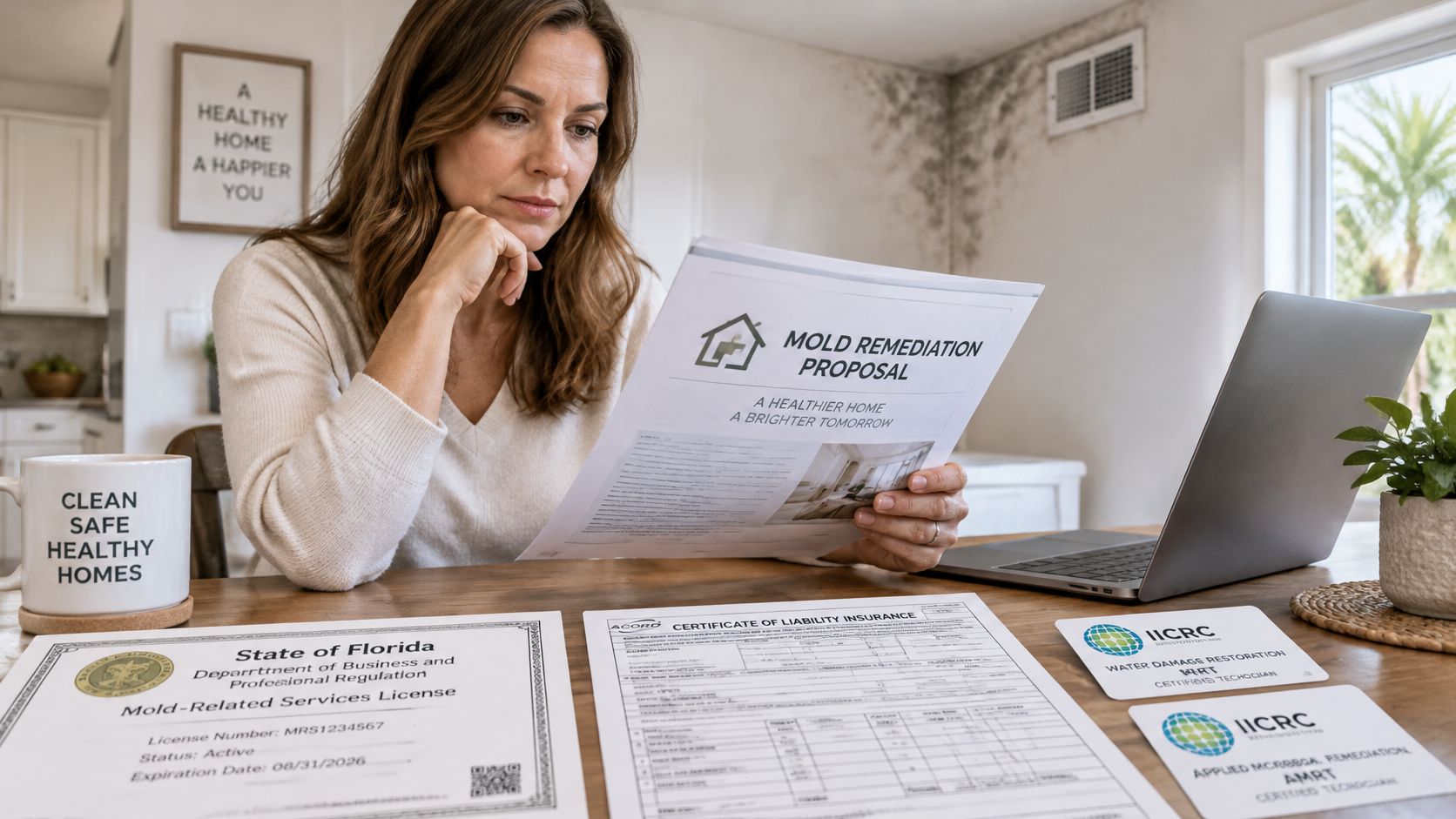
Follow a document-first routine
- Get the name and number. Request the Florida license number and the individual or business associated with it. Compare those details with the entity preparing your contract.
- Confirm the regulated role. Mold assessment and mold remediation are separate functions in Florida. An inspection credential alone doesn't establish authorization to perform remediation.
- Request insurance evidence. Have the insurance agent issue a certificate identifying you as the certificate holder. Check policy dates and ask which coverage applies to mold work. Being a certificate holder isn't the same as being an additional insured.
- Identify the site supervisor and technicians. Ask whose credentials apply to your project, rather than accepting the salesperson's description of the company.
AMPM Restoration Services holds mold remediation license MRSR4840, and our mold removal work is carried out by certified technicians.
Ask which standard guides the work
The ANSI/IICRC S520 standard was first published in 2003, revised in 2008, issued in a third edition in 2015, and released in a fourth edition in 2024. Ask which edition guides the proposed procedures and which training the assigned technicians have completed.
S520 is a remediation standard, not a substitute for checking an individual's certification. Our IICRC-certified restoration company overview provides context for that credential check.
Practical rule: A useful credential answer gives you a person, a number, and a role you can verify. A logo alone doesn't.
Demand a Written Scope That Fixes the Moisture Source
A cheap quote and impressive equipment don't establish a complete remediation plan. Give every bidder the same scope checklist before comparing prices.
- Water pathway and repair responsibility. Identify where moisture enters or accumulates, and name who will correct it.
- Access and affected materials. Specify the walls, cabinets, flooring, or other assemblies to be opened.
- Containment and air controls. Describe barriers, negative-air arrangements where appropriate, and protection for adjoining spaces.
- Cleaning versus disposal. Identify which materials can remain and which must be removed.
- Drying evidence. Record moisture readings, measurement locations, and the criteria used to judge readiness.
- Occupant protection. Address access routes, contents, HVAC involvement, and restrictions during work.
- Completion verification. Name who checks the finished work, what they inspect, and whether verification will be independent.
The EPA's homeowner mold-cleanup guidance recommends contractors with mold-cleanup experience who follow recognized government or professional guidance. Turn that recommendation into a document you can review, rather than accepting a verbal assurance.

Start with moisture evidence, not a test package
NIOSH's testing and remediation guidance says thorough visual inspection and musty-odor detection are more reliable for identifying mold problems than routine air sampling, recommends against routine air sampling for building evaluations, and advises drying wet materials within 48 hours or removing them. Its sequence is practical: inspect, identify moisture sources, repair them, remediate, and reassess.
Painting over damaged or moldy surfaces doesn't complete that sequence. Neither does applying a chemical without evaluating the underlying material.
Our process has four steps: inspection to identify mold hotspots, containment to isolate affected areas, removal using advanced equipment, and prevention that addresses moisture issues and applies antimicrobial spray. We address moisture causes through measures that may include repairing leaks, improving ventilation, or adjusting humidity. Our explanation of how to remediate mold outlines that process.
Protect the scope before work begins
Request a written statement of qualifications and walk through the identified areas with the contractor. Photograph existing conditions and distinguish remediation from reconstruction so you know whether replacement drywall, cabinets, and finishes are included.
Agree on installment payments tied to identifiable progress, rather than giving up control through a large deposit. Put the final inspection and payment conditions in the contract before demolition begins.
A spray-and-wipe proposal after a hurricane may cost less because it leaves out the work that prevents recurrence.
Check the Safety Plan Against the Size of Damage
Use the contractor's affected-area estimate to evaluate the protection plan. The relevant question isn't whether workers own respirators, but whether they've selected appropriate protection for the material and activity.
| Work condition | Protection benchmark to discuss |
|---|---|
| Small affected area | The EPA remediation table gives examples for areas under 10 square feet using at least an N95 respirator, gloves, and goggles, generally without containment for listed materials such as carpet, concrete, hard flooring, plastics, and metals. |
| Larger areas or dust-generating work | OSHA's mold-remediation guidance identifies half-face or full-face N-, R-, or P95 options for areas smaller than 100 square feet, and full-face N-, R-, or P100 protection for areas greater than 100 square feet, heavy blanket-like coverage, or substantial dust generation. |
EPA's area categories guide technique selection. They aren't health-effect thresholds, and they don't make every job within a category identical. Removing moldy insulation above an occupied hallway presents a different exposure problem from cleaning an accessible hard surface.
Read the demolition and isolation details
Ask what measurements the company used and whether the estimate includes concealed damage. Have the contractor explain whether cutting drywall, abrasive cleaning, or debris handling will generate substantial dust.
For larger jobs, the proposal should explain barriers, controlled entry, negative-air arrangements, and the route workers will use to remove bagged debris. Our mold work uses physical barriers and negative air pressure systems to isolate affected areas.
A documented respiratory-protection program addresses training, medical clearance, and fit testing, not just mask availability. Ask the supervisor to confirm those elements and identify the respirator and filter rating assigned to the work.
Safety check: If the contractor can describe its spray product but cannot explain isolation, dust control, or worker protection, the proposal isn't ready to approve.
Keep the safety documentation with the scope. It gives you a way to distinguish planned protection from improvisation once walls are open.
Check Track Record, Guarantees and Complaint History
A contractor may offer inspection, remediation, and clearance under one agreement. Ask who sets the completion criteria and who checks the finished work. Independent verification can help separate the contractor's recommendation from an assessment of the result.
The CDC's mold-cleanup guidance highlights exposure prevention and identifies people with allergies, immune suppression, or underlying lung disease as facing higher risks during cleanup. Tell the contractor if vulnerable occupants live in the home, and seek medical guidance about individual exposure concerns rather than relying on a salesperson's assurance.

Separate the recommendation from the verification
Ask what evidence supports the proposed work, who defines completion, and who evaluates the finished project. The mold remediation clearance testing overview explains post-work verification. Before work begins, confirm the evaluator's qualifications and whether they have a financial or contractual relationship with the remediation contractor.
A Florida attorney general report described complaints across multiple counties, including Sarasota, Hillsborough, and Manatee, alleging deceptive practices involving storm-related roof, water, and mold remediation. Use complaint records as a prompt to check the exact contracting entity, not as a substitute for reviewing the proposed scope.
- References. Request recent local customers you can call. Ask about communication, handling of concealed damage, and whether the completed work matched the written scope.
- Complaint records. Search the legal business name and license holder, not just the trading name on a vehicle. Look for recurring concerns about unclear authorization, unfinished work, or disputed charges.
- Warranty terms. Read the duration, covered work, exclusions, and stated remedy. Check whether recurrence linked to an unrepaired leak is excluded.
On the first call, be cautious if a representative presses for immediate testing, a large deposit, or broad authorization before explaining what the work covers. Emergency stabilization may be urgent, but the written scope should still define what you are authorizing before testing or payment. A guarantee has limited value if its coverage and remedy are vague.
Compare Estimates With Final Costs and Insurance Paperwork
A low bid can become the higher final invoice if it leaves quantities open or excludes predictable demolition. A more detailed estimate may cost more because it includes disposal, drying, verification, or reconstruction omitted elsewhere. Compare the written scope before comparing totals.
Homeowners spend an average of $1,500 for small mold remediation jobs, while extensive remediation can exceed $10,000. These are reference points, not a quote for your property.
| Job size | Reference cost | Common cost drivers |
|---|---|---|
| Small, limited area | Average about $1,500 | Single-room work, surface cleaning, minimal drywall removal |
| Mid-size, multi-area | Itemized project estimate required | Several rooms, partial drywall or flooring removal, containment setup |
| Extensive | More than $10,000 | Whole-floor or whole-building work, HVAC involvement, structural materials, hidden moisture repairs |
Make the bids comparable
- Match the boundaries. Compare the same rooms, materials, access work, and completion requirements.
- Check quantities. Require estimated quantities alongside unit prices, with a written review point.
- Control changes. Get written authorization that describes newly discovered conditions, added work, and the price before work proceeds.
- Separate rebuilding. Confirm whether replacement finishes and repairs are included in remediation or covered by a separate agreement.
A drywall removal rate means little if the contractor can remove an unlimited amount without approval. A change order should identify the newly affected area and explain why it falls outside the original scope. Check that disposal and drying are assigned, too.
Prepare the claim file
Keep inspection findings, photographs, moisture readings, scopes, change orders, and invoices together for the carrier's review. AMPM Restoration offers claim assistance and can communicate with the adjuster; use the written records to document the work. Read about whether mold remediation is covered by insurance to understand why the damage's cause and policy wording matter. Claim help improves documentation; it does not determine coverage.
Review payment milestones and financing terms before signing, and make sure the agreement states when final payment is due. A financing option should not substitute for a clear scope, itemized changes, and documented completion requirements.
Confirm These Points Before You Sign
Before authorizing work, check that the written agreement names the responsible business, defines the work, and states how completion and payment will be handled. Treat signing as a yes-or-no decision. Resolve missing documents before you sign.
- Identity confirmed? The contract identifies the license holder and contracting entity. Confirm the insurance documents cover the entity performing the work.
- Scope complete? The agreement assigns responsibility for moisture correction, containment, removal, disposal, drying, and final verification. Include every unresolved condition in the scope and the payment agreement.
- Communication established? Get the project lead's name, the expected update schedule, and an after-hours contact in writing.
- Guarantee documented? Check that its coverage, duration, exclusions, and remedy are stated in the agreement.
- Payment controlled? Require written approval for changes. Tie final payment to the agreed completion inspection.
What if the inspection finds additional damage?
Ask how newly discovered conditions will be documented and priced before that work begins. The written change should identify the affected area, explain what changed, and state the added cost. If the company cannot explain how approval works before work expands, pause before authorizing the change.
What should happen before a deposit?
Read the payment schedule and confirm what each payment covers. Make sure the agreement explains how a deposit is applied and what happens if the scope changes or work cannot proceed. A request to pay before you receive the written scope, license information, and insurance documentation is a reason to stop and get those items first.
How should I handle a proposed test?
Ask what question the test is intended to answer, who will conduct it, and how the result could change the written scope. Testing is useful when it resolves a specific uncertainty. If the company recommends testing or requests a deposit before showing its license and a clear scope, ask for those documents first.
Use the first phone call to assess communication, not just availability. A company should be able to explain what it will inspect, how it will document proposed work, and how it will handle changes. Vague answers about authorization, payment, or who is responsible for completion are practical red flags.
Knowing how to choose a mold remediation company means prioritizing a clear scope and documented accountability. AMPM Restoration offers a free mold inspection and estimate, and customers can call 941-946-7807 to request one.
AMPM Restoration provides mold inspection, testing, and remediation, with certified technicians and a final inspection to verify the work. The company serves Florida's Suncoast, including Bradenton, Sarasota, Palmetto, St. Petersburg, and the greater Tampa Bay area. Review the written proposal and payment terms before deciding whether to proceed.