

Symptoms of Mold Exposure in a Home
If you’re in Bradenton, Sarasota, Tampa Bay, or anywhere along Florida’s Gulf Coast, this may feel familiar. You notice a musty smell after the AC kicks on. Your nose stays stuffy even when pollen season should be easing up. Someone in the house keeps coughing, waking congested, or rubbing itchy eyes, and nobody can quite explain why.
Those are often the exact moments homeowners start searching for symptoms of mold exposure in a home. That search makes sense. In Florida, heat, humidity, roof leaks, plumbing leaks, storm intrusion, and AC condensation can all create the damp conditions mold needs. The hard part is that mold-related symptoms usually don’t look dramatic or unique. They often look like allergies, irritation, or an asthma flare.
That’s why this guide matters. The goal isn’t to scare you. It’s to help you separate well-established warning signs from internet claims that go too far, and to show you what proves effective when a house has a moisture problem.
Is Your Florida Home Making You Sick?
You wake up congested, get through the workday feeling a little better, then start coughing again an hour after you get home. In Florida, that pattern gets my attention fast, especially if the house has had a roof leak, an AC drain problem, a plumbing drip, or a room that never seems to dry out.
Homeowners often blame dust, pollen, or a cold that will not quit. Sometimes that is true. But repeated symptoms that flare up indoors usually point to a building problem worth checking.
The first thing to understand is simple. Symptoms of mold exposure in a home usually look like allergy or irritation symptoms. They do not announce themselves as one clear, unique illness. That distinction matters because online discussions often blur well-documented reactions, such as nasal congestion, coughing, wheezing, itchy eyes, and skin irritation, with much broader claims about “mold toxicity” that are not supported the same way. If you want a plain-language overview of the health patterns property owners report most often, review these common health effects of mold exposure in a home.
In the field, I pay close attention to timing and location. Symptoms that worsen in a bathroom, around an air handler closet, near a laundry room, under a sink, or in a bedroom with a musty AC smell are more useful clues than the color of a spot on the wall. If someone feels better after leaving the house for a few hours and worse again after sleeping there, that is a practical sign the indoor environment deserves inspection.
Practical rule: If respiratory or eye irritation started after water damage, treat the moisture event and the health pattern as connected until proven otherwise.
Moisture problems also affect more than visible fungal growth. They can aggravate whole-home air quality, which is why some homeowners benefit from reviewing broader whole-home air quality factors alongside leak repair, drying, and containment.
You do not need to identify a mold species on your own to take action. A musty odor, recurring dampness, staining, warped materials, or symptoms that track with time spent indoors are enough reason to inspect the property and decide whether you need a doctor, a mold inspector, or a remediation crew.
Decoding the Health Symptoms of Mold Exposure
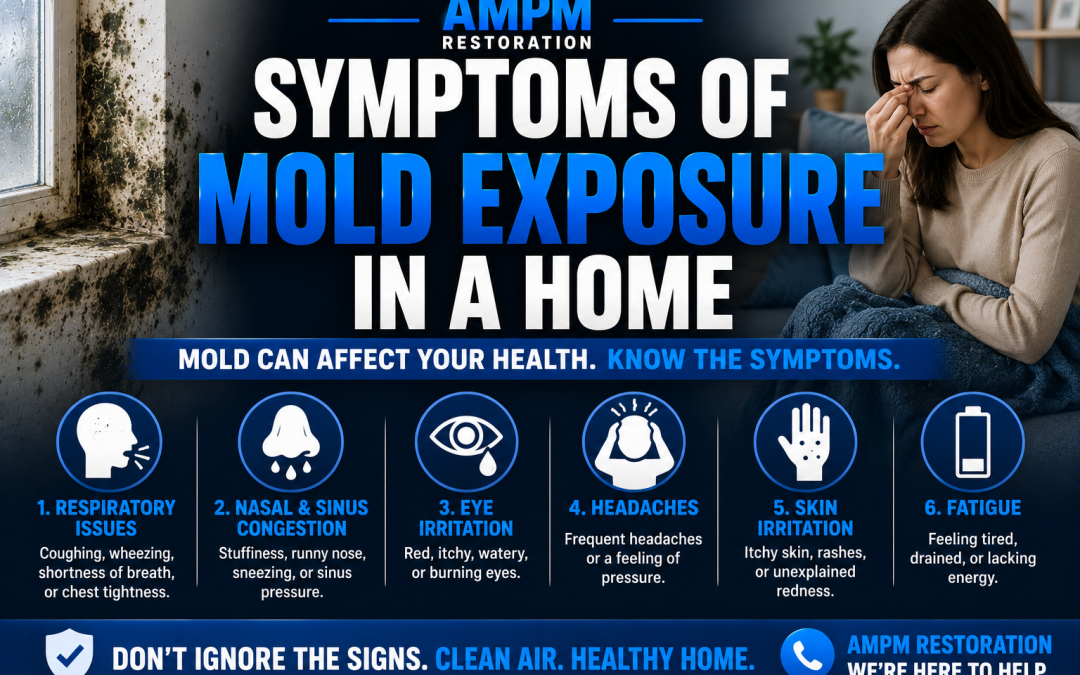
When searching for symptoms of mold exposure in a home, a straight answer is generally desired. Here it is. The most established symptoms are upper-respiratory and irritation-related. That includes stuffy or runny nose, sneezing, cough, wheezing, red or itchy eyes, and sometimes skin irritation. Mainstream clinical guidance is much more cautious about broader “mold toxicity” claims and stays centered on allergy and asthma-type reactions, as explained by Cleveland Clinic’s discussion of black mold symptoms.

The symptoms doctors recognize most consistently
These are the reactions that line up most clearly with damp indoor environments:
- Nasal symptoms: Stuffy nose, runny nose, sneezing, and congestion.
- Eye irritation: Red, itchy, or watery eyes.
- Throat and airway irritation: Coughing, sore throat, throat clearing, or wheezing.
- Skin irritation: Rash or irritated skin in some people.
- Asthma aggravation: Mold exposure can worsen asthma.
That doesn’t mean every cough or headache comes from mold. It means mold belongs on the list when these symptoms show up alongside a leak, musty odor, staining, peeling paint, or chronic indoor dampness.
Where people get confused
A lot of online content jumps from common mold exposure to sweeping claims about fatigue, brain fog, digestive problems, and other body-wide complaints. Those complaints may be real experiences for some people, but authoritative public-health guidance is more limited and more careful. It does not treat the average home mold problem as proof of a broad, unique toxic syndrome.
That distinction matters because it changes your next step. If your main issues are congestion, cough, wheezing, eye irritation, or skin irritation, the mold question is straightforward. Check the home for moisture. If you also have vague symptoms with no obvious property clues, you still need a medical evaluation so other causes aren’t missed.
| Symptom Category | Common Allergic & Respiratory Symptoms (Widely Documented) | Potential Severe or Chronic Symptoms (Reported with Heavy/Long-Term Exposure) |
|---|---|---|
| Nose and sinuses | Stuffy nose, runny nose, sneezing, congestion | Ongoing sinus-type complaints that need medical evaluation |
| Eyes and skin | Red or itchy eyes, skin irritation | Persistent irritation that may overlap with other conditions |
| Throat and chest | Cough, sore throat, wheezing | Worsened breathing problems, especially in susceptible people |
| General complaints | Headache can occur with irritation-related exposure history | Fatigue or difficulty concentrating are sometimes discussed online, but authoritative guidance is more cautious |
If you want a deeper property-health overview, this related guide on health effects of mold exposure adds more context.
Don’t get stuck on whether the mold is “toxic.” If it’s contributing to symptoms or showing that moisture is out of control, it needs attention.
Identifying Who Is Most Vulnerable to Mold
Not everyone in the same house reacts the same way. One person may barely notice anything. Another may start coughing within days. That difference is normal, and it’s one reason mold problems get dismissed for too long.

The people I worry about first
Certain groups deserve faster action:
- People with asthma: Mold exposure can worsen asthma, so even a modest indoor problem can trigger bigger breathing issues.
- People with existing allergies: Their immune systems may react faster and more intensely to mold and damp indoor conditions.
- Infants and young children: They spend a lot of time close to floors, upholstery, and other surfaces where moisture problems may be hiding.
- Older adults: They may be less resilient to ongoing respiratory irritation.
- People with compromised immune systems or chronic lung issues: They need a doctor involved sooner, not later.
Why their reactions can be stronger
Mold doesn’t affect every body the same way. Some people are more reactive to airborne irritants. Others already have inflamed airways, so a damp environment adds another burden their body has to handle. That’s why one family member can feel miserable while another says the house seems fine.
If you have children in the home, this article on how mold affects children is worth reading closely.
The biggest mistake families make is waiting for everyone to have symptoms before taking the house seriously. You don’t need unanimous complaints to have a legitimate indoor air and moisture problem.
Finding Mold in Your Home Visible and Hidden Signs
Homeowners often expect mold to announce itself with black patches crawling up a wall. Sometimes it does. More often, it leaves smaller clues first. In Florida homes, those clues can show up around AC systems, window frames, bathroom ceilings, under sinks, behind furniture on exterior walls, inside closets, and near roof leak paths.
What you can see and smell
Start with the obvious signs:
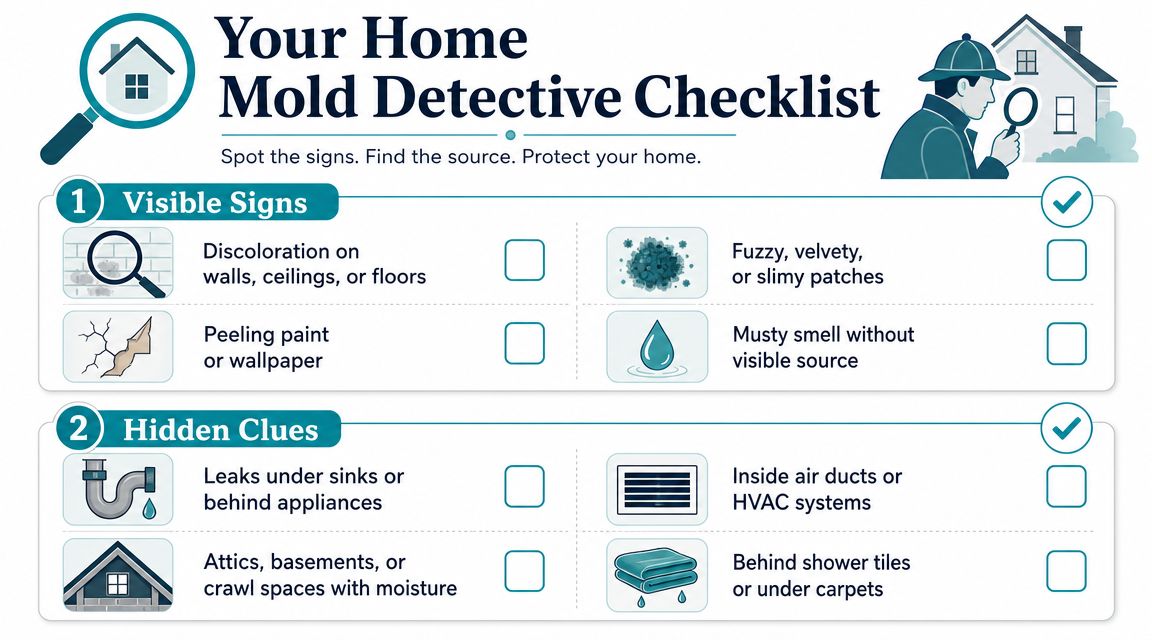
- Discoloration: Brown, green, gray, or dark spotting on walls, ceilings, baseboards, or around vents.
- Surface change: Fuzzy, slimy, or powdery-looking growth.
- Material damage: Bubbling paint, peeling wallpaper, warped trim, soft drywall, or staining.
- Odor: A musty smell, especially in a room that feels closed up or damp.
That musty odor matters more than people think. A room can smell moldy long before you find visible growth. If you smell it repeatedly in the same area, something is feeding it.
Where mold hides
Mold often grows in places homeowners don’t inspect until damage is advanced.
Look closely at these areas:
- Behind or below leaks: Under sinks, around supply lines, behind dishwashers, refrigerators, and washing machines.
- Around HVAC components: Air handlers, drain pans, closet units, vent boots, and duct-adjacent areas with condensation.
- Inside moisture-prone assemblies: Behind shower tile, under flooring, beneath cabinets, and inside wall cavities after a leak.
- Stored items and porous materials: Carpet, upholstery, drywall, ceiling tile, and cardboard all hold moisture.
The EPA states that if mold is present, you must clean up the mold and fix the water problem, and porous materials such as carpets, upholstery, drywall, and ceiling tiles are often hard to dry fast enough, as noted in the EPA guide to mold and moisture in your home.
A spotless-looking wall doesn’t clear the house. If the smell is there, or the materials are swelling, staining, or staying damp, keep looking.
The detective test that actually helps
A useful homeowner test is not a gadget. It’s a pattern check.
Ask yourself:
- Did symptoms begin after a leak, storm, overflow, or AC issue?
- Do symptoms flare in one room or one side of the home?
- Is there a recurring musty smell, even when surfaces look clean?
- Do you see staining, peeling paint, or swollen trim anywhere?
If the answer is yes to several of those, there’s enough reason to stop guessing. This page on five signs of mold damage in homes is a helpful companion if you want to compare what you’re seeing to common field conditions.
When to Call a Doctor vs a Mold Inspector
You wake up congested again. The AC has been running hard, one bedroom smells musty, and a small leak under the air handler happened last week. In that situation, the right first call depends on what is happening to your health and what is happening in the house.
A doctor checks your symptoms. A mold inspector or remediation specialist checks the conditions causing exposure.
Call a doctor when your body needs attention
Persistent coughing, wheezing, sinus irritation, burning eyes, rashes, headaches, or a flare in asthma deserve medical evaluation, whether mold is involved or not. Those symptoms can overlap with seasonal allergies, viral illness, dust, pet dander, and other indoor air problems. A physician can sort out what needs treatment now and what should be ruled out.
Get medical care promptly if breathing feels harder than usual, an inhaler is not working like it normally does, a child is struggling with symptoms, or an older adult or immunocompromised person is affected.
This distinction also matters because homeowners often hear broad claims about “mold toxicity” online. In practice, the most well-documented household mold reactions are allergy and irritation symptoms. If symptoms are significant, unusual, or worsening, let a doctor evaluate the person. Do not rely on internet labels to diagnose the cause.
Call a mold professional when the home has a moisture story
From the building side, I look for water first. A leak, overflow, roof intrusion, AC condensate issue, storm damage, or a room that stays humid too long can turn a small problem into a larger contamination job fast. As noted earlier, wet materials need to be dried quickly after a water event, and indoor humidity should stay controlled. Once that window is missed, drywall, baseboards, insulation, carpet backing, and other porous materials become much harder to trust.
That is why “wait and see” is a poor plan in Florida. Heat, humidity, and closed-up houses speed up the conditions mold uses.
Use this split:
- Doctor first: Breathing trouble, persistent symptoms, asthma flare-ups, or any concern that another medical condition may be involved.
- Inspector first: Musty odor, visible staining, recurring dampness, a recent leak, or materials that stayed wet.
- Both at the same time: Symptoms started around the same time as a water problem or are noticeably worse in the home.
If you are weighing whether a store-bought kit will answer the question, read this guide on how to test air for mold at home. It explains where simple testing helps and where it gives a false sense of certainty.
Insurance questions often come up at this stage too, especially after a leak or storm. These For The Public Adjusters Inc. mold insights can help you understand how coverage issues may connect to the damage.
The practical question is not whether the mold looks dark or dramatic. The practical question is where the moisture started, how far it spread, and what materials can still be saved.
What to Expect from Professional Mold Remediation
A proper mold job starts with the house, not the stain. In Florida, I often see homeowners focus on the spot they can smell or see, while the underlying problem is a wet wall cavity, an AC issue, or a leak that never fully dried. Public health guidance keeps returning to the same point. Dampness and moisture control drive the risk, as explained in Harvard Health’s overview of mold in the home.

What proper remediation includes
A professional project usually follows a sequence like this:
-
Inspection and moisture assessment
The team maps the affected area, checks what materials stayed wet, and traces the water source. If you want a clearer sense of roles before work begins, this guide to mold assessment vs mold remediation explains the difference. -
Containment
The work area is isolated so dust, spores, and debris do not spread through the rest of the home. That matters even more if someone in the house has asthma, allergies, or other respiratory concerns. -
Air filtration
HEPA-equipped air scrubbers are used during demolition and cleaning to reduce airborne particles stirred up by the work. -
Removal of unsalvageable material
Wet drywall, insulation, carpet pad, cabinet backing, and other porous materials may need to come out. This is often the hardest part for homeowners because it feels invasive, but leaving compromised material behind is a common reason problems return. -
Detailed cleaning
Remaining structural surfaces and salvageable contents are cleaned based on the material and the level of contamination. The goal is not to mask odor. The goal is to remove contamination. -
Drying and moisture correction
Drying equipment, humidity control, and repairs to the leak or drainage issue are part of the job. If the moisture source is still active, the cleanup is incomplete no matter how clean the room looks. -
Repair and rebuild
After the area is dry and cleaned, reconstruction can begin. Depending on the loss, that may include drywall, trim, flooring, or cabinetry.
Homeowners often ask whether remediation will also answer every health question. It will not. A good remediation company addresses the building conditions that support mold growth. Your doctor addresses symptoms, allergy concerns, asthma flares, and any broader questions about mold exposure versus more serious toxicity claims.
What does not remove it?
Bleach wipes, fragrance sprays, fogging alone, and paint-over products rarely fix a Florida mold problem. They may change the smell for a short time or lighten staining on the surface, but they do not correct moisture trapped behind baseboards, inside drywall, under flooring, or around HVAC components.
The same caution applies to panic over the term “black mold.” From a remediation standpoint, the practical questions are simpler. What got wet, how far did it spread, what can be saved, and what has to be removed?
A solid remediation plan should leave you with a drier structure, cleaner air pathways, and a clear record of what was removed, cleaned, and corrected. That is what helps lower the chance of the same problem coming back.
Frequently Asked Questions About Mold Removal
Does homeowners insurance cover mold removal?
Sometimes, but it depends on the cause of loss and the policy language. Coverage questions often turn on whether the mold resulted from a covered water event or from a long-term maintenance issue. That’s why documentation matters. Photos, leak history, mitigation records, and inspection findings all help support a claim.
Is DIY mold cleanup a good idea?
For a very small, isolated issue on a non-porous surface, basic cleaning may seem manageable. The problem is that homeowners often underestimate spread, miss the moisture source, or disturb contaminated material and move spores into other parts of the house. DIY efforts also don’t answer the key question of what’s wet behind the surface.
How long does mold remediation take?
It depends on how far the moisture spread, what materials are affected, whether demolition is needed, and whether reconstruction follows immediately. A simple isolated job moves much faster than a project involving drywall removal, cabinetry, flooring, or HVAC-related contamination. The useful question isn’t “How fast can you spray it?” It’s “How thoroughly can you dry, remove, clean, and restore it?”
What happens during a free mold inspection?
A practical inspection usually includes a walkthrough, moisture-focused observations, discussion of leak history and symptoms, and identification of visible or suspected affected areas. The goal is to determine whether there are credible signs of mold and what kind of remediation scope may be needed. If you’re preparing for that visit, it helps to gather any photos of past leaks, invoices for plumbing or roof repairs, and notes about where odors or symptoms are strongest.
Is all visible mold toxic?
No. Homeowners use the word “toxic” loosely, but visible mold does not have to be a special dangerous variety to be a problem. If it’s growing indoors, it means moisture is supporting it. Any indoor mold issue deserves correction because the moisture problem itself is unhealthy for the building and can contribute to irritation-related symptoms.
How do you keep mold from coming back?
Control moisture aggressively. Repair leaks fast. Dry wet materials immediately after a water event. Watch humidity, especially in Florida summers. Improve ventilation in bathrooms and laundry areas. Keep an eye on AC drainage and condensation.
If you’re dealing with symptoms of mold exposure in a home, don’t keep guessing. A medical provider can evaluate your health, and a qualified remediation team can evaluate the building. For homeowners in Bradenton, Sarasota, Tampa Bay, Saint Petersburg, Lakewood Ranch, and nearby Gulf Coast communities, AMPM Restoration Services provides 24/7 help with mold inspection, mold removal, water damage restoration, and reconstruction. Call 941-946-7807 for a free inspection and estimate. We also provide insurance claim assistance and financing options to make the process easier when fast action matters.