


Minor water damage repairs can cost around $1,000, while extensive water damage restoration can exceed $10,000. For Florida homeowners, the useful estimate separates emergency drying from reconstruction, then considers how much of the bill insurance may cover.
Flood damage and an indoor plumbing leak can lead to very different insurance outcomes. The Congressional Budget Office's analysis of flood damage and insurance claims estimated average annual U.S. flood damage of $55 billion over the decade through 2024, measured in 2025 dollars. Average National Flood Insurance Program claims represented about 8% of that estimated damage.
A restoration bill and an insurance payment are separate numbers. Rising water in Saint Petersburg and a broken supply line in Bradenton may both damage a home, but the cause of the water can affect coverage and your out-of-pocket cost.
Water Damage Restoration Cost Ranges
A U.S. estimate for flood or heavy-rain cleanup ranges from $1,000 to $4,000, according to HomeAdvisor's disaster recovery cost guide. The same guide puts standing-water removal at roughly $2,800 and projects combining extraction with repairs above $5,700. These figures describe different scopes, so they are useful for orientation rather than as a local quote.
Typical water damage restoration cost bands
| Job type | Typical cost | Usually includes |
|---|---|---|
| Flood or heavy-rain cleanup | $1,000–$4,000 | Emergency cleanup without full reconstruction |
| Standing water removal | About $2,800 | Pump-out and extraction of standing water |
| Extraction plus repairs | Above $5,700 | Water removal, drying, and material repairs |
The rows represent different scopes, so do not add them together. A standing-water removal figure also does not mean every pump-out costs that amount.
What the word restoration includes
Homeowners may use restoration to describe the full job, from removing water to making the room usable again. The first estimate may cover mitigation, the emergency work to extract water and dry the building. Reconstruction follows if damaged materials need replacement, such as drywall, flooring, paint, or cabinetry.
The split matters when comparing prices. A dry-out estimate and a finished-room estimate cover different stages of the work. The water mitigation cost guide explains the emergency drying portion.
A shallow puddle on accessible tile may need little material removal. Water trapped beneath flooring or behind kitchen cabinets can require more access and additional drying before repairs begin. The visible wet area alone does not show the full scope.
For a Bradenton or Sarasota home, a useful estimate makes clear which stage it covers and what remains for later. The emergency drying bill and the reconstruction bill can be separate parts of the same loss.
Price Drivers From Category to Rebuild
Water category helps explain why two losses in the same room can have different cleanup scopes. Use the basement ranges below to compare severity, not to price a Florida slab home.
Water category and typical basement cleanup cost
| Water category | Typical basement cleanup | Why the price rises |
|---|---|---|
| Category 1 clean supply water | $1,500–$3,500 | A sanitary source may leave more materials suitable for drying |
| Category 2 gray water | $3,000–$7,000 | Additional protection, cleaning, and disposal may be needed |
| Category 3 black or flood water | $7,000–$15,000 | Contamination can require removing and replacing affected materials |
A Category 1 loss starts with a sanitary source, such as a broken supply line. If addressed promptly, more materials may remain suitable for drying.
Category 2 gray water calls for additional protection, cleaning, and disposal. Category 3 black water, including sewage or floodwater, poses a more serious contamination problem and often requires removing affected porous materials.
The appliance alone doesn't determine the category. Water from a clean appliance supply connection isn't automatically gray water, while used wash water may call for a different cleaning plan.
Materials determine access and demolition
Square footage matters, but so does the path water takes. It can travel beneath carpet, into wall cavities, under cabinets, and through flooring seams.
Tile over a dry, intact slab may stay in place. Wet insulation, damaged carpet padding, swollen cabinet bases, and deteriorated drywall may need removal because airflow across the room cannot reliably dry materials that are trapped or badly damaged.
The decision depends on contamination, physical condition, access, and moisture readings that show whether drying is working. A slab home can still have moisture beneath floor coverings, and Gulf Coast humidity can make controlled dehumidification important when outdoor air won't help dry the space.
Drying and rebuilding are different decisions
Drying equipment and monitoring continue while materials release moisture. Reconstruction begins once the affected assembly is suitable for repair.
A small kitchen leak can become a larger project if cabinet bases and continuous flooring need replacement. A wider clean-water spill across accessible, salvageable surfaces may require less rebuilding.
Before approving an estimate, check that it identifies:
- Source and category: What escaped, and how was contamination assessed?
- Affected area: Which rooms and assemblies are included?
- Material removal: What will be removed, and why?
- Drying duration: What equipment and monitoring days are anticipated?
- Rebuild scope: Are drywall, flooring, paint, and cabinetry included or separate?
The 48 Hour Window and Drying Bills
The U.S. Environmental Protection Agency recommends drying wet areas and belongings within 24–48 hours to help prevent mold, while keeping indoor relative humidity below 60%, ideally 30–50%. This is a practical cost-control window, not a promise that mold can't develop sooner or that every assembly will be dry by the deadline.
A wet stain is like the visible edge of a spill beneath a rug. You can wipe away what you see while leaving the material underneath soaked.
The timeline below explains why early action matters.

Follow the drying sequence
- Stop the source safely. Shut off the appropriate water supply when you can reach it safely. Don't enter standing water around energized equipment or attempt electrical work yourself.
- Extract standing water. Pumps and extraction vacuums remove bulk water before drying equipment addresses moisture held in materials.
- Expose and dry affected assemblies. Carpet backing and the subfloor need separate attention. For suitable clean-water situations, technicians combine extraction, airflow, and reduced humidity.
- Check concealed moisture. Measure walls, flooring, and accessible cavities rather than judging dryness by touch.
For wood surfaces, the EPA's material-specific guidance calls for prompt moisture removal supported by dehumidifiers, gentle heat, and fans. Technicians must also account for the substrate, not just the exposed finish.
At AMPM Restoration Services, our certified technicians use advanced diagnostic tools to gauge moisture during assessments. Our water damage work includes sanitizing affected areas and applying mold-prevention treatments, without treating those products as substitutes for proper drying.
Pay for verified drying, not appearances
Equipment rental and monitoring can feel like avoidable expenses when the floor already looks dry. But stopping too early can leave you paying later for removal, disposal, replacement, and mold remediation.
The EPA's commercial-building remediation guidance directs evaluation under mold-remediation procedures when materials remain wet for more than 48 hours or mold develops. Absorbent materials that become moldy may need replacement rather than continued drying.
A dry-looking room isn't proof of a dry wall cavity. Drying should stop on documented readings, not appearance.
Waiting through a humid Bradenton or Sarasota weekend can turn a manageable dry-out into demolition. Our guide to how long water damage restoration takes explains how material condition and access affect scheduling.
Line Items From Extraction Through Repair
The restoration plan should make each charge traceable to a room and a task. After you call, AMPM Restoration's specialists arrive promptly to assess the damage, using diagnostic equipment to evaluate water penetration and identify affected areas.

Match the invoice to the work
Use the written scope to connect the assessment and drying work to any removal, cleaning, and repairs. For example, an extraction charge should describe the affected area and work involved. The drying portion should identify equipment and monitoring, while repair lines should specify materials and finished surfaces.
Ask how added equipment days or newly discovered damage will be recorded and approved. That makes it easier to distinguish a documented change in scope from an unexplained increase.
Contents handling also deserves its own line. Moving furniture to reach wet flooring differs from cleaning belongings, packing them out, or arranging storage.
Make every charge traceable
If the estimate lists drywall removal, it should identify the affected area. If it includes painting, it should say which surfaces will be finished. The same principle applies to sanitizing and other cleaning work: each charge should correspond to a task in the scope.
Ceiling work needs a close look because an overhead stain may involve insulation, electrical fixtures, or water that traveled from another location. The guide to the cost to repair a water-damaged ceiling in Florida explains how cosmetic repairs can differ from a broader restoration scope.
Before work begins, agree on how hidden moisture will be documented and what records you'll receive at completion. Keep the final invoice, moisture documentation, and repair scope together. If the team recommends added work, ask for a written change order that states the new task and charge before approving it.
Suncoast Florida Price Examples
These are illustrative scenarios, not completed customer projects or fixed local quotes. Use them to recognize the type of work your property may need, rather than choosing a price solely from the room name.
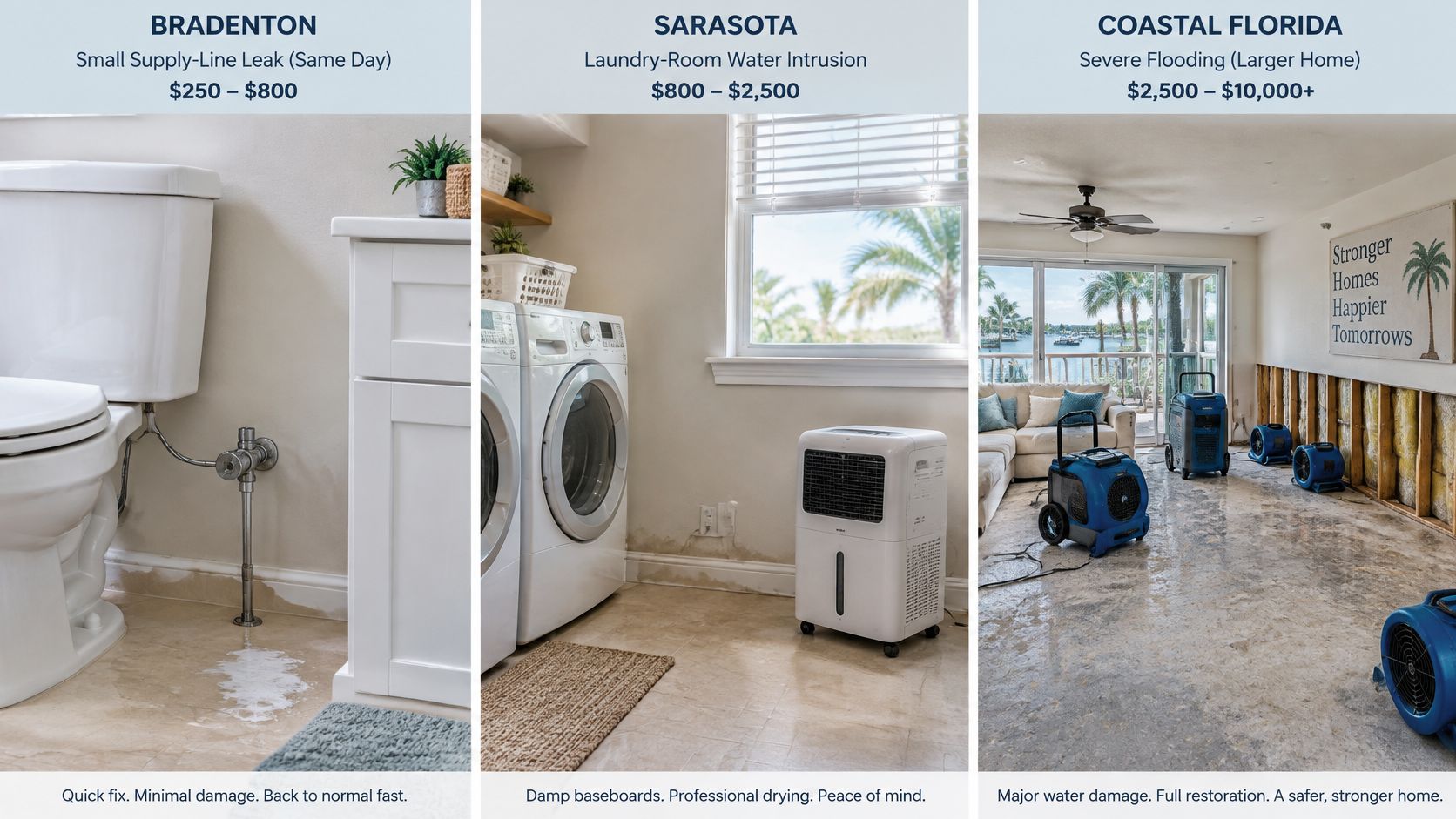
A limited Bradenton bathroom leak
Say a toilet supply connection leaks onto bathroom flooring and the owner catches it promptly. The source is sanitary, the affected area is limited, and moisture readings show that adjacent cavities can dry without extensive removal.
That's the kind of incident that may sit near the lower end of the cleanup band. A small repair can be around $1,000, and a minor incident may take a few days to restore.
The important detail isn't that it happened in a bathroom. It's that water stayed accessible and didn't saturate extensive concealed materials.
A Sarasota laundry overflow
Now consider used laundry water entering a hallway and reaching cabinet bases. If assessment establishes gray-water contamination, technicians need a cleaning and disposal plan that goes beyond a clean supply-line dry-out.
Wet carpet pad, deteriorated cabinet bases, or affected drywall may require removal. Don't automatically apply the same scope to a water-heater supply leak, which may begin with sanitary water.
The comparison below illustrates how different scopes produce different repair expectations.
A Lakewood Ranch multi-room loss
A leak that travels beneath wood-look flooring and wets several walls requires more than surface extraction. Technicians must determine the flooring construction, locate trapped moisture, and assess whether the affected materials remain serviceable.
Extensive restoration can exceed $10,000 when the project requires substantial flooring replacement, wall repairs, and painting. The finished appearance also matters, so the repair scope should explain transitions between retained and replaced finishes.
A Saint Petersburg or Tampa Bay flood
Rising stormwater brings a contamination problem, not just a larger puddle. Porous materials that might be candidates for drying after a clean leak may instead require removal, followed by cleaning and reconstruction.
When the event also damages the roof or building exterior, coordinating the separate repair scopes matters. JA Edwards of America Roofing offers a homeowner's guide to insurance coordination that can help organize the contractor and documentation side of a combined loss.
Access can complicate any of these scenes. In a condo, elevator scheduling and neighboring units may restrict equipment movement; in a Palmetto or Manatee retail property, an after-hours dry-out may change labor scheduling so operations can resume.
We handle minor leaks through major floods across Sarasota County and Manatee County. The assessment turns the closest scenario into a property-specific plan.
Insurance Coverage Versus Your Out of Pocket
Insurance claim averages describe reported losses across many different water damage projects. Figures attributed to the Insurance Information Institute in This Old House's water damage statistics show that water damage and freezing represented 22.6% of U.S. homeowners' claims during 2019–2023, with an average claim of $15,400.
Other summaries cover different periods and claim groups. An ISO/Verisk-based insurance loss summary reports $13,954 per water damage and freezing claim for 2018–2022. These figures reflect insurer-reported losses with varying mitigation, contents, and repair scopes, so they can't predict a specific homeowner's payment.
Match coverage to the water source
What you may pay by water source
| Scenario | Typical policy result | What you may still pay |
|---|---|---|
| Sudden pipe or appliance leak | Often covered by homeowners insurance | Deductible and uncovered upgrades |
| Gradual seepage or long-term leak | Often excluded | Most or all of the restoration bill |
| Storm flood or surge | Usually needs a separate flood policy | Flood deductible, or the full cost if uninsured |
| Sewer or drain backup | Usually needs a backup endorsement | Deductible if endorsed, otherwise the cleanup |
| Mold found after drying | Often limited or excluded | Mold work beyond any cap |
These are common coverage patterns. The insurer evaluates the cause, policy language, exclusions, endorsements, and limits for each claim.
A burst pipe and rising outdoor water can leave similar damage but receive different coverage decisions. Review the details in our water damage insurance coverage guide before reporting a loss.

Identify what sits outside mitigation
An emergency estimate may include extraction, equipment, monitoring, demolition, and sanitization without covering every step needed to finish the property. Plumbing repair, structural rebuilding, contents replacement, and upgraded finishes may be separate.
Your deductible is distinct from whether the loss is covered. Ask which costs are due before work begins, which remain subject to carrier review, and how uncovered work will be approved.
Photograph damaged materials before removal and contact your carrier early. Ask what evidence or samples to retain, while allowing safety-critical mitigation to proceed and avoiding unnecessary storage of contaminated materials.
AMPM Restoration works with insurance providers and supplies documentation supporting the restoration scope. The company can assist with coordination, but the carrier decides which charges are covered.
Get a Free Inspection and Estimate
AMPM Restoration offers a free inspection and estimate to help you understand the proposed work before deciding how to proceed. A specialist assesses the damage and creates a plan for the property. You can request an inspection and water damage restoration estimate.
Serving Bradenton, Sarasota, Tampa Bay, and Saint Petersburg, AMPM Restoration is available 24/7 for water damage emergencies. When you call, describe where the water appeared, whether the source is still active, and which rooms or business areas are affected. The team can then assess the damage and explain the recommended scope.
Can a small clean-water leak cost around $1,000?
Yes. Minor water damage repairs can cost around $1,000. Ask the technician which work is included in the estimate and whether repairs are listed separately from emergency drying.
What should I have ready when I call?
Share the property address, the suspected source of the water, and any steps already taken to stop it. If you have photos or claim details, keep them handy for the assessment.
Can you help with an insurance claim?
AMPM Restoration works with insurance providers and supplies necessary documentation for water damage claims. Ask which records will be prepared and how the proposed scope will be shared with your insurer.
Do you restore commercial properties and other types of damage?
Yes. AMPM Restoration serves homes and commercial properties, with services that include mold removal and remediation, fire damage restoration, storm and flood damage restoration, and leak detection. Its certified technicians also provide water damage restoration and emergency dry-out.
For a clear estimate and a plan designed for your property, visit AMPM Restoration Services. Call 941-946-7807 for a free inspection and estimate.