

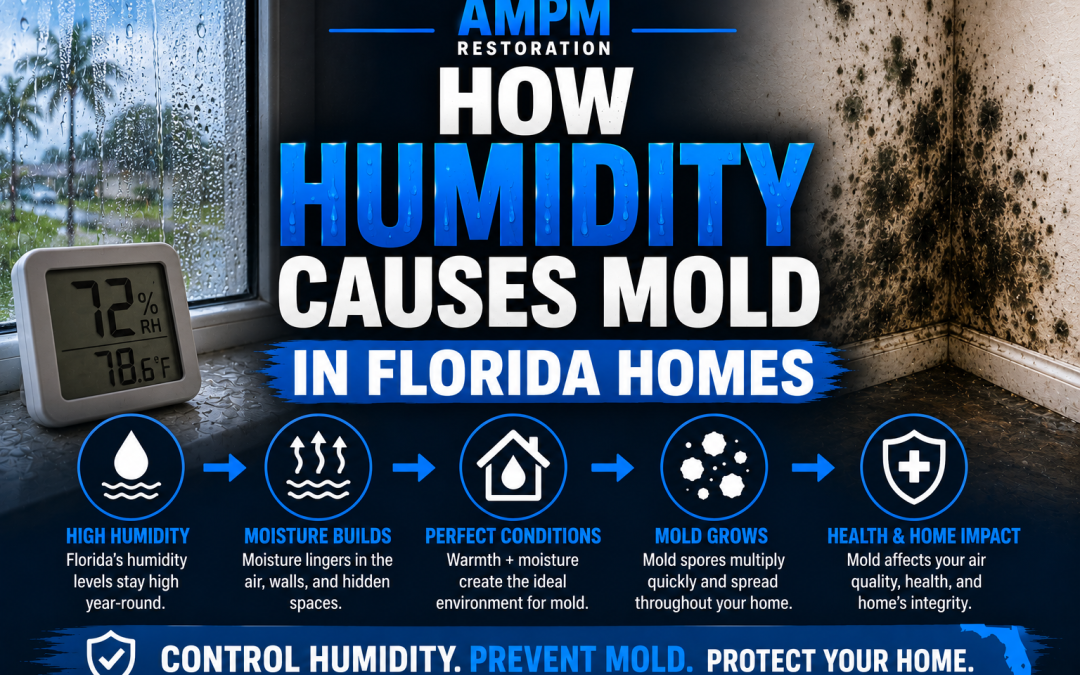
How Humidity Causes Mold in Florida Homes
Your AC is running, but the house still feels sticky. The windows fog in the morning. Towels take too long to dry. A closet smells musty even though nothing looks wet. That’s a familiar pattern on the Florida Suncoast, and it’s often the first clue to how humidity causes mold in Florida homes.
For many homeowners in Bradenton, Sarasota, Lakewood Ranch, Saint Petersburg, and across Tampa Bay, mold doesn’t start with a dramatic pipe burst. It starts with damp air that hangs around too long, settles onto cool surfaces, and feeds hidden growth behind drywall, inside closets, around window frames, and near HVAC components.
The Unseen Threat in Florida’s Air
A lot of Florida homeowners assume mold only follows storm damage or a major leak. In reality, high indoor moisture can create trouble long before you see standing water. Your home can feel clean, cool, and still be damp enough for mold to start growing on ordinary materials like drywall, wood trim, ceiling texture, cardboard, and dust.
That’s one reason this issue shows up so often in local homes. In Florida, an estimated 264,000 mold-related claims were filed in 2022, representing over 20% of all home insurance claims, according to WUSF’s reporting on Florida’s mold problem. The same report notes Florida Department of Health guidance that indoor mold growth can begin when humidity is high, and that indoor relative humidity should stay below 60%, with below 50% being best for controlling mold growth.
Why the house can feel dry and still be too humid
Air conditioning cools air. It also removes some moisture. But those aren’t the same job.
A home can feel comfortable by temperature standards while still holding enough airborne moisture to wet surfaces over time. That’s where people get confused. They think, “The AC is on, so humidity can’t be the problem.” In Florida, it often still is.
Practical rule: If your home feels clammy, smells musty, or shows repeated condensation, don’t wait for visible black spots to take the issue seriously.
What homeowners usually notice first
Small warning signs often appear before visible mold does:
- A stubborn musty odor that comes back after cleaning
- Condensation on windows or vents during humid weather
- Closets that smell damp even with the doors shut
- Ceiling stains or peeling paint near vents, bathrooms, or exterior walls
If you’ve noticed any of that, you’re already dealing with the conditions that explain how humidity causes mold in Florida homes.
The Science Behind Humidity and Mold Growth
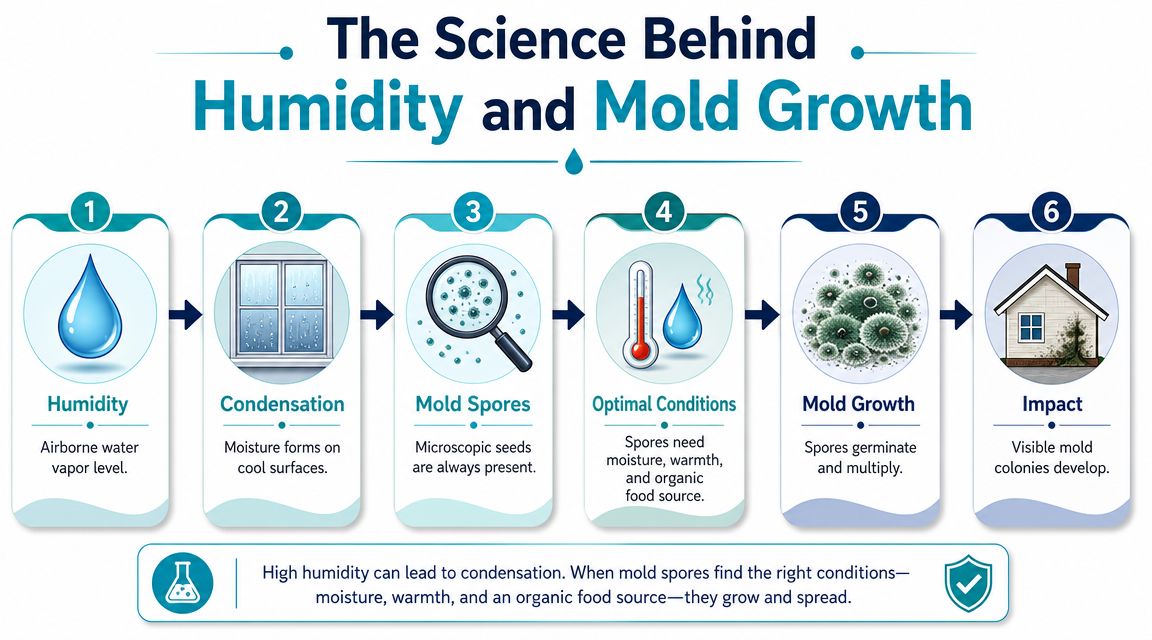
Mold needs three things: a food source, a suitable temperature, and moisture. The first two are already present in most homes. Drywall paper, wood, dust, and fabric all give mold something to feed on. Florida temperatures rarely slow it down for long. That leaves moisture as the factor homeowners can control.
What relative humidity means inside your home
Relative humidity, or RH, is the amount of moisture in the air compared with how much moisture the air can hold at that temperature. You don’t need to memorize the physics. Think of air like a sponge. When that sponge is already holding a lot of water, it doesn’t take much for nearby materials to get damp.
In Florida homes, mold risk rises sharply once indoor relative humidity stays above about 60%, and many building-science sources treat 70% RH as the zone where fungal growth becomes much more likely, according to UCF’s building science guidance on mold growth. The same guidance explains why this happens: humid air can push porous materials like gypsum board and wood above their critical moisture content even when there’s no visible leak.
Why condensation matters so much
Condensation is water leaving the air and landing on a cooler surface. You see it on a cold drink outside. The same thing happens on supply vents, window glass, metal fasteners, and sometimes inside wall cavities.
Once that moisture settles in, mold spores have what they need. Spores are already present in normal indoor air. They don’t need an invitation. They just need the right surface conditions.
That’s also why hidden mold is common in homes with AC issues. If you want a deeper look at one common concern, AMPM’s article on what causes black mold in homes explains how moisture and surface materials work together.
Why drywall and wood are vulnerable
Porous materials absorb moisture instead of shedding it. Drywall paper, framing lumber, subfloors, ceiling texture, and stored cardboard all hold dampness longer than tile or glass. That turns a temporary humidity problem into a long-lasting mold problem.
Here’s the chain reaction:
- Humid air enters or builds up indoors
- Cool surfaces collect moisture
- Porous materials absorb that moisture
- Spores settle and begin growing
- Colonies spread where airflow is limited
Warm air can carry moisture you never see. Building materials respond to that moisture even when the wall or ceiling looks dry from the outside.
That’s the core science behind how humidity causes mold in Florida homes. The air itself becomes the delivery system for moisture.
Common Moisture Hotspots in Suncoast Homes
The science becomes easier to spot when you walk through a typical Suncoast house room by room. In Bradenton and Sarasota homes, mold often shows up where humid air slows down, condenses, or gets trapped behind everyday finishes.

Bathrooms and laundry areas
Bathrooms create short bursts of heavy moisture. If the exhaust fan is weak, dirty, or rarely used, steam settles onto ceilings, grout lines, vanity walls, and the back sides of doors. Laundry rooms have a similar problem when warm, damp air from washing and drying lingers in a tight space.
Look for:
- Ceiling spotting above showers
- Darkened caulk or grout
- Soft drywall near baseboards
- Condensation on mirrors or paint that hangs around too long
Windows, exterior walls, and under-sink cabinets
Window areas are trouble spots because Florida rain, sun, and temperature differences all stress seals. If humid indoor air keeps meeting cooler glass, water forms repeatedly and wets nearby trim or sills. For practical maintenance tips focused on this exact issue, Professional Window Cleaning’s guide is a useful reference for preventing mold on window sills.
Under-sink cabinets are another hidden zone. A tiny drip plus poor airflow can keep cabinet walls damp for weeks. Homeowners often miss it because the doors stay shut and the leak never becomes dramatic.
HVAC closets and duct-related spaces
On the Gulf Coast, HVAC systems are often at the center of the problem. Condensation around air handlers, clogged drain lines, sweating ducts, and unbalanced airflow can all leave nearby materials damp. If you suspect growth is tied to your system, AMPM’s guide on how to remove mold from air ducts covers what to look for and why duct contamination needs careful handling.
A quick walkthrough checklist helps:
| Area | Why it gets damp | What you might notice |
|---|---|---|
| Bathroom ceiling | Steam lingers | Speckling, peeling paint |
| Window sill | Repeated condensation | Swollen trim, dark corners |
| HVAC closet | Condensation or poor drainage | Musty smell, staining |
| Under sink | Slow leak and trapped air | Warped cabinet floor |
| Laundry room | Warm moist air | Damp walls, stale odor |
Most moisture hotspots aren’t dramatic. They’re persistent.
The Hidden Dangers of Unchecked Mold
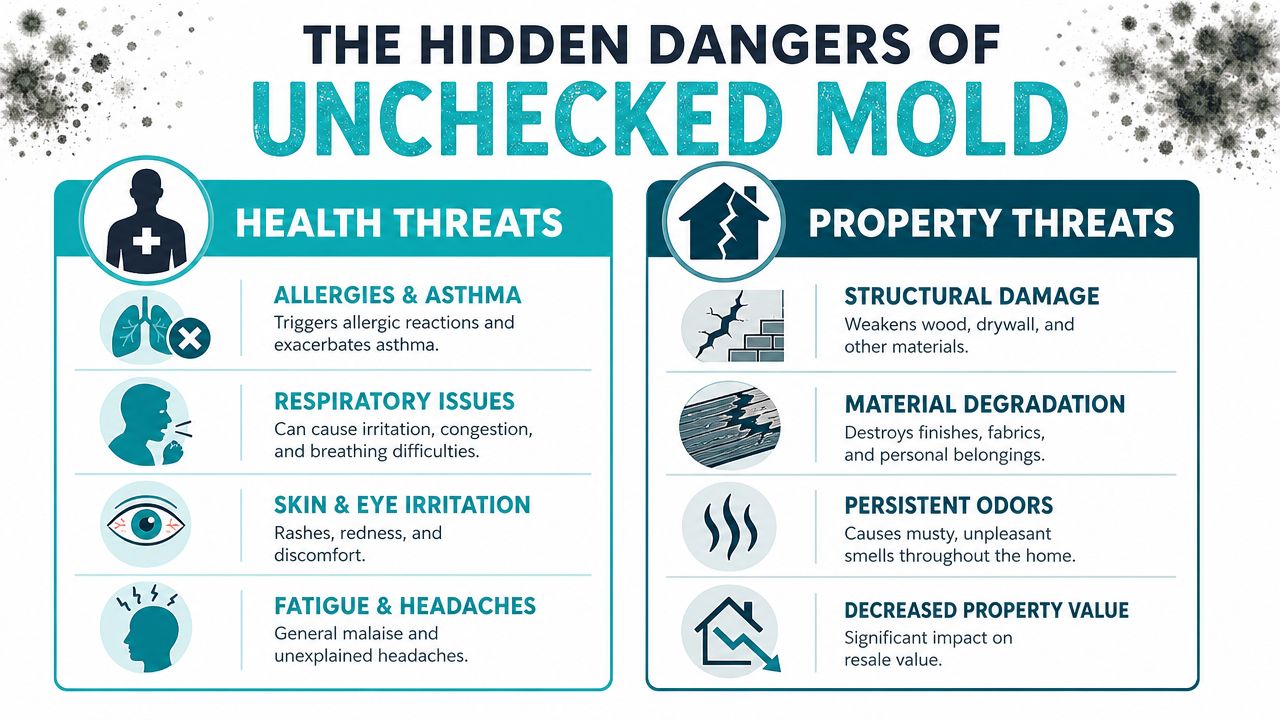
Mold is more than a cosmetic problem. Once it starts feeding on damp materials, it can affect both the people living in the home and the structure itself.
What mold can do to indoor health
Some people react quickly to mold exposure. Others notice symptoms more gradually and don’t connect them to the house right away. Common complaints include congestion, throat irritation, coughing, sneezing, eye irritation, and worsened asthma symptoms. People with allergies, asthma, or other respiratory sensitivities often have a harder time in mold-affected spaces.
If you want a fuller overview of common symptoms and exposure concerns, AMPM has a resource on 10 health effects of mold exposure.
If family members feel worse in one room, one wing of the house, or only when the AC runs, that pattern matters.
What mold does to building materials
Mold doesn’t just sit on the surface. On porous materials, it can grow into the material itself. Drywall loses strength. Wood stays damp and begins to deteriorate. Baseboards swell. Paint blisters. Ceiling texture loosens. Carpet backing and stored contents can hold odor long after the original moisture source is gone.
A simple way to view it:
- Surface damage starts with staining and odor
- Material damage follows as drywall, wood, and fabrics stay wet
- Hidden spread develops behind walls, under flooring, or near ducts
- Repair scope grows because more materials need removal and replacement
Why delay makes cleanup harder
Humidity-driven mold often goes unnoticed longer than flood-related mold. There’s no dramatic event to trigger action. By the time a homeowner sees staining or smells a strong musty odor, growth may already be established in more than one area.
That’s why early inspection matters. The longer excess moisture stays in place, the less likely a simple surface cleaning will solve the problem.
Proactive Strategies to Control Home Humidity
Prevention works best when you treat humidity control as a system, not a single fix. A dehumidifier alone won’t solve a bad drain line. A repaired leak won’t solve poor ventilation. You need to reduce moisture entry, remove indoor moisture, and keep air moving.

Start by measuring what the air is doing
You can’t manage humidity by feel alone. A simple hygrometer gives you a real reading, and that matters because Florida homes can feel comfortable while still being too damp for safety. The Florida Department of Health advises keeping indoor humidity below 60%, ideally below 50%, and says common molds can take hold when water stands for even 24 hours. The same guidance recommends drying wet building materials and carpets within 24 hours, as explained in the Florida Department of Health mold guidance.
Check readings in the main living space, a bedroom, and any problem area such as a laundry room or closet. If one area stays consistently higher, that’s a clue about where moisture is entering or getting trapped.
Build a routine around moisture control
These habits make a real difference:
- Run exhaust fans during and after showers. Let them clear steam instead of switching them off the moment you leave the room.
- Inspect AC components regularly. Pay attention to drain lines, filters, vents, and any signs of water near the air handler.
- Repair small leaks quickly. A slow drip under a sink can keep a cabinet damp enough for mold.
- Keep air circulating in closed spaces. Closets, utility rooms, and corners behind furniture often trap stale humid air.
- Insulate cold plumbing where condensation forms. Pipes that sweat repeatedly can wet nearby framing and drywall.
For homeowners trying to understand broader building-envelope issues tied to moisture movement, this article on preventing home moisture issues offers useful background on vapor barriers and how moisture moves through a structure.
Match the solution to the source
Not every home needs the same fix. One house needs better bath ventilation. Another needs AC service. Another needs leak detection and drying after a hidden plumbing issue. A practical first step is using a whole-home prevention checklist like AMPM’s guide on how to prevent mold the full home guide.
Moisture control works fastest when you stop asking, “How do I clean this?” and start asking, “Why is this area staying damp?”
That shift is what protects a home long-term. It also helps homeowners understand how humidity causes mold in Florida homes before damage spreads.
Found Mold? When to DIY and When to Call Professionals
Not every mold spot means a major remediation project. Some small issues can be cleaned safely. But many Florida homeowners underestimate how often visible mold is only the tip of a bigger moisture problem.
When DIY may be reasonable
If the growth is very limited, on a non-porous surface, and clearly linked to a small isolated issue you’ve already corrected, cautious cleaning may be enough. A little spotting on tile near a shower, for example, is different from staining on drywall around an AC vent.
DIY should stay limited. If you scrub a surface but ignore the humidity source, the mold usually returns.
When professional help makes more sense
Call a remediation professional when the mold appears to be spreading, keeps coming back, smells stronger than it looks, follows water damage, or may involve porous materials, HVAC components, wall cavities, or people with respiratory concerns in the home. Those situations need containment, moisture mapping, source correction, and safe removal procedures.
If you’re unsure where that line is, AMPM’s page on when do I need professional mold removal gives a useful framework for deciding.
DIY vs. Professional Mold Remediation
| Scenario | DIY Approach (Use Caution) | Professional Recommendation (Call AMPM) |
|---|---|---|
| Small spotting on tile or other non-porous surface | Clean carefully after fixing the moisture source | Call if it returns or spreads |
| Mold on drywall, wood, ceiling texture, or carpet | Surface cleaning often won’t reach the root | Professional assessment is the safer choice |
| Strong musty odor with little or no visible mold | Hard to locate hidden growth on your own | Professional inspection can identify concealed moisture |
| After leak, overflow, or storm intrusion | Drying must be thorough and immediate | Professional drying and remediation may be needed |
| HVAC or duct concerns | DIY cleaning can miss contamination pathways | Professional containment and cleaning are recommended |
For larger or hidden problems, AMPM Restoration Services can inspect, contain, dry, remediate, and rebuild affected areas as needed. That matters because proper mold work isn’t just cleaning. It’s finding where moisture is coming from and preventing cross-contamination while the affected materials are handled.
Your Florida Mold Questions Answered
Can high humidity alone cause mold without a leak?
Yes. That’s one of the main points homeowners miss. If indoor air stays humid enough for long enough, materials like drywall and wood can absorb moisture from the air itself. That’s a direct part of how humidity causes mold in Florida homes.
Is condensation on windows a real warning sign?
Yes. Repeated condensation means moisture is regularly reaching a surface cool enough for water to form. Even if the glass dries later, nearby trim, paint, or wall materials may be getting damp again and again.
Can I just paint over mold?
No. Paint can hide staining, but it doesn’t remove active growth or solve the moisture source. If the material underneath is still damp, the problem usually comes back through the new finish.
Why does mold keep returning after I clean it?
Because cleaning the spot and fixing the cause are different jobs. If the room still has high humidity, poor airflow, condensation, or a hidden leak, mold can regrow on the same surface or nearby materials.
Are DIY test kits enough to diagnose the problem?
They can be confusing for homeowners because mold spores are common in normal environments. A kit may tell you something is present without answering the key questions: where it’s growing, what area is wet, and whether hidden materials are affected.
Will homeowners insurance cover mold from humidity?
Coverage depends on the policy and the cause of loss. Gradual humidity issues are often treated differently from sudden accidental water damage. The best approach is to document the problem early and ask for claim guidance before assumptions turn into delays.
If you’re dealing with musty odors, visible growth, or signs of persistent indoor dampness in Bradenton, Sarasota, Tampa Bay, Saint Petersburg, or Lakewood Ranch, AMPM Restoration Services can help identify the moisture source and explain your options clearly. Call 941-946-7807 for a free inspection and estimate. We offer insurance claim assistance and financing options, and we’re available 24/7 when mold, leaks, or water damage can’t wait.