

Homeowners insurance covers mold remediation only when the mold comes from a sudden, accidental covered peril like a burst pipe, and many policies cap that mold payment at about $2,500 to $10,000 instead of paying the full cleanup bill. If the mold came from a slow leak, neglect, or flood water, it's usually excluded.
If you're reading this, you're probably standing in a hallway staring at a stain, smelling that musty odor, or waiting on an adjuster who hasn't given you a straight answer. The question isn't just is mold remediation covered by insurance. The question is whether you can prove the mold followed a covered water event, whether you reported it fast, and whether your policy buries the payout inside a mold sublimit.
I've sat across from enough adjusters to tell you exactly where these claims go sideways. Homeowners focus on the mold. Carriers focus on the water source, the timeline, and the paperwork. If you can't connect the mold to a covered loss with clean documentation, the carrier will treat it like a maintenance problem and shut the door.
AMPM Restoration is a 24/7 emergency restoration company based at 4301 32nd St W b18, Bradenton, FL 34205, serving Bradenton, Sarasota, Tampa Bay, Saint Petersburg, Lakewood Ranch, and surrounding Gulf Coast communities with professional water damage restoration, mold inspection and mold removal, fire and smoke damage restoration, storm and flood damage restoration, commercial restoration services, and full reconstruction solutions. In Florida, especially on the Gulf Coast, speed matters because wet drywall, baseboards, cabinets, and insulation don't wait for the insurance company to get organized.
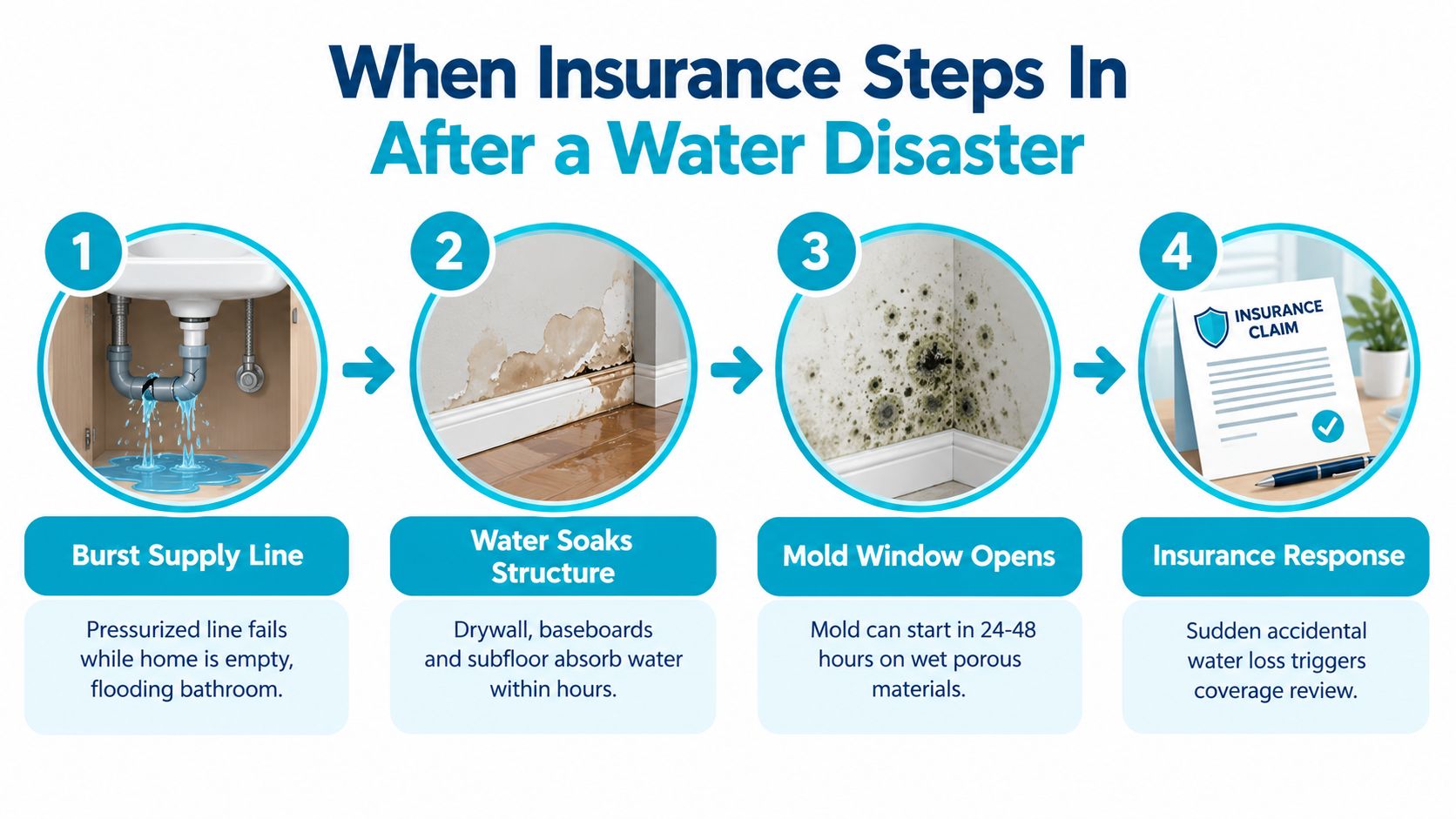
When Insurance Steps In After a Water Disaster
You get home Sunday night, step into the bathroom, and hear the floor squish. A supply line let go under the sink. Water ran long enough to soak the vanity, wick into the baseboards, and push moisture behind the drywall. By the time the plumber stops the leak, the mold question has already started.
Insurance usually enters the picture at the water-loss stage first. That is the point many Florida homeowners miss. The carrier is not opening a claim because they see discoloration on drywall. The carrier is opening a file because there was a covered water event, fast mitigation, and a paper trail that ties the resulting damage together.
What the carrier wants to see
If you want the mold portion paid, build the claim like a water claim from day one. Adjusters look for three things:
- A clear starting event. The file needs a specific cause of loss, such as a burst supply line, appliance discharge, or overflow.
- Fast mitigation. Dry-out, extraction, demolition of wet materials, and plumber invoices show you took reasonable steps to stop further damage.
- A clean timeline. Photos, moisture readings, emergency service records, and reporting dates must line up.
Practical rule: Call it in as water damage immediately, then document the mold as damage that followed the same event and same affected area.
That framing changes the entire claim arc. It affects how the adjuster writes the estimate, how the carrier applies mold limits, and whether later remediation gets treated as part of the same loss or pushed into a denial letter.
Homeowners dealing with roof failures, wind-driven rain, or other storm openings should also review JA Edwards of America storm repair for examples of how exterior damage can start the same chain of events. If you need the bigger insurance picture before you report the loss, this guide on home insurance coverage for water damage lays out how carriers typically sort these claims.
What insurance may actually pay
A covered water loss can open the door to payment for extraction, dry-out, tear-out of wet materials, repairs to damaged building components, and limited mold cleanup tied to that same event. The catch is simple. Full damage does not mean full payment.
Many policies carve mold into a separate bucket with its own cap, conditions, and exclusions. Homeowners learn that too late, after the adjuster accepts the water claim but trims the remediation scope or applies a low mold sublimit. I see that fight all the time in Florida.
Get the claim opened fast. Get mitigation started. Get every invoice, photo, moisture log, and contractor note into the file early. That is what moves a claim toward a real check instead of a partial payment with a lot of excuses.
Why Sudden Damage Gets Covered and Gradual Damage Does Not
You call the carrier on Monday after water pours through a ceiling from a burst supply line. The adjuster sees a clear event, a short timeline, and damage that matches the story. That claim has a real chance.
You call two months after finding mold behind a vanity where a slow drip has been soaking the cabinet base. The drywall is stained, the wood is soft, and nobody can say when it started. That file usually heads straight toward wear, tear, neglect, or repeated seepage.
That difference controls the claim.
Homeowners get stuck on the mold. Adjusters focus on the water source. Standard homeowners policies are built to insure sudden and accidental direct physical loss, while long-term leakage and maintenance problems are commonly excluded. Consumer guidance from the Insurance Information Institute on homeowners insurance and maintenance-related losses lines up with what plays out in real claims every week.

The first question adjusters ask
They start with cause and timeline.
If the water came from a burst pipe, failed supply line, overflowing appliance, or storm-created opening, the carrier can tie the damage to a specific event. If the moisture came from failed caulk, bad grout, old roof wear, chronic humidity, or a leak that kept dripping, the carrier has an easy argument that the house needed maintenance, not an insurance payout.
That is why the same mold growth can lead to two completely different outcomes.
What separates a payable loss from a denial
Adjusters look for three things right away:
- A clear trigger. One identifiable event beats a vague history every time.
- A short timeline. Damage discovered quickly is easier to connect to a covered loss.
- Evidence that matches the story. Photos, plumber findings, moisture readings, and mitigation notes need to line up.
Miss one of those, and the claim gets weaker. Miss all three, and the denial letter is usually already half-written.
Covered versus denied in plain English
| Scenario | Why it matters | Likely claim direction |
|---|---|---|
| Pipe burst overnight | Sudden discharge from plumbing with a defined date of loss | Stronger coverage path |
| Washer hose fails during a cycle | Accidental water release tied to one event | Stronger coverage path |
| Slow leak under sink | Repeated seepage over time | Common denial path |
| Shower seepage from failed caulk or grout | Maintenance problem, not sudden loss | Common denial path |
| Chronic indoor humidity | No single covered water event to pin the mold on | Weak claim |
Mold is rarely the main coverage issue. The timeline of the moisture intrusion is.
If you are not sure whether the staining, swelling, or odor in your home looks recent or long-term, review how to identify water damage months later before the adjuster inspection. It will help you spot the red flags that push a file into the maintenance bucket.
One more hard truth from the field. Homeowners hurt their own claims when they clean up the visible mold but throw away the evidence of the leak, the damaged supply line, or the wet materials that show how fresh the loss was. Keep the failed part if you can do it safely. Get photos before tear-out. Get a plumber or mitigation crew to put the cause in writing. That is how you prove sudden damage instead of giving the carrier room to call it gradual.
Mold Sublimits Exclusions and Endorsements Explained
A lot of Florida homeowners think the hard part is getting the water loss accepted. Often, the fight starts after that, when the carrier agrees the leak happened but points to a mold cap buried in the policy.
That cap matters because mold is often handled in its own bucket. Even when the water damage is covered, the mold portion may be limited to a much smaller amount, commonly somewhere in the $2,500 to $10,000 range. The numbers that show up over and over are $2,500 and $5,000. If your remediation estimate comes in above that, the gap usually lands on the homeowner unless an endorsement raises the limit.
Exclusions that shut claims down fast
Some policy problems are obvious once you know where to look:
- Flood water: Standard homeowners insurance usually does not pay for mold tied to rising water or flood intrusion.
- Long-term leaks or neglect: Ongoing seepage, deferred maintenance, and moisture you had time to fix are common denial triggers.
- Restricted mold wording: Some policies acknowledge the resulting mold condition but still limit or exclude testing, containment, or remediation steps.
Policy wording can get tighter than homeowners expect. The Texas Department of Insurance has published endorsement language showing a common carrier position: a sudden covered discharge may open the door to part of the loss, while mold testing and remediation can still be carved out or restricted under that form (Texas Department of Insurance mold endorsement language). Different state, same lesson. Read the endorsement line by line before you assume what is paid.
Typical Florida Mold Coverage Components
| Policy Element | Standard HO-3 | With Endorsement |
|---|---|---|
| Mold coverage | Often excluded or limited | May add or expand limited mold protection |
| Mold payout limit | Commonly a separate small sublimit | Can sometimes increase the available mold limit |
| Water backup loss | Often excluded without added coverage | May be covered if backup endorsement is added |
| Flood-related mold | Typically excluded | Still handled separately from standard homeowners coverage |
| Mold testing and remediation wording | Can be restricted | Must be reviewed carefully, not assumed |
Here is my recommendation. Ask for the full policy, the declarations page, and every endorsement before you approve cleanup beyond emergency drying. Then match the remediation scope to the actual mold limit, not the adjuster's verbal summary. A good outside read on where disputes start and how public adjusters help with mold claims can sharpen your expectations before you sign anything or accept the first estimate. If you want the contractor-side version of what carriers usually request, review this mold remediation report guide. It shows the paperwork that helps move a claim from argument to payment.
How to Document and File a Strong Mold Claim
Bad documentation ruins good claims. I've seen covered water losses turn into ugly fights because the homeowner cleaned too much, waited too long, or never wrote down a clear timeline.
The order matters
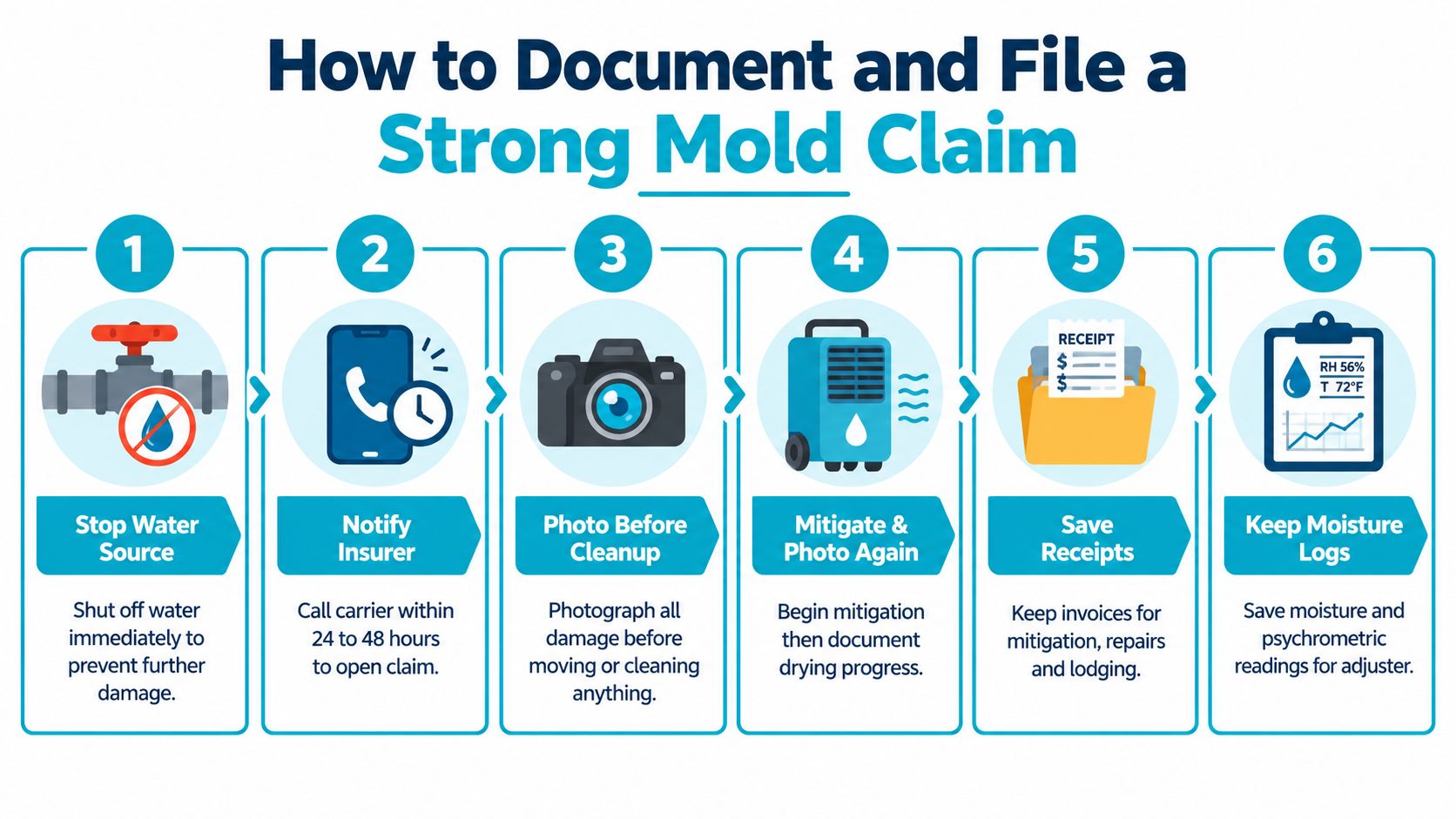
Start with the water source. If the line is still active, shut it off. Then notify the carrier quickly. Industry guidance consistently ties mold coverage to prompt reporting of the original water event because mold is usually treated as a resulting loss from the covered water damage, not a separate standalone event (The Zebra on resulting loss and prompt reporting).
What to gather before the adjuster visit
Use this checklist and keep it simple:
- Photos before cleanup: Get wide shots of each room, then close-ups of wet materials, staining, swelling, and visible growth.
- A short timeline: Date the water event, the discovery, the first mitigation step, and the date you reported it.
- Moisture records: Ask the mitigation company for moisture maps and daily readings.
- Material samples and damaged pieces: Don't throw everything in the dumpster before inspection if it can be safely retained.
- Invoices and receipts: Emergency dry-out, hotel stays if applicable, plumbing repairs, and mitigation charges all belong in the file.
Three mistakes that sink otherwise solid claims
- Waiting to report: Carriers love delay arguments. If weeks pass, they'll say the mold worsened because you didn't act.
- Cleaning without documenting: Once materials are stripped and tossed, proof disappears with them.
- Signing broad paperwork too fast: Some contracts hand over too much control before you understand the claim.
Keep the story straight. “Pipe burst on Tuesday, mitigation started Wednesday, mold was visible in the same wet wall area on Friday” is the kind of cause-of-loss narrative adjusters can follow.
When homeowners ask me what a “strong file” looks like, I tell them it looks boring. Clear dates, clean photos, itemized scope, no gaps, no drama. If you need help organizing that process, this walkthrough on how to file an insurance claim for water damage lines up with what carriers expect to see.
Working With a Restoration Company to Strengthen Your Claim
Hiring the right restoration company isn't just about drying the house. It's about protecting the claim while the house is being dried.
What professionals document that homeowners usually don't
An experienced IICRC-certified crew records the details adjusters use:
- Moisture readings: Wet versus dry standards by material and area.
- Psychrometric conditions: The drying environment, not just surface appearance.
- Containment setup: How the crew prevented cross-contamination.
- Daily logs: What equipment ran, where it sat, and how conditions changed.
That documentation matters because mold claims are rarely arguments about whether water was present. They're arguments about scope, timing, and whether the work was necessary.

What proper mitigation should include
A real remediation effort should address more than visible staining. It should include source identification, containment, HEPA air scrubbing, material removal where needed, antimicrobial application where appropriate, drying logs, and post-work verification before rebuild starts.
If a contractor shows up with bleach, a shop vac, and no readings, that's not claim support. That's cleanup theater.
Keep control of your claim
Don't sign an Assignment of Benefits just because someone put it in front of you at a stressful moment. A proper work authorization should let the contractor perform mitigation and bill for the work. It should not strip you of control over the insurance negotiation unless you fully understand what you're giving away.
Some homeowners also ask about equipment for odor control and air quality during recovery. Consumer products like a mold air purifier can play a supporting role after proper source removal and drying, but they don't replace containment or remediation.
One practical option on the Gulf Coast is AMPM Restoration Services, which handles moisture mapping, mitigation documentation, and insurer coordination as part of the restoration process. If you want a clearer picture of that role before you hire anyone, this article on what a restoration company does lays it out plainly.
Florida Specific Rules That Change the Playbook
A Florida mold claim can turn on one question the adjuster asks early: did this start with a covered water event, or did this house stay wet too long? In this state, that distinction decides whether you are dealing with a payable loss, a limited mold payment, or a denial tied to maintenance, flood, or long-term seepage.
Licensed remediation matters here
Florida puts real weight on who does the mold work. State law requires licensed mold remediators to carry at least $1,000,000 in general liability insurance that includes mold-related claims under Florida Statute 468.8421.
That matters for two reasons. First, you want a contractor who is qualified to write a scope, document containment, and explain why material removal was necessary. Second, carriers take the file more seriously when the work is performed by a properly licensed Florida remediator instead of a handyman with a fogger and a pickup.
Florida coverage triggers and exclusion traps
Florida claims usually rise or fall on the cause of the moisture, not the mold itself.
| Cause of Water Intrusion | Covered Peril Trigger | Typical Policy Outcome |
|---|---|---|
| Burst plumbing line | Sudden accidental discharge | Stronger path for water claim and related mold review |
| Appliance overflow or failure | Sudden accidental event | Often handled as a covered water loss |
| Slow plumbing seepage | Ongoing leak | Commonly treated as maintenance-related and excluded |
| Long-term shower or window seepage | Gradual moisture intrusion | Frequent exclusion path |
| Storm surge or rising water | Flood event | Usually excluded under standard homeowners coverage |
Here is the practical takeaway. If the loss started with a pipe break, supply line failure, or overflow, open the claim around that event and support it with dates, photos, plumber findings, and drying records. If the house had hidden moisture for months, Florida carriers usually classify it as a maintenance issue and push the mold damage outside coverage.
Flood and post-storm mold follow different rules
On the Gulf Coast, homeowners get tripped up after tropical weather. Wind-driven rain through a storm-created opening may fall under a homeowners policy. Rising water, storm surge, and overland flood usually do not.
That changes the mold claim path immediately. Mold that develops after a covered interior water intrusion has one set of coverage arguments. Mold that develops after floodwater entered the home is usually tied to flood coverage, not the standard homeowners policy.
Florida claim handling has changed
Florida has also changed the pressure points in insurance disputes. Assignment of benefits abuse drew a lot of scrutiny, and litigation incentives are not what they were a few years ago. That means sloppy paperwork hurts more now.
Homeowners need a clean timeline, a clear cause of loss, a licensed remediation vendor, and documentation that shows the carrier had a fair chance to inspect. That is how you keep a Florida mold claim from turning into a fight over notice, scope, or policy exclusions.
In Florida, local knowledge changes the claim from day one. The winning files are the ones built correctly before the adjuster writes the first estimate.
Your Claim Ready Action Plan and Next Steps
If you want the shortest path from discovery to payment, do these in order.
The checklist I'd follow in my own house
- Stop the water: Shut off the source if it's active.
- Call the insurer fast: Open the claim right away and give a simple, accurate cause-of-loss report.
- Photograph everything first: Get room shots and close-ups before cleanup starts.
- Bring in an IICRC-certified mitigation crew: You need moisture mapping, drying logs, and controlled containment if mold is present.
- Save every receipt: Emergency drying, plumbing repair, temporary lodging, and cleanup invoices all matter.
- Ask for a prompt site visit: Don't let the file drift while materials sit wet.
What to have ready when you make the call
Write down the date you discovered the issue, where the water started, which rooms were affected, and what emergency steps you already took. Keep your photos in one folder. Ask for the claim number during the first call and start using it on every email and invoice.
If you're on the Suncoast and need on-site help, the next practical move is a property inspection, a written scope tied to carrier estimating standards, direct coordination with the adjuster, and follow-up moisture verification after remediation. That's how you keep a mold problem from turning into a documentation problem.
Frequently Asked Questions Florida Homeowners Ask
Why do insurers push back on old-looking stains and mold?
Because old staining suggests long-term moisture. If the adjuster thinks the damage sat there for months, the file shifts toward maintenance instead of sudden loss. A moisture meter reading, a plumbing report, and a cause-of-loss letter from the contractor can help narrow down whether the moisture source was active and recent.
Is there a 30-day waiting period for mold claims?
No standard waiting period controls whether a homeowners mold claim can be filed. What matters is prompt reporting. Carriers want notice as soon as you discover the water loss or the resulting mold condition tied to that loss. If you wait, you hand them an avoidable defense.
Does flood insurance cover mold remediation?
Standard homeowners insurance usually excludes flood water, so mold after flooding typically doesn't belong under the regular homeowners policy. Keep the categories separate. A plumbing discharge claim is one thing. A storm surge or rising-water event is another. Don't mix them when you report the loss.
Will insurance pay the full mold bill?
Usually not. Even when mold is covered, many policies apply a separate sublimit, often in the lower ranges already discussed earlier, rather than paying everything up to the full dwelling limit. That's why policy review matters before and after the claim.
Should I throw away moldy materials before the adjuster sees them?
Not unless they create an immediate safety issue and your remediation contractor tells you removal can't wait. Document first. Save photos, affected samples when practical, and detailed notes showing where the materials came from.
Who should I call first, the insurer or the restoration company?
If active water is still damaging the house, call for emergency mitigation immediately and notify the insurer right away as part of the same response window. The strongest claims usually start with both tracks moving together instead of waiting on one while the damage spreads.
If you're dealing with a burst pipe, hidden leak, or mold after water damage in Bradenton, Sarasota, Tampa Bay, Saint Petersburg, or Lakewood Ranch, AMPM Restoration can inspect the damage, document the loss for the carrier, and help you push the claim in the right direction from the start. Visit AMPM Restoration Services or call 941-946-7807 for a free inspection and estimate, plus insurance claim assistance and financing options if your policy leaves part of the remediation out of pocket.