

Water Damage Restoration Estimate: What It Includes
A water stain on the ceiling, a wet hallway carpet, a musty smell that wasn’t there yesterday, that’s when the questions start. The biggest one is usually the same: what will a water damage restoration estimate include, and why does the number change after the first inspection? The answer lives in the details, not the headline price, and the best estimates read less like a guess and more like a working plan for drying, cleanup, repairs, and documentation.
Understanding the Water Damage Restoration Estimate
A homeowner usually sees the damage first, then the anxiety about cost. One room is wet, a cabinet base is swollen, and a contractor starts talking about extraction, dehumidifiers, and hidden moisture. A water damage restoration estimate exists to turn that chaos into a scope, because the number has to reflect not just visible water, but the work needed to stop damage from spreading.
What the estimate is really measuring
The first inspection is about more than measurement with a tape. A restoration company is looking at the source of the water, how far it has traveled, what materials absorbed it, and whether the affected areas can be dried or need removal. That matters because a small leak and a contaminated multi-room loss can sit in completely different cost bands even if both get labeled water damage restoration, and a practical guide on cleanup prevention can help homeowners protect finishes while they wait for service, such as the prevention tips from Canes Cleaners.
Practical rule: the estimate should track the damage category, the materials affected, and the drying plan, not just the square footage of the wet area.
For a homeowner, that means the first quote is a starting point, not the final word. If a company is thorough, it will note whether baseboards can stay, whether drywall has to come out, and whether moisture has reached subflooring or cavities behind the wall. If you want a clearer sense of what a restoration company is responsible for from start to finish, the breakdown at what does a restoration company do is a useful companion.
Why the first visit matters so much
The first visit sets the scope. If the source is shut off quickly, the estimate may stay in a lower range. If the damage has spread, or the material has had time to absorb water, the scope expands and the number changes with it.
That’s why a good estimate reads like a living document. It should be clear enough to explain the initial pricing, but flexible enough to adjust when hidden moisture shows up during drying and monitoring. That’s not a flaw in the process, it’s how real restoration works.
Core Components of a Restoration Estimate
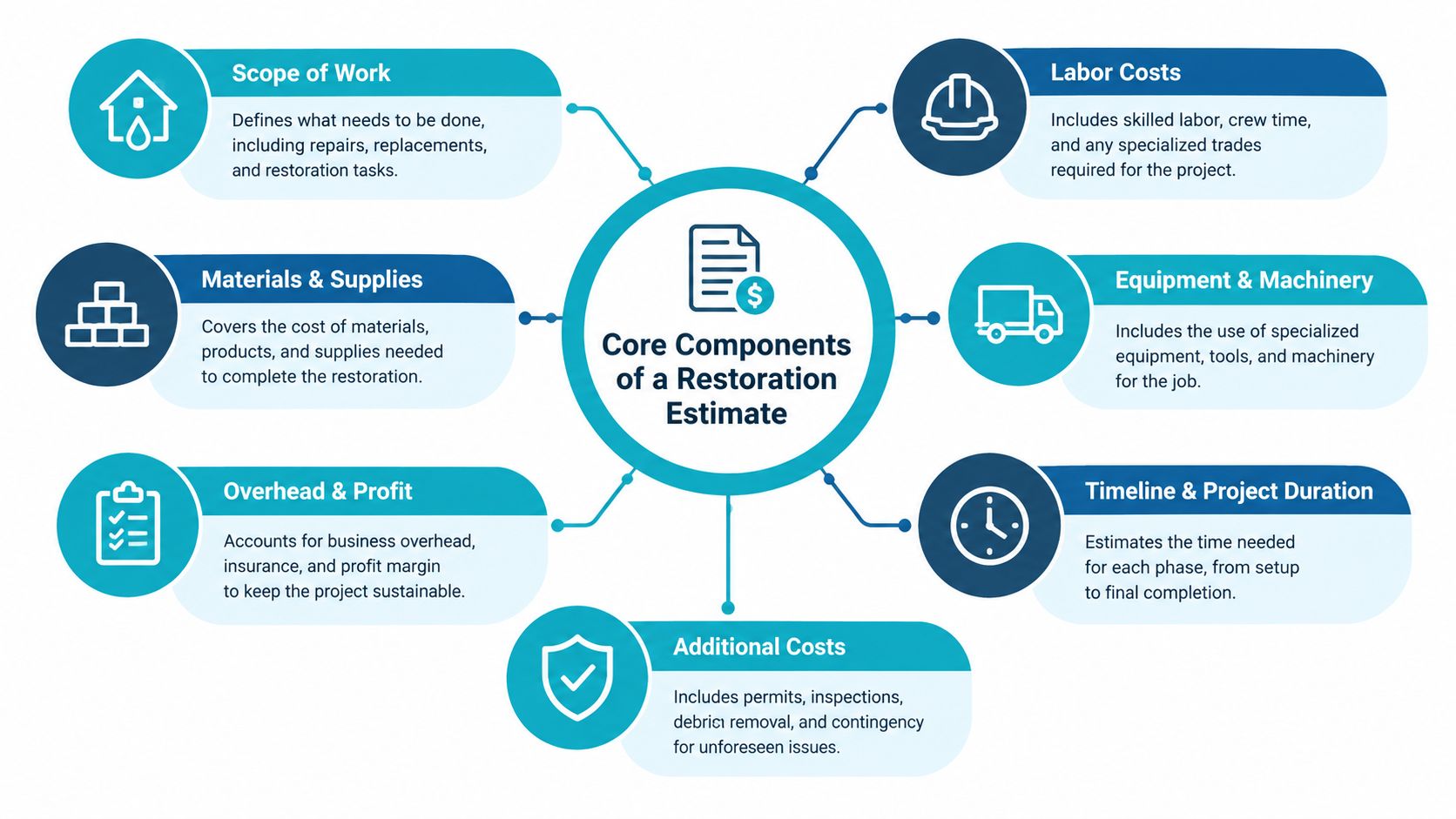
A solid estimate is built from separate pieces, and each piece answers a different question. The homeowner needs to know what is being removed, what is being dried, what is being cleaned, and what gets rebuilt after mitigation is done. A useful way to read it is as a sequence, not a single charge.
The work that comes before repairs
The first line items usually cover extraction and stabilization. That’s where standing water comes out, affected materials get assessed, and the crew starts controlling humidity so the loss doesn’t expand. Drying equipment then becomes part of the cost because the job isn’t done when the puddles disappear, it’s done when moisture readings confirm the structure is drying.
The practical details matter here. A company may price setup, equipment-days, monitoring visits, and sanitation separately, because each one consumes labor and resources. If you want to compare wording and scope on a repair quote, the CS1 Real Interiors cost guide is a useful reference point for how restoration-related repair costs are often broken down.
A restoration estimate also has to account for the pace of the job. Drying equipment and monitoring aren’t decorative add-ons, they’re part of the mitigation process. The company’s equipment strategy should line up with the actual structure, and the internal overview of water damage drying equipment helps show why fans, dehumidifiers, and moisture checks often appear as separate elements in the job.
The table most homeowners need
| Core component | What it covers | Why it appears on the estimate |
|---|---|---|
| Extraction | Removing standing water | Stops spread and shortens drying time |
| Drying setup | Air movers and dehumidifiers | Creates the controlled drying environment |
| Moisture monitoring | Meter checks and documentation | Confirms the structure is actually drying |
| Sanitization | Cleaning affected surfaces | Reduces contamination concerns |
| Selective demolition | Removal of unsalvageable materials | Protects against hidden damage |
| Repairs | Drywall, trim, flooring, finish work | Returns the property to pre-loss condition |
| Documentation | Photos, logs, and scope notes | Supports claim review and final billing |
A real estimate usually moves through those categories in order. When one of them is missing, the quote can look cheaper than it really is.
How Water Category Impacts Cost
Water category is one of the biggest reasons two jobs with similar visible damage can land at very different price points. Under the IICRC S500 framework, Category 1 is clean water, Category 2 is significantly contaminated gray water, and Category 3 is grossly contaminated black water, with drying difficulty measured separately as Classes 1 through 4 (IICRC categories and classes). The contamination level changes what can be saved, what has to be removed, and how much protective work the crew has to perform.
Category changes the scope, not just the label
A pipe leak from a supply line may stay in a lower-cost range because the water started clean and the loss is often easier to dry if it's handled quickly. A washing machine overflow or a toilet-related event is different, because the water already carries contaminants and the affected materials are treated more aggressively. By the time black water is involved, the estimate can expand fast because demolition and decontamination become central to the job.
Published market data shows mitigation often runs about $3 to $4 per square foot for Category 1, $4 to $6.50 for Category 2, and $7 to $7.50+ for Category 3, with severe black-water losses exceeding $20,000 when the scope expands into decontamination and demolition (Category-based pricing). A neutral science summary also places a small Category 1 loss around $2,000 to $5,000, a moderate Category 2 loss around $5,000 to $15,000, and a large Category 3 event with structural drying above $30,000 (restoration science summary).
Practical takeaway: the dirtier the water, the less likely the job stays in a simple dry-out category.
Water Damage Restoration Costs by Category
| Water Category | Description | Avg. Cost per Sq. Ft. |
|---|---|---|
| Category 1 | Clean, sanitary water | $3 to $4 |
| Category 2 | Significantly contaminated gray water | $4 to $6.50 |
| Category 3 | Grossly contaminated black water | $7 to $7.50+ |
Timing changes what survives
The job also gets more expensive when the response is delayed. Multiple IICRC-based sources emphasize that Category 1 losses are most salvageable when extraction and drying begin within 24 to 48 hours (timing and classification guidance). After that, the estimate may shift because more materials lose salvage value.
That’s why contamination category and speed of response should be read together. A small area with dirty water can cost more than a larger area with clean water if demolition is required.
Sample Line Item Breakdown
A single total doesn’t tell a homeowner much. The useful part is the line-item detail, because that’s where you can see whether the estimate covers mitigation only, or whether it also includes repairs that bring the space back together. A line-by-line quote makes comparison possible.
A bathroom pipe leak versus a multi-room overflow
A Category 1 pipe leak in a bathroom usually starts with extraction, then drying, then a short repair list if drywall or trim had to come out. A Category 2 washing machine overflow that reaches a hallway and closet can add sanitation, more equipment time, and more demolition. The difference isn’t just labor, it’s how far the moisture moved and what materials had to be sacrificed.
For repair-side context, the internal page on water damage repair cost is useful because it helps separate mitigation costs from reconstruction work. Those are different phases, and homeowners often see them combined in one quote even though they serve different purposes.
Practical rule: if two estimates don’t separate mitigation from reconstruction, they’re harder to compare honestly.
Sample Water Damage Restoration Estimate
| Line Item | Description | Estimated Cost Range |
|---|---|---|
| Emergency extraction | Remove standing water and stabilize the area | Varies by size and severity |
| Drying equipment setup | Place air movers and dehumidifiers | Varies by equipment-days needed |
| Moisture monitoring | Check materials and document readings | Varies by number of visits |
| Sanitization | Treat affected surfaces and contents | Varies by contamination level |
| Selective demolition | Remove damaged drywall, trim, or flooring | Varies by material loss |
| Reconstruction | Replace removed finishes and repair surfaces | Varies by scope of finish work |
That format helps you see what’s included and what isn’t. It also makes it easier to ask a contractor why one quote includes more drying time or more demolition than another.
A strong estimate should show why each line exists. If the company is skipping moisture monitoring, or burying reconstruction in a vague lump sum, you lose visibility into the actual job.
Restoration Estimates and Insurance Claims
Insurance claims are where a restoration estimate stops being a simple price sheet and becomes part of the evidence file. Adjusters want a clear scope of loss, photos, drying notes, and repair details because the estimate supports coverage review and payment decisions.
Why the paperwork matters
Water damage and freezing are common homeowners claim categories. Recent data shows they accounted for about 22.6% of all U.S. homeowners insurance claims from 2019 to 2023, with average severity near $15,400, and about 1 in 60 insured homes files a claim each year (claims data). That is why restoration estimates are often written to hold up in a claim file, not just to quote repairs.
The estimate should show the path from extraction to dry-out to reconstruction. If it does not, an adjuster may question the scope because the documentation does not support it. Detailed drying logs, moisture readings, and time-stamped photos matter because they show the work followed a recognized process instead of a rushed cleanup.
How the estimate and the claim work together
A restoration contractor often has to explain what was damaged and why some materials had to come out instead of being dried in place. That matters most when hidden moisture is found behind walls or under flooring. For homeowners working through the claim side, how to file an insurance claim for water damage lays out the basic documentation flow.
The best way to read a water damage estimate is as a living claim document. It starts with the first inspection, then changes as drying logs and meter readings show what can be saved and what must be removed. Those revisions are not random. They are the record of conditions in the home, and they often decide the final cost.
Preparing for and Comparing Estimates
The best comparisons start before the contractor arrives. Take clear photos, turn off the water if you can do so safely, and keep damaged items in place until someone documents them. A clean record makes it easier for a restoration company to build an accurate scope.
What to do before the inspection
Make the space easy to inspect. Open access to affected rooms, move pets, and note when the leak started if you know it. If you have multiple affected areas, point them out in order of severity so the technician can map the spread.
A homeowner should also ask direct questions. Does the quote include moisture monitoring? Are demolition and reconstruction separate? How many days of equipment are included? Is the company planning to revisit the site after the first dry-out reading? Those answers tell you whether the estimate is comparable or just formatted to look neat.
For licensing and accountability, the local overview at licensed restoration company is a helpful reminder that credentials and scope matter just as much as price.
What to compare side by side
- Scope clarity: Does the estimate say exactly what gets removed and what stays?
- Drying plan: Does it mention equipment, monitoring, and expected revisit points?
- Repairs: Are reconstruction costs separated from mitigation costs?
- Documentation: Are photos, moisture logs, and notes included?
- Responsiveness: Does the contractor answer questions without dodging the details?
The cheapest number is not always the best comparison point. A quote that leaves out monitoring, sanitation, or selective demolition can look attractive and still cost more later. A complete estimate is usually easier to trust than a short one.
Common Pitfalls and Red Flags
A low number can be misleading if the contractor hasn’t accounted for hidden moisture, demolition, or claim documentation. In water restoration, the cheapest bid is sometimes the one most likely to grow later. That’s especially true when the first visit happened before the structure was fully opened up.
Warning signs worth taking seriously
A vague estimate is a problem. So is pressure to sign right away before anyone has checked behind walls, under flooring, or inside cabinets. If a company won’t explain how it determined the scope, or if it avoids listing equipment-days and monitoring, the homeowner loses the ability to compare offers fairly.
Another red flag is language that sounds complete but isn’t. Phrases like “dry-out included” don’t mean much if the quote doesn’t say how much drying time or what materials are covered. On the other side, a contractor that gives a very detailed scope but refuses to answer follow-up questions is also worth questioning.
A restoration estimate should feel specific enough to audit, not vague enough to escape review.
You should also be cautious with bids that ignore contamination category. Category 2 and Category 3 losses need different treatment than clean-water losses, and a company that prices them like simple drying jobs may be under-scoping the work. That can lead to skipped sanitation, incomplete demolition, or surprise charges after the project starts.
The best protection is comparison. Ask each contractor to explain what changes the estimate, what would cause a revision, and how moisture readings affect the final bill. If the answers are clear, you’re probably dealing with a company that understands the job.
Trusted Local Restoration Experts
In Bradenton, Sarasota, Tampa Bay, Saint Petersburg, Lakewood Ranch, and nearby Gulf Coast communities, a water loss moves fast and the estimate has to move with it. AMPM Restoration Services handles emergency water damage restoration, mold inspection, mold removal, storm and flood cleanup, fire and smoke damage restoration, commercial restoration services, and full reconstruction, with 24/7 response from 4301 32nd St W b18, Bradenton, FL 34205. The value for homeowners is simple, clear documentation, practical communication, and a process built around real moisture readings, not guesswork.
A good estimate should make the scope understandable, the claim process manageable, and the repair path transparent. That’s the standard to look for whether you’re comparing bids or waiting on an adjuster.
If you’re dealing with water damage right now, AMPM Restoration Services can inspect the loss, document the damage, and explain what your water damage restoration estimate should include. Call 941-946-7807 for a free inspection and estimate, ask about insurance claim assistance and financing options, and visit AMPM Restoration Services to get started.