

A musty smell appears when you open the door of a vacant Sarasota home. A brown mark has spread beneath a window, or a ceiling feels cool and damp after a storm. You may be wondering whether to buy a home mold kit, order an air test, or call someone immediately. In Sarasota, mold testing Sarasota FL services are most useful when they answer a practical question: where is the moisture, how far has it traveled, and what must be corrected before mold returns?
The important distinction is that a spore count alone can't prove a home is safe. A professional evaluation connects visual evidence, moisture readings, building history, HVAC conditions, and targeted laboratory analysis when sampling can answer a specific question. That approach gives homeowners, landlords, and commercial property managers a clearer path from suspicion to correction.
Recognizing the Warning Signs of Hidden Mold
A Sarasota homeowner may notice a musty odor in a guest room that sits unused for weeks. The air conditioner has been turned off while the family is away, and the room appears clean. Then the baseboard swells, paint blisters beside a window, or a closet develops a stale smell that returns after cleaning. Those changes often deserve a closer look behind finished surfaces.
Sarasota buildings face steady moisture pressure. Roughly 80% of Sarasota's annual rainfall falls during the six-month wet season from May through October, and relative humidity remains above 75% for much of that period, according to local Sarasota mold and moisture guidance. Summer humidity commonly rises above 70%, while a vacant home without air conditioning can reach indoor humidity between 85% and 95% during the rainy season. These conditions make moisture mapping and visual inspection valuable early steps. An air sample can measure airborne spores at one moment, but it cannot locate a wet wall, identify a hidden leak, or prove that the building is safe.

Signs that call for a closer look
A humid day alone does not establish active mold growth. Concern increases when humidity occurs alongside a water source, a lasting odor, or material changes that indicate moisture has entered the assembly.
- Persistent musty odor: A smell that returns after airing out a room may come from damp drywall, insulation, carpeting, cabinetry, or an HVAC component.
- Localized staining: Discoloration around a ceiling penetration, window, exterior wall, or plumbing fixture can trace a water path more effectively than a general indoor-air sample.
- Soft or swollen materials: Buckled flooring, crumbling drywall, lifted baseboards, and damaged cabinets indicate that moisture has affected building materials.
- Repeated condensation: Water on supply vents, windows, ductwork, or cold plumbing can create a recurring damp zone that requires correction.
- Unexplained irritation: Occupants may feel worse in one room and better after leaving it. That pattern does not diagnose mold, though it helps an assessor understand how the building is being used.
Storm damage creates a separate warning scenario. Major hurricanes can drive rain through roofs, windows, and wall assemblies, leaving insulation and framing wet behind surfaces. Mold may begin developing soon after water intrusion in Florida's heat and humidity, so drying and inspection should begin before a visible colony appears. Moisture readings, thermal observations, and careful visual review can show whether water remains trapped.
A slow plumbing leak can create the same problem without dramatic storm damage. An earthy smell inside a sink cabinet, a damp wall, or flooring affected by a slab leak indicates that the water source needs attention before mold cleanup can last. Homeowners who suspect an underground plumbing failure can review how to fix a slab leak under your home, then arrange an independent moisture evaluation.
Practical rule: A musty odor paired with a known leak, flood, condensation problem, or damaged material is a reason to investigate the building and map moisture, not to rely on an airborne spore count.
Professional inspection has added value before a property purchase, after flooding, when a tenant reports recurring odors, or when growth appears near an HVAC system or inside a wall cavity. Homeowners can also use this guide to review five signs of mold damage in homes. Early action helps locate the source while repairs remain limited, reducing the chance that moisture will weaken finishes, framing, insulation, or flooring.
Understanding Florida Mold Testing Regulations and Methods
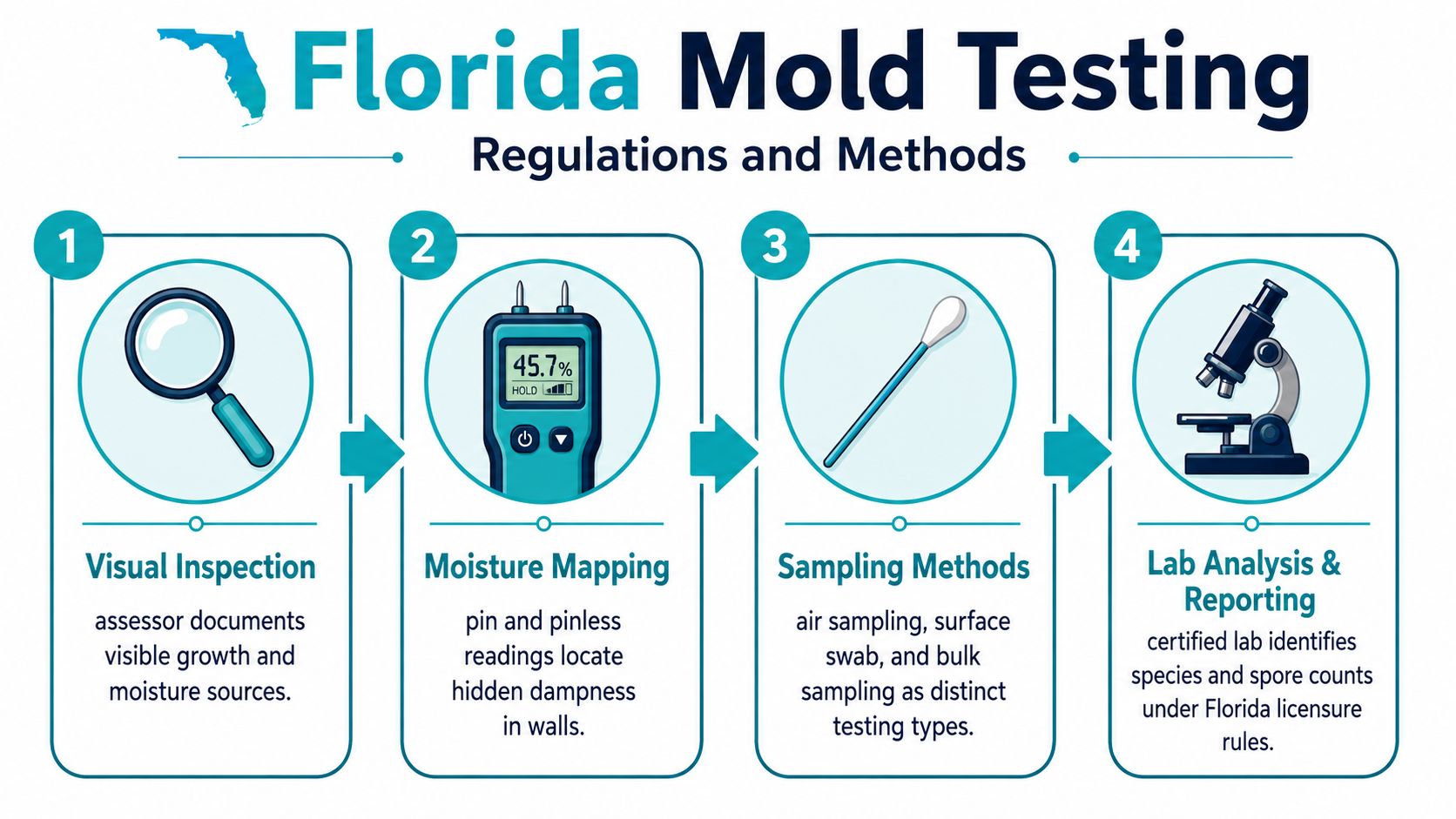
Florida's rules place the visual and moisture investigation before laboratory sampling. An assessor must inspect accessible surfaces and hidden areas that are prone to moisture, then document the estimated extent of growth in square feet, the suspected cause, affected areas, and the chain of custody when samples are collected. The Florida mold assessor standards of practice also state that when visible mold growth is present, sampling is unnecessary in most cases.
That framework changes the question a homeowner should ask. Instead of asking, "Can an air test tell me whether my home is safe?" ask, "What building condition is this sample helping us understand?" The Florida Department of Health says there are no health- or exposure-based standards for interpreting mold sampling results and doesn't recommend testing just to determine whether mold exists or what type it is.
What each method can and cannot answer
Air sampling collects airborne particles for laboratory analysis. It may help compare an indoor condition with outdoor air or investigate a suspected hidden source, but it doesn't identify every reservoir of mold in a building and can't establish a federal safety threshold.
Surface sampling, such as a tape lift or swab, examines growth on a particular material. It can help characterize a visible area or support a source theory, but it won't map moisture behind walls or determine whether the entire building has been affected.
Bulk sampling sends a piece of material to a laboratory. It can help identify what is growing in a specific section of drywall, insulation, carpet, or another building component. Removing a piece of material without first understanding the moisture path, however, can miss the larger problem.
ERMI sampling analyzes settled dust for mold-related markers. It may be considered when a qualified professional has a defined investigative reason, but it isn't a substitute for inspecting the structure, locating damp materials, and correcting water entry.
The EPA's guidance is direct. When visible mold is present, sampling is usually unnecessary, and there are no federal mold or spore limits against which an indoor air result can establish compliance. The EPA mold remediation guide supports a visual and moisture-first workflow, with sampling selected only when it answers a defined question.
Why moisture data matters more than a single number
Moisture mapping shows where the building is wet now or where it may have remained wet. A technician may use pin and pinless moisture meters, infrared imaging, visual examination, and a review of plumbing, roof, drainage, and HVAC history. Those findings explain why a laboratory result matters, or why sampling would add little value.
That is the difference between useful mold testing and a report that creates false certainty. A laboratory can identify particles in a sample, but the property owner still needs to know whether water is entering, whether materials are drying, and whether occupants or building systems could spread contamination. Homeowners comparing providers can review the details of professional mold testing and ask how the proposed samples relate to those questions.
Comparing DIY Kits and Professional Mold Inspections
A petri dish left open in a room can grow something. That result doesn't tell you whether the growth came from an indoor colony, ordinary outdoor air, dust, or the dish itself. In Sarasota, a breezy or stormy day can change outdoor spore levels, which makes an indoor number difficult to interpret without a same-day outdoor control sample and building context.
The main advantage of a DIY kit is convenience. The main disadvantage is that it can turn uncertainty into misleading confidence. A homeowner may see a large amount of growth and assume the home is dangerous, or see little growth and overlook a wet wall cavity, leaking HVAC component, or contaminated porous material.
DIY Mold Kits vs Professional Inspection
| Feature | DIY Petri Dish Kit | Professional Mold Assessment |
|---|---|---|
| Primary purpose | Shows that organisms can grow in a collected sample | Investigates visible conditions, moisture, source, spread, and targeted sampling needs |
| Moisture investigation | Usually absent or limited | Uses moisture meters, visual inspection, and may include infrared imaging |
| Outdoor comparison | Often not included | Can include same-day indoor and outdoor control samples when air sampling is justified |
| Hidden moisture | Cannot locate dampness behind walls or under finishes | Maps suspect areas and traces likely water pathways |
| Laboratory context | May provide a growth image or basic result | Produces findings tied to sample location, chain of custody, building conditions, and the inspection |
| Best use | Satisfying curiosity, with limited decision value | Supporting repair, remediation, post-water-event documentation, or due diligence |
| Main risk | False reassurance or unnecessary alarm | Higher upfront cost, but a more defensible basis for action |
Professional assessors don't begin with a sample bottle. They begin by asking what happened to the property. Was there a roof leak, plumbing failure, flood, condensation problem, renovation, or long vacancy? Which rooms smell different? Has the HVAC system been operating, and could it have moved air from an affected area?
The assessor then selects air, surface, or bulk sampling only if the result can resolve a specific uncertainty. A surface sample may characterize a visible area. An air sample may help compare indoor and outdoor conditions. A bulk sample may identify material that must be removed. None of these replaces moisture control.
A cheap test becomes expensive when it delays the repair that would have stopped the damage.
DIY kits also can't establish whether a property is ready for re-occupancy after drying and remediation. A professional post-remediation evaluation considers the work performed, remaining moisture, containment practices, visible cleanliness, and any targeted clearance question. For a more detailed explanation of the trade-off, see mold kit versus mold inspection.
The practical choice is simple. If there is no odor, no water history, and no visible or material warning sign, a petri dish adds little useful information. If the property has damage, recurring moisture, or an occupancy decision pending, a building inspection gives you evidence that a dish can't provide.
What to Expect During a Professional Mold Assessment
A professional assessment should feel like an investigation, not a sales presentation built around a predetermined number of samples. The assessor needs to understand the property's history, inspect the affected areas, locate moisture, and explain what the findings mean before recommending removal or additional laboratory work.
The inspection sequence
1. The initial call establishes the event. Tell the technician when the leak, storm, flood, or odor began, which materials were wet, whether drying occurred, and whether anyone has disturbed the suspected area. Photographs, plumber reports, roof records, and insurance notices can help establish the timeline.
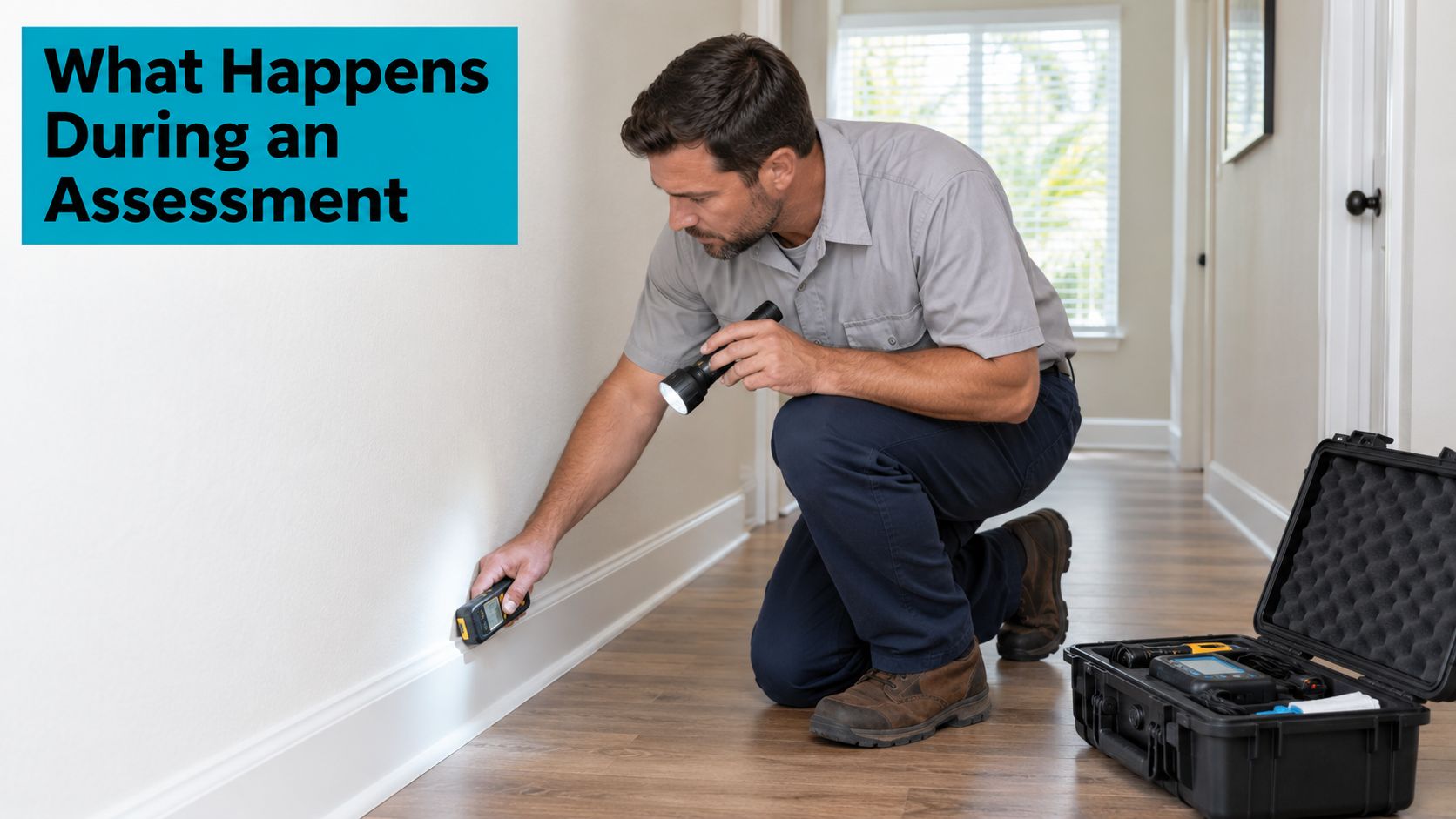
2. The visual inspection defines the problem. The assessor examines ceilings, walls, floors, cabinetry, closets, utility areas, crawl spaces, attics, and accessible HVAC components. They look for staining, swelling, peeling finishes, previous repairs, musty odors, and pathways that could move water or air.
3. Moisture mapping tests the structure. A pin meter can evaluate moisture within suitable materials, while a pinless meter can scan broader areas without making holes. Infrared imaging can reveal temperature patterns associated with moisture, but it doesn't directly prove that mold is present. The technician still needs to confirm unusual areas with physical readings and visual evidence.
Containment follows the extent of contamination
The inspection should identify whether the affected material can be isolated and removed without spreading dust or spores. The U.S. military mold assessment guide generally recommends limited containment for visible mold areas between 10 and 100 square feet, while full containment is recommended above 100 square feet or when contamination could spread without stronger controls. Those thresholds come from the U.S. military mold assessment guide, and the actual work plan still depends on material type, location, HVAC connections, occupant risk, and the likelihood of hidden spread.
Containment may involve barriers, controlled airflow, negative-air equipment, and careful removal procedures. A technician should explain what will be isolated and why. A handyman who sprays a visible patch may leave contaminated drywall, insulation, or flooring in place and may spread particles through an occupied home.
The report should connect evidence to action
A useful report identifies affected rooms, observed conditions, moisture readings, suspected causes, photographs, sample locations if samples were taken, laboratory documentation, and recommended next steps. It should distinguish confirmed observations from assumptions. It should also state whether additional investigation is needed behind a wall, beneath flooring, inside cabinetry, or around an HVAC component.
An IICRC-certified, licensed, bonded, and insured restoration company can coordinate inspection, drying, containment, removal, cleaning, repairs, and final verification. AMPM Restoration Services provides mold inspection and sampling options within a broader restoration response, including water damage, storm damage, and reconstruction services. The company is based at 4301 32nd St W b18, Bradenton, FL 34205, and serves Sarasota, Bradenton, Tampa Bay, Saint Petersburg, Lakewood Ranch, and surrounding Gulf Coast communities.
Interpreting Lab Results and Planning Remediation
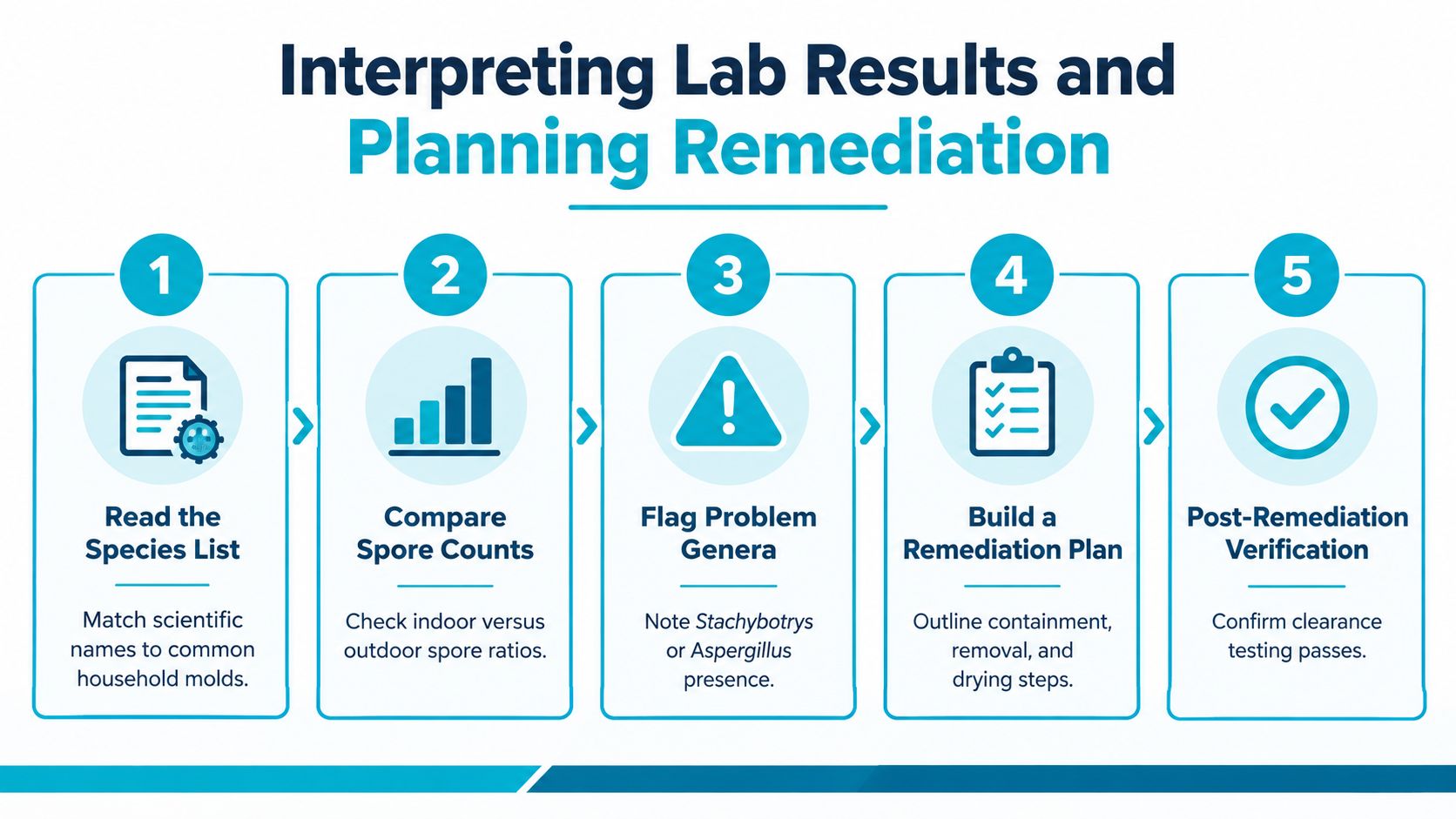
A Sarasota homeowner may receive a report filled with species names, indoor counts, outdoor counts, sample locations, and laboratory notes, then assume the highest number determines the answer. It does not. Interpretation starts with the building's moisture history, visible conditions, and the location of any suspected growth.
The EPA states that there are no federal threshold limits, regulations, or standards for airborne mold or mold spores. An air sample therefore cannot prove that a home meets a federal mold standard or is safe for occupancy. NIOSH also reports that no health-based indoor-air standards exist for mold, does not recommend routine air sampling for building air-quality evaluations, and cautions that short-term samples cannot measure health risk. Visual inspection, musty odors, moisture mapping, and inspection of likely concealed spaces usually provide more useful direction. Wet materials should be dried within 48 hours or removed. See the NIOSH guidance on mold testing and remediation.
Read the report in its physical context
Start with the sample's location and purpose. An indoor air sample from a dry living room answers a different question than one collected beside a wet wall after a roof leak. Check whether an outdoor comparison sample was collected on the same day, whether the HVAC system was running, whether weather affected outdoor conditions, and whether sampling occurred before or after drying and containment.
Moisture mapping often matters more than a standalone spore count. A technician can use moisture readings, thermal imaging where appropriate, visible staining, odor, and building history to identify patterns that air sampling may miss. A report showing an unusual indoor pattern has more practical meaning when the assessor also finds damp drywall behind a cabinet. Spores without moisture evidence require careful interpretation, not an automatic remediation order.
Translate findings into a work plan
A sound remediation plan should address:
- The moisture source: Repair the roof, plumbing, drainage, condensation, or HVAC problem keeping materials damp.
- Affected materials: Decide what can be cleaned and what porous material must be removed because growth has penetrated it.
- Containment and protection: Isolate work areas, control airflow, protect occupants, and keep dust from reaching clean rooms.
- Drying and humidity control: Keep indoor relative humidity below 60%, with an ideal EPA range between **30% and 50%, as stated in the EPA guide to mold, moisture, and homes.
- Verification: Inspect completed work, confirm that affected materials are dry and visibly clean, and use targeted post-remediation testing when the project or occupancy decision requires it.
Sarasota properties must account for seasonal humidity, vacant periods, storm exposure, and HVAC operation. A dehumidifier may lower indoor moisture temporarily, but it will not repair a leaking roof or dry a wet wall cavity. Antimicrobial treatment also cannot make saturated porous materials suitable to remain in place.
The final report should support a clear decision. It should identify what was found, what was removed, what remains under observation, which repairs prevent recurrence, and whether the space is suitable for re-occupancy. A detailed mold inspection report organizes those findings through room observations, moisture evidence, photographs, sample information when collected, and recommended actions, rather than relying on laboratory terminology alone.
Navigating Insurance Claims and Next Steps
Insurance decisions depend on the cause of the loss, the policy language, exclusions, endorsements, dates, and documentation. Mold that follows a covered plumbing failure or storm-related intrusion may be handled differently from long-term seepage, deferred maintenance, or an unresolved humidity problem. No restoration company can promise coverage before the carrier reviews the claim.
Documentation still gives the adjuster a clearer record. Photograph the original condition before disturbing materials, save damaged components when practical, record when the leak or storm occurred, and keep invoices for emergency drying, plumbing, roofing, temporary protection, and repairs. A professional assessment can add moisture maps, room-by-room observations, sample records, containment notes, and a written remediation scope.
Evidence that helps after water intrusion
Property managers and commercial owners need an operational record as well as a repair estimate. After a hurricane or significant leak, that record should show:
- The timeline: When the event occurred, when occupants reported it, and when mitigation began.
- The moisture condition: Which rooms and materials were wet, which readings were high, and how drying progressed.
- The source correction: What plumbing, roof, drainage, HVAC, or building-envelope repair stopped the water.
- The containment work: Which areas were isolated and how workers limited movement of dust and debris.
- The restoration result: What materials were removed, what surfaces were cleaned, and what repairs remain.
- The occupancy decision: Whether the assessor recommends re-occupancy, continued restriction, additional investigation, or post-remediation verification.
Clearance testing isn't a universal pass or fail test because federal mold standards don't exist. It can still be useful when tied to a defined project requirement, especially after containment and removal in a commercial space, rental property, healthcare setting, or other building where a documented re-opening decision matters. The result should be reviewed alongside visual cleanliness, moisture conditions, HVAC status, and the completed scope.
Homeowners also need to understand the relationship between testing and coverage. Sampling before drying may document a condition, but it won't make a wet building safe. Sampling after incomplete removal may produce another report without solving the source. The practical sequence is to stop the water, dry the structure, investigate hidden areas, remove or clean affected materials, and verify the completed work when appropriate. For policy questions and documentation considerations, review whether mold remediation is covered by insurance.
Frequently asked questions about mold testing Sarasota FL
Is air sampling always necessary in Sarasota?
No. If visible mold is present, Florida guidance and EPA guidance generally make sampling unnecessary in most cases. Air sampling is most useful when it answers a specific question about a suspected hidden source, an indoor versus outdoor condition, or a post-remediation concern.
What does a professional mold inspection include?
It should include a visual inspection, moisture investigation, review of water history, identification of affected areas, and a recommendation about whether targeted sampling is justified. Depending on the property, the assessor may use moisture meters, infrared imaging, and air, surface, or bulk samples.
Can a DIY mold kit prove that my home is safe?
No. A DIY petri dish generally lacks the building inspection, moisture mapping, same-day outdoor control, and source analysis needed to interpret growth reliably. It can create false reassurance or unnecessary alarm.
How quickly can mold develop after a leak?
Mold can establish within 24 to 48 hours after water intrusion in Florida's heat and humidity, according to Sarasota restoration guidance. Drying should begin promptly, and wet materials that can't be dried effectively may need removal.
What humidity level should I maintain indoors?
EPA recommends keeping indoor relative humidity below 60%, with an ideal range between 30% and 50%, as explained in its mold and moisture guidance. A hygrometer helps monitor conditions, but it won't locate a leak or confirm that hidden materials are dry.
Should I test after remediation?
Post-remediation verification may be appropriate when a project requires documented clearance, when occupants need a formal re-entry decision, or when the affected area was contained and extensively removed. Testing should be paired with a visual inspection, moisture confirmation, and review of the completed work, not treated as the only measure of success.
Call 941-946-7807 for a free inspection and estimate when you need practical help with mold testing Sarasota FL, moisture mapping, water damage restoration, or remediation planning, with 24/7 emergency response, insurance claim assistance, and financing options available. Visit AMPM Restoration Services to arrange an evaluation for your Sarasota, Bradenton, Tampa Bay, Saint Petersburg, Lakewood Ranch, or surrounding Gulf Coast property.