


Mold Kit vs Mold Inspection
That musty smell after a Gulf Coast rainstorm gets your attention fast. Maybe it’s coming from a closet in Bradenton, the air handler area in Lakewood Ranch, or a guest room in Sarasota that always feels damp. Maybe nobody sees obvious growth, but everyone notices the odor. Or maybe your allergies kick up every time the AC runs and you’re wondering whether a cheap test kit will settle the question.
That’s where most homeowners get stuck on mold kit vs mold inspection. One option looks inexpensive and easy. The other sounds more serious, and more costly. In Florida’s humidity, choosing wrong can waste time, delay the necessary repair, and leave water damage or hidden mold spreading behind drywall, under flooring, or inside HVAC components.
The right move depends on what’s happening in your house right now. If you’ve got visible mold, a mystery odor, health concerns, or a pending home sale, the action trigger changes. What works in a bathroom corner doesn’t work in a real estate dispute or after a leak in Saint Petersburg or Tampa Bay.
Suspect Mold? The Critical First Decision for Florida Homeowners
A Florida homeowner usually reaches for answers after one of three things happens. They smell something musty after heavy rain. They find staining around an AC vent or baseboard. Or they keep cleaning a spot that comes back.
The first decision is not really about buying a test. It’s about defining the problem. That’s the heart of mold kit vs mold inspection. Are you trying to satisfy curiosity, confirm a minor surface issue, or figure out whether hidden moisture is driving a bigger problem?
Start with what you already know
Before spending money, look at the situation in plain terms.
- Visible growth on a small, known surface: Think shower caulk, grout, or a window sill that stays wet.
- Musty odor with no visible source: This raises concern about hidden moisture in drywall, insulation, cabinetry, or the HVAC system.
- Symptoms or high-stakes consequences: If the issue could affect health, a sale, an insurance file, or a landlord dispute, the standard is higher.
If you need help spotting warning signs before choosing your next step, this guide on how to check your home for mold gives a solid starting point.
Practical rule: If you can see mold and you know why it’s there, the first job is usually to fix the moisture. If you can smell mold but can’t find it, that’s when investigation matters.
What Florida changes
On the Suncoast, humidity complicates everything. Homes in Bradenton, Sarasota, St. Petersburg, and surrounding areas deal with storm moisture, condensation, AC drain issues, roof leaks, and humid attics. A small leak doesn’t stay small for long when materials stay damp.
That’s why the smartest decision isn’t always the cheapest one up front. The useful question is this: Will this option tell me what to do next with confidence? If the answer is no, it’s probably not saving you money.
What Are You Really Buying with a DIY Mold Kit
Most DIY mold kits promise clarity. In practice, many deliver uncertainty.
A typical over-the-counter kit is a petri dish or settle plate. You expose it to the air, wait, and watch for growth. That sounds simple, but it doesn’t answer the questions homeowners truly care about. It doesn’t tell you whether the level is high, where the mold is coming from, or whether the source is active.
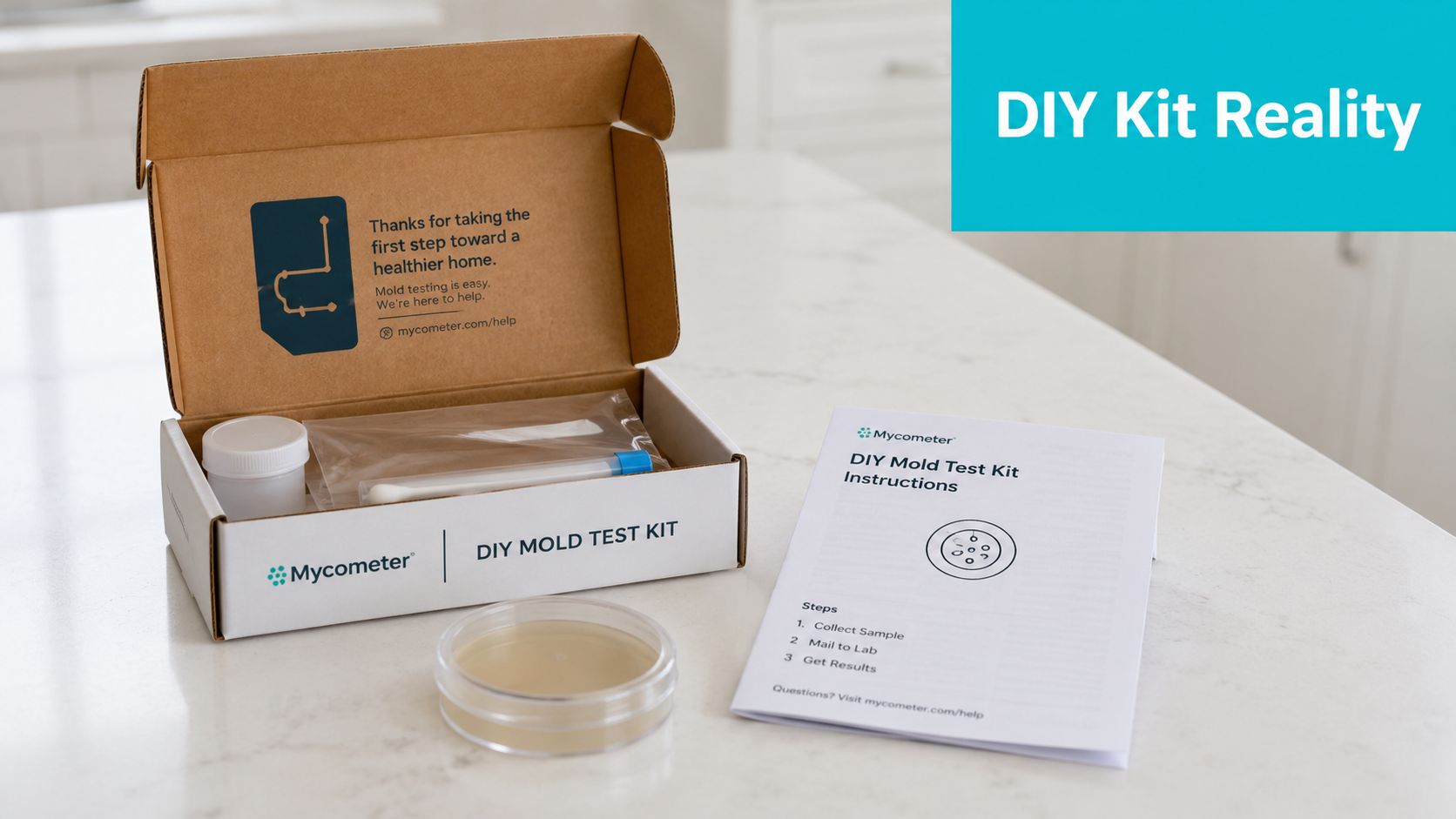
What petri dish kits can’t tell you
The biggest issue is method. Settling plates capture only spores that happen to land on them. That’s a tiny and highly incomplete snapshot of what’s in the air. In a Florida home, where mold spores exist naturally, growth on a dish often proves very little.
According to this review of home mold kit accuracy, home mold test kits relying on petri dish methods fail up to 80% of the time, and Consumer Reports gave every kit in its 2006 evaluation a “Not Recommended Rating” because of major reliability flaws.
Here’s the practical problem with that. A plate with growth can scare you even when it reflects normal background spores. A plate with little or no growth can calm you down when hidden contamination is still active elsewhere.
What a homeowner often expects, versus what the kit delivers
| What you want to know | What a basic DIY kit usually gives you |
|---|---|
| Is there a mold problem in this house? | Only that some spores may be present |
| Is the level abnormal? | No reliable concentration data |
| What species is it? | Often no meaningful species identification |
| Where is it coming from? | No source location |
| Is this enough for a serious decision? | Usually no |
If you’re comparing methods, this page on how to test air for mold at home helps explain why some sampling approaches are far more useful than others.
A DIY kit can answer a narrow question. It usually can’t answer the important one, which is why the mold is there and what needs to happen next.
When a kit has any value
A DIY kit may have limited value in a low-stakes situation where you already see suspicious residue and want a rough confirmation that it’s biological growth. That’s very different from diagnosing a hidden issue in a Florida home after a leak, storm intrusion, or ongoing humidity problem.
If your decision affects your health, your finances, or the condition of the property, a petri dish is usually the wrong tool.
The Professional Mold Inspection Process Explained
A professional inspection isn’t just “doing a better test.” It’s a building investigation.
The job starts with moisture and building conditions, not with collecting random samples. That’s a major difference in mold kit vs mold inspection. A trained inspector is trying to answer four questions: where moisture is entering or accumulating, how far it has affected materials, whether hidden growth is likely, and what action is needed to correct it.
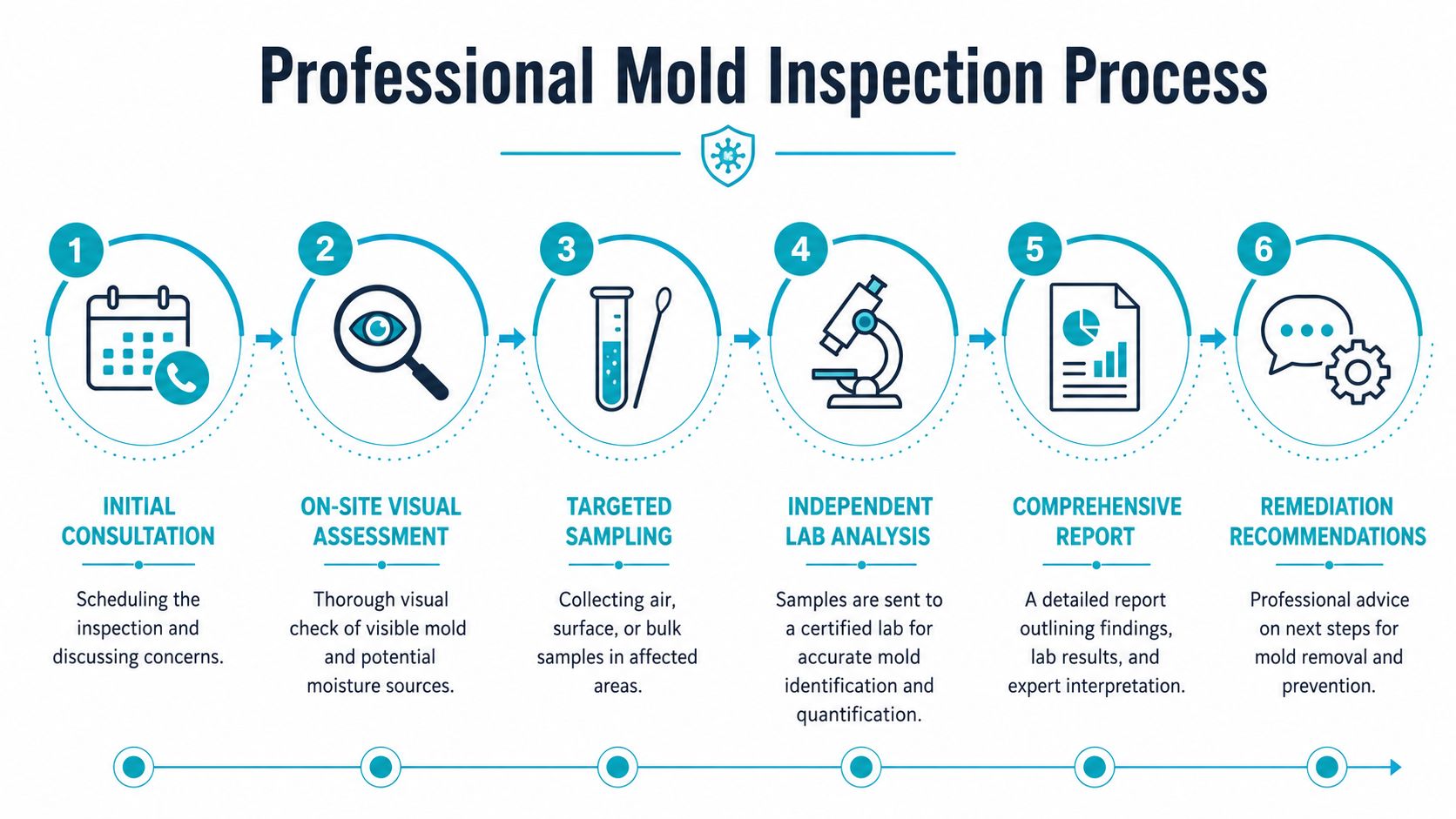
What happens on site
A proper inspection usually begins with a walkthrough and interview. The inspector asks where the odor is strongest, when it started, whether there has been a leak or storm event, how the AC has been performing, and which rooms feel damp or trigger symptoms.
From there, the inspection moves into building science.
- Visual assessment. The inspector looks for staining, microbial growth, warped materials, condensation patterns, and damage around windows, plumbing, roofs, and HVAC areas.
- Moisture mapping. Moisture meters help identify damp drywall, trim, subfloors, and cabinetry.
- Odor tracking and source checking. Closets, air handlers, return plenums, under-sink cavities, and attic transitions often reveal the full picture.
- Targeted sampling when needed. If the situation calls for it, samples are chosen based on evidence, not guesswork.
As outlined in this discussion of the mold test vs mold inspection process, the CDC and Minnesota Department of Health say testing shouldn’t be the first response to indoor air quality concerns, and the ANSI/IICRC S520 Standard requires physical removal of moldy materials as the primary means of remediation.
Why inspection beats blind testing
Sampling can be useful, but only when it follows the inspection, not when it replaces it. If you sample first, you may get data without context. If you inspect first, you know where to sample, why you’re sampling, and how to interpret the result.
A strong inspection also defines scope. That means answering practical questions like these:
- Is the issue confined to one room, or has it moved through the HVAC system?
- Is the source an active plumbing leak, roof intrusion, condensation, or poor drainage?
- Do materials need removal, drying, cleaning, or reconstruction?
For homeowners weighing next steps, professional mold inspection services show what a real field investigation should include.
The most useful mold inspection doesn’t just confirm contamination. It identifies the wet materials, the likely source, and the corrective path.
What the report should do
A good report should give you more than photos and a lab sheet. It should connect findings to action. That means identifying affected areas, explaining whether hidden growth is suspected, and stating whether remediation, drying, source repair, or post-cleaning verification is appropriate.
That’s what turns an inspection from an expense into a decision-making tool.
When to Use a Kit vs When to Call a Professional
Homeowners need a clear answer. Not every mold concern deserves the same response.
For Florida homes, the action trigger matters more than the product. If the issue is visible and minor, testing may be unnecessary. If the problem is hidden, medically sensitive, or tied to money or liability, a professional inspection becomes far more important.
The fast decision guide
| Your Situation | Recommended Action | Reasoning |
|---|---|---|
| Small visible growth on shower grout or caulk | Clean the area and fix the moisture source | You already know where it is and why it’s growing |
| Musty smell in a bedroom, closet, or hallway with no visible mold | Professional inspection | Hidden moisture or concealed growth is possible |
| You had a leak or storm intrusion and now smell mildew | Professional inspection | The key issue is locating wet materials and defining spread |
| You want to know if dust or staining is “maybe mold” on an accessible surface | DIY kit can be a limited curiosity tool | It may provide rough confirmation, but not a diagnosis |
| Family members are worried about symptoms in the home | Professional inspection | Higher stakes require source identification and defensible findings |
| You’re buying or selling a home | Professional inspection | Documentation and interpretation matter |
| You need records for insurance or a landlord dispute | Professional inspection | DIY kits don’t provide the level of evidence needed |
| Visible mold covers a larger area or keeps returning | Professional inspection | Recurrence usually points to unresolved moisture |
Situations where testing is often a waste of money
If you can plainly see mold on a damp surface, the first step usually isn’t testing. It’s correcting the moisture and cleaning or removing affected material appropriately. In many Florida bathrooms, laundry rooms, and around windows, the mistake isn’t failing to test. It’s allowing the damp condition to continue.
That’s especially true when the contamination is obvious and localized. A test doesn’t stop a leak. It doesn’t dry a wall cavity. It doesn’t remove damaged drywall.
Situations where a professional is the right call
Some scenarios change the standard immediately. According to this guide on DIY vs professional mold testing, professional mold inspections are essential for health concerns, real estate transactions, insurance claims, and landlord disputes because DIY kits can’t identify the source or provide the definitive species and concentration information those situations require.
That same practical logic applies after water damage, when musty odor appears without visible growth, or when mold returns after repeated cleaning.
If you’re on the fence about cleanup versus investigation, this article on whether you should remove mold yourself or hire a professional is useful.
A Florida homeowner’s trigger list
Call for a professional inspection if any of these are true:
- You smell mold but can’t see it.
- The area keeps coming back after cleaning.
- The problem followed a leak, flood, roof issue, or AC drain problem.
- Someone in the home is concerned about exposure.
- You need documentation that can stand up in a transaction or dispute.
Use a simple DIY approach only when the situation is low-stakes, the source is obvious, and you’re not relying on the result to make an important financial or health decision.
The Hidden Dangers and Costs of Getting It Wrong
The biggest mistake in mold kit vs mold inspection isn’t always picking the cheaper option. It’s losing time while moisture keeps feeding the problem.
A false sense of security is expensive. If a DIY result looks harmless, some homeowners wait. During that delay, wet drywall, baseboards, insulation, cabinets, or flooring can stay damp. In Florida, that’s how a manageable issue becomes a wider remediation and repair job.
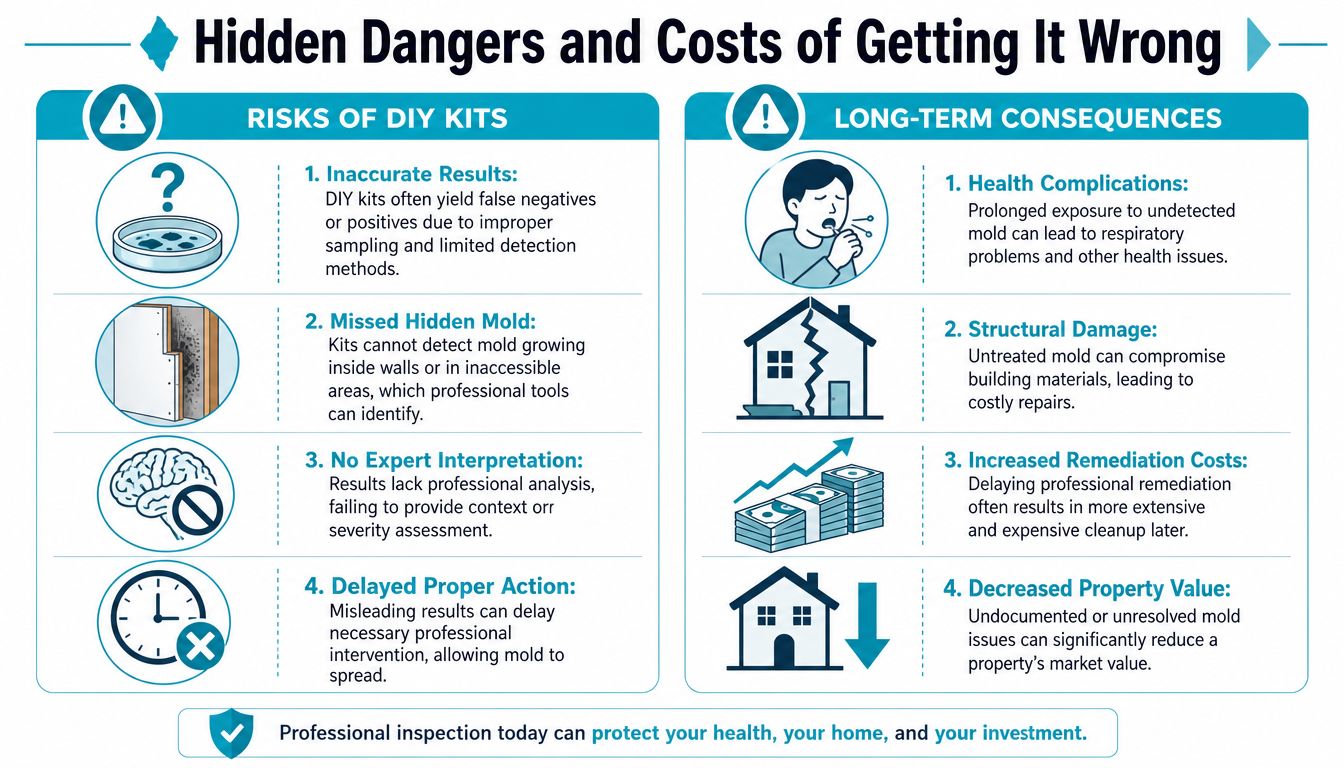
Delay is often the real damage multiplier
The Minnesota Department of Health and EPA position is more practical than most homeowners expect. As explained on the Minnesota Department of Health mold testing page, testing is often unnecessary as a first step when mold is visible, and the priority is to fix the moisture source. That same source also notes that 90% of mold-related health issues stem from unchecked moisture, not the specific spore type.
That leads to the most useful advice in this whole discussion.
Stop testing visible mold. Start fixing leaks.
The two bad outcomes homeowners run into
One bad outcome is the false negative. You trust a weak test, assume the home is fine, and ignore the closet wall, AC plenum, or wet baseboard that’s driving the odor.
The other is the false positive panic cycle. A dish grows something, you assume the house is contaminated everywhere, and you spend money chasing the wrong problem without identifying where water is entering.
Both outcomes have the same root issue. The test result didn’t tell you what action was needed.
Where the real cost comes from
The hidden cost is usually not the test itself. It’s what happens after the wrong conclusion.
- Missed hidden growth: Odors continue, materials deteriorate, and the repair scope expands.
- Wrong cleanup approach: People wipe visible staining but leave damp drywall or insulation in place.
- Transaction trouble: Buyers, sellers, landlords, and insurers often need documented findings, not a consumer kit.
- Recurring contamination: If the moisture source remains, the problem returns.
In mold work, indecision is expensive. Fast, informed action protects both the building and the people living in it.
Your Next Steps with AMPM Restoration
For most Florida homeowners, the answer to mold kit vs mold inspection comes down to one question. Do you need curiosity satisfied, or do you need a real answer you can act on? A DIY kit may scratch the first itch. It usually won’t solve the second.
If you’re dealing with a musty odor, hidden moisture, repeated mold growth, or a situation involving health, insurance, or property value, get a professional evaluation. AMPM Restoration, based at 4301 32nd St W b18, Bradenton, FL 34205, serves Bradenton, Sarasota, Tampa Bay, Saint Petersburg, Lakewood Ranch, and surrounding Gulf Coast communities with 24/7 emergency restoration, mold inspection, mold removal, water damage restoration, fire and smoke cleanup, storm and flood restoration, commercial services, and reconstruction.
For a no-obligation next step, request a free mold inspection. Call 941-946-7807 for a free inspection and estimate. Insurance claim assistance and financing options are available.
Frequently Asked Questions about Mold Testing and Removal
| Question | Answer |
|---|---|
| Can I use bleach to kill mold on walls or ceilings? | Bleach isn't a complete strategy for porous materials. The more important issue is whether the material is still wet and whether contamination has spread beyond the surface. In many cases, proper cleaning, drying, and removal of damaged material matter more than spraying a product. |
| What does IICRC mean? | IICRC refers to the Institute of Inspection, Cleaning and Restoration Certification. In mold and water damage work, that matters because standards and field procedures help guide safe inspection, containment, cleanup, and restoration practices. |
| If I can see mold, should I test it first? | Usually no. If growth is visible, the smarter first step is to address the moisture source and determine whether the affected material needs cleaning or removal. Testing becomes more useful when the source is hidden or documentation is needed. |
| What if the house smells musty but I can't find mold anywhere? | That's a strong reason to get a professional inspection. Musty odor without visible growth often points to concealed moisture in drywall, cabinets, under flooring, inside closets, or around HVAC components. |
| Will homeowners insurance cover mold? | Coverage depends on the policy and the cause of loss. Insurers often look closely at whether the mold resulted from a covered water event or from long-term neglect. Good documentation and quick action help. |
| Can carpet keep a mold smell even after the room looks dry? | Yes. Carpet and pad can hold odor after moisture exposure, especially in humid homes. If the issue is limited to odor and not active contamination, practical cleaning guidance like Rubber Ducky's carpet odor removal can help you understand the next step. If the carpet was exposed to ongoing moisture or visible mold, have it evaluated professionally. |
If you need fast, trustworthy help with mold, water, fire, storm, or reconstruction work on Florida's Suncoast, contact AMPM Restoration Services. Call 941-946-7807 for your free inspection and estimate. The team is available 24/7, provides insurance claim assistance, and offers financing options to help you move quickly and restore your property with less stress.