

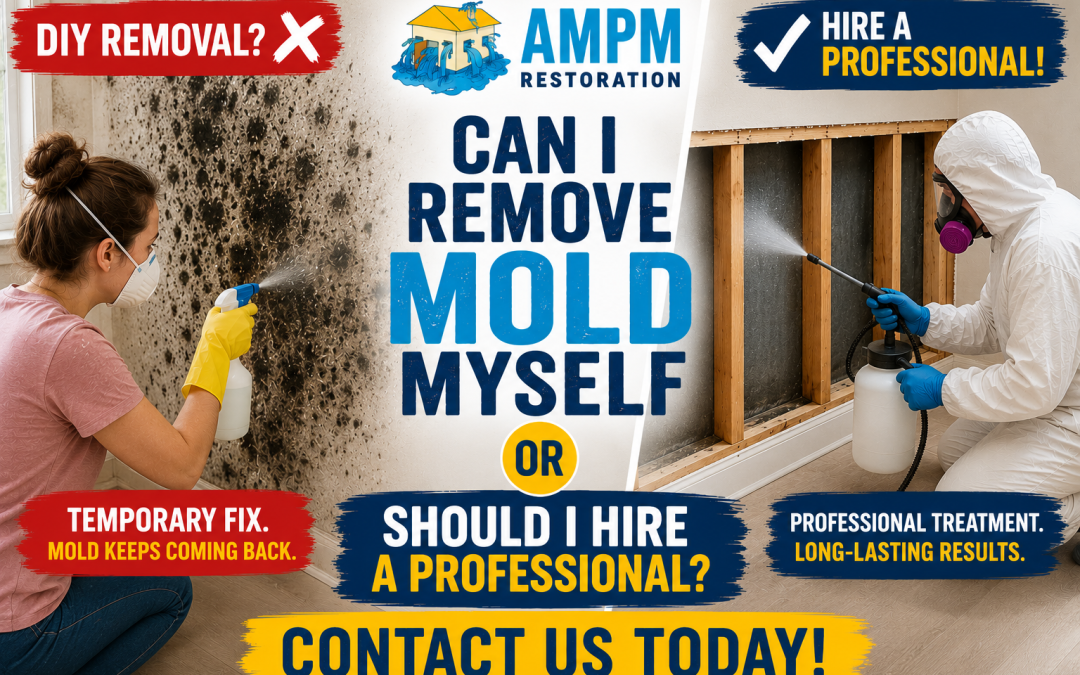
Can I Remove Mold Myself or Should I Hire a Professional?
That musty smell after a Florida rainstorm isn’t something to shrug off. You notice it in the hallway, under the air vent, or near the baseboard where a small leak dried weeks ago. Then you spot the dark patch. At that point, the question becomes immediate and practical: Can I remove mold myself or should I hire a professional?
My direct answer is simple. Sometimes you can clean a very small mold spot yourself. Most of the time, you shouldn’t. In Bradenton, Sarasota, Lakewood Ranch, Saint Petersburg, and across the Gulf Coast, humidity, hidden leaks, and HVAC condensation turn small mold problems into expensive property problems fast.
If you’re already wondering whether the growth you see is only the part that’s visible, read this guide on how to tell if mold is in your walls. That’s often where homeowners realize this isn’t a wipe-it-down job. It’s a moisture and contamination problem.
That Musty Smell Wont Go Away Now What
Florida homes make mold easy. One slow plumbing leak, one wet drywall seam, one AC issue in a humid house, and you’ve got conditions mold loves. By the time you smell it, there’s already a reason for it.
A lot of homeowners start the same way. They spray cleaner on a bathroom ceiling, wipe a closet wall, or paint over a stained section of drywall and hope that’s the end of it. It usually isn’t. Mold isn’t dirt. If moisture is still present, or the growth has moved into porous material, you’re not cleaning it away. You’re delaying the proper fix.
What your nose is telling you
That persistent odor matters because mold often shows up in the air before it shows up clearly on the surface. In Florida properties, I get especially concerned when the smell gets stronger after the AC runs or after afternoon humidity spikes. That can point to hidden growth around ductwork, wall cavities, or materials that stayed damp too long.
Musty odor with no obvious source is a warning sign, not a housekeeping issue.
The real decision isn’t cleaning
When people ask, Can I remove mold myself or should I hire a professional?, they’re usually thinking about labor and cost. The better question is this: Will a DIY attempt solve the moisture problem, protect indoor air, and avoid making the contamination worse?
If the answer is no, hire help.
This matters even more if you’re a landlord or property manager. A bad DIY cleanup can create tenant complaints, documentation issues, and property damage that gets harder to defend later. For homeowners, it can affect resale disclosures, repair scope, and whether the original water problem was resolved.
For Gulf Coast properties, mold is rarely just about the patch you can see. It’s about where the water went, what absorbed it, and what your HVAC may already be moving through the house.
The 10 Square Foot Rule Defining the DIY Threshold
There is a clear starting line for this decision. According to the U.S. Environmental Protection Agency, homeowners can typically handle mold cleanup themselves if the affected area is less than about 10 square feet, roughly a 3 ft. by 3 ft. patch in its EPA guidance on mold cleanup in your home.
Think of that as roughly the size of a standard beach towel. If the visible mold is larger than that, stop treating it like a weekend chore.
When DIY is actually reasonable
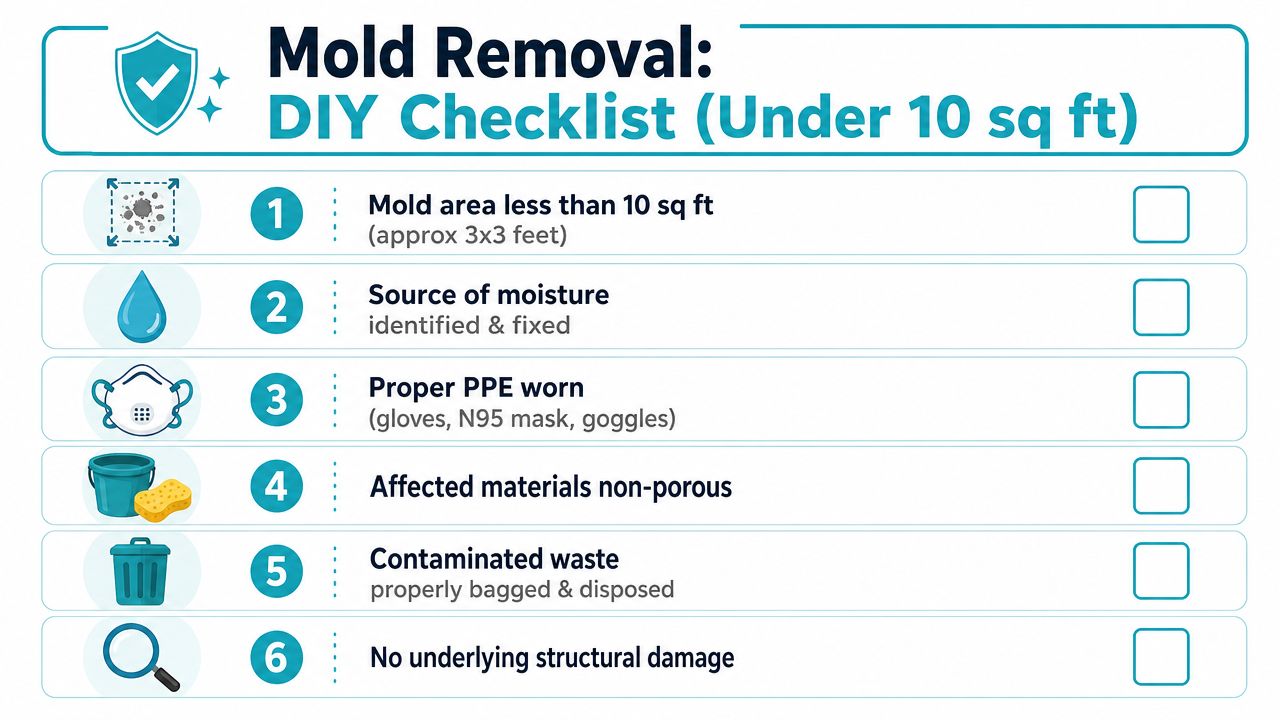
A homeowner might handle it safely if all of these are true:
- Small area only: The visible growth is under 10 square feet.
- Hard surface: The mold is on non-porous material such as tile, glass, or metal.
- Moisture problem fixed: The leak, condensation issue, or humidity source has already been corrected.
- No health vulnerability: Nobody in the home has respiratory issues or a compromised immune system.
- No repeat growth: It hasn’t returned after prior cleaning.
If any one of those fails, the job moves out of DIY territory.
What automatically pushes you to professional help
The EPA guidance is useful because it gives homeowners a line they can understand. But size isn’t the only issue.
Use this rule. If the mold is on drywall, wood, carpet, insulation, ceiling tile, or inside the HVAC system, don’t mess with it yourself. Porous materials hold contamination below the surface. Surface cleaning won’t fully remove it. The same goes for mold that keeps coming back after you think you’ve cleaned it.
Practical rule: If you can’t say with confidence where the water came from, whether the material is porous, and whether the growth extends beyond the visible edge, don’t start scrubbing.
A lot of people need a second opinion right at this point. If that’s where you are, this page on when you need professional mold removal helps clarify where the line is.
The Hidden Dangers of DIY Mold Removal
The biggest mistake homeowners make is assuming mold removal is just cleaning. It isn’t. Once you disturb active growth, you can spread contamination through the house.

One expert data point says DIY mold removal is generally safe only for small, surface-level patches, but disturbing mold without proper containment releases massive quantities of spores, increasing indoor contamination by 300 to 500 percent in many cases according to comparison of professional mold remediation and DIY. That’s the part most homeowners never see happening.
You can turn one room into a whole-house problem
Scrub a moldy drywall corner without containment and you may send spores into adjacent rooms, soft furnishings, closets, and return vents. In Florida homes that run AC constantly, that matters. Air movement does the spreading for you.
The danger isn’t only the patch on the wall. It’s what gets loose when you attack it the wrong way.
- Cross-contamination: Spores move into clean rooms and settle on other damp surfaces.
- HVAC spread: Returns and ducts can circulate contamination beyond the original source area.
- False confidence: The wall looks cleaner, but the underlying growth remains active.
Surface cleaning doesn’t solve hidden moisture
A lot of DIY advice still pushes bleach-first thinking. That’s not remediation. If the wall cavity is still damp, if the baseboard backs onto wet drywall, or if the AC closet has condensation, mold comes back.
This is why failed DIY jobs feel so frustrating. You thought you handled it. A few weeks later, the smell returns, the stain reappears, or a tenant complains that the room still feels damp and stale.
If mold keeps returning, the problem was never the stain. The problem was moisture and incomplete removal.
Health risk isn’t limited to obvious exposure
People often think health risk means visible black growth and obvious symptoms. In reality, poor containment can make indoor air quality worse even when the visible area looked minor before you touched it. That’s one reason I tell families with asthma, allergies, older adults, infants, or anyone immunocompromised to skip DIY altogether.
If you’re dealing with irritation, headaches, coughing, or unexplained indoor discomfort, this article on mold toxicity symptoms your home could be making you sick is worth reading. The symptoms may not be random.
Professional Mold Remediation What You Actually Pay For
Homeowners sometimes look at a remediation quote and think they’re paying a premium for someone to spray and wipe. That’s not what a real mold remediation company does. You’re paying for investigation, controlled removal, drying, and verification.
The standard matters here. The ANSI/IICRC S520-2024 Standard for Professional Mold Remediation defines the fundamental principle of remediation as “source removal” rather than chemical killing, and explains that no silver bullet replaces cleaning, containment, and working under pressure differentials, as discussed in this ANSI/IICRC S520 source removal summary.
What a competent remediation crew actually does
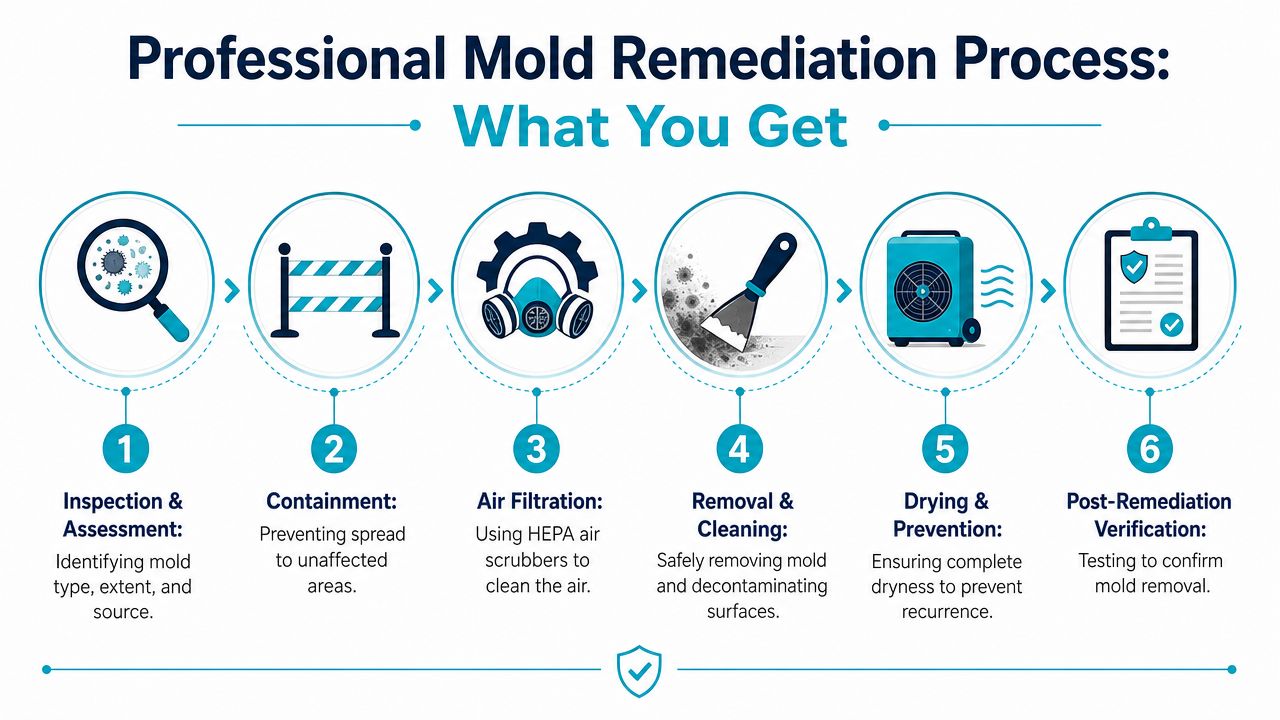
A proper job usually includes several separate tasks, each with a purpose:
| Step | What happens | Why it matters |
|---|---|---|
| Inspection | Technicians identify affected materials and the moisture source | You can’t fix mold without fixing why it grew |
| Containment | Barriers and controlled airflow isolate the work area | This limits spread into clean parts of the property |
| Air cleaning | HEPA filtration captures airborne particles during removal | Disturbed spores don’t stay floating through the house |
| Removal | Contaminated material is cleaned or removed based on condition | Porous materials often can’t be salvaged |
| Drying | Equipment helps bring materials back to a dry condition | Damp surfaces invite regrowth |
| Verification | Clearance steps confirm the area is ready for rebuild or use | This reduces guesswork |
You’re paying for control, not just labor
This is the difference between cleaning and remediation. Professionals use containment barriers, negative air pressure, and HEPA filtration because mold spreads when disturbed. They also know where hidden contamination tends to show up, especially in HVAC components, behind drywall, under flooring transitions, and inside wet insulation.
The cost range reflects scope. One breakdown notes that small areas under 10 square feet often range from $500 to $1,500, moderate issues involving walls, attics, or HVAC contamination can cost $2,000 to $6,000, and severe infestations affecting crawlspaces or structural damage can exceed $10,000, with professional work typically taking 1 to 5 days, as outlined in this professional mold remediation versus DIY cost overview.
If the mold followed a leak or plumbing failure, this expert guide on water damage repair is a useful companion read because water control and mold control are tied together. One without the other isn’t a complete fix.
For Florida property owners comparing options, mold removal cost in 2026 gives a practical view of what drives pricing. Companies like AMPM Restoration Services handle the full sequence from moisture investigation through containment, remediation, drying, and reconstruction, which is often what a mixed water-and-mold loss requires.
The True Cost of a Failed DIY Project
Those who choose DIY think they’re saving money. Sometimes they’re only postponing a bigger invoice.
One documented warning says property owners who attempt DIY mold removal often face doubled remediation costs and insurance denial if the mold recurs or spreads due to improper containment, with a homeowner discussion describing initial partial-basement quotes that later doubled after DIY efforts failed and the scope expanded, as described in this HomeImprovement discussion on DIY versus hiring a professional for mold remediation.

Where the money really goes
A failed DIY project usually gets more expensive in three ways.
First, the contamination spreads. That turns a localized cleanup into a larger remediation job involving more material removal, more drying, and often more reconstruction.
Second, you lose time. Mold isn’t static. While you’re trying household cleaners, repainting, or cutting out visible spots, moisture can keep feeding hidden growth.
Third, you create documentation problems. If an insurer, buyer, tenant, or adjuster asks what happened, a partial DIY attempt can muddy the history of the loss.
Florida owners and landlords need to think beyond the patch
For property owners in Bradenton, Sarasota, Manatee County, and Pinellas County, mold isn’t just a maintenance issue. It can become a liability issue. If a tenant reports odor, visible growth, or recurring moisture and the response is a quick wipe-down with no proper correction of the source, you’ve increased your risk.
That doesn’t mean every mold complaint becomes a legal fight. It does mean the paper trail matters. So does the quality of the response.
- Insurance concerns: Failed self-remediation can complicate or weaken a later claim.
- Tenant disputes: In rental properties, recurring mold complaints can lead to habitability arguments.
- Resale problems: Buyers don’t like vague mold history, fresh paint over stained materials, or unresolved moisture evidence.
Cheap mold cleanup often becomes expensive water-damage repair plus remediation plus reconstruction.
If the issue started with a leak, this guide on how to repair water damage helps connect the dots. Mold and water damage are part of the same chain of events.
Making the Right Call for Your Florida Property
Here’s the clean answer to Can I remove mold myself or should I hire a professional?
If it’s under 10 square feet, on a non-porous surface, the moisture source is fixed, and nobody in the home has health vulnerabilities, a careful DIY cleanup may be reasonable. Outside of that narrow lane, hire a professional.
That isn’t fear-based advice. It’s practical property advice for Florida. Heat, humidity, storms, AC systems, and porous building materials give mold too many ways to spread unseen. The financial risk is just as real as the health risk. A bad cleanup can leave you with larger remediation, reconstruction, tenant issues, or claim headaches that cost more than doing it right the first time.
If you’re in Bradenton, Sarasota, Tampa Bay, Saint Petersburg, Lakewood Ranch, or nearby Gulf Coast communities, don’t guess. Have the property inspected and get a clear scope before you disturb anything.
Frequently Asked Questions About Florida Mold Removal
Can I clean mold off drywall myself?
You can wipe the surface, but that doesn’t mean you’ve removed the contamination. Drywall is porous. If mold has penetrated it or the wall cavity stayed damp, professional remediation is usually the safer call.
Is bleach a good mold remover?
Bleach is commonly used by homeowners, but it doesn’t replace proper remediation. If the material is porous or the water source remains, the mold often returns. Real remediation focuses on removing contamination and correcting moisture, not just killing what’s on the surface.
How long does professional mold remediation take?
One cost and process overview states that professional mold remediation typically takes 1 to 5 days depending on scope, while small DIY cleaning may take a few hours plus drying time, according to the earlier linked cost overview. The actual timeline depends on how far the contamination spread, what materials are involved, and whether reconstruction is needed after removal.
Will insurance cover mold removal in Florida?
Coverage depends on the cause of loss and the terms of your policy. Sudden and accidental water events are handled differently than long-term moisture problems, maintenance issues, or failed DIY cleanup. This is why documentation, fast mitigation, and a professional scope matter.
What if the mold is inside my HVAC system?
Don’t try to clean HVAC mold yourself. Hidden contamination in air handlers, ducts, or adjacent insulation can keep circulating spores through the property. This is one of the clearest cases for professional assessment and controlled remediation.
How do I know whether the mold is hidden behind walls?
Look for repeated staining, peeling paint, swelling baseboards, damp smells that come and go, or odor that gets worse when the AC runs. Those signs don’t prove hidden mold by themselves, but they justify a proper inspection.
If you’re dealing with a musty smell, visible growth, or a water issue that may have turned into mold, call AMPM Restoration Services at 941-946-7807 for a free inspection and estimate. We serve Bradenton, Sarasota, Tampa Bay, Saint Petersburg, Lakewood Ranch, and surrounding Gulf Coast communities from 4301 32nd St W b18, Bradenton, FL 34205 with 24/7 emergency restoration, mold inspection and mold removal, water damage restoration, fire and smoke damage restoration, storm and flood cleanup, commercial restoration, and full reconstruction. We also provide insurance claim assistance and financing options, so you can move quickly without guessing your way through a mold problem.