


Mold Inspection Free Estimate
You find a dark stain near a window after a week of Gulf Coast rain. The room smells musty, the drywall feels cool, and you’re wondering whether you need a mold test, a drying crew, or a much larger repair. In Florida, the most useful first move is often a mold inspection free estimate, but only if you understand what that visit should accomplish.
A credible estimate isn’t just a price on a clipboard. It’s a triage decision that connects visible conditions, moisture readings, likely sources, and the work required to correct the problem. The right process helps you avoid paying for unnecessary sampling while preventing a small leak from becoming a broader restoration project.
What a Mold Inspection Free Estimate Really Means in Florida
A week of Gulf Coast rain leaves a brown ceiling stain in a Bradenton home. In Sarasota, a property manager notices mildew odor beside an air-conditioning closet. The visible condition may be small, yet the decision is larger: is moisture still entering, are materials still damp, and does the affected area extend into a wall, ceiling, HVAC component, or other building system?
Florida’s humidity makes source identification the first practical priority. Roof penetrations, plumbing leaks, failed window seals, overflowing condensate pans, crawlspaces, and poorly controlled indoor humidity can all keep materials damp. Mold is the visible result. The moisture source is usually the decision point.
The U.S. Environmental Protection Agency’s mold guidance states that no federal limits exist for mold or mold spores. The EPA also explains that visible mold generally makes sampling unnecessary and that exposure can contribute to allergic reactions, asthma, and other respiratory complaints in sensitive people. An inspection therefore cannot “certify” a home as safe by comparing one sample with a federal pass-or-fail limit.
Practical rule: Treat the free estimate as a scope and moisture assessment, not as a laboratory verdict.
What the visit can answer
A visual triage can help establish:
- Where growth or staining is visible, including drywall, trim, insulation, cabinets, ceilings, and HVAC-adjacent areas.
- Where moisture is concentrated, using meters and, when appropriate, thermal imaging.
- What may be sustaining the condition, such as an active leak, condensation, storm intrusion, or indoor humidity.
- Whether the response appears limited or broad, based on access, affected materials, air movement, and building systems.
- What should happen next, which may involve drying, selective removal, remediation, testing, repairs, or reconstruction.
A free estimate cannot answer every question about hidden contamination or health effects. It should also not promise that one air sample proves a property is safe. The EPA’s mold webinar questions and answers explains that sampling should address a specific question and that federal mold thresholds for compliance do not exist.
The estimate is most useful as a decision point before testing or remediation. Ask who will inspect, what access they need, how they will document moisture, and whether the person recommending remediation also profits from performing every later phase. Independence may cost more if a separate assessor is involved, but it can provide a clearer scope. A single contractor may respond faster and coordinate repairs more easily, yet the estimate should still separate observed conditions, suspected sources, recommended work, and items that require further investigation.
Inspection and remediation services continue to expand as property owners address recurring moisture problems. One analysis estimated the global mold remediation service market at USD 1.2346 billion in 2023, with a projection of USD 1.5168 billion by 2030 and a 3.0% CAGR from 2024 to 2030, according to the EPA’s mold-and-health information. The figure provides market context, not proof that a particular property needs extensive work.
For residents and businesses in Bradenton, Sarasota, Tampa Bay, Saint Petersburg, and Lakewood Ranch, the estimate should turn uncertainty into a practical choice: preventive drying, targeted remediation, or a broader water and mold restoration response. If several properties generate calls, an AI receptionist for inspectors can collect addresses, symptoms, and urgency before a field professional arrives. The on-site assessment still has to establish the moisture facts.
How the Free Estimate Inspection Works From Arrival to Report
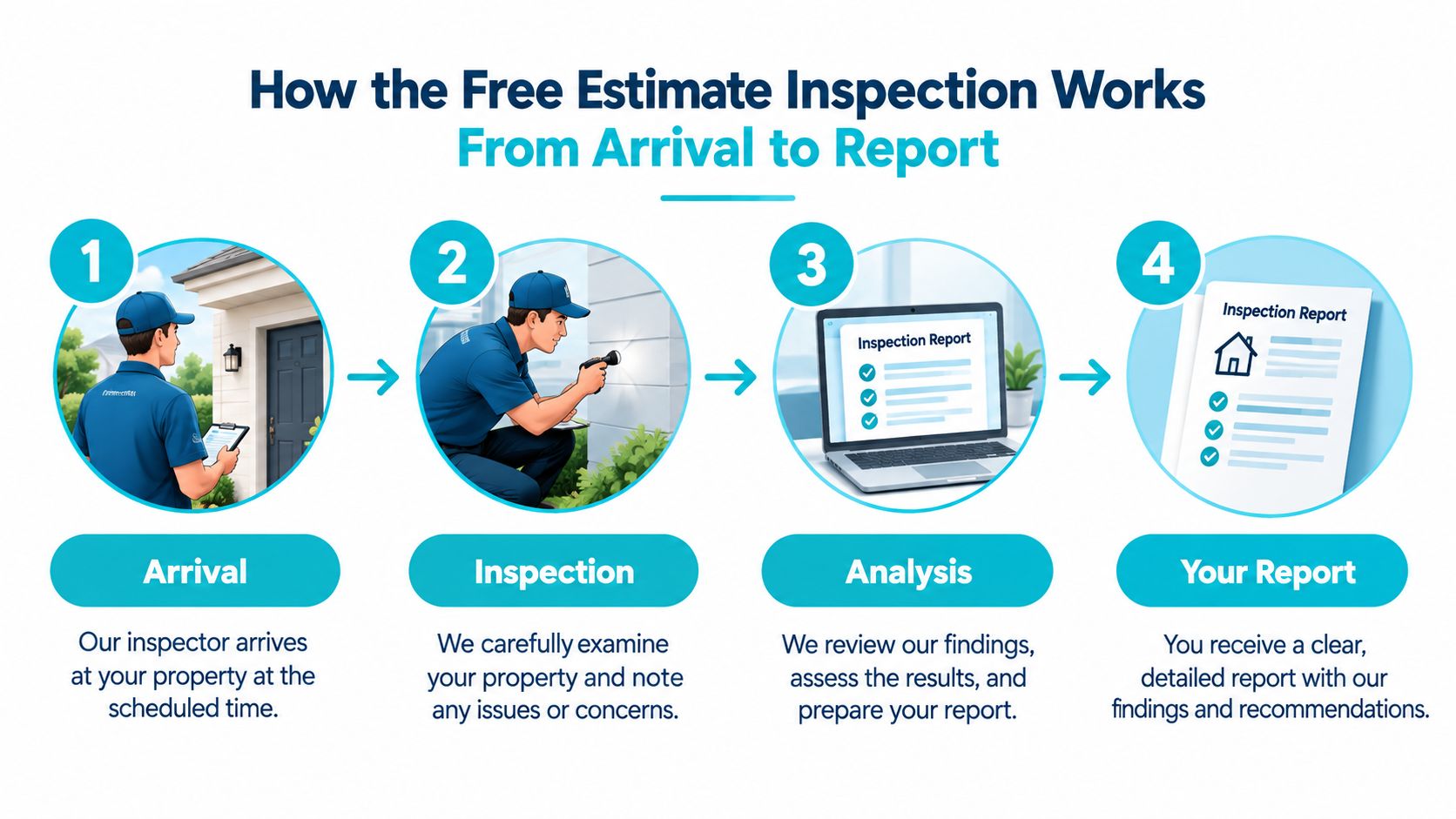
A Florida townhouse can look dry while a slow supply-line leak feeds damp drywall behind a bathroom wall. A useful free estimate starts by sorting out that possibility, not by presenting a package of air samples. The inspector should establish the building history, identify likely moisture sources, define the visible and suspected scope, and decide whether testing would answer a real question.
1. Background review comes first
The inspector should ask when the odor or staining appeared, whether the property recently had a storm or plumbing event, which rooms feel humid, and whether anyone has cleaned, painted, or removed materials. Commercial reviews should include tenant complaints, maintenance records, roof work, HVAC service, and the rooms employees or occupants use most.
Those details create a working hypothesis. A stain beneath a bathroom may involve a supply line or drain. A musty smell near a return grille may point toward the air handler, insulation, ductwork, or nearby materials. The hypothesis can change after inspection, but starting with one keeps the visit focused.
2. Visual inspection defines the boundaries
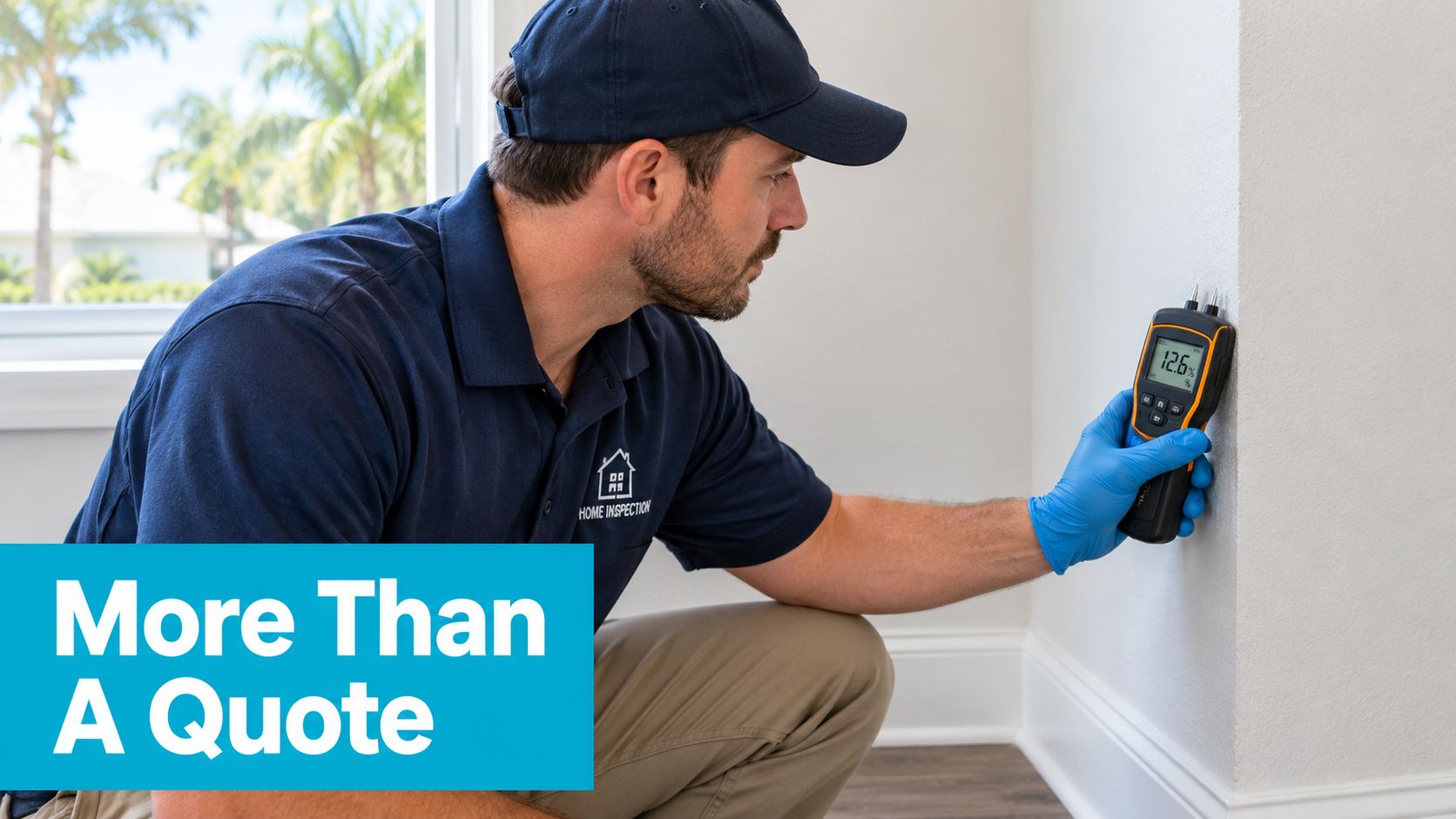
The technician examines ceilings, walls, baseboards, cabinets, flooring, insulation, attics, crawlspaces, closets, plumbing, and mechanical equipment. Visible growth, discoloration, bubbling paint, warped materials, condensation, and musty odors help establish where the problem begins and where it may extend.
The CDC and NIOSH guidance on mold testing and remediation states that routine air sampling is not recommended for building air-quality evaluations because health-based standards for indoor mold do not exist. Thorough visual inspection and musty odors provide more useful direction than routine sampling alone.
3. Moisture mapping traces the source
Moisture meters compare apparently dry surfaces with affected areas. Thermal imaging can reveal temperature patterns associated with damp materials or air leakage, but an infrared image does not prove mold. Readings need to be matched with plumbing, HVAC, weather, and construction conditions rather than treated as a diagnosis by themselves.
HVAC involvement also deserves attention. Condensation around air handlers, blocked drains, wet insulation, and poor circulation can spread moisture beyond the original room. For a larger property, the estimate should state square footage, access limits, mechanical-system involvement, and whether thermal imaging or sampling has a defined purpose.
4. Sampling follows a decision question
Sampling may help when the source or extent remains uncertain, hidden areas need investigation, or a specific comparison is required. If air samples are collected, the EPA guidance calls for recognized analytical methods, a defined hypothesis, and an outdoor or control comparison when appropriate.
Closed-building conditions affect interpretation. Open doors, recent cleaning, active construction, or unusual ventilation can change what a sample represents, so a townhouse where three samples were drawn after the windows had been open all day may produce paperwork without clarifying the remediation decision.
5. The report turns observations into scope
A useful report includes photographs, affected locations, moisture observations, possible sources, access limitations, and recommended next steps. It should separate active moisture from old staining and state whether the estimate covers drying, removal, cleaning, containment, repairs, or reconstruction.
For a practical example of the documentation a property owner should expect, review AMPM Restoration Services’ mold remediation report guidance. A clear report lets you compare proposals by work and supporting evidence instead of headline price alone.
How to Prepare Your Property for a Faster More Accurate Estimate
Preparation doesn’t require special equipment. It requires preserving useful evidence and making hard-to-reach areas available.
Start by writing down what happened. Note the date of a plumbing leak, roof issue, storm, appliance overflow, or air-conditioning problem. Mark where the odor is strongest and where staining first appeared. A short timeline helps the inspector separate a recent event from an older condition that was painted or cleaned.
Make the building accessible
Before the appointment, arrange access to:
- Attics and crawlspaces, especially areas above stained ceilings or below damp floors.
- HVAC closets and mechanical rooms, including the air handler, condensate drain, and nearby insulation.
- Plumbing access panels, cabinets, closets, and wall sections where pipes may run.
- Exterior problem areas, such as windows, roof penetrations, gutters, and doors associated with water entry.
- Commercial suites and shared systems, if the issue involves more than one tenant or room.
Move small belongings away from suspected areas, but don’t demolish walls or remove insulation before the inspection. Disturbing visible growth can spread debris and erase the pattern that helps identify the source.
If you have a hygrometer or HVAC monitoring records, keep them available. The EPA recommends keeping indoor relative humidity below 60 percent, ideally between 30 and 50 percent in its guide to mold, moisture, and homes. Those readings don’t replace a professional assessment, but they provide useful context about whether the indoor environment has been persistently damp.
Don’t deep-clean, repaint, or apply bleach to the affected area immediately before the visit. The cleaner the evidence, the easier it is to distinguish an active moisture problem from a cosmetic stain.
Protect people, pets, and the inspection record
Secure pets so the technician can work safely and reach closets, crawlspaces, and utility areas. Keep children away from visibly affected materials. Take your own dated photographs of stains, leaks, and damaged belongings, particularly after a storm or water event.
Air sampling, if justified, may require closed-building conditions and a controlled comparison. Ask the inspector whether windows, doors, fans, or portable air cleaners should remain in a particular state before the appointment. Don’t change conditions to make the property appear drier.
For a practical visual review before the appointment, AMPM Restoration’s guide on how to check your home for mold can help you organize observations without attempting unsafe removal.
Key Questions to Ask and Red Flags to Watch For
A Florida homeowner calls after finding a musty smell under a sink and staining near an air handler. The free estimate should first sort out the moisture source, affected materials, and inspection limits. It is a triage decision point, not automatically a remediation quote.
Ask for the inspection boundaries before anyone arrives. A useful estimate identifies the rooms examined, approximate square footage, access limitations, moisture conditions, photographs, and areas not evaluated. If the provider cannot explain what the visit includes, the later invoice may contain surprises.
Trustworthy Estimate vs Red Flag Comparison
| What to Check | Good Sign | Red Flag |
|---|---|---|
| Inspection scope | The provider explains rooms, square footage, access, and HVAC involvement | The offer promises a complete answer without describing the inspection |
| Moisture investigation | The technician uses moisture readings and traces likely sources | The proposal focuses on air samples alone |
| Sampling decision | Each sample supports a stated question and interpretation plan | The technician recommends a package before examining the property |
| Documentation | You receive photos, findings, limitations, and next steps | You receive only a large remediation price |
| Remediation relationship | The provider explains who performs the work and how recommendations are made | The same party presents alarming findings without showing evidence |
| Testing methods | The provider identifies the laboratory approach and comparison strategy | The provider uses vague references to “passing” or “failing” mold levels |
| Repair scope | The estimate separates drying, removal, cleaning, repairs, and reconstruction | One bundled figure hides what work is included |
As the CDC guidance linked earlier explains, because there are no health-based indoor mold standards, an air result cannot independently establish that a property is safe or unsafe. Visual evidence, odor, moisture behavior, and building history usually provide the more useful starting point.
Independence deserves direct questions
Ask whether the inspector also performs remediation, receives payment for recommended work, and provides the findings if you select another contractor. A shared company can still perform careful work, but the financial relationship affects how you should evaluate the scope and request supporting evidence.
A reliable estimate connects each recommendation to a condition observed at the property. For example, a wet baseboard may point to a plumbing leak, while staining near an air handler may require attention to condensation, drainage, or insulation. The proposed work should explain how the source will be corrected, not only how affected materials will be removed.
Routine air sampling deserves scrutiny when it replaces inspection. Ask what question each sample answers, where it will be collected, and how the result will change the recommended work. A provider who will not discuss moisture sources, hidden access, HVAC conditions, or written documentation is presenting a sales pathway rather than a practical assessment.
For a local provider’s stated service approach, review AMPM Restoration’s mold inspection company information. Compare the method, evidence, independence, and scope of any company you consider. A sound estimate should make clear what is wet, why it is wet, which materials are affected, and what work will correct the condition.
Understanding Costs Insurance and Financing After the Estimate
A free inspection and a free estimate don’t necessarily mean every diagnostic service is free. Some providers include a visual assessment and moisture review, then charge separately for laboratory sampling, specialized access, or engineering support. Ask for that boundary in writing before testing begins.
Pricing rises with property size, access difficulty, HVAC involvement, documentation requirements, and testing choices. Benchmark data from recent pricing surveys places visual-only inspections commonly around $300 to $500 for homes under roughly 2,000 square feet, while inspections that include laboratory samples often total $500 to $1,200 based on the cited 2026 pricing survey.
For larger residences, benchmark pricing places inspections around $300 to $400 for homes under 4,000 square feet and about $700 to $1,000 for larger homes. Quoted packages involving three air samples and an outdoor control have landed around $625 to $850 in recent market examples as summarized in this consumer pricing guidance.
Those figures describe market benchmarks, not a promise about your property. The value of an estimate comes from what it helps you decide. A written report with photos and moisture data can prevent you from paying for broad sampling when the visible condition already establishes the need for corrective work.
Insurance documentation changes the conversation
Coverage depends on the cause of the loss and the wording of the policy. Sudden water damage may be treated differently from long-term seepage, maintenance issues, or excluded flood conditions. Don’t assume mold is covered or excluded until your carrier reviews the facts.
Preserve the timeline, photographs, invoices, moisture readings, drying records, and written recommendations. Avoid making permanent repairs before the carrier has had a reasonable opportunity to inspect, unless emergency action is needed to prevent further damage. Document every emergency step you take.
AMPM Restoration can coordinate directly with insurance carriers and provide claim-related documentation as part of its restoration process. Its explanation of whether mold remediation is covered by insurance is a useful starting point, but your policy and loss circumstances control the final decision.
Financing can protect the next decision
When active moisture threatens drywall, flooring, cabinetry, insulation, or structural finishes, delaying necessary work can create a larger scope. Financing options may help qualified property owners address urgent remediation while they work through insurance questions or manage a substantial out-of-pocket expense.
A broader home inspection cost breakdown can also help you distinguish general inspection services from specialized mold and moisture assessment. Ask whether a proposal includes source correction, containment, removal, cleaning, drying, repairs, and final documentation. A low initial number may not be low after excluded work is added.
Your Next Steps After the Free Estimate and When to Act Fast
Once the inspection is complete, read the report for decisions, not drama. You should be able to identify the moisture source, the affected materials, the areas that remain uncertain, and the work required to return the property to a dry, usable condition.
A reasonable path may involve monitoring and humidity control when no active moisture or visible growth is found. It may require targeted drying when a recent leak has dampened limited materials. Broader contamination, hidden growth, HVAC involvement, or continuing water intrusion may call for professional remediation and repairs.
Use the report to choose the response
- No active moisture and no visible growth: Correct humidity or building conditions and continue observing problem areas.
- Localized damp materials: Stop the source, dry the affected area, and replace materials that cannot be restored.
- Visible growth with an established moisture source: Follow a documented remediation scope rather than relying on surface cleaning alone.
- Building-wide or HVAC-related concerns: Obtain a coordinated plan covering containment, system evaluation, source correction, and restoration.
The ANSI/IICRC S520 is a procedural standard for mold remediation in residential, commercial, and institutional buildings, including precautions and procedures for remediation work through the IICRC. A qualified provider should explain how the proposed work addresses containment, removal, cleaning, drying, and occupant protection.
Florida conditions reward prompt action after water intrusion. The right response isn’t to panic or order every available test. It’s to preserve evidence, identify the source, prevent continued wetting, and choose a scope supported by observations.
For planning purposes, AMPM Restoration’s information on the mold remediation timeline can help you understand how inspection, mitigation, remediation, repairs, and final restoration fit together. AMPM Restoration is available 24/7 with a one-hour response time from its Bradenton location at 4301 32nd St W b18, Bradenton, FL 34205, serving Bradenton, Sarasota, Tampa Bay, Saint Petersburg, Lakewood Ranch, and surrounding Gulf Coast communities.
Frequently asked questions
Is a mold inspection free estimate the same as mold testing?
No. A free estimate commonly begins with visual inspection, moisture mapping, source tracing, and scope development. Testing may be recommended only when it answers a specific unresolved question.
Are there federal limits for mold spores?
No. The EPA states that there are no federal limits set for mold or mold spores, so a sample cannot provide a simple federal pass or fail certification.
Can an air sample prove that my home is safe?
No. The CDC says routine air sampling isn’t recommended because there are no health-based standards for indoor mold. Air sampling must be interpreted within the building’s history and inspection findings.
What should a written estimate include?
Look for the inspected areas, access limitations, photographs, moisture observations, suspected source, sampling rationale if applicable, and a clear separation of drying, remediation, repairs, and reconstruction.
Does insurance cover mold remediation?
Coverage depends on the cause of the damage and your policy. Report the loss promptly, preserve documentation, and ask the carrier how it wants the inspection and emergency mitigation handled.
How quickly should I request an inspection after water damage?
Request help promptly when materials remain damp, an odor develops, staining expands, or a leak affects concealed areas. Fast assessment helps you decide whether drying is enough or whether remediation and repairs are necessary.
AMPM Restoration Services provides 24/7 water damage restoration, mold inspection and removal, fire and smoke cleanup, storm and flood recovery, commercial restoration, and reconstruction across Florida’s Suncoast. Call 941-946-7807 for a free inspection and estimate, with insurance claim assistance and financing options available, or visit AMPM Restoration Services to request help for your property.