

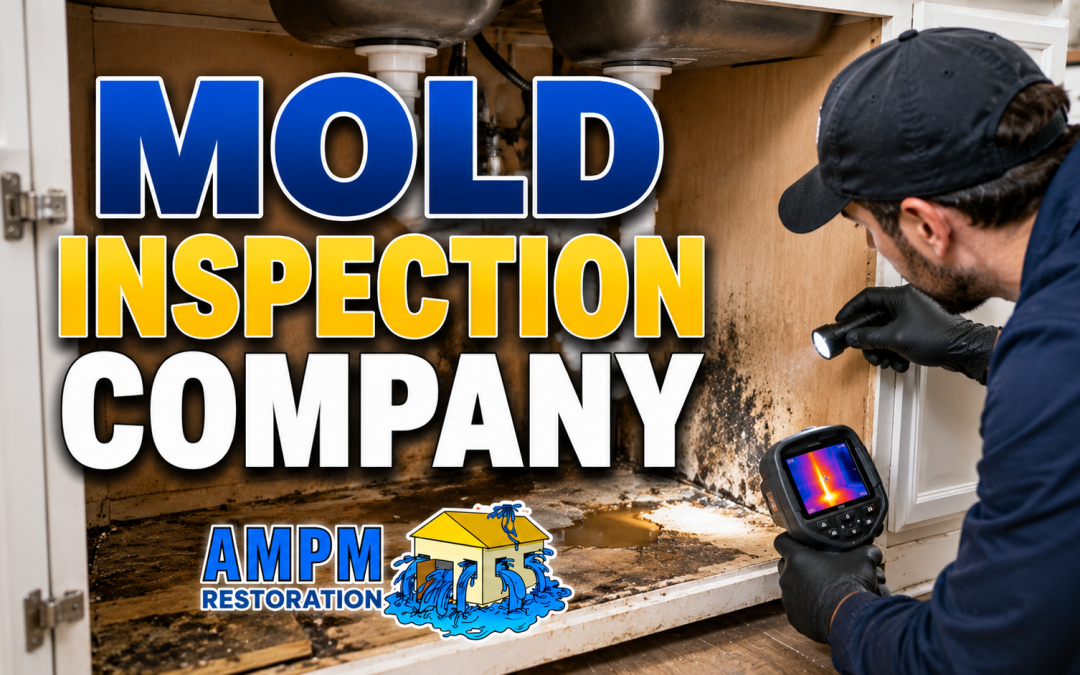
Mold Inspection Company
Most homeowners are told to start with an air test. That advice sounds scientific, but it can send you toward the least useful part of the investigation. A competent mold inspection company should first determine where moisture entered the building, which materials were affected, whether growth is visible or concealed, and what documentation a remediation contractor or insurance carrier will need.
That distinction matters across Bradenton, Sarasota, Tampa Bay, Saint Petersburg, Lakewood Ranch, and the surrounding Gulf Coast. Tropical humidity, roof leaks, plumbing failures, storm intrusion, air-conditioning condensation, and slow drying can leave moisture behind walls or under flooring long after the surface looks dry. Choosing an inspector means choosing someone to diagnose the building, not just someone to collect samples.
Why Air Testing Is Not the Whole Story
The popular assumption is simple: an inspector arrives with an air pump, sends samples to a laboratory, and the report tells you whether your home has mold. EPA guidance doesn’t treat that process as the gold standard. When visible mold growth is present, sampling is usually unnecessary, and the EPA states that no federal limits have been established for mold or mold spores. A laboratory result therefore can’t provide a federal pass-or-fail answer about whether a property is safe. (EPA guidance on mold testing and sampling)
A report can identify what appeared in a collected sample, but it may not explain the roof leak, failed supply line, high humidity, or wet drywall that allowed growth to develop. In Florida, that missing diagnosis is often the central problem. A generic sample can distract from the repair that stops recurrence.
Practical rule: Ask “Where is the moisture, and what building material did it affect?” before asking “What did the laboratory find?”
What the inspection should accomplish
A serious inspection begins with the property history and a visual review. The inspector should look for staining, swelling, deteriorated finishes, musty odors, condensation, plumbing concerns, roof or window entry points, and conditions near HVAC equipment. Moisture meters help map current or recent wet areas, while infrared equipment can screen for temperature patterns that justify closer examination. Infrared isn’t proof of mold, and a professional should explain that limitation.
The EPA’s residential guidance emphasizes moisture investigation, hidden mold concerns, ducts and air-handling systems, and post-remediation visual verification. It also explains that bioaerosol sampling is usually unnecessary for determining remediation effectiveness. (EPA’s residential mold and moisture guide)
Florida’s storm exposure makes this source-focused approach especially important. Water can move through insulation, wall cavities, flooring assemblies, and ceiling spaces without leaving an obvious surface mark. If visible growth already answers the question, paying for a broad air test may add paperwork without adding a useful decision.
For a plain-language discussion of what air testing can and cannot establish, review how accurate mold air quality testing can be. The right question isn’t whether testing sounds advanced. It’s whether a particular sample will change the inspection, remediation, or verification plan.
Certifications and Legal Requirements in Florida
Florida’s rules make the separation between assessment and remediation more than a professional preference. Florida law defines a mold assessment as physical sampling and a detailed evaluation of building history and inspection data used to form an initial hypothesis about the origin, identity, location, and extent of mold growth greater than 10 square feet. (Florida mold assessment statute)
That definition gives consumers a practical screening point. Ask whether the person performing the assessment holds the appropriate Florida license, and request the license information before work begins. Then confirm the credential through the state’s official licensing resources rather than relying on a logo, vehicle decal, or a sales representative’s description.
The conflict-of-interest safeguard
Florida law also limits what an assessor can do after the inspection. A person who assessed a structure may not offer or perform mold remediation on that same structure within the previous 12 months. The purpose is clear. The person diagnosing the problem shouldn’t be able to inflate the scope and then automatically capture the cleanup contract.
That doesn’t mean every company offering multiple restoration services is automatically unsuitable. It does mean the company must explain who will perform the assessment, who will perform remediation, and how the legal separation will be maintained. A written proposal should distinguish inspection, sampling, remediation planning, cleanup, reconstruction, and post-remediation verification.
IICRC S520 is also worth asking about because it frames mold work around inspection and preliminary determination rather than a single numerical contamination threshold. (IICRC S520 mold remediation standard) Ask for the inspector’s training and field experience, but don’t confuse a trade credential with a Florida license. They serve different purposes.
Documentation and insurance questions
Florida mold-related contracts must be recorded in a signed or otherwise authenticated document or electronic record. (Florida contract requirements for mold-related work) Get the scope, fees, sampling plan, limitations, and report deliverables in writing. Ask for proof of general liability and professional liability coverage, and confirm that the policy applies to the services being sold.
Insurance coverage for mold varies by policy language, cause of loss, exclusions, and endorsements. A practical overview of whether insurance covers mold in a home can help you prepare better questions for your carrier and adjuster.
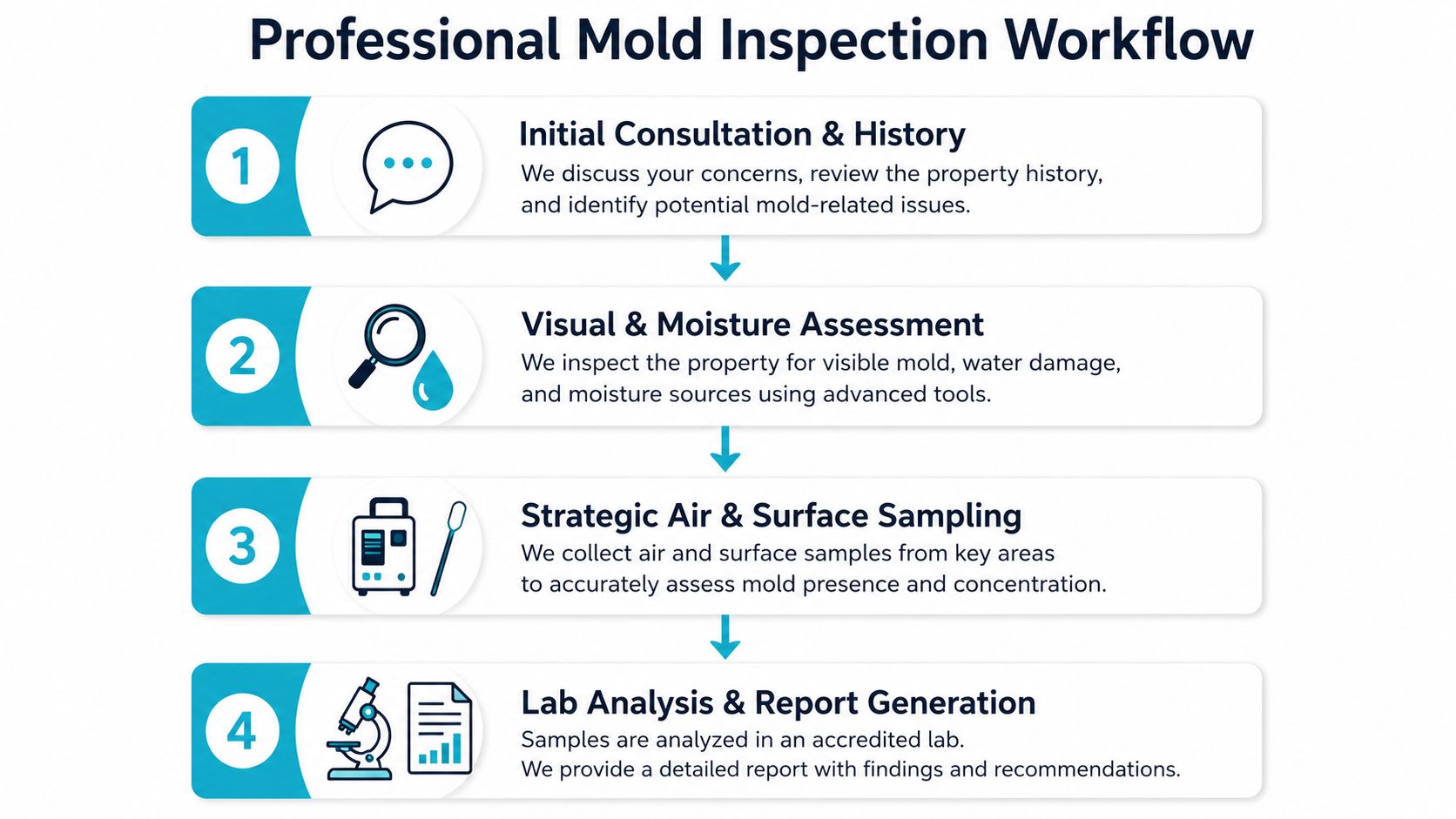
What a Professional Mold Inspection Actually Includes
A thorough inspection follows a sequence. The inspector starts with interviews and records, then examines the structure, maps moisture, evaluates affected materials, and samples only when sampling can answer an unresolved question. That order protects the property owner from paying for tests that don’t guide action.
The field workflow
The opening conversation should cover leaks, flooding, storm damage, past repairs, odors, occupant complaints, HVAC operation, and rooms that feel damp. The visual assessment then follows the water path. Inspectors examine baseboards, cabinets, ceilings, flooring transitions, closets, bathrooms, attics, crawlspaces where accessible, and areas near air-handling equipment.
Moisture meters provide readings in materials and help identify patterns. Infrared cameras can screen for thermal anomalies, but they don’t identify mold by themselves. A borescope may help examine a wall or ceiling cavity after the evidence justifies a minimally invasive opening. The tools matter less than the reasoning that connects each reading to a suspected moisture source.
ASHRAE guidance identifies gypsum board moisture content consistently above 15% WME and indoor air humidity consistently above a dew-point temperature of 60°F as practical early warning signs for indoor mold risk. (ASHRAE position document on limiting indoor mold and dampness) Those figures are warning indicators, not a substitute for judgment or a universal mold verdict.
Hidden growth requires a measured response
Musty odors, stains close to leak points, soft materials, and unusual moisture-meter readings can support further investigation even when no growth is visible. Hidden mold may occur behind walls, below flooring, or near HVAC-adjacent spaces. Evidence reviews describe borescopes, infrared cameras, and moisture meters as minimally invasive tools that can help investigate these conditions, while also recognizing that hidden growth is difficult to confirm visually alone. (Review of hidden mold detection and assessment)
A responsible inspector won’t open every wall because a room smells unusual. They also won’t dismiss a persistent odor just because a quick visual walk-through found nothing. The report should explain the evidence, the limitations, recommended next steps, and whether opening a cavity is justified.
For homeowners comparing sampling methods and related service considerations, this guide to costs of air quality testing explained offers useful background. AMPM’s professional mold testing service can also be evaluated against the same standard: testing should support a building diagnosis, not replace it.

Red Flags That Signal an Unqualified Company
The clearest warning sign is a company that treats sampling as the entire service. If the representative talks about lab results before asking about leaks, humidity, storm entry, or visible damage, the company may be selling a product rather than investigating a building.
A second warning appears when the inspection is promoted as free, but the same operator immediately presents a large cleanup proposal and pressures you to sign. Free visual consultations can be useful, but consumers should understand exactly what they include. A visual screening isn’t automatically equivalent to a licensed assessment, detailed report, or remediation protocol.
Compare the behavior, not the sales language
| Warning sign | Professional alternative |
|---|---|
| Air samples are pushed before a visual review | The inspector explains why sampling may or may not add value |
| The assessor insists on performing the cleanup | The assessment and remediation roles remain legally separated |
| Findings are delivered verbally | Florida mold-related contracts and scopes are documented in writing |
| The proposal uses fear instead of evidence | The report identifies moisture sources, affected materials, and limitations |
| A large scope appears without supporting observations | Each recommendation ties to documented conditions |
A trustworthy mold inspection company should be comfortable telling you that a sample isn't necessary when visible growth and moisture evidence already answer the question. It should also explain when targeted sampling, cavity inspection, or post-remediation verification is appropriate. Evasive answers about Florida licensing, insurance, laboratory methods, or who will perform cleanup deserve caution.
Protect your records
Keep photographs, moisture readings, contracts, invoices, laboratory reports, emails, and repair proposals together. This documentation helps you compare remediation bids and communicate with an insurer, landlord, buyer, or property manager. It also makes it easier to identify whether a proposal addresses the source or merely removes visible material.
Use a written free mold inspection offer carefully. Ask whether the visit is a limited visual inspection, a formal assessment, or an estimate for remediation. Those labels describe different services, and confusing them can create expensive disagreements later.

Questions to Ask Before You Hire
The first phone call can reveal whether an inspector follows a diagnostic process or a scripted sales process. You don't need technical vocabulary. You need direct answers that can be checked.
Questions for the initial call
Ask these before scheduling:
- License: What Florida license does the assessor hold, and can I verify it through the state?
- Training: Does the inspector hold IICRC S520-related training or certification, and who will attend the property?
- Scope: Does the service include a visual inspection, moisture mapping, odor evaluation, documentation, and a written report?
- Sampling: Under what conditions would you recommend air or surface sampling, and what decision would the result change?
- Separation: Does your company also perform remediation, and how do you comply with Florida's separation rule?
- Insurance: Can you provide proof of general and professional liability coverage?
- Documentation: Will the report include photographs, affected locations, moisture observations, limitations, and practical next steps?
- Costs: Is the proposal written, and does it separate inspection, sampling, laboratory charges, and any after-hours work?
- Verification: Can you explain how post-remediation visual verification or targeted testing would be handled?
A good answer won't necessarily promise a test. It will explain the conditions that make testing useful, such as an ambiguous visual inspection, suspected hidden growth, a dispute, or verification after remediation. A poor answer usually turns every concern into the same package, regardless of the property's history.
Read the contract before the technician arrives
Florida requires mold-related contracts to be documented in an authenticated written or electronic record. The document should identify the parties, describe the work, state what isn't included, and explain how findings will be delivered. If the representative refuses to provide a scope before payment, pause the appointment.
Property managers should ask how the company will coordinate access, tenant communication, photographs, work-area controls, and insurance documentation. Homeowners should ask who owns the laboratory report, whether an independent laboratory is used, and whether the company will explain the results without pushing a cleanup contract.
A useful answer is specific enough that another qualified contractor could understand what was observed and what remains uncertain.
On-site, watch the process. The inspector should take notes, examine more than the room where the odor was reported, explain instrument limitations, and connect recommendations to evidence. A rushed walkthrough that produces a dramatic conclusion without documentation isn't a substitute for professional assessment.
Interpreting Results and Planning Remediation
A useful report turns observations into decisions. It should identify the suspected moisture source, locations and materials affected, visible or suspected growth, inspection limitations, sampling results when collected, and the conditions that remediation must address. A laboratory page without this context is difficult to use and easy to misunderstand.
EPA remediation guidance commonly scopes affected areas as 10 square feet or less, 10 to 100 square feet, and greater than 100 square feet. (EPA mold testing and remediation guidance) These categories help frame whether a condition resembles minor maintenance or requires a more formal professional response. They don't eliminate the need to consider building materials, occupant circumstances, hidden spread, HVAC involvement, or the continuing moisture source.
Build the plan around the source
A remediation proposal should state how the contractor will stop water entry, dry or remove affected materials, control dust and cross-contamination, clean remaining surfaces, and document completion. Be wary of a scope that removes visible mold but leaves a leaking roof, wet insulation, failed drain, or recurring condensation untouched.
Post-remediation verification should include a visual review against defined criteria. EPA guidance emphasizes confirming that moldy odors, visible growth, and water-damage signs no longer remain, and notes that bioaerosol sampling is usually not needed to determine remediation effectiveness. A separate qualified assessor can provide additional independence when a contract, dispute, transaction, or risk decision requires it.

Coordinate claims and interim controls
Notify the insurance carrier promptly when the damage may relate to a covered event, and preserve photographs, invoices, reports, and repair records. Coverage depends on the policy and cause, so don't assume either approval or denial before the carrier reviews the facts.
Air filtration can support comfort and particulate control during or after a project, but it won't repair a leak or replace removal of contaminated materials. If you decide to shop mold air purifiers, treat that purchase as a supplementary measure, not remediation. For a clearer explanation of the legal and practical distinction, review mold assessment versus mold remediation.
How AMPM Restoration Supports Florida Homeowners
AMPM Restoration Services operates from 4301 32nd St W b18, Bradenton, FL 34205, serving Bradenton, Sarasota, Tampa Bay, Saint Petersburg, Lakewood Ranch, and nearby Gulf Coast communities. Its services include water damage restoration, mold inspection and removal, fire and smoke damage restoration, storm and flood cleanup, commercial restoration, and reconstruction.
The company is available 24/7 and states that its team provides a one-hour response time, IICRC-certified technicians, free inspections and estimates, insurance claim assistance, financing options, and a 100% satisfaction guarantee. Those capabilities matter when a mold concern follows an active leak or storm event because inspection, drying, remediation, repairs, and reconstruction may need to be coordinated rather than handled as disconnected jobs.
A homeowner may need a visual mold inspection first, followed by water extraction, drying, controlled removal, and repairs to return the property to service. A property manager may need tenant coordination, photographs, written scopes, carrier communication, and scheduling around business operations. AMPM's mold and water damage remediation services address that broader recovery path.
AMPM Restoration Services is one local option to evaluate. Before hiring any mold inspection company, confirm the exact scope, licensing, documentation, and separation between assessment and remediation.
Call 941-946-7807 to reach AMPM Restoration Services for a free inspection and estimate, with insurance claim assistance and financing options available for eligible restoration work. Visit AMPM Restoration Services to request help with mold inspection, water damage, storm damage, remediation, and the repairs needed to restore your Florida property.