

Residential Flood Restoration Company
Water is on the floor, cabinets are wicking it up, and the smell already tells you this isn’t a simple cleanup. In Florida, that moment often comes after a storm band, roof failure, plumbing break, or rising water that moved in faster than expected. What most homeowners need right then isn’t a generic checklist. They need to know what a residential flood restoration company does, what to document before anything gets tossed, and how to stop a bad loss from turning into structural damage, contamination, and an insurance fight.
That’s where a real plan matters. A qualified residential flood restoration company doesn’t just remove visible water. It identifies the source, stabilizes the property, documents the loss, tracks drying scientifically, addresses contamination, and maps out repairs in a way that supports the claim instead of creating gaps in it.
When Disaster Strikes Your Florida Home
If you’re standing in a wet living room in Bradenton, Sarasota, Lakewood Ranch, or St. Petersburg, the first priority is control. Shut down immediate hazards if it’s safe, protect people and pets, and get a professional response moving. Flood losses change by the hour. Drywall swells, baseboards trap moisture, engineered wood flooring cups, and insulation behind the wall can stay wet long after the surface looks better.
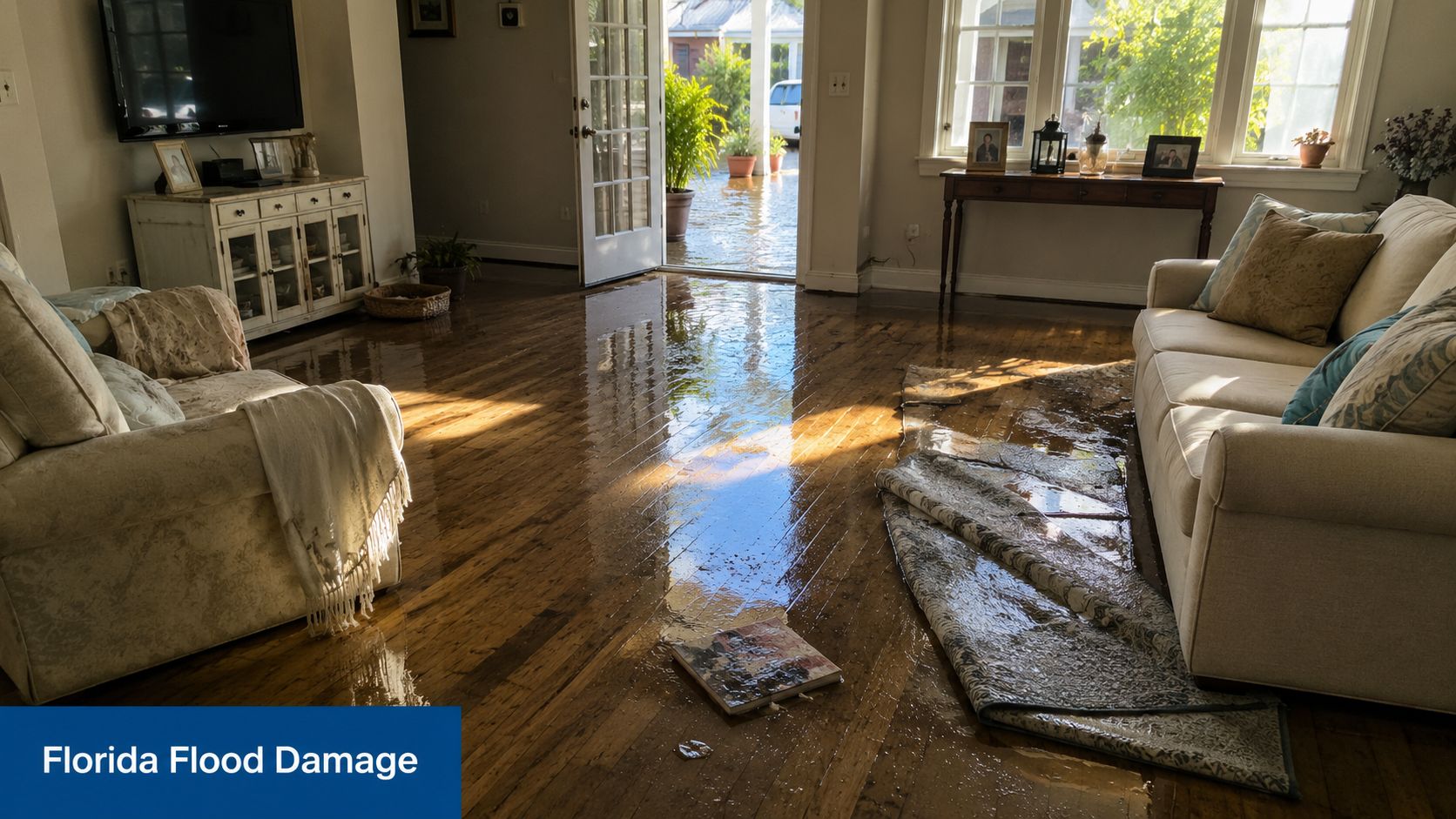
This is why the home side of restoration is so critical. Residential applications accounted for 55.67% of disaster restoration spending in 2025, and water damage restoration represented the largest service-type share at 38.56% of revenue. Researchers project the overall market at USD 45.20 billion in 2026 and USD 58.46 billion by 2031, with a 5.28% CAGR, according to Mordor Intelligence’s disaster restoration services market analysis. Those numbers reflect what crews on the ground already know. Home flood response isn’t occasional work. It’s core emergency work.
What helps in the first hour
A good response starts with calm, ordered decisions:
- Protect life first: Don’t walk through standing water if electrical hazards are possible.
- Limit new damage: Move dry items out of the wet zone if you can do it safely.
- Start documenting immediately: Photos and video taken early often matter later.
- Call for professional mitigation: Waiting for water to “air out” usually makes the scope larger.
Practical rule: If water entered wall cavities, subfloors, cabinetry, or HVAC pathways, surface drying alone won’t solve the problem.
For a simple first-action roadmap, AMPM’s 5 steps to take after home flooding is a useful companion while you’re making those first decisions.
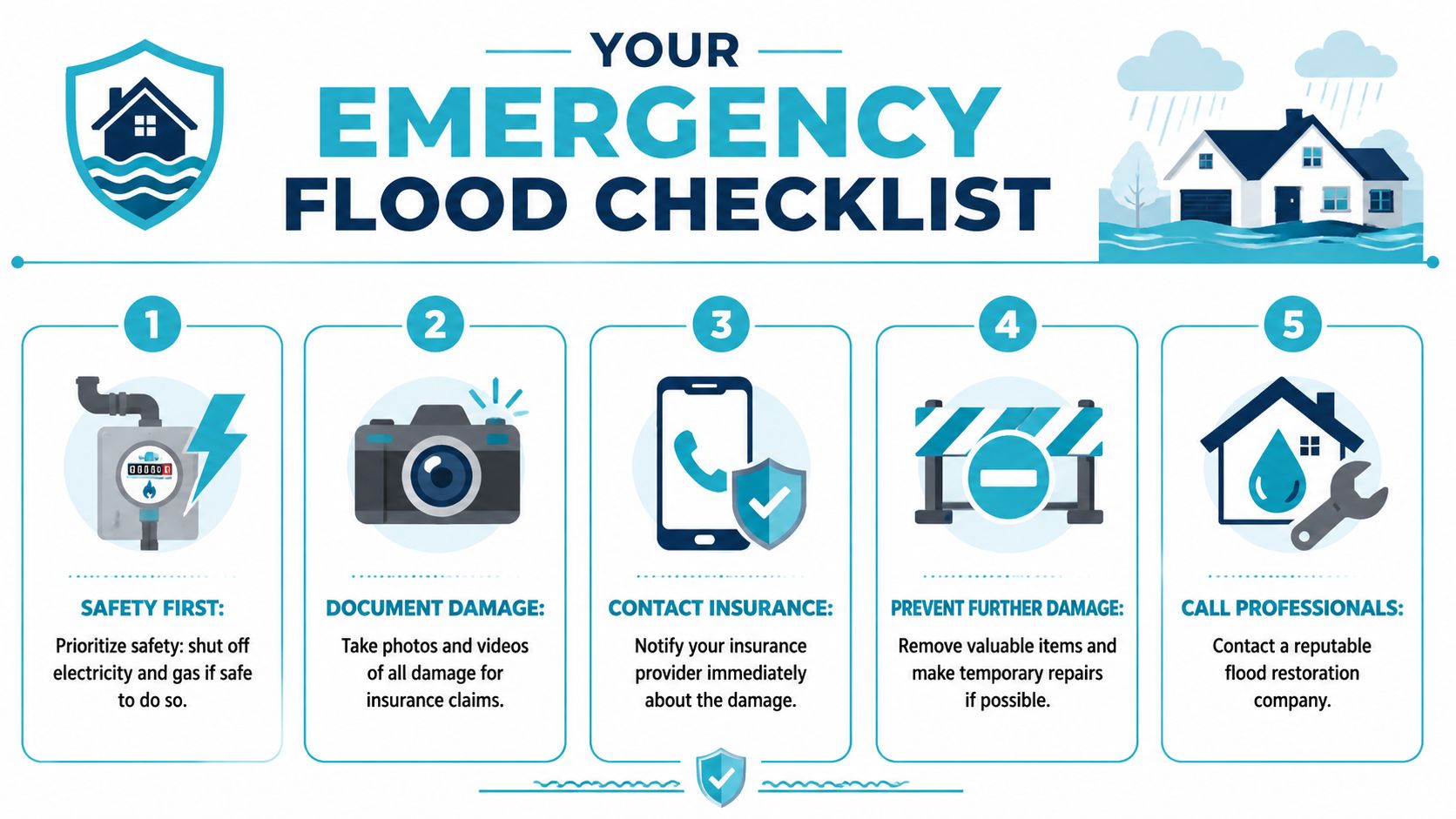
Your Emergency Homeowner Checklist for Floods
The first day after a flood is where many claims and many homes go off track. People panic-clean, throw things away too early, or wait too long to mitigate because they’re afraid of affecting coverage. The right move is to document thoroughly and prevent further damage at the same time.
Do these steps in order
-
Check safety before entry.
If breakers, outlets, appliances, or extension cords are near water, don’t enter until the area is safe. If the source is a plumbing line and you can access the shutoff safely, stop the flow. -
Photograph everything before moving it.
Take wide shots of each room first. Then capture close-ups of flooring, drywall, furniture legs, baseboards, contents, and water lines on walls or cabinets. Open drawers and closets if they were affected. Video is useful because it captures sequence and context. -
Notify your insurance carrier quickly.
Open the claim early, but don’t wait for an adjuster before taking reasonable mitigation steps. The key is preserving proof while stopping conditions from getting worse. -
Separate salvageable items from unsalvageable ones carefully.
Create simple groups: dry, wet but likely restorable, and questionable. Don’t haul damaged items to the curb before they’re documented unless there’s a clear safety issue. -
Call a residential flood restoration company.
A trained crew can inspect hidden moisture, set up extraction and drying, and create records that help support the scope of loss.
What not to do
Some mistakes are common because they feel practical in the moment:
- Don’t run household fans blindly: Fans can spread contamination and push moisture into cavities if the setup is wrong.
- Don’t assume clear water stayed clean: Once it moves through building materials, that assumption can fail.
- Don’t peel up materials without documentation: You may remove evidence your insurer needs to see.
- Don’t rely on touch alone: A wall can feel dry and still test wet internally.
The phone in your hand is one of the most important tools in the first 24 hours. Use it to create a room-by-room record before cleanup changes the scene.
If you need a more detailed timeline for the day of loss, see AMPM’s guide on emergency water damage repair in the first 24 hours.
The Complete Flood Restoration Process Step by Step
A professional flood job should feel organized, not improvised. The sequence matters because each step affects the next one. If extraction is rushed, drying takes longer. If drying is declared too soon, reconstruction traps moisture. If cleaning isn’t matched to the contamination level, the home can look better without being safer.
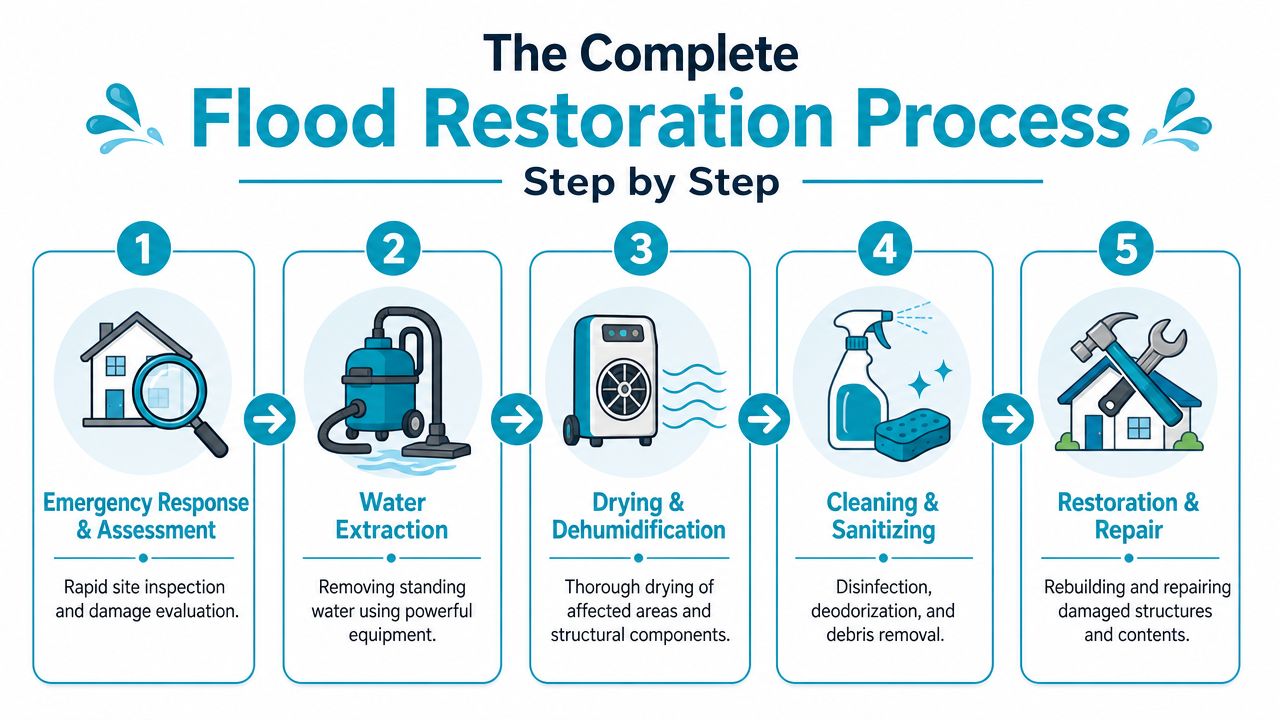
Emergency response and assessment
The first site visit should answer practical questions fast. Where did the water come from. How far did it travel. What materials are affected. What can be saved. What needs immediate removal for safety or sanitation.
The crew should inspect visible damage and likely migration paths, including under flooring transitions, behind baseboards, inside vanity toe-kicks, around cabinet backs, and near HVAC returns if water moved through occupied areas.
Water extraction
Standing water is removed first because drying equipment works poorly when bulk water is still present. Extraction can involve truck-mounted or portable equipment depending on access, floor type, and volume. In homes, this stage also includes pulling water from carpets, pads, and low spots where water settles out of sight.
This is also where decisions start. Some materials can stay in place and dry with the right system. Others trap moisture so aggressively that removal is the safer and faster path.
Drying and dehumidification
Skilled work differentiates itself from cosmetic cleanup, as drying isn’t just “set fans and wait.” Professional plans rely on psychrometric monitoring of temperature, humidity, and dew point, and technicians aim for material-specific moisture targets, typically around 10 to 12% for wood and under 1% for concrete, according to this drying and dehumidification guidance. Those targets matter because secondary damage often begins after visible water is gone.
What do technicians track during drying?
| Reading | Why it matters |
|---|---|
| Temperature | Affects evaporation rate and equipment performance |
| Relative humidity | Shows how much moisture remains in the air |
| Dew point | Helps control condensation risk |
| Material moisture | Confirms whether wood, drywall, and concrete are still wet |
A good drying log tells a story. Readings should trend in the right direction. If they don't, the plan needs adjustment. That may mean changing equipment placement, opening more cavities, or removing materials that are blocking progress.
Drying goals should be based on measurements, not appearance. Surfaces can look normal while framing and subfloors remain wet.
Cleaning and sanitization
Once the structure is controlled, cleaning begins. This can include debris removal, surface cleaning, odor treatment, and sanitation steps that match the type of water involved. A flood loss from outside intrusion is not handled the same way as a small supply-line leak in a clean bathroom.
At this point, some homeowners are surprised by how much detail is required. Cabinets may need disassembly at the toe-kick. Insulation may need selective removal. Contents may need separate handling so the structure can dry correctly.
Restoration and repair
The final phase returns the home to pre-loss condition. That can include drywall replacement, trim, paint, flooring, cabinet work, and rebuilding affected sections after drying and cleaning are complete. Some companies stop at mitigation and leave homeowners to find separate repair contractors. Others coordinate both sides of the job. One local option that handles mitigation, sanitization, and reconstruction is AMPM's flood damage repair and home restoration service.
Identifying Hidden Water Damage and Contamination
Many homeowners judge progress by what they can see. That's understandable, but it's also where bad flood jobs happen. A room can look dry while the wall bottom plate is still wet, insulation is holding moisture, and the subfloor under a floating floor is trapped in a humid pocket.
Where water hides after a flood
A thorough residential flood restoration company looks past the obvious wet area. Hidden moisture often shows up in places homeowners rarely inspect:
- Behind drywall and baseboards: Water travels horizontally and settles at the lowest enclosed points.
- Under flooring systems: Laminate, engineered wood, and vinyl assemblies can trap moisture below the finished surface.
- Inside cabinets and built-ins: Toe-kicks, backs, and side panels can hold moisture even when doors look fine.
- In insulation and wall cavities: Wet insulation loses performance and slows drying of surrounding materials.
- Around HVAC pathways: If contaminated water or damp air moved through returns or adjacent cavities, cleanup standards change.
The reason this matters is simple. Drying the room is not the same as drying the assembly.
Why standards matter
The restoration industry relies on the IICRC S500 standard, which requires technicians to classify the water category and loss class, document affected areas with moisture meters and thermal imaging, and then apply targeted extraction, drying, cleaning, and reconstruction steps instead of generic cleanup methods, as described by the IICRC S500 standard overview.
That scientific approach changes decisions in real homes. It helps answer whether drywall can remain, whether insulation must come out, whether the subfloor is drying, and whether contamination requires more than ordinary cleaning.
If a contractor never checks inside the assembly, they're making a guess. Flood restoration should not be guesswork.
For homeowners who suspect the damage extends past what's visible, these signs of hidden water damage behind drywall are worth reviewing.
How to Choose a Reputable Restoration Company
When your house is wet, every company sounds urgent. That doesn't mean every company is qualified. A dependable residential flood restoration company should be able to explain its process clearly, show its credentials, and tell you how it documents the job. If the conversation is only about getting fans in place and signing paperwork fast, keep asking questions.

What to verify before authorizing work
Use this short screening table when you're comparing companies in Bradenton, Sarasota, Tampa Bay, or nearby Gulf Coast communities:
| What to ask | Why it matters |
|---|---|
| Are your technicians IICRC-certified? | Flood work should follow a scientific process, not a generic cleanup routine |
| Do you document moisture and drying daily? | Claims and job quality both depend on records |
| Do you handle both mitigation and repairs? | Fewer handoff problems, clearer accountability |
| Are you local and available 24/7? | Storm-event contractors can disappear after the first phase |
| Will you communicate with my insurer? | Good documentation only helps if it's organized and sent correctly |
A reputable company should also explain how it classifies the loss, what equipment it expects to use, and what materials may need removal. If answers stay vague, expect problems later.
Watch for these red flags
Some warning signs show up fast:
- Pressure to sign immediately: A serious contractor can move quickly without forcing the decision.
- No written scope: If demolition, drying, and cleaning aren't described, disputes are likely.
- No mention of moisture mapping: That usually means limited technical control.
- Promises that everything will be saved: Real jobs involve trade-offs.
If reconstruction is part of the conversation, it also helps to understand how to find trusted general contractors for comparison purposes, especially if your project expands beyond mitigation into broader repair planning.
Navigating Insurance Claims and Restoration Costs
Most homeowners are dealing with two emergencies at once. The house is damaged, and the paperwork clock starts immediately. A professional residential flood restoration company can help by creating a clear record of the loss while the job is unfolding.
Why documentation matters so much
Water damage is common and expensive. About 1 in 60 insured homes files a water-damage claim each year, water damage and freezing account for nearly 24% of all insurance claims, the average payout is USD 13,954, and 98% of U.S. basements will experience water damage during their lifetime, according to this restoration reporting on water damage statistics. Those figures explain why insurers expect detailed evidence and why homeowners shouldn't rely on memory after the fact.
Good claim support usually includes:
- Photo and video records: Before mitigation changes the scene
- Moisture documentation: Readings that justify drying and material removal
- A scope of work: What was affected, what was removed, and why
- Communication logs: Notes on approvals, inspections, and changes
- Contents documentation: Lists of damaged personal property and condition notes
The practical trade-off homeowners face
The difficult part is timing. You need to mitigate quickly to avoid further damage, but you also need to preserve evidence. That means not waiting idly for someone to inspect while materials continue to deteriorate, and not tearing everything out before the loss is documented.
The cleanest claims usually come from homes where mitigation and documentation happened together, not one after the other.
Costs vary based on the source of water, how far it traveled, what materials are affected, whether contamination is present, and how much reconstruction is needed at the end. The cheapest-looking response often becomes the most expensive if hidden moisture is left behind or if records are too weak to support the full scope.
If you want a plain-language overview of how to protect the paper trail while the house is being stabilized, AMPM's water damage insurance claim tips cover the basics homeowners ask about most.
Frequently Asked Questions About Flood Restoration
How long does the flood restoration process usually take
It depends on the amount of water, the materials involved, and whether moisture spread into hidden cavities. Extraction can start quickly, but drying, cleaning, and reconstruction follow their own timeline. The right answer comes from inspection data, not guesses made over the phone.
Is the water from a flood dangerous to my health
It can be. Storm-driven water, overflow, and water that moved through dirty building materials can introduce contamination concerns. That's why a professional crew treats sanitation as part of the job, not an optional add-on.
Can I stay in my home during the restoration
Sometimes yes, sometimes no. It depends on the affected areas, electrical safety, equipment noise, contamination level, and whether demolition or sanitation work makes parts of the house unsuitable for occupancy. Homes with limited damage in isolated rooms are different from homes with widespread intrusion.
What is the difference between flood damage and water damage for insurance
That distinction can affect how a claim is handled. Insurers often look closely at the source of water and the policy language tied to it. The practical step for homeowners is to document the origin, the timing, and the affected areas clearly from the start.
Will my belongings be saved or thrown away
Neither outcome should be assumed. Contents are usually sorted by material type, contamination exposure, and the likelihood of safe restoration. Upholstered items, paper goods, wood furniture, electronics, and sentimental items all require different decisions.
What if you find mold during the flood cleanup
That changes the work plan. Mold concerns can require containment, additional removal steps, and more detailed cleaning protocols before rebuilding starts. It's much better to identify that early than to cover it up during repairs.
If you need a residential flood restoration company on Florida's Suncoast, AMPM Restoration Services is available 24/7 from 4301 32nd St W b18, Bradenton, FL 34205, serving Bradenton, Sarasota, Tampa Bay, Saint Petersburg, Lakewood Ranch, and surrounding communities. Call 941-946-7807 for a free inspection and estimate. The team provides insurance claim assistance, financing options, and full support from emergency mitigation through repairs so you can make fast, informed decisions while protecting both your home and your claim.