

You find the problem after stepping into a cold, wet patch near the dishwasher, washing machine, exterior door, or sliding glass door. By the time the water reaches the visible flooring, it may already be moving beneath the finish and into the underlayment or subfloor. In Florida, Gulf Coast humidity can slow evaporation, so a floor that feels dry by evening may still hold moisture below the surface.
Floor water damage repair isn't just a matter of mopping, placing a box fan in the room, and waiting. The right response removes the water, exposes and evaluates damaged material, dries the structure against readings from unaffected areas, and restores the floor only after the materials are stable. Water damage and freezing account for 22.6% of homeowners insurance claims, affect about 1 in every 67 insured homes each year, and have an average paid claim of about $15,400 over the 2019 to 2023 period, according to industry water damage loss data. Flooring often provides the first visible warning that a larger building assembly has been affected.
Emergency Response in the First 24 Hours
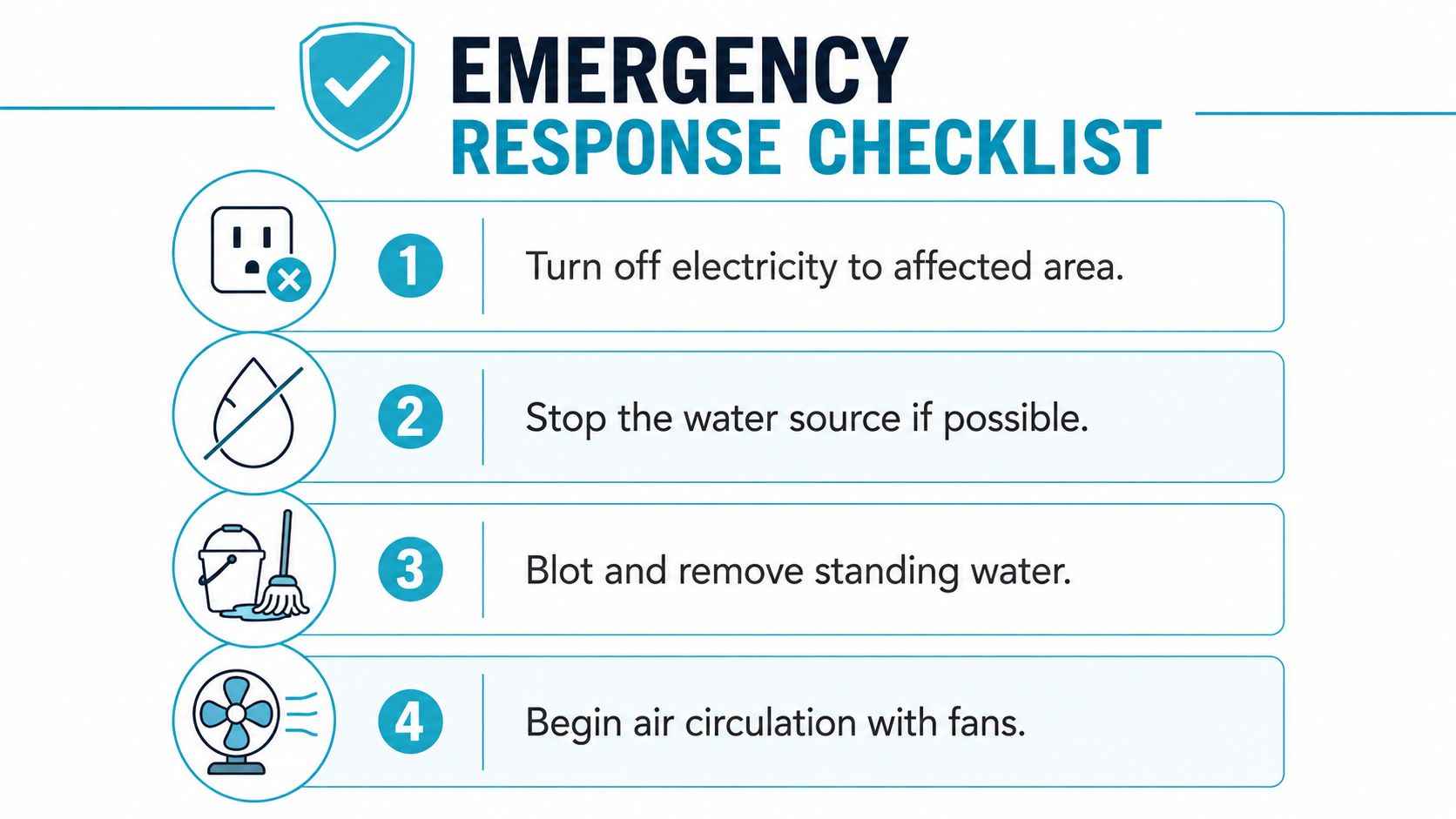
The first few hours determine whether you're dealing with a limited cleanup or a floor removal and reconstruction project. Start with safety, not speed. If standing water is near outlets, appliances, electrical panels, or damaged wiring, keep people and pets out of the area and don't step into the water to reach a switch. Shut off electricity to the affected zone only if you can do so safely. If the source is a burst supply line, appliance hose, toilet, or roof opening, stop the flow at its valve or contact the appropriate emergency provider.
Once the area is safe, stop the water source and remove anything resting on the floor. Rugs, cardboard, furniture pads, baskets, and stored contents can hold water against the finish and prevent air from reaching seams. Use towels for a small, clean spill. For a larger release, a wet/dry vacuum or professional extraction equipment removes far more water than blotting alone.
What to do before the restoration crew arrives
- Document the scene: Photograph the source, standing water, swollen seams, lifted boards, stained flooring, baseboards, nearby contents, and any visible damage from below. Don't throw away damaged materials before documenting them unless they pose a safety or sanitation hazard.
- Extract visible water: Run a wet/dry vacuum only where electrical conditions are safe. Don't use a household vacuum that isn't rated for liquid extraction.
- Create controlled airflow: Use fans to move air across the surface, but don't rely on airflow alone. In humid Bradenton, Sarasota, or Tampa Bay conditions, moving damp air without dehumidification can spread moisture without removing enough of it.
- Call promptly: Water can begin creating a more serious microbial environment within 24 to 48 hours, a commonly cited response window in guidance on mold risks in water-damaged subfloors.
Don't start sanding cupped hardwood, seal wet seams, or install replacement planks over a damp subfloor. Those actions can hide the problem and lock moisture into the assembly. If water came from sewage, floodwater, a toilet backup, or a source you can't identify, avoid direct contact and leave removal to trained technicians.
For a concise response sequence, review AMPM Restoration's emergency water damage repair guidance. Homeowners who want additional perspective on the restoration process can also review NW Claims Management's restoration expertise, particularly its emphasis on rapid assessment, extraction, and structural drying.
Moisture Testing and Drying Standards
A floor can feel dry while its plywood subfloor remains wet. In Florida homes, water often travels below hardwood, engineered wood, laminate, underlayment, and tile before surface damage becomes obvious. Effective floor water damage repair starts with a control point from an unaffected area of the same structure, then compares each affected layer with that baseline.
How technicians locate the wet zone
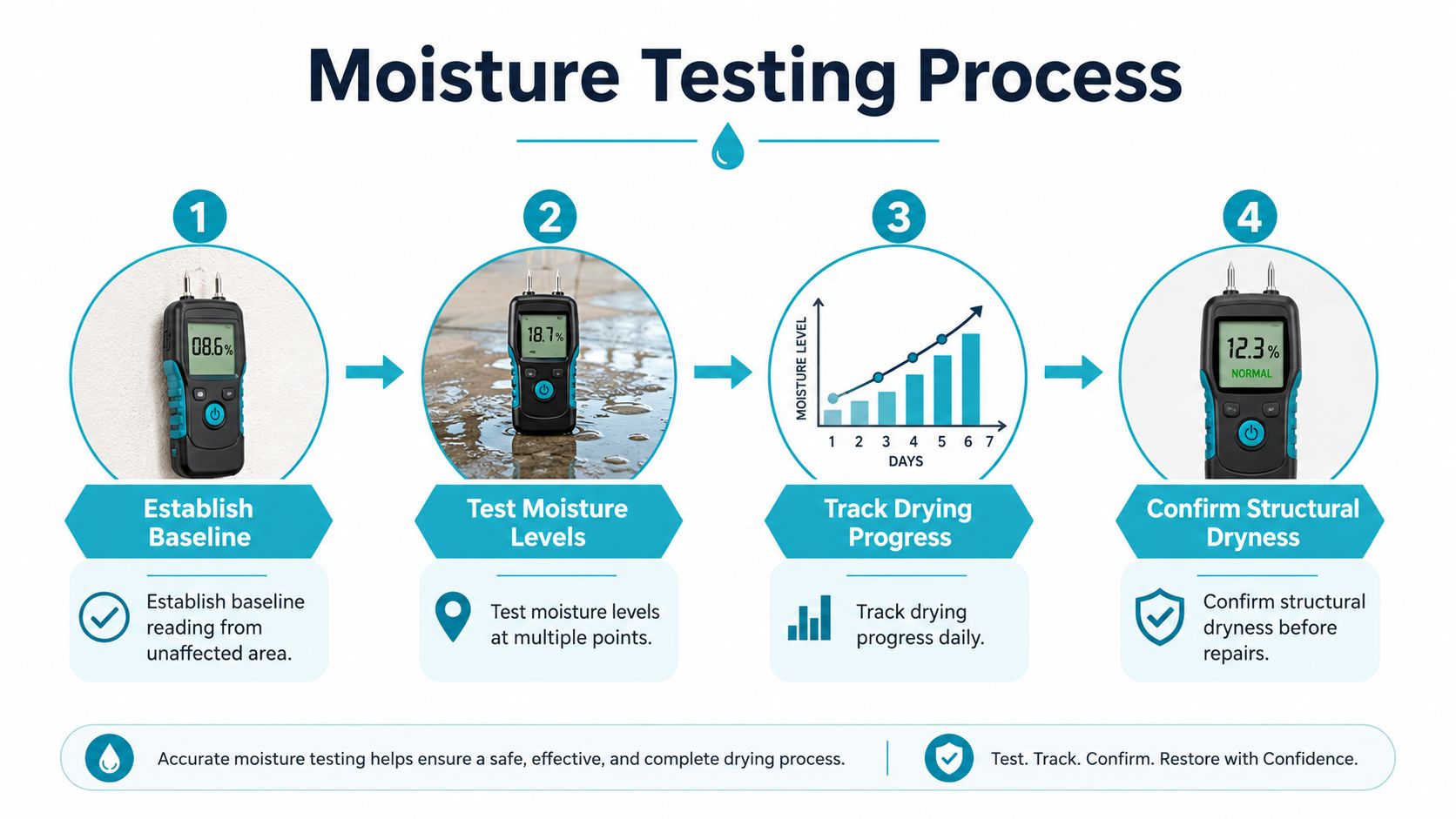
A professional assessment records readings from a dry room or unaffected section of matching flooring. Technicians then scan the room, transitions, baseboards, adjacent spaces, and accessible crawlspace areas with a pinless meter to map the moisture pattern without making holes. Pin meters provide targeted readings and help confirm depth in wood, plywood, trim, and other accessible materials.
IICRC S500 treats drying as a comparative, material-specific process, not a universal moisture number. Wood flooring is commonly targeted below about 20% moisture content, and hardwood should generally return to within 2% to 4% of adjacent unaffected flooring before equipment is removed, according to drying and moisture guidance tied to IICRC S500.
Why drying logs matter
Technicians keep equipment in place based on documented readings, indoor humidity, equipment placement, and the direction of change. A surface that looks improved does not prove that the subfloor is ready for repair.
- Establish the baseline: Record unaffected readings from comparable flooring and structural materials.
- Map affected areas: Scan rooms, transitions, baseboards, adjacent spaces, and accessible crawlspace areas.
- Confirm depth: Use pin measurements where surface readings suggest moisture has penetrated.
- Dry and re-check: Combine air movement with dehumidification, then re-measure at approximately 24-hour intervals until readings stabilize near the control point, following professional guidance on setting drying targets.
Gulf Coast humidity slows evaporation, especially when warm outdoor air enters the building. A fan can move that damp air without removing its moisture. Commercial dehumidifiers, containment, and directed airflow must work together to reduce the moisture load around the floor and pull water from deeper layers.
Drying is complete only when wood moisture is decreasing appropriately, affected wood is within about 2.5% of its normal moisture content, and the HVAC environment remains stable. Skipping control readings or checking only the surface can leave wet plywood hidden beneath a floor that appears ready for installation. AMPM Restoration's structural drying methods explains how extraction, airflow, and dehumidification are coordinated during structural drying.
Repair Methods by Flooring Type
Flooring material shapes the repair path, but it does not decide it alone. Material type, contamination category, and saturation duration determine whether boards, adhesives, padding, or the underlying structure can be salvaged. That restore-versus-replace assessment follows industry guidance on water-damaged flooring restoration. A clean leak addressed quickly may leave more options than contaminated water held in the assembly through Florida's humid Gulf Coast conditions.
| Flooring Type | Repairability | Typical Cost Range | Drying Time |
|---|---|---|---|
| Hardwood | Often salvageable when boards remain stable, clean, and structurally sound. Buckling, mold, severe staining, or delamination can require removal. | $4,000 to $10,000 for hardwood repairs, depending on exposure and material type. | Depends on board and subfloor readings. Equipment remains until readings approach the control point. |
| Laminate | Swollen or bubbled cores generally aren't repairable. Damaged planks usually require replacement. | Room repair costs vary with the affected area, replacement planks, and subfloor work. Cost data | Depends on whether the subfloor is exposed and wet. |
| Tile | Tile may survive, while grout, adhesive, underlayment, or the subfloor beneath it may not. Loose tile and hollow areas need inspection. | The bill is driven less by the tile surface than by removal, drying, and repairs beneath it. | Hidden moisture beneath tile can make drying slower than surface appearance suggests. |
| Vinyl | The surface may remain intact, but water can travel beneath seams, adhesive, and resilient flooring into the subfloor. | Costs depend on whether only sections can be removed or the full installation must be replaced. | Requires inspection beneath edges, transitions, and affected sections. |
| Carpet | Carpet may be cleanable in limited clean-water situations, but saturated padding commonly needs removal and replacement. | Padding replacement and subfloor treatment often determine the repair cost, rather than cleaning the carpet face. | Padding and subfloor readings control the schedule. |
Hardwood and engineered wood
Hardwood can sometimes be dried, stabilized, and refinished. Sanding wet or cupped boards is a mistake because the upper surface may dry before the underside. Sand too soon, and the boards can crown after remaining moisture moves out. Engineered flooring depends on the condition of its layers. A separated or swollen core usually makes replacement more practical than refinishing.
Saltwater exposure raises the replacement risk. Residue can remain in joints, fasteners, and subfloor materials after visible water is removed, so cleaning and moisture checks must precede any finish work.
Laminate, tile, vinyl, and carpet
Laminate resembles wood but behaves differently because its core can swell after water exposure. Tile and vinyl create a different risk. The visible finish may look intact while adhesive, underlayment, or plywood below remains saturated. Carpet presents another common trap. Drying the carpet face does not dry contaminated padding or the subfloor beneath it.
Replacement decisions should account for the source of water, the time materials stayed wet, and whether the subfloor can be dried without opening the assembly. Homeowners comparing waterproof hybrid products with conventional flooring can compare SPC hybrid flooring. The suitable replacement still depends on subfloor condition, installation requirements, and the original water source.
The Hidden Subfloor Problem
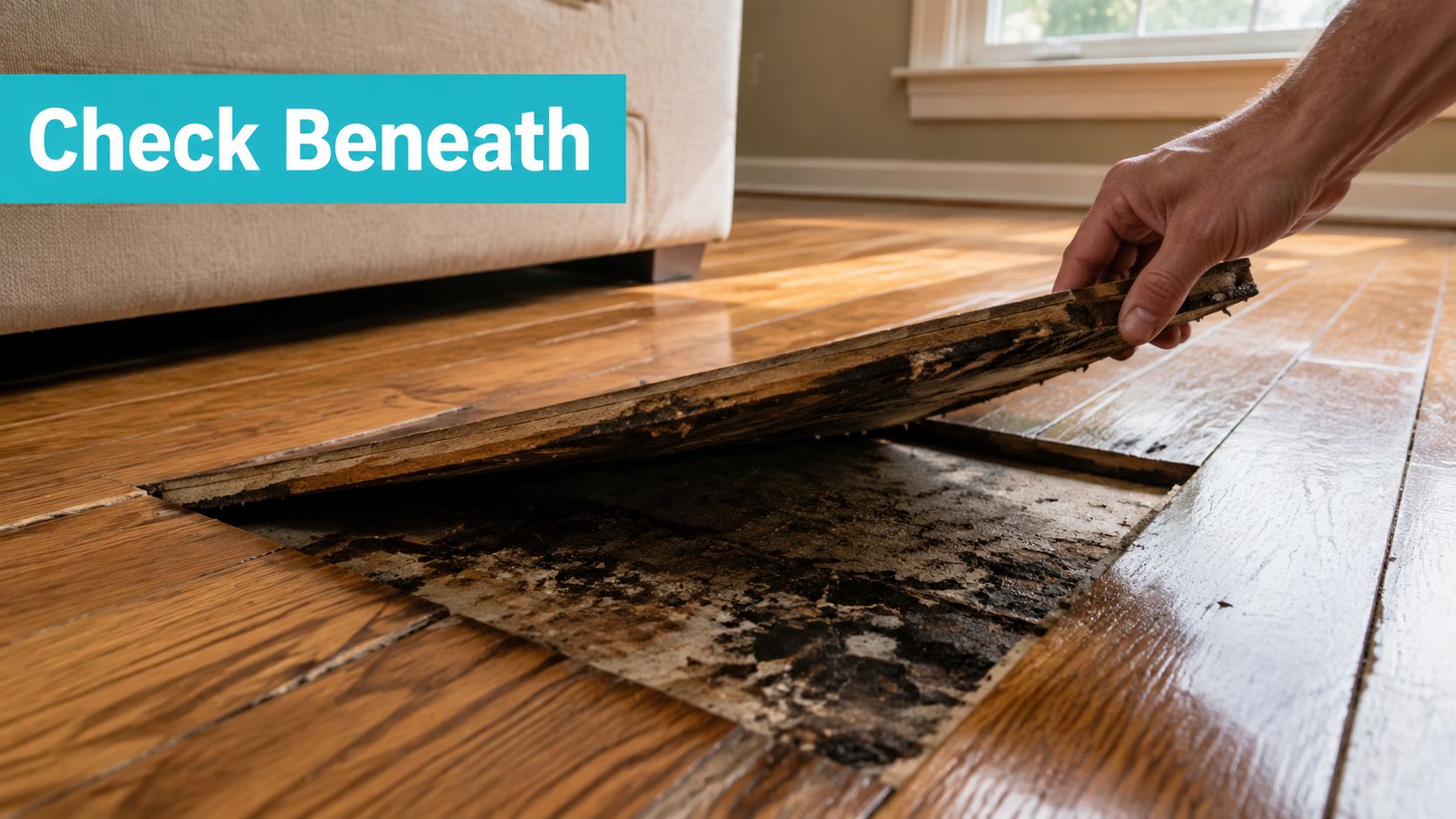
The most expensive repair can begin below a floor that looks clean and dry. Plywood may have absorbed water, softened, delaminated, or retained an odor while the finish above appears serviceable. Replacing or refinishing that surface without checking below it can seal in moisture and leave a structural problem unresolved.
Start with how the floor responds underfoot. Spongy spots, movement, squeaks, buckling, musty odors, dark staining, and soft transitions warrant closer inspection. In a home with a crawlspace, examine the underside of the subfloor and accessible joists. Water can travel into adjacent rooms, closets, baseboards, and low points after the visible spill has been removed.
When the subfloor can stay
Intact plywood may remain in place when it is cleanable, dries fully, stays firm, and retains its structural integrity. Wet finish flooring or sections of underlayment may need removal so air can reach the plywood. The sequence is extraction, containment, directed airflow, and dehumidification.
Delamination changes the decision. Separating layers, pronounced softness, rot, mold contamination, or fasteners that no longer hold indicate that removal and replacement may be safer than in-place drying. Guidance on flooring and subfloor evaluation distinguishes intact, cleanable material from plywood whose layers have separated.
Practical rule: If the floor feels solid but its underside is stained, soft, or persistently damp, treat the hidden assembly as damaged until moisture testing shows otherwise.
Drying below the finish
A subfloor dries poorly when an impermeable finish, wet pad, or trapped underlayment remains above it. One repair approach removes wet flooring, exposes the subfloor, and uses commercial dehumidifiers with high-velocity fans for 3 to 14 days, based on severity, as described in subfloor water damage repair guidance. Equipment should promote air exchange across the affected assembly rather than blow over one visible area.
Florida crawlspaces create added risk. Ground moisture, limited ventilation, Gulf Coast humidity, and saltwater exposure near coastal properties can keep materials damp after an interior leak has stopped. Information about a garage floor vapor barrier explains why moisture control beneath a finished surface matters. For odor or suspected growth beneath hardwood, signs of mold under hardwood floors offers relevant inspection considerations.
When to Call Professional Restoration Services
A small, clean spill may be manageable if you remove it fully and confirm normal moisture readings. Professional help is warranted once water has moved beneath the finish, affected several rooms, remained standing, or carried contamination. A mop and household fan cannot extract saturated plywood, identify separated layers, or prove that the hidden assembly is dry.
Call a professional restoration company when:
- The source is contaminated: Sewage, floodwater, toilet backups, and unknown-quality water require controlled handling. Florida storms can also introduce contaminants and saltwater that ordinary fans may spread through the home.
- Several rooms are affected: Water travels through flooring transitions, wall plates, and framing. The visible wet area may be smaller than the actual loss.
- Saturation continued past the early response window: Wet flooring, padding, underlayment, and subflooring may need invasive inspection and removal.
- The floor shows structural symptoms: Sponginess, buckling, delamination, soft joists, or movement underfoot should be evaluated before new material is installed.
- Indoor humidity will not stay under control: Gulf Coast humidity can stall drying even while equipment is operating, especially around crawlspaces and coastal properties.
IICRC-trained technicians treat mitigation as the first phase and reconstruction as the second. They document the source, classify the water, extract standing water, map moisture, establish containment when needed, and position commercial dehumidifiers and air movers. They monitor readings over time and remove damaged materials instead of covering them with new flooring.
The assessment should identify what can remain, what must be removed, how technicians will reach the subfloor, and which readings confirm completion. The guidance on why homeowners shouldn't DIY water damage restoration explains the equipment and safety limits that make larger losses unsuitable for improvised cleanup.
For Suncoast property owners, AMPM Restoration Services provides emergency water extraction, drying and dehumidification, mold inspection and removal, and flooring-related restoration. The company serves Bradenton, Sarasota, Tampa Bay, Saint Petersburg, Lakewood Ranch, and nearby Gulf Coast communities from 4301 32nd St W b18, Bradenton, FL 34205.
Insurance Claims and Cost Expectations
A floor can look repairable while water remains below it. Florida humidity slows evaporation, and Gulf Coast homes may also face saltwater exposure that affects materials and equipment. Insurance coverage depends on the water source, policy language, exclusions, and whether the loss was sudden or linked to neglected maintenance.
Before moving damaged materials, photograph the source and every affected surface. Capture room-wide views, swollen seams, lifted boards, baseboards, contents, and visible damage in a crawlspace or lower level. Include the subfloor when it becomes accessible.
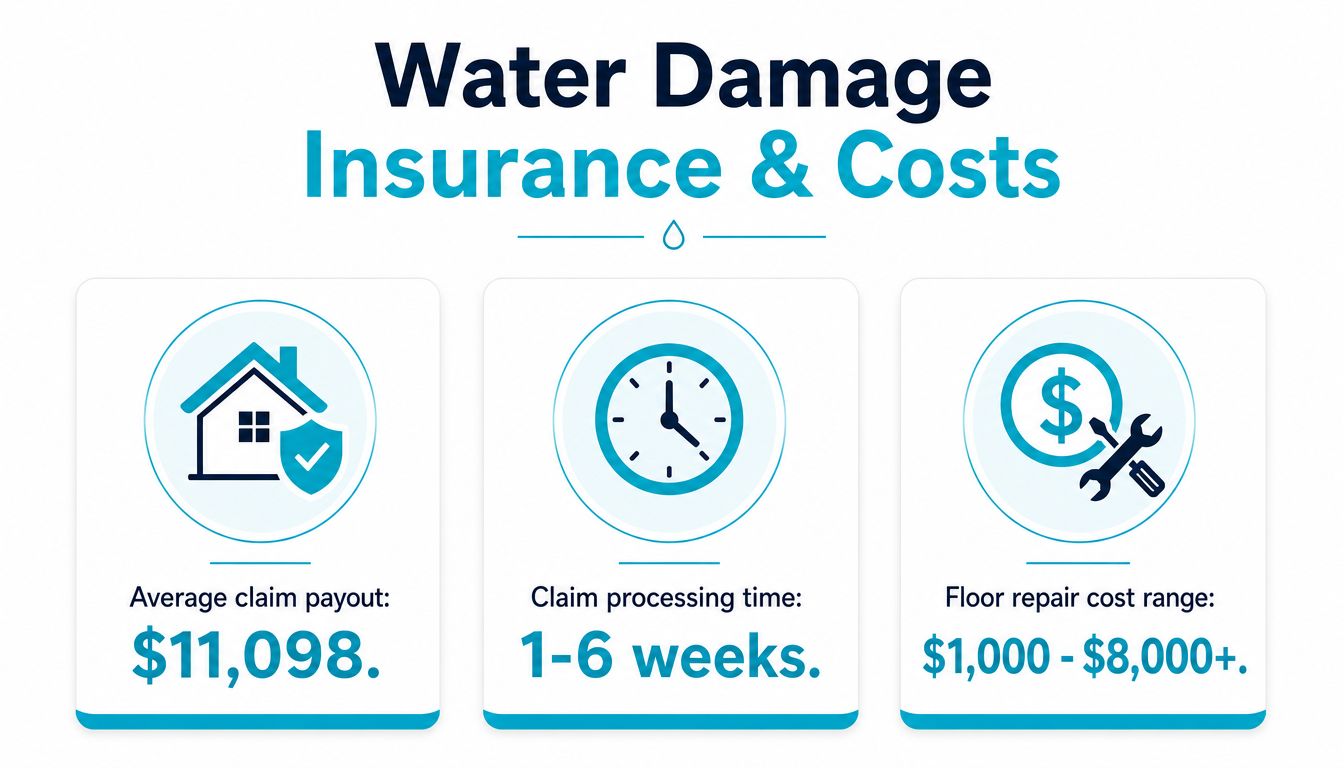
Repair costs vary because extraction, demolition, subfloor work, replacement materials, and reconstruction are separate tasks. Common water-damaged flooring repairs may range from $200 to $3,000 per room. Hardwood repairs may reach $4,000 to $10,000, depending on exposure and material type. These figures do not determine coverage or the final invoice. They show why early inspection and moisture documentation matter.
Build a useful claim file
- Record the timeline: Note when you discovered the water, stopped the source, and began extraction.
- Preserve evidence: Keep damaged planks, padding, trim, and removed materials available when practical.
- Save professional records: Retain moisture maps, equipment logs, drying readings, photographs, estimates, and invoices.
- Report promptly: Contact your carrier before permanent reconstruction, and ask how it handles flood, seepage, gradual leaks, and mold.
The project may move from extraction to drying and reconstruction, but hidden subfloor damage, humidity, approvals, and finish availability can change the schedule. AMPM Restoration's water damage insurance claim tips explains useful documentation steps for homeowners.
AMPM Restoration is available 24/7 for emergency response, inspections, estimates, claim assistance, and financing options. Call 941-946-7807 or visit AMPM Restoration Services to request help with floor water damage repair.
Frequently asked questions
How quickly should I respond to floor water damage?
Stop the source safely and remove standing water as soon as possible. A commonly cited mold-risk window is 24 to 48 hours, but material type, contamination, airflow, and Florida humidity affect results. Moisture testing is more reliable than appearance.
Can hardwood flooring be saved after water damage?
Sometimes. Stable hardwood may be dried and refinished if it is not badly stained, buckled, cracked, moldy, or delaminated. Do not sand wet boards or subflooring.
Does tile need replacement after a leak?
Not always. Inspect the adhesive, grout, underlayment, and subfloor for trapped moisture or deterioration before deciding.
When does a subfloor require replacement?
Replacement is more likely when plywood is delaminated, spongy, rotted, moldy, or unable to hold fasteners. Sound subflooring may be salvageable after drying and verification.
Will insurance pay?
Coverage depends on the loss cause and policy terms. Keep photographs, readings, estimates, invoices, and removed materials for review.