

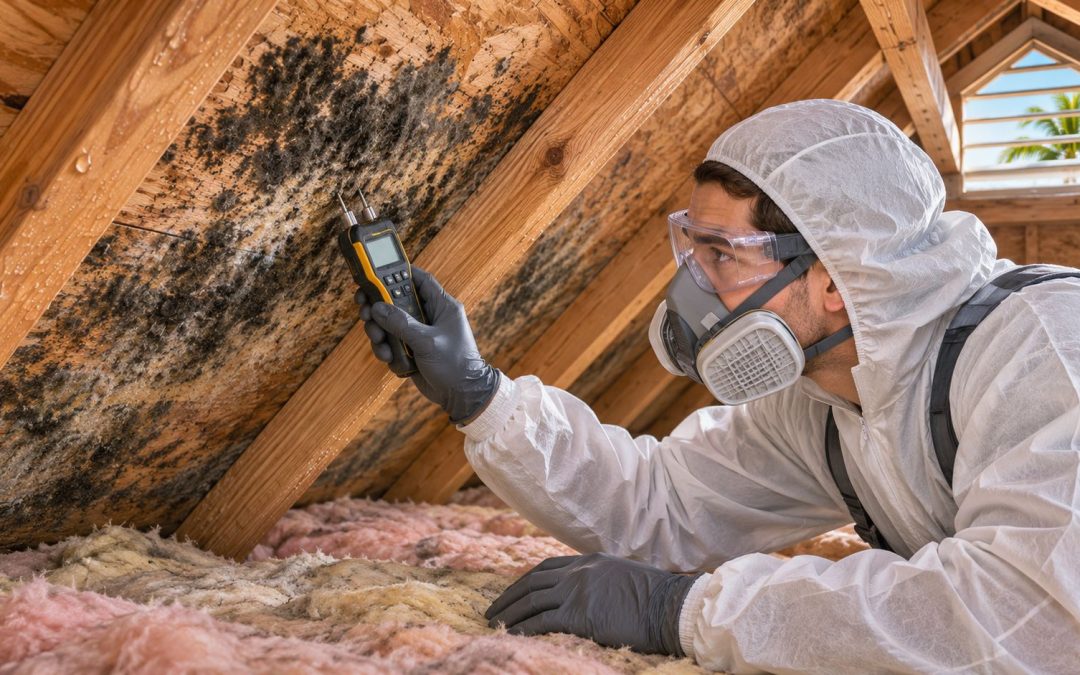
The smell reaches you at the top of the stairs, that wet, earthy odor that wasn't there before the storm. You lift the attic hatch in your Bradenton home, run a phone light across the rafters, and find dark fuzz along the roof sheathing plus a brown ring on the bedroom ceiling directly under the upstairs bathroom fan. You type "black mold in attic" into your phone expecting a straight answer and get a wall of headlines about toxicity instead.
The color of what you're looking at tells you less than you think. The moisture that fed it tells you almost everything: where it came from, how long it's been there, whether it's still arriving, and what has to happen before anyone sprays, wipes, or replaces anything.
What follows is the calm version. It covers how to read the signs, why Florida attics grow mold so readily, what the health and property risks really are, when testing earns its cost and when it doesn't, and what safe removal and prevention involve on the Suncoast.
Signs of Black Mold in an Attic and What They Mean
Attic growth is rarely the first thing a homeowner notices. It's usually the smell near the hatch, or the stain on the ceiling below, that prompts a look upward. By then the colony has often been developing for weeks, because the wood up there stays damp long after the storm that wetted it.
Take the Bradenton case above. The brown ring under the bathroom fan is the clue. Warm, moist shower air was likely escaping into the attic instead of outdoors, condensing on cooler sheathing, and dripping back onto the ceiling drywall. The fuzz on the wood and the stain below are the same problem showing up in two places.
Use this table as a starting point. Some signs are cosmetic, some are structural, and the response time differs.
| Sign | What it usually means | Urgency |
|---|---|---|
| Musty smell near the attic hatch or upstairs vents | Mold growth or damp insulation is already active | Act within 48 hours |
| Dark stains on rafters, roof sheathing or ceiling drywall below | Past or ongoing leak or condensation | Inspect within 48 hours |
| Damp, matted or discolored insulation | Water entry or air leakage into the attic | Inspect within 48 hours |
| Peeling paint or bubbling ceiling under a bathroom or dryer vent | Warm moist air condensing in the attic | Schedule inspection within a week |
| Fuzzy dark growth on wood sheathing or framing | Established colony, possibly Stachybotrys or another species | Professional assessment now |
| Wood moisture content near or above 20 percent | Conditions that support mold growth for weeks | Fix the source this week |
| Allergy or breathing symptoms that ease away from home | Mold exposure inside the house | See a doctor and call a professional |
That 20 percent figure isn't a guess. Research cited by the Florida Building Commission identifies roughly 20% wood moisture content as the level above which the potential for mold or mildew becomes substantially higher once the condition persists for several weeks. A $40 pin meter pressed into a rafter gives you a real number instead of an opinion.
Three moves matter in the first 48 hours. Photograph everything with a timestamp, wide shots and close-ups, because a claim adjuster will want to see what you saw on the day you found it. Keep the hatch closed so you don't pull spores into the living space with the pressure change. Stop storing things up there until the moisture question is settled, since boxes and holiday bins block the airflow you need and hide the next leak.
Visible growth, or a sign that returns after you've dried everything, calls for a professional assessment. A wipe-down with a household spray handles a stain. It doesn't handle a moisture source.
What Black Mold Is and Why Its Color Misleads
Think about rust on a nail. The orange stain tells you the metal got wet. It doesn't tell you how deep the corrosion runs or whether the beam still carries its load. Dark growth in an attic behaves the same way. The color confirms moisture was present. It says nothing reliable about which organism is growing, how far it has worked into the wood, or what it means for the people sleeping twenty feet below.
"Black mold" is the everyday name for Stachybotrys chartarum, a species that favors cellulose-rich materials such as paper-faced drywall, wet framing, and the paper facing on insulation. It needs sustained wetness, not one humid afternoon. But it isn't the only dark species. Cladosporium, Aspergillus, and Penicillium all colonize wet attic wood, insulation, drywall, and roof sheathing, and many of them read as dark green, gray, or black to a phone camera.
Mildew and mold get confused constantly. Mildew is a surface colonizer: it sits on top of a material, wipes away fairly easily, and leaves the wood beneath looking sound. Mold penetrates. The wood under a mold colony is usually stained, darkened, or soft even after the surface growth is gone, and attic framing often carries both at once.
Widespread dampness is not unusual, which is why these questions come up so often. The World Health Organization's indoor air guidelines on dampness and mould estimate that indoor dampness occurs in roughly 10% to 50% of buildings, depending on climate, construction quality, and how dampness is measured. That doesn't mean half of all attics hold black mold. It means the conditions that feed mold are common.
What matters when you decide what to do next: the moisture source, the materials affected, how far the growth extends, and who lives under the attic. If you're unsure whether you're looking at mildew or something deeper, this comparison of the difference between black mold and mildew walks through the visual and structural tells.
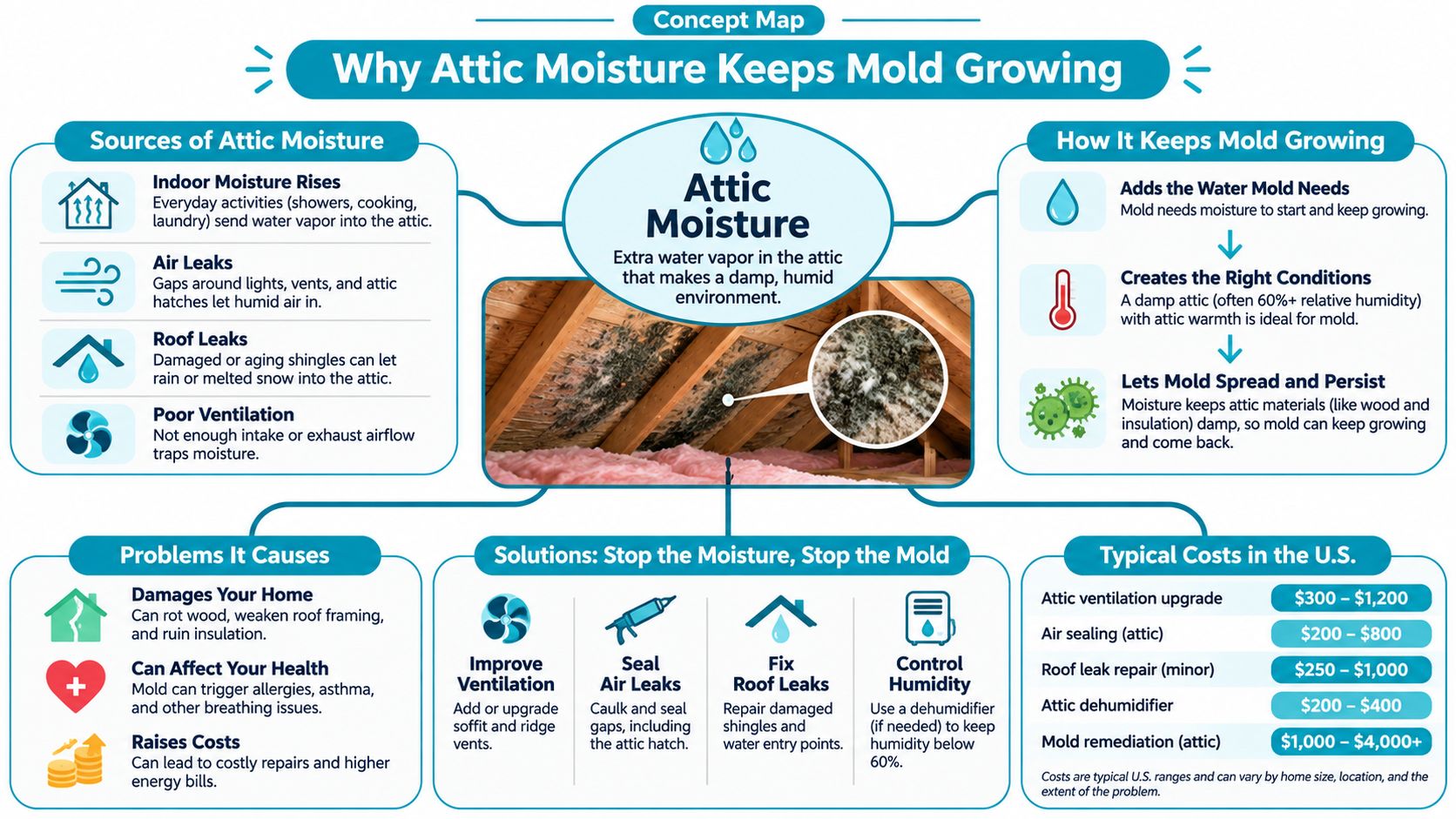
Why Attic Moisture Keeps Mold Growing
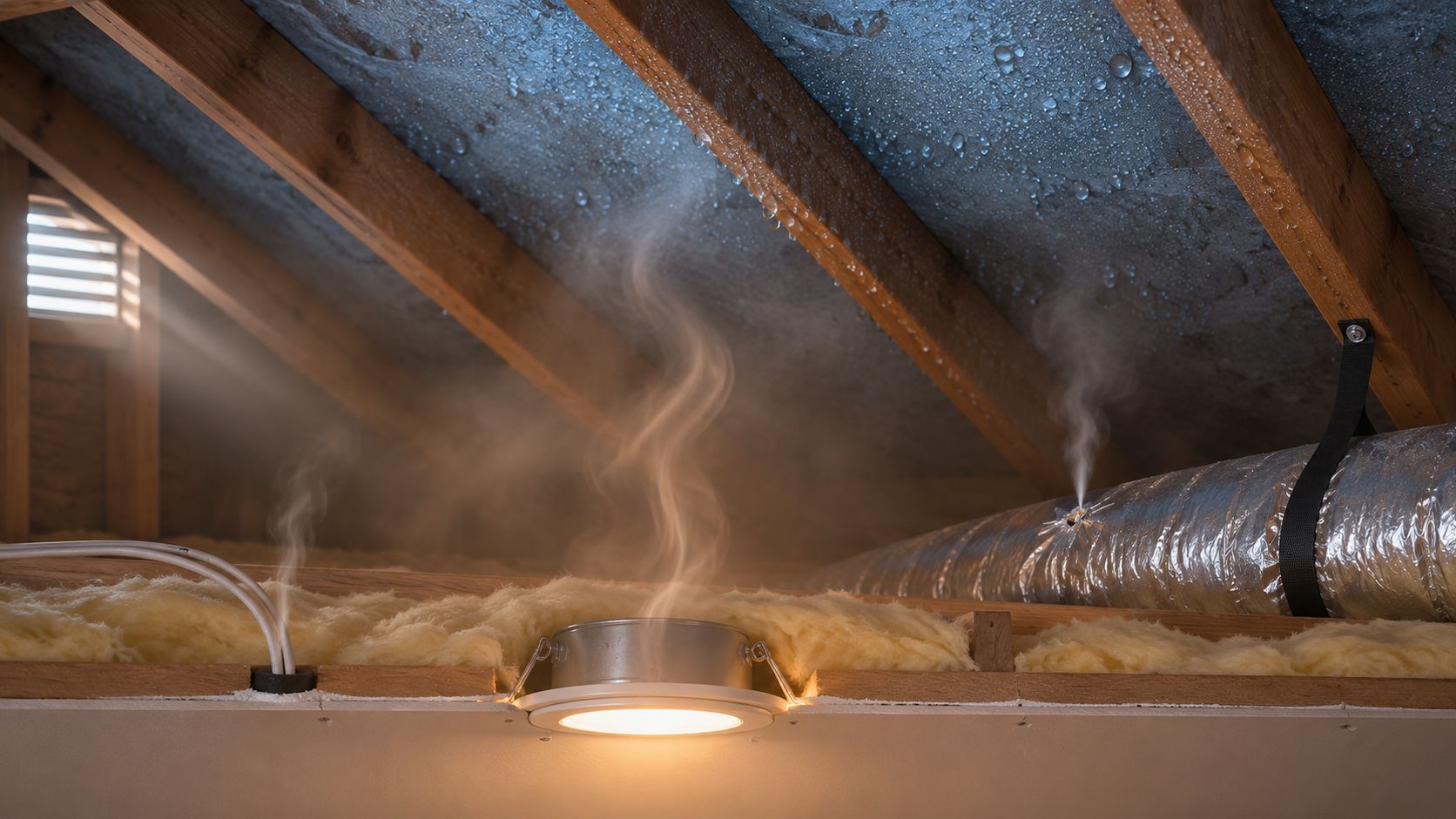
A Florida attic can look dry while moisture keeps returning. Warm, humid air from the living space rises through gaps around lights, ducts, and ceiling penetrations. When that air meets cooler roof sheathing, water can condense on the wood, repeating the wetting cycle.
Outdoor humidity, air-conditioned rooms, roof temperature changes, and bathroom exhaust vented into the attic can all add moisture. So can a roof leak, failed flashing, leaking duct, or insulation displaced from its intended position. The seasonal patterns behind how humidity causes mold in Florida homes help explain why cleanup alone may not solve the problem.
Moisture control is the key. ASHRAE's handbook chapter on dampness and mold describes conditions requiring control, including sustained surface relative humidity above approximately 80% for more than 30 days, or conditions that produce condensation.
| Measure | Typical range or condition | Why it matters |
|---|---|---|
| Surface relative humidity on roof sheathing | Above 80% for more than 30 days, or condensation | Persistent moisture can support mold growth |
| Indoor relative humidity | 30% to 60% | Higher humidity can add moisture to the attic |
| Moisture source | Leaks, humid air, or poor ventilation | Mold can return if the source remains |
Roof airflow also matters. Learn how roof ventilation basics for Florida homes relate to moisture movement through an attic.
Painting or caulking over damp, moldy wood can hide staining without fixing the moisture problem. Mold may continue growing beneath the coating. AMPM Restoration addresses moisture causes as part of mold work, which may include repairing leaks, improving ventilation, or adjusting humidity levels.
Health and Property Risks of Attic Black Mold
Start with the honest version of the health story. The CDC's National Institute for Occupational Safety and Health reports respiratory symptoms and infections, developing or worsening asthma, hypersensitivity pneumonitis, allergic rhinitis, and eczema among the problems people report after time in damp buildings, as summarized in NIOSH's mold and health guidance. Mold can also irritate eyes, nose, throat, skin, or lungs in people who aren't allergic, and those with mold allergies may react after inhaling or touching it.
Reactions vary widely between households and between people in the same household. Some occupants notice nothing at all. Others feel it within an hour of walking in. Asthma, mold allergy, chronic lung disease, and a weakened immune system are the factors that raise the odds of a stronger response, and children and older adults deserve the most caution.
A practical test beats a hunch. If coughs, congestion, or eye irritation ease when the family is away for a few days and return within hours of getting home, the house is the variable worth investigating. Bring that pattern to a doctor.
Property damage runs on its own timeline. Rafters and roof sheathing lose strength as moisture persists, and soft wood holds fasteners poorly. Insulation that has been wet loses R-value, so your Florida cooling bills climb while the attic performs worse. Stained ceiling drywall can sag or fail outright, especially where a fan has been dripping into it for months. Ductwork and return plenums sitting in a contaminated attic can pull spores into the rooms you just cleaned. Insurance adds another layer: many policies limit mold coverage and may question claims where damage appears to have been ignored, so documenting when you found the problem and what you did about it protects you.
Early action costs far less than a rebuild. Every week of delay moves a cleaning job closer to a carpentry job.
When an Air Sample Helps
An air sample is a photograph of the air at one moment in one spot. It can't tell you where the moisture is coming from, whether the growth is still active, or whether the fiberglass above the hallway is saturated. That's why public-health guidance puts more weight on correcting dampness than on indoor air sampling, as the CDC's mold and health overview explains: promptly fixing the moisture is more effective for preventing health problems than relying on air samples.
A useful inspection covers the building, not the air. It checks roof penetrations and flashing, whether bathroom and dryer exhaust terminates outdoors, soffit, ridge and gable ventilation, insulation coverage and ceiling-plane air leakage, attic and indoor humidity readings, and any HVAC component that might be drawing attic air. We start every mold job with an examination using advanced detection tools to identify all affected areas, including the ones you can't see, and detection methods that find both hidden and visible growth are the reason a probe into a suspicious corner beats a sample jar.
The tools are unglamorous. A pin-type moisture meter tells you what percentage of water is in a rafter. A thermal camera shows cool, damp patches behind drywall before staining appears. Attic growth often hides behind insulation baffles, under displaced batts, or on the far side of a cathedral ceiling.
| Situation | Next step |
|---|---|
| Visible growth with a known moisture source | Remediation scope without lab testing |
| Moisture source still unclear | Investigate moisture first |
| Occupants with symptoms | Medical advice plus industrial-hygiene assessment |
| Insurer dispute or unclear extent | Sampling justified |
When a lab result settles a question, this explanation of air quality testing for mold sets out what a sample can and can't establish for your home.
Sampling never replaces fixing the moisture. A lab report that names a species and a spore count changes nothing about the repair.
Practical rule: spend the testing budget on the moisture investigation first. It answers the question you're actually asking.
Before you hire anyone, verify the license covers the exact service. Florida requires licensing for both mold assessment and mold remediation and treats them as distinct activities under the state's mold licensing statute, so a provider licensed for one isn't automatically covered for the other.
How to Remove Black Mold From an Attic Safely
A Saturday plan that starts with bleach fog and an attic fan "to air it out" usually moves the problem downstairs. Growth that is already established treats that airflow like a conveyor. Spores ride the hatch into bedrooms. Containment is why the work looks more like a small construction job than a cleaning day.
AMPM Restoration Services treats attic mold as a moisture-control failure, not a stain to wipe off. Certified technicians, trained for this work and working under a Mold Remediation License and Certified MRSR4840, follow four stages: inspection, containment, removal, and prevention. The actions below sit inside those stages. They are one sequence, not a second plan.
Inspection
- Stop the water and start drying. Find the source before equipment comes out: flashing, a vent boot, a bath fan dumped into the attic, or a leaking duct collar. Drying a space that is still taking on water wastes time and money. The inspection looks for every hotspot and the moisture behind it, including growth that is not obvious from the hatch.
Containment
- Isolate the attic. Physical barriers and negative air pressure keep spores from drifting into bedrooms and hallways. Seal the hatch. That opening is where house pressure is weakest, so it is the easiest path downstairs.
- Filter the air and hold dust down. Specialized filtration, including HEPA equipment, cleans the air while work is underway. A light mist on surfaces before anyone disturbs them keeps the spore load from jumping.
Removal
- Remove what cannot be saved. Heavily infested insulation, colonized ceiling tiles, and drywall that has gone soft are bagged and disposed of. In porous material, growth runs through the piece the way water runs through a sponge, rather than sitting on the face.
- Clean what stays. HEPA-vacuum framing and sheathing, lift growth off the wood mechanically, then apply an antimicrobial so remaining mold is killed at the surface.
- Dry to the wood-moisture level already set for this attic. Covering framing before it reaches that dryness puts finishes back over a wet substrate. Drying also has to stay inside the short window after wetting, the one that decides whether new growth gets a start.
Prevention
- Sanitize, treat, and rebuild. After cleaning, the space is sanitized and prepared for occupancy. A mold inhibitor goes on before insulation and finishes return. Inhibitors back up the moisture repairs. They do not replace a dry attic.
- Verify with a final inspection. Odor, visible growth, and meter readings are checked before the job is signed off.
Under Florida's mold remediation statute, remediation means removing, cleaning, sanitizing, demolishing, or otherwise treating mold or mold-contaminated matter greater than 10 square feet, including preventive activities, and work requiring a separate construction license must be performed by someone licensed for it. Treat that number as a regulatory boundary, not as proof that smaller growth is harmless.
| Material | Typical treatment | Reason |
|---|---|---|
| Fiberglass or unfaced cellulose insulation | Remove and replace | Porous; fungal growth can extend into the structure |
| Ceiling tiles and saturated drywall below | Remove and replace | Cannot be cleaned completely once colonized |
| Light surface growth on wood framing | HEPA vacuum, mechanical removal, antimicrobial, then dry | Structural wood can often be cleaned if drying succeeds |
| Heavily colonized roof sheathing | Controlled removal and replacement | Growth extends into the material |
| Ducts and HVAC components in the attic | Professional inspection and cleaning | Risk of spreading spores into living spaces |

Nobody with asthma, a mold allergy, chronic lung disease, or a compromised immune system should be in the house during the dusty phase, and they should not return until drying is verified. To tell whether your own situation is a weekend project or a professional one, this breakdown of whether you can remove mold yourself or should hire a professional sets the line clearly.
Stopping Attic Mold From Coming Back
A dry attic depends on several parts working together: the roof must keep rain out, household air must stay out of the attic, and ventilation must release heat and moisture. If one part fails, cleanup alone may leave the conditions mold needs to return. The EPA's guidance on preventing mold recommends fixing leaks, drying wet materials promptly, and addressing humidity. It also identifies condensation, insulation gaps, ventilation problems, roof leaks, and HVAC issues as possible contributors.
Start with the moisture pathway. Repair roof leaks and flashing problems, then make sure bathroom and dryer exhaust ducts vent outdoors rather than into the attic. Check that insulation is not blocking soffit openings and that ridge or gable vents are clear. Seal gaps around recessed lights, top plates, and wiring penetrations so warm, moist indoor air does not leak upward.
Attic ducts need attention, too. A torn or loose duct can release cooled air onto warm roof sheathing, where moisture may condense. Fixing the leak and correcting the airflow addresses the cause, rather than just the visible growth.
For indoor humidity, follow the guidance discussed earlier and monitor conditions in the living space. In a humid Florida home, dehumidification may help if indoor moisture remains high.
After repairs, look for evidence that the attic is staying dry: no visible regrowth at previously affected areas, no lingering odor near the hatch, and no renewed dampness after rain. A final inspection can help confirm that the affected areas have been addressed. Recheck the attic after storms and near the end of the rainy season.

A useful guide to stopping mold from coming back can help you connect moisture control with the repair and prevention steps needed to keep an attic dry.
Get Answers and a Free Attic Inspection
A dark patch on the roof deck and a musty smell at the hatch raise the same practical questions every time.
Is black mold in attic space always dangerous? No. The patch is a reliable signal that moisture is getting in and staying. That moisture is the part that needs fixing. The growth itself does not make a home unsafe overnight.
Can I remove it myself? A small, dry, surface-only patch on an accessible board can be handled carefully with respiratory protection. Anything that disturbs insulation, covers structural wood, or sits near a path into the living space belongs with a professional. Certified technicians isolate that area with physical barriers and negative air pressure so spores do not ride the hatch into the rooms below.
What does remediation cost? Homeowners typically spend between $1,500 for small mold remediation jobs and more than $10,000 for extensive ones. Scope and access drive the number more than how dark the growth looks. A free mold inspection, using detection tools that find growth a flashlight misses, shows which materials are too damaged to clean before any work starts.
Will insurance cover it? Coverage depends on the cause and the timing. Photograph what you found, note the date, and document what you did next. A claim is easier to support when the response is on record, and AMPM Restoration coordinates directly with your insurance carrier.
Does mold go away after drying? Only the moisture does. Dormant spores reactivate the moment conditions turn damp again, the way a dry sponge swells the first time it gets wet. Cleanup without the leak, the ventilation gap, or the humidity problem sets up another colony.
How fast should I call? Within 48 hours of finding visible growth or a fresh moisture stain. That window is when a contained wetting event is still a drying job.
AMPM Restoration is a locally owned, licensed, bonded, and insured company serving Bradenton, Sarasota, Palmetto, St. Petersburg, and the greater Tampa Bay area. The IICRC-certified team answers around the clock and can be on site within one hour. Financing options are available so the work does not stall on a budget. Visit AMPM Restoration Services to get started.
