

Commercial Water Damage Cleanup in Sarasota
A Sarasota property manager walks into the building on Monday morning, opens the suite, and hears it before seeing it. Water is still dripping above the ceiling grid. The lobby flooring is wet, a rear office has a soaked wall cavity, and the HVAC closet smells damp. At that moment, commercial water damage cleanup in Sarasota stops being a maintenance issue and becomes an operations problem.
Every decision after discovery affects two things. First, how much of the building can be saved. Second, how long the business stays disrupted. In Sarasota, humidity and storm exposure make that window tighter than many owners expect. The U.S. EPA guidance for commercial buildings states that clean water damage should be addressed within 24-48 hours to reduce mold risk, which matters even more in humid Gulf Coast conditions like Sarasota’s EPA guidance for schools and commercial buildings.
Commercial losses rarely stay simple. A small pipe break can affect drywall, insulation, flooring adhesives, baseboards, electrical components, inventory, and indoor air conditions long before the stain on the wall looks dramatic. The right response is fast, controlled, and documented. The wrong response is mopping visible water, setting up a few box fans, and assuming the building is drying.
Your Guide to Commercial Water Damage in Sarasota
Most owners don’t call for help when the loss starts. They call when they find it. That delay is common in offices after weekends, in retail spaces after overnight plumbing failures, and in hospitality properties where a leak moves between floors before anyone traces the source.
That’s why commercial water damage cleanup in Sarasota has to be handled like an emergency mitigation project, not a janitorial task. The visible mess is only part of the loss. Water moves into wall assemblies, under resilient flooring, into carpet pad, around door frames, and through HVAC pathways. By the time staff sees staining or warping, moisture has often spread beyond the original point of entry.
What owners are really dealing with
A commercial building owner usually has several problems at once:
- Property damage: Wet materials may lose structural integrity or require removal.
- Business interruption: Tenants, employees, guests, or customers may lose access to part of the property.
- Documentation pressure: Insurance carriers want prompt, organized records of conditions and mitigation.
- Decision fatigue: Owners have to decide what can stay in place, what must be moved, and how to protect operations.
Commercial water losses punish hesitation. Fast mitigation usually preserves more materials and creates a cleaner insurance file.
For many Sarasota properties, the smartest move is to bring in a team that handles emergency mitigation, drying, and coordination as one process. A useful starting point is reviewing what’s included in commercial restoration services for Gulf Coast properties, because the need often extends beyond extracting water.
What works and what does not
A practical comparison helps.
| Approach | What usually happens |
|---|---|
| Immediate professional assessment | Source control, moisture mapping, drying plan, and cleaner documentation start early |
| In-house cleanup only | Surface water gets removed, but hidden moisture is often missed |
| Waiting for visible damage to worsen | More demolition, higher mold risk, and longer operational disruption |
| Treating it like a small residential loss | Commercial assemblies, occupied zones, and insurance complexity get underestimated |
The goal is simple. Stabilize the building, protect operations, and keep a manageable problem from turning into a reconstruction-heavy one.
Your First Hour Emergency Mitigation Actions
The first hour matters because it sets the direction of the whole project. Panic leads people to do unsafe things. Good mitigation starts with control.
A professional response model for commercial water losses states that crews should arrive within 60 minutes to control the source, limit secondary damage, and start documentation for insurance reporting commercial water damage restoration response benchmark. Until help arrives, the property team should focus on safety, containment, and preservation.
Safety first, always
If water is near outlets, equipment, or electrical panels, treat the area as hazardous. Don’t step into standing water where electrical exposure is possible. If you can isolate power to the affected area safely, do it. If you can’t, leave it alone and keep staff out.
Use this first-hour checklist:
- Protect people first. Restrict access to wet areas, place temporary warning signs, and keep employees or tenants away from slipping hazards and possible electrical exposure.
- Stop the source if it’s safe. Shut a local valve, isolate an appliance line, or stop an overflowing fixture only if you can do it without risk.
- Move what can be saved. Lift electronics, documents, boxed inventory, soft goods, and portable furniture out of the affected zone.
- Take initial photos and video. Capture where the water started, how far it spread, and what contents were affected before cleanup changes conditions.
- Call an emergency extraction team. For Sarasota losses, 24-hour water extraction services in Sarasota are part of the mitigation chain, not an optional add-on.
What not to do
Owners sometimes create bigger problems by trying to “help” the wrong way.
- Don’t use household fans randomly. They can push humid air through the building and spread contamination if the water isn’t clean.
- Don’t pull up materials without a plan. Premature demolition can complicate cause-and-origin documentation.
- Don’t discard damaged contents too early. Insurance carriers may need evidence of condition and scope.
- Don’t assume the water is clean. If the source is uncertain, treat it cautiously until the loss is assessed.
Practical rule: In the first hour, your job is to reduce risk and preserve evidence, not to finish cleanup.
The duty to mitigate
Commercial policies often expect owners to take reasonable steps to prevent further damage. That doesn’t mean performing full restoration yourself. It means acting promptly, securing the area, and starting a documented mitigation response. A clean timeline, a controlled scene, and early photos can make later claim discussions much easier.
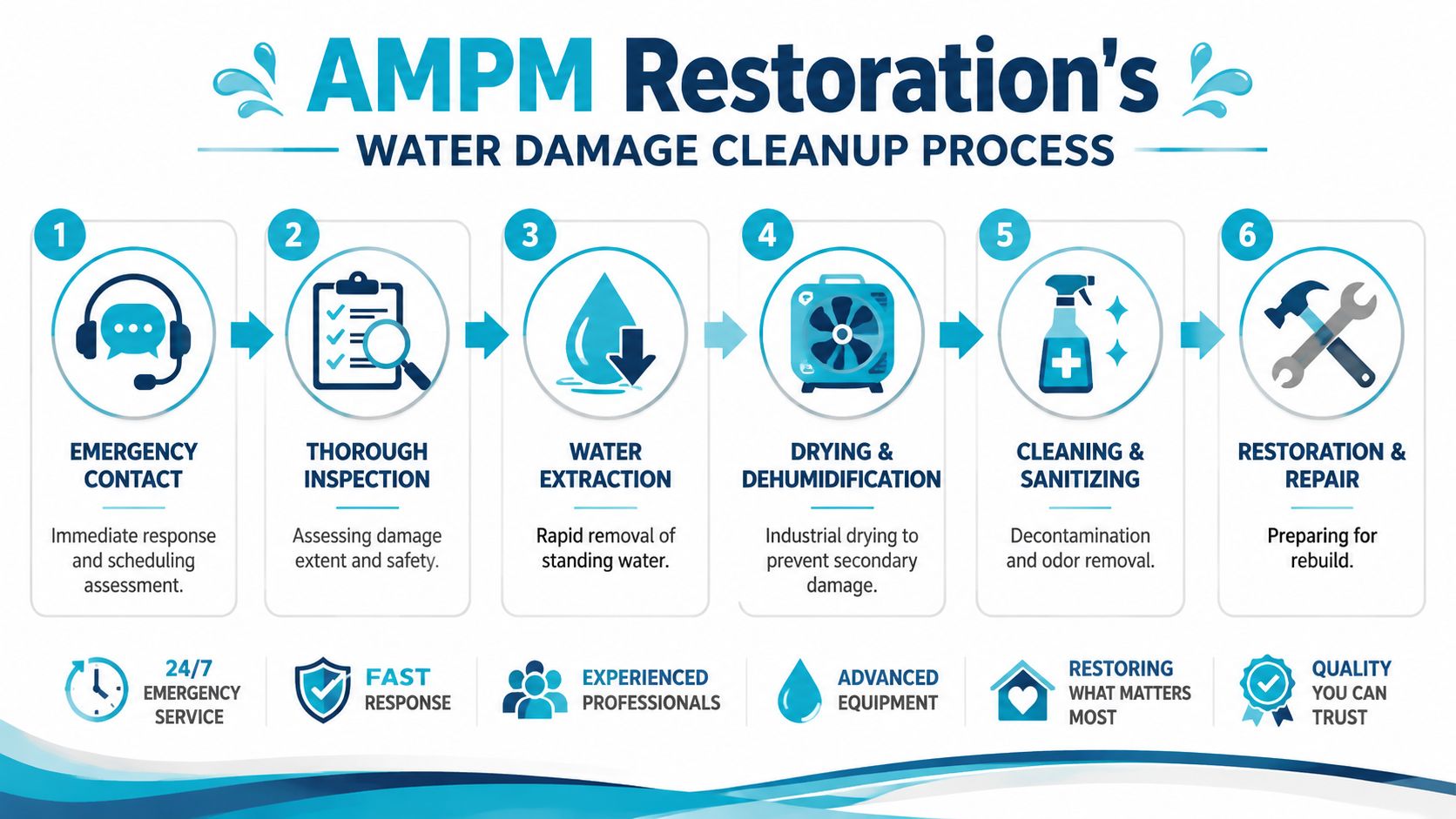
The Professional Water Damage Cleanup Process
Professional restoration is a sequence, not a single service call. In a commercial loss, each phase affects the next one. If the inspection is shallow, extraction misses trapped water. If extraction is incomplete, drying drags out. If drying is based on guesswork, reconstruction starts on a wet substrate and fails later.
Inspection has to go past what the eye sees
Commercial water damage cleanup in Sarasota starts with finding the true wet footprint. A technician should inspect not just obvious damage, but likely migration paths. That includes wall bases, shared partitions, flooring transitions, cabinet toe kicks, elevator-adjacent walls, and HVAC returns.
Tools matter here. Moisture meters, infrared cameras, thermo-hygrometers, and written moisture logs create the drying map. Without those readings, crews often dry the room and miss the assembly.
A common failure point in commercial losses is under-drying hidden cavities. Moisture left behind drywall, under flooring, or in insulation after visible water is removed can drive rot, mold, and later demolition.
Extraction and demolition have to be deliberate
Standing water gets removed first with truck-mounted or portable extractors, weighted tools for carpeted areas, pumps where needed, and containment where contamination is a concern. But extraction alone isn’t the job. The key judgment call is deciding what can dry in place and what has to come out.
Porous materials often force that decision. Wet insulation, swollen composite trim, compromised carpet pad, and certain drywall sections may not be good candidates for salvage. In a commercial building, selective demolition is often what allows the rest of the space to be saved.
One option property managers use for this phase is structural drying services in Tampa Bay, which typically involve extraction, equipment setup, moisture tracking, and adjustment of the drying plan as readings change.
Drying is where technical discipline shows
After extraction, crews place air movers and commercial dehumidifiers based on material type, chamber size, and airflow path. This isn’t about making the room feel dry. It’s about changing the moisture condition inside building materials.
What works:
- Targeted airflow: Air movers directed along wet wall lines, under floating cabinetry, and across affected floor systems.
- Controlled humidity removal: Dehumidifiers sized to the space and adjusted as conditions stabilize.
- Containment: Poly barriers or zip walls to isolate affected zones and avoid drying the whole building unnecessarily.
- Daily moisture verification: Readings from framing, drywall, and flooring guide equipment changes.
What doesn’t work:
- Open every door and hope for airflow
- Rely on building HVAC alone
- Remove equipment because surfaces feel dry
- Restart operations before assemblies test dry enough for repair
Surface dryness fools people. The hidden cavity is what drives callbacks.
Sanitizing and preparing for repair
Once the structure reaches appropriate dry conditions, crews clean affected surfaces, address odors where needed, and prepare the space for repair. In commercial settings, that often includes detail cleaning around workstations, contents handling, and coordination with facilities staff so operations can restart in the right order.
Minimizing Downtime with Business Continuity Strategies
At 8:15 on a Sarasota Monday, a medical office may have water in the rear admin suite, patients arriving in 45 minutes, and staff asking whether the day is cancelled. In that moment, the question is not only how fast the building dries. It is how to keep appointments, protect records, and limit the part of the property that has to come offline.
That is the difference between basic cleanup and a business continuity plan. Sarasota properties deal with persistent humidity, frequent storm-related intrusions, and mixed-use buildings where one wet area can affect tenants, customers, and shared access at the same time. A capable commercial restoration company should build the work plan around operations, not just around equipment placement.
Phased work usually beats a full shutdown
Many commercial properties can keep part of the operation running if the loss is sectioned correctly. That may mean keeping the lobby and front offices open while a rear suite stays under containment, or taking a bank of hotel rooms out of service instead of closing the whole floor.
That approach takes planning on the first day.
Crews and facility managers need to decide which spaces produce revenue, which spaces support life safety, and which spaces can wait. In Sarasota, that decision also has to account for outside moisture load. Doors opening constantly during cleanup can push humid air into adjacent areas and expand the problem if containment is weak.
The work plan usually includes:
- Zone isolation: Keep affected areas separated from occupied areas with clear containment lines.
- After-hours disruption control: Schedule noisy demolition, extraction, and material movement outside peak business hours when possible.
- Safe access paths: Give employees, tenants, customers, and vendors a clean route that does not cross active work areas.
- Recovery sequencing: Put drying, cleaning, and repair resources on the spaces that restore revenue first.
Prioritize the spaces that keep the business running
Commercial losses should be triaged by operational value. For one property, that is the reception and point-of-sale area. For another, it is a server room, exam room, kitchen line, reservation desk, file archive, or tenant corridor that supports multiple suites.
Owners who make these priorities early usually lose less time because the field team can make smarter calls on contents movement, access, and repair order.
| Priority area | Typical continuity move |
|---|---|
| Customer-facing zone | Isolate nearby damage and keep entrances, signage, and walk paths usable |
| Inventory storage | Relocate vulnerable stock, protect shelves, and control humidity around retained goods |
| Administrative offices | Shift staff into dry offices, conference rooms, or temporary workstations |
| Shared tenant corridors | Clean, dry, and reopen access routes early to reduce conflict with occupants |
The best plan restores usable square footage in the order the business needs it, not in the order the water happened to spread.
Communication keeps a manageable loss from turning into an operational mess
Silence creates confusion fast. Employees start guessing. Tenants assume the whole building is affected. Customers see fans, barriers, and open ceiling areas, then assume the business is closed.
A clear update schedule prevents that. State what is affected, what remains open, where people should enter, and when the next update will go out. For larger Sarasota properties, especially retail centers, offices, and hospitality buildings, that message often needs to go to staff, tenants, vendors, and ownership at the same time.
Business continuity is also tied to the claim. If a business closes areas that could have stayed open, the carrier may question parts of the interruption narrative later. If the owner keeps occupied areas open without proper separation, the loss can spread and increase the repair scope. Good restoration planning balances both risks from the start.
Navigating Sarasota Commercial Water Damage Insurance Claims
Commercial insurance claims are where many owners lose time and money. Not because the damage isn’t real, but because the file gets built poorly in the first days. In Sarasota, storm-driven moisture makes that harder. Water may enter through roof failures, wind-driven openings, plumbing failures after storms, or surface intrusion with different coverage implications.
For commercial properties in Sarasota, storm-driven moisture creates significant insurance complexity. Thorough documentation and rapid moisture control in the first 72 hours are critical for preventing broader mold impact and supporting the claim record.
The file starts before cleanup looks organized
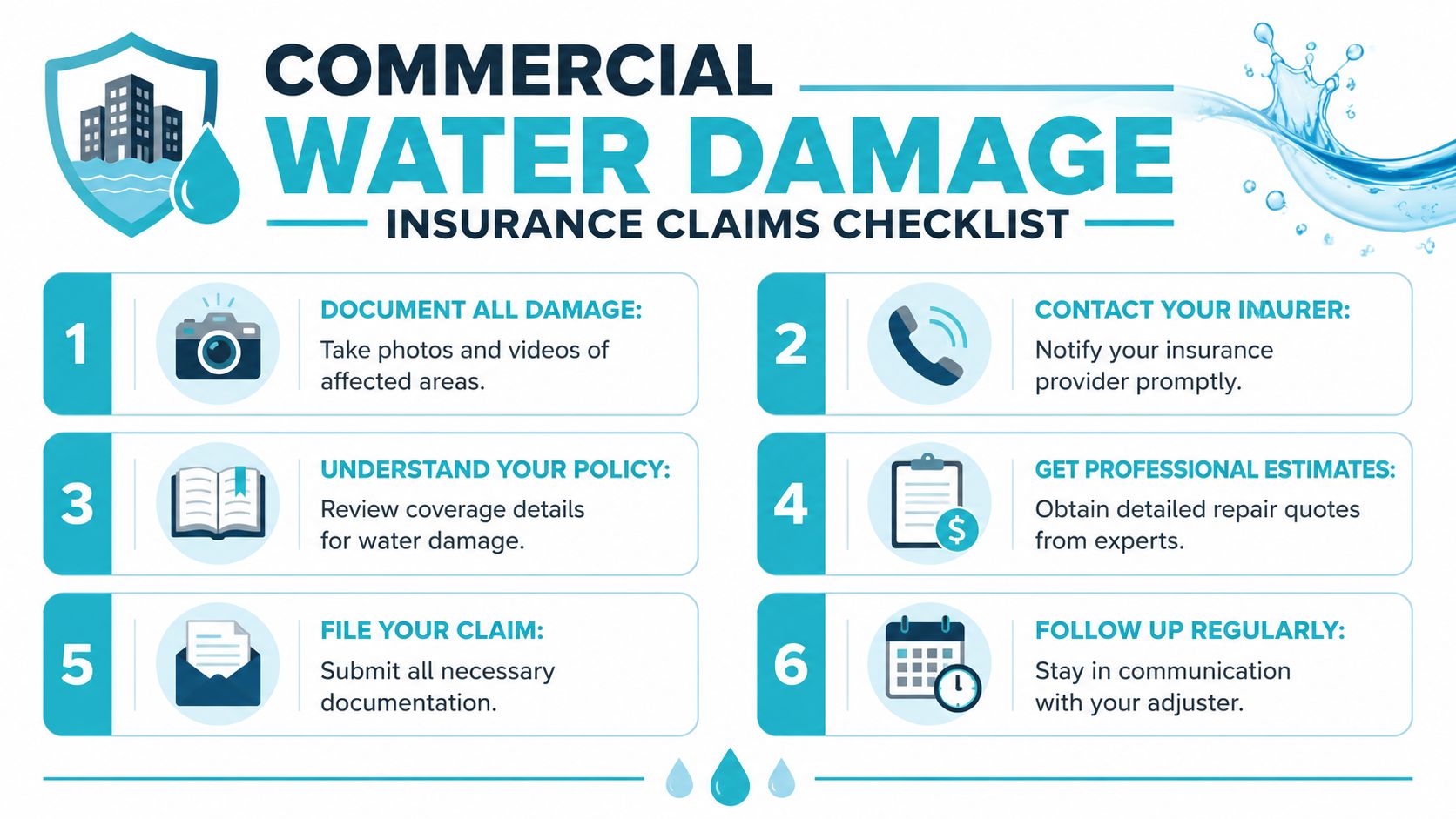
Owners often think documentation begins after the adjuster is assigned. It doesn’t. It begins at discovery.
The strongest commercial claims usually include:
- Cause and origin notes: What was observed first, where it appeared to begin, and who found it
- Photos before major disturbance: Wide shots, room views, close-ups of damaged materials, and affected contents
- Moisture records: Meter readings and mapped wet areas
- Mitigation logs: Equipment placement, extraction activity, demolition decisions, and daily progress
- Communication records: When the insurer was notified and what instructions were given
Many commercial files drift off course. The building gets cleaned up enough to look better, but the owner loses a clear record of scope.
Coverage questions that matter in Sarasota
Not all water claims are treated the same way. Commercial policy language often distinguishes between sudden interior water damage and flooding or storm-related surface water. That’s why owners shouldn’t make assumptions based on broad terms like “water damage.”
A practical review should consider:
| Claim issue | Why it matters |
|---|---|
| Cause of loss | Pipe break, roof leak, appliance failure, and flood conditions may be handled differently |
| Timing of response | Prompt mitigation supports the record that the owner acted reasonably |
| Damaged materials vs business personal property | Building components and contents may fall into different claim categories |
| Business interruption questions | Access limitations and operational loss may require separate documentation |
What helps adjusters and what frustrates them
Adjusters generally need a clear, organized scope they can verify. They don't need chaos, mixed piles of discarded materials, and vague statements like “everything got wet.”
A better approach is to preserve removed materials when appropriate, label affected rooms clearly, separate salvageable contents from non-salvageable ones, and keep moisture and photo records tied to locations. Owners who need a practical overview can review how to file an insurance claim for water damage before the claim conversation gets complicated.
Clean documentation shortens arguments. Sloppy documentation creates them.
Keep the claim and the restoration moving together
One mistake is waiting for every insurance decision before beginning meaningful mitigation. Another is doing aggressive tear-out without enough proof of why it was necessary. The right balance is evidence-based mitigation. Stabilize, document, dry, and communicate in a way that preserves both the building and the claim.
Full Reconstruction and Returning to Pre-Loss Condition
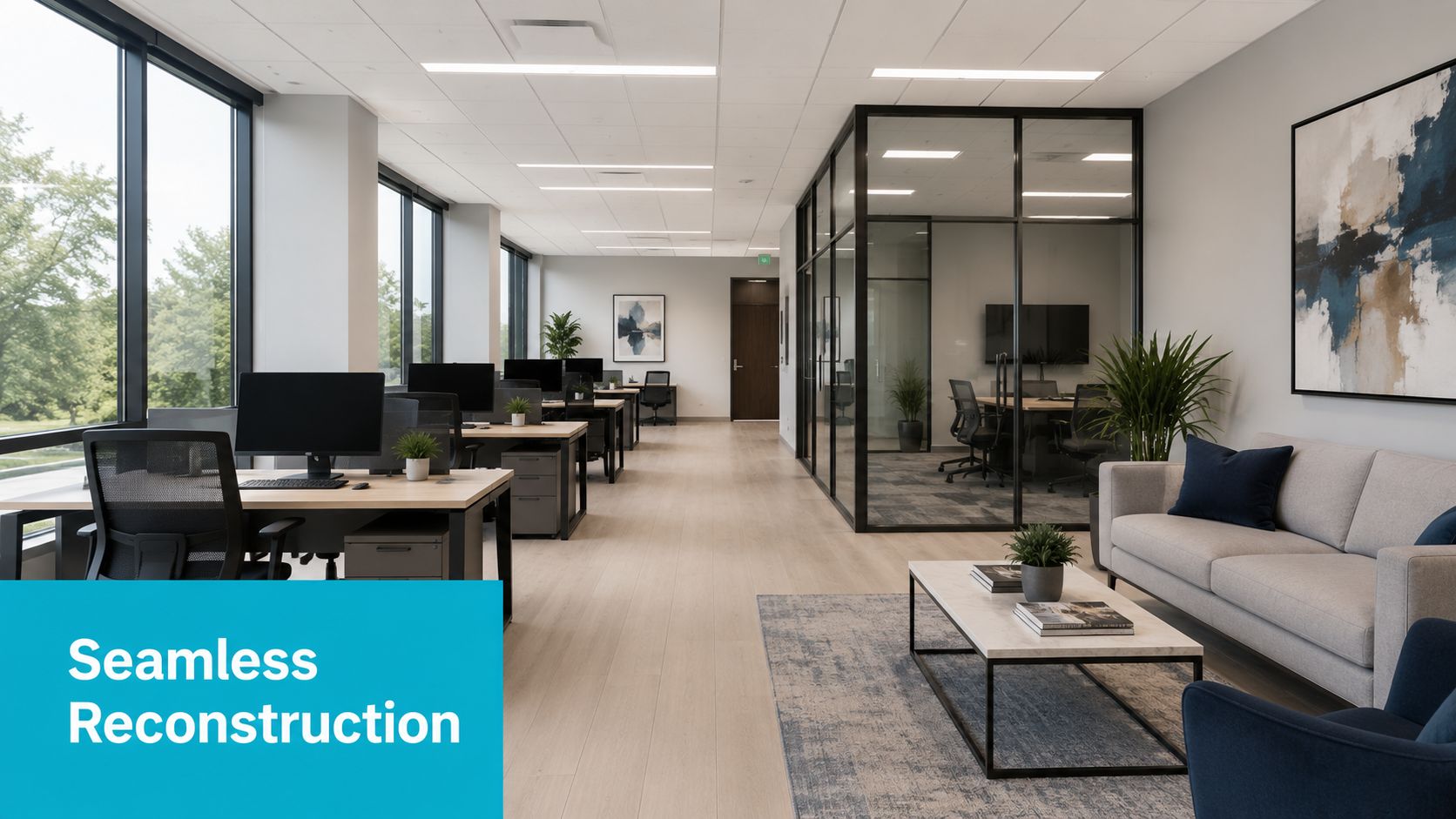
Drying is only the midpoint. A commercial property isn't back until it's safe, functional, code-compliant, and presentable for staff, tenants, or customers. That's where reconstruction matters. If mitigation and build-back are handled by different parties with weak handoff notes, owners often end up re-explaining the loss, re-scoping damage, and losing time.
Commercial restoration sits inside a large professional sector. The disaster-restoration market was valued at USD 46.0 billion in 2025 and is projected to reach USD 89.1 billion by 2036, reflecting a 6.2% CAGR from 2026 to 2036. That same market definition includes water damage restoration as a core service and identifies commercial buildings among major end users disaster restoration services market analysis. The point for Sarasota owners is simple. The rebuild process follows established industry workflows, not improvised local guesswork.
What reconstruction usually includes
Commercial build-back can range from targeted finish replacement to broad interior restoration. Typical scopes include drywall replacement, insulation replacement, base and trim installation, paint, flooring replacement, ceiling grid and tile work, cabinetry, door hardware, and finish carpentry. In larger losses, it may also involve more substantial structural repair and coordination with trades.
A smooth reconstruction phase depends on decisions made earlier:
- Accurate drying records support reinstalling materials on stable substrates.
- Selective demolition notes reduce disputes about what must be rebuilt.
- Room-by-room scope writing helps owners reopen usable areas sooner.
- Code-aware repairs avoid delays late in the project.
Contents, furniture, and reset planning
Commercial recovery isn't only about walls and floors. It also includes workstations, shelving, reception areas, conference rooms, and stored materials that may need to be removed, reset, replaced, or reconfigured during the build-back. For owners planning the logistics side, this guide for managing office cleanouts is useful for thinking through furniture removal, staging, and access during restoration.
Pre-loss condition means operational condition
A room can look finished and still not be ready. True pre-loss recovery means the area supports the use it had before the incident. In an office, that means staff can work there. In retail, customers can move through it comfortably. In hospitality, the space has to meet presentation standards, not just pass a moisture check.
That's also why reconstruction sequencing matters. A property may be technically dry well before it's commercially useful. The right build-back plan restores the spaces that bring operations back first, then completes lower-priority finishes without disrupting reopened areas.
Commercial water damage cleanup in Sarasota is done when the property can function again, not when the fans leave.
FAQs About Commercial Water Damage in Sarasota
How quickly should a commercial property respond after discovering water?
Immediately. Commercial losses get more expensive when the first response is delayed. In Sarasota, waiting is especially risky because warm, humid conditions make secondary damage more likely. The best first move is to secure the area, stop the source if it's safe, protect contents, and start documented mitigation.
Can a business stay open during commercial water damage cleanup in Sarasota?
Often, yes, at least in part. Many office, retail, and hospitality properties can operate in phases if the affected area is isolated properly and the work is sequenced around occupancy. The decision depends on the source of water, the extent of contamination, life-safety concerns, and whether access routes can stay safe and clean.
What makes Sarasota commercial losses different from inland markets?
Humidity, coastal storms, and wind-driven moisture make drying discipline more important. Sarasota buildings also deal with roof exposure, HVAC moisture issues, and mixed-use occupancies where one loss can affect multiple tenants or floors. That means the restoration plan has to account for hidden moisture, occupied areas, and tighter turnaround pressure.
If the building has multiple suites or operational zones, treat the response like a coordination project, not just a cleanup project.
Will insurance cover my commercial water damage claim?
It depends on the cause of loss and the policy language. Sudden interior water damage may be handled differently than flood-related loss or storm-driven intrusion. Owners should notify the carrier early, preserve evidence, and avoid making assumptions about coverage before the cause and scope are documented.
Why is DIY cleanup a bad idea for commercial buildings?
Because commercial assemblies are harder to dry than they look. Water can sit under flooring, behind drywall, inside insulation, and around built-in fixtures after the surface appears clean. Mops, shop vacs, and janitorial fans may help with visible water, but they don't replace moisture mapping, structural drying, and room-by-room documentation. If flooring is part of the loss, this practical article on how to fix water-damaged floors gives a good overview of why floor systems need careful evaluation before repair decisions are made.
What documentation should an owner keep from day one?
Keep discovery notes, photos, videos, communication with staff and the insurer, lists of affected contents, and any contractor moisture or drying records. Separate what was damaged, what was moved, and what was removed. Commercial claims go smoother when the file shows what happened, what was done to mitigate it, and why each action was necessary.
Commercial water damage cleanup in Sarasota moves fastest when the owner treats it as both a building emergency and an operational event. The cleanup matters. The drying matters. The documentation and continuity planning matter just as much.
If your office, retail space, hotel, medical suite, school, or multi-tenant property has water damage, contact AMPM Restoration Services for commercial water damage cleanup in Sarasota. Call 941-946-7807 for a free inspection and estimate. Insurance claim assistance and financing options are available, and the team can help you move from emergency mitigation through drying, repairs, and reconstruction with a clear plan.