

24-Hour Water Extraction Services in Sarasota
Water on the floor changes the mood of a house fast. One minute you’re getting ready for work or trying to get the kids out the door. The next, you’re standing in soaked socks, opening cabinets, checking baseboards, and wondering how far the water has already traveled.
That’s when 24-hour water extraction services in Sarasota matter. In this part of Florida, water emergencies don’t wait for business hours, and the local market reflects that. Multiple Sarasota-area restoration providers advertise around-the-clock service because rapid extraction is a foundational need in a coastal area that deals with plumbing failures, leaks, and storm-related intrusion. The hard part for homeowners is figuring out who is prepared to respond, what happens after the water is removed, and how to avoid a small emergency turning into a much bigger repair.
A Water Damage Emergency in Your Sarasota Home
A typical call starts with confusion. A homeowner in Sarasota wakes up to a failed supply line under the sink, or comes home after a summer storm to find water pushing in under a slider. The visible mess gets attention first. Towels come out. A shop vac comes out. Someone starts moving rugs, boxes, and furniture.
That first burst of action is understandable, but it usually doesn’t answer the real question. Where has the water already gone? Into the drywall. Under the plank flooring. Behind the baseboards. Into the vanity toe-kick. Across the slab surface and into adjacent rooms.
What people see and what they miss
Most homeowners react to the puddle. Restoration crews react to the spread pattern.
That difference matters because the water you can see is often only part of the problem. A dishwasher leak in the kitchen can wick into adjoining rooms. An overflowing toilet can reach trim, drywall, and cabinetry before the floor even looks saturated. A roof leak may show up as a ceiling stain long after insulation and framing have already absorbed moisture.
When you’re panicked, the best first move is simple. Stop the source if you can, avoid contaminated water, and get a qualified team moving.
If you’re dealing with active water damage right now, practical homeowner steps like shutting off the water supply, moving valuables, and staying away from electrical hazards can help while a crew is on the way. AMPM’s guide on what to do after water damage in a Florida home is a useful starting point.
Calm decisions beat rushed guesses
A lot of damage gets worse because people lose time deciding whether it’s “bad enough” to call. If water is more than a quick surface spill, it’s worth treating it like an emergency. Fast extraction protects materials, shortens the drying phase, and gives you a better shot at limiting demolition.
Sarasota homeowners don’t need hype in that moment. They need a clear plan, a crew that answers, and a process that starts now, not tomorrow morning.
Why Immediate Water Extraction Is Non-Negotiable
Water damage gets more expensive when it sits. That’s the plain truth.
Municipal utilities in this region already treat water-related incidents as urgent. Sarasota County Utilities publishes a dedicated line for sewer leaks, backups, and emergencies, and nearby cities including Venice and North Port also maintain published 24-hour water emergency numbers, which shows local governments view these incidents as time-sensitive infrastructure problems that need immediate action (Sarasota County sewer leaks and sewer emergencies).

Delay changes the job
If a crew reaches a loss early, the work may stay focused on extraction, targeted opening, controlled drying, and cleaning. If the same loss sits, the scope often shifts. Flooring swells. Drywall softens. Trim separates. Odors set in. Cabinets and built-ins may no longer be salvageable.
A homeowner usually asks, “Can’t I just mop it up and run fans?” Sometimes for a very minor spill, yes. For a true intrusion event, no. Household fans move air, but they don’t create a drying plan. They also don’t tell you whether moisture remains trapped in wall cavities or under finished flooring.
What waiting often leads to
- Hidden moisture: Water migrates under flooring, into insulation, and behind cabinets where surface drying won’t reach.
- More demolition: Materials that might have been saved early may need removal later.
- Air quality concerns: Damp building materials create conditions where microbial activity becomes a concern. For homeowners who want a broader primer, this resource on understanding black mold in Florida homes gives helpful context on why moisture control matters in this climate.
- Longer disruption: The longer moisture sits, the harder it is to return a home to normal use.
Practical rule: If water has affected drywall, flooring, cabinets, or more than one room, treat it as a professional extraction and drying job, not a cleanup chore.
The speed issue is even more obvious inside walls. Moisture doesn’t stay in the neat shape of the puddle you see on the floor. It follows seams, framing, and absorbent materials. If you want a clearer picture of that movement, how fast water damage spreads in walls explains why delays create secondary damage that homeowners often don’t discover until much later.
AMPM Restoration’s Rapid Response and Certified Expertise
The biggest misunderstanding in this space is the phrase “24/7.” A phone can be answered at any hour. That does not always mean a staffed, equipped crew can reach your property quickly, especially during major rain events or regional storm activity.
In emergency extraction work, response time is the critical variable, and restoration firms in Southwest Florida commonly work from dispatch windows of about 60 to 90 minutes because standing water can quickly push a loss from simple extraction into broader structural remediation (commercial water damage restoration).
What real emergency availability should include
When you call a company for 24-hour water extraction services in Sarasota, ask direct questions. Don’t settle for vague reassurance.
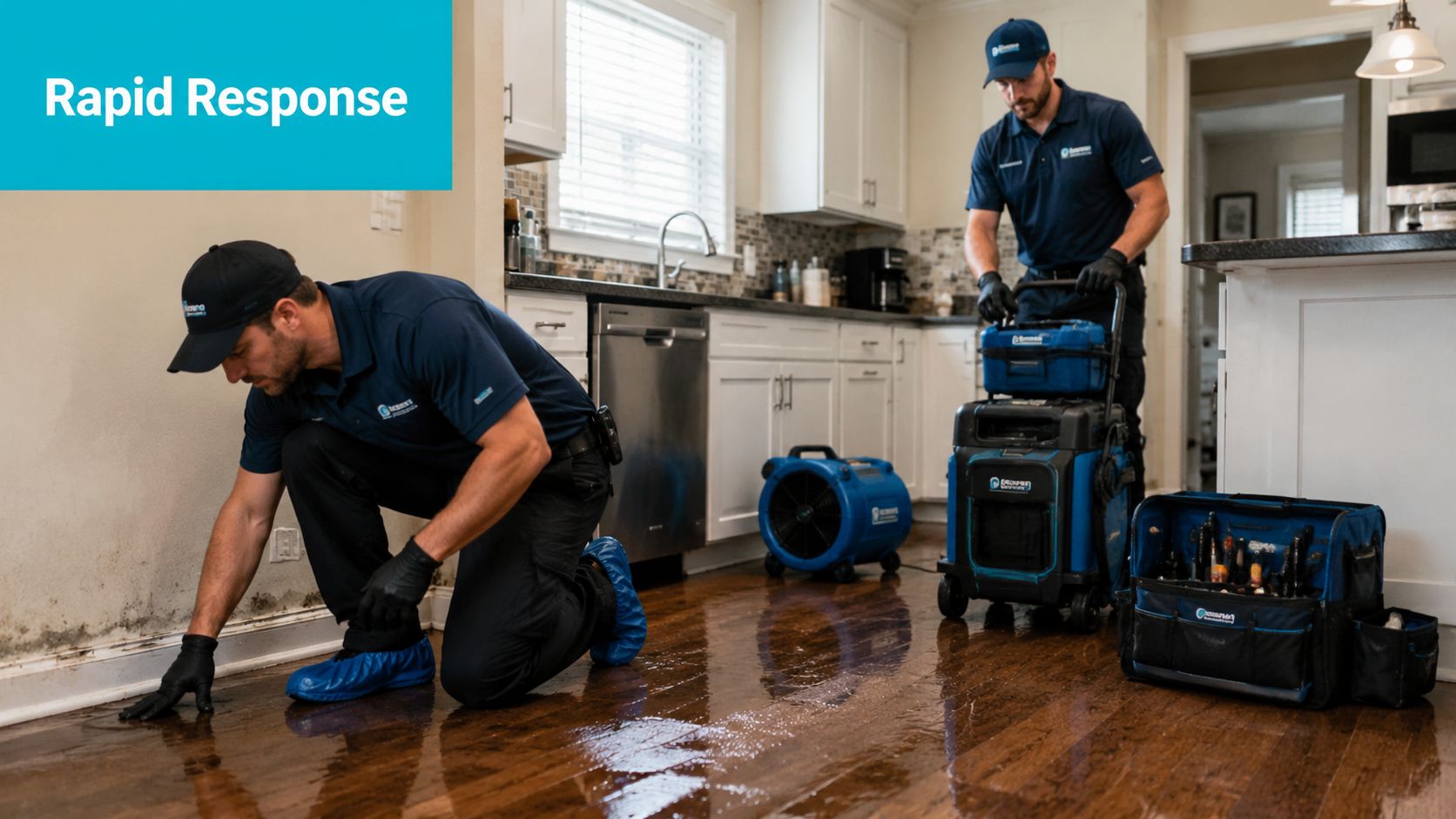
A capable after-hours response should include:
- Actual dispatch screening: Someone should ask where the water came from, whether power is affected, whether sewage is involved, and which rooms are impacted.
- Equipment readiness: Extraction tools, air movers, dehumidifiers, moisture meters, and containment supplies should be available without waiting for the next business day.
- Triage during peak demand: During storm-heavy periods, companies need a way to prioritize active intrusions, contaminated water, and occupied homes with immediate safety concerns.
- Clear scope on arrival: The first team should tell you whether they’re handling full mitigation immediately or stabilizing the loss and returning with additional drying capacity.
That’s the practical difference between “open” and “operational.”
Why certification matters on site
An IICRC-certified technician doesn’t just remove water. The certification matters because the work involves judgment calls that affect salvage, health, and cost. A trained crew knows when to extract versus detach and float carpet, when trim needs removal for cavity drying, when containment is appropriate, and how to document moisture conditions in a way that supports the file.
Some companies, including AMPM Restoration Services, describe a one-hour response model for emergency restoration. The useful question for a homeowner isn’t the slogan itself. It’s whether the company has the staffing, routing, and equipment depth to support that promise when several calls hit at once.
During storm season, ask one thing directly: “If multiple homes call tonight, do you still have crews and drying equipment available for my job?”
What works and what doesn’t during Florida storm periods
What works is honest dispatching. If the first available team can stabilize the property, begin mitigation, and set expectations for the next phase, that helps the homeowner make good decisions. What doesn’t work is overpromising immediate full-service restoration when a company is already stretched thin.
In Sarasota and across the Suncoast, reliability comes down to process. Fast call intake. Accurate triage. Qualified technicians. Enough drying equipment. Clear communication after hours.
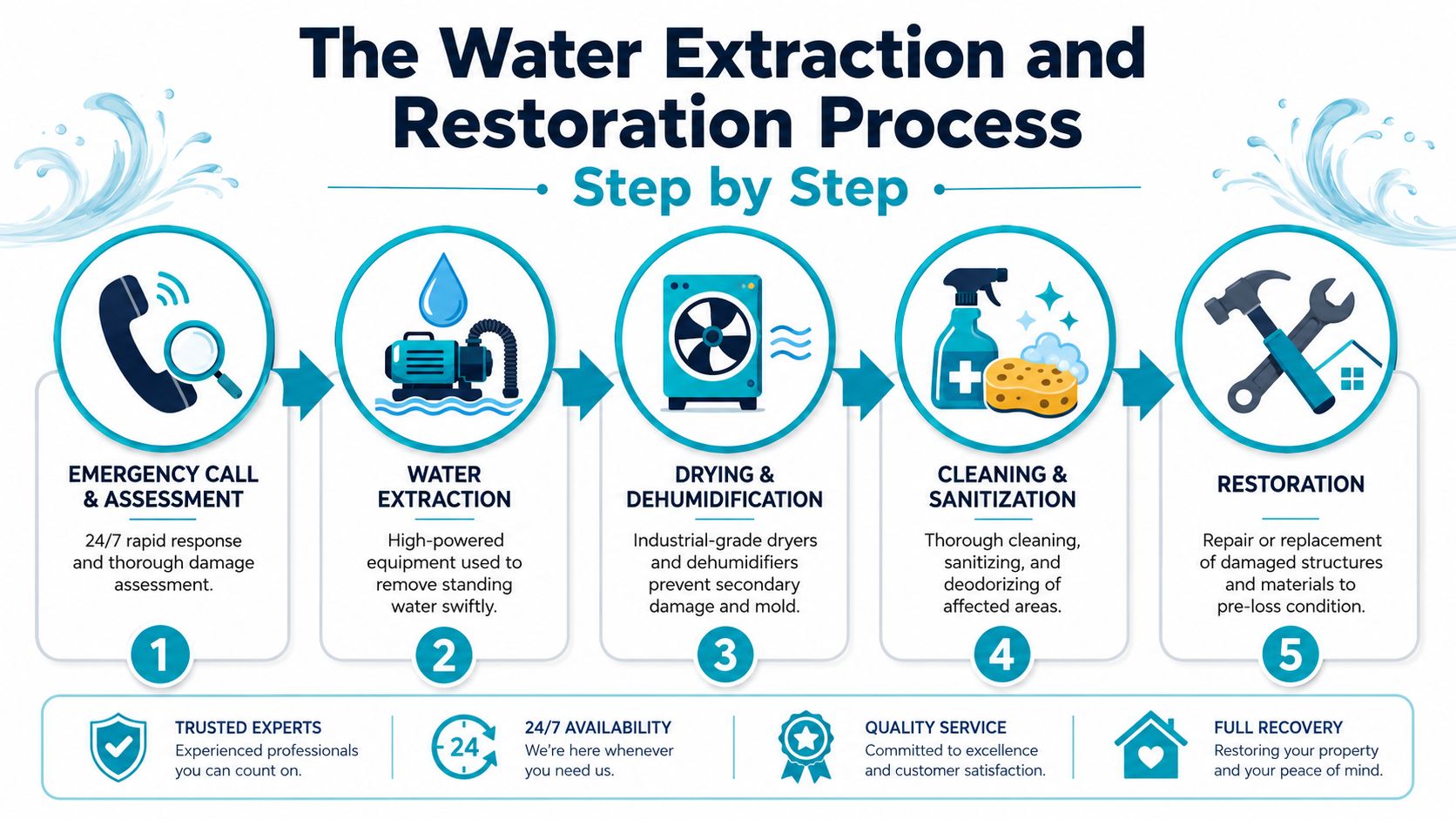
The Water Extraction and Restoration Process Step by Step
A professional water loss should follow a controlled sequence. If the process feels random, the result often is too.
Effective restoration isn’t just pumping out visible water. It requires a sequence of high-capacity extraction, dehumidification, and structural drying to help prevent microbial growth and material breakdown, and Sarasota-area providers explicitly pair extraction with moisture-removal equipment and drying protocols.
Step one is assessment, not guessing
The first task on site is identifying the source and category of water, then mapping the affected area. Technicians inspect the visible damage, but they also check adjacent rooms, lower wall sections, cabinets, and transitions between flooring types.
This is where moisture meters, thermal imaging, and direct inspection matter. The point isn’t just to confirm that water is present. It’s to define the wet boundary so the drying setup matches the actual spread.
Extraction comes before broad drying
Standing water needs to be removed first. That may involve portable extractors, truck-mounted equipment, weighted extraction tools for carpet, or direct vacuum extraction around cabinetry and hard-surface transitions.
A common homeowner mistake is skipping straight to fans. Air movement matters later, but trapped bulk water needs to come out first.
If water is still sitting in the structure, drying equipment is doing the wrong job. Extraction has to lead the process.
Drying is controlled, not improvised
Once bulk water is removed, the crew places air movers and dehumidifiers based on the material load and room configuration. Drying should be adjusted as conditions change, not left untouched for days.
That’s why monitoring matters. A good drying plan includes return visits, moisture checks, and equipment changes when needed. Some rooms dry quickly. Others hold moisture in sill plates, cabinets, or wall cavities and need targeted intervention.
For homeowners who want a better idea of what happens after extraction, drying out a flooded home step by step gives a useful overview of how the drying phase progresses.
Cleaning, sanitizing, and odor control
Not every water loss needs the same level of cleaning. Clean-water pipe breaks are different from overflow losses or water that has tracked through dirty building cavities. The crew should match treatment to the source and conditions.
This phase may include:
- Surface cleaning: Wiping and treating affected non-porous or salvageable surfaces.
- Sanitization where appropriate: Especially important when the source isn’t clean water.
- Odor management: Useful when water has sat, affected porous materials, or involved kitchen and bathroom areas.
Final repairs restore function
Mitigation and restoration are related, but they aren’t identical. Mitigation stops the damage and dries the structure. Restoration puts the property back together.
That may mean replacing baseboards, reinstalling sections of drywall, repainting, rebuilding cabinetry components, or completing more extensive reconstruction if materials weren’t salvageable. Homeowners are usually calmer once they understand that sequence. First stabilize. Then dry. Then rebuild correctly.
| Phase | What the crew is trying to accomplish |
|---|---|
| Inspection | Define source, spread, and safety concerns |
| Extraction | Remove standing and trapped bulk water |
| Drying | Lower moisture in structural materials |
| Cleaning | Address residue, sanitation, and odors |
| Restoration | Return damaged areas to pre-loss condition |
Navigating Insurance Claims and Costs for Water Damage
Water loss is stressful enough without trying to decode policy language while your floors are wet. Most homeowners want two things answered quickly. “What should be documented?” and “Who is going to talk to the insurance company?”
The right approach is methodical. Photograph the affected rooms, damaged contents, material transitions, and the source if it's visible and safe to access. Keep any emergency invoices and notes from the first response. Don't throw out damaged materials before the loss is documented unless they create a safety or sanitation issue and your mitigation team has recorded them.
What good claim support looks like
A restoration company helps most when it creates a clean record of the loss. That usually includes moisture readings, photo documentation, scope notes, equipment logs, and communication that ties the emergency mitigation work to the observed conditions on site.
Homeowners should also understand the difference between insurance guidance and legal guidance. If a claim becomes disputed or unusually complex, broader legal context can help. This overview of understanding Florida property damage law is a practical reference for property owners trying to understand their rights and options.
The cost question homeowners always ask
There isn't one flat price for 24-hour water extraction services in Sarasota because the scope changes with the source, affected materials, contamination level, access, and drying requirements. A small clean-water appliance leak is not the same job as a multi-room storm intrusion or a sewer backup.
What matters is this. Fast, competent mitigation often protects more of the structure and contents. Delayed action tends to increase demolition, cleaning needs, and repair scope. That's why emergency extraction should be viewed as loss control, not just cleanup.
A strong contractor also reduces stress by helping with claim organization. If you need a better sense of the paperwork side, how to file an insurance claim for water damage can help you prepare for the process.
When coverage is limited or out-of-pocket costs are a concern, financing can be the difference between immediate mitigation and damaging delays. That matters because waiting on a financial decision rarely helps the property.
Serving Sarasota and Our Florida Gulf Coast Communities
Sarasota water losses don't happen in isolation from the rest of the Gulf Coast. The same weather patterns, humidity, plumbing failures, and storm pressures affect homes and commercial buildings across Bradenton, Lakewood Ranch, Tampa Bay, Saint Petersburg, and surrounding communities.
AMPM is based locally at 4301 32nd St W b18, Bradenton, FL 34205, which matters when response logistics and local building conditions affect the work. A local company understands how slab homes dry, how storm calls stack up, and how Gulf Coast humidity changes the drying strategy from one property to the next.
That local reach also means homeowners aren't calling a faceless remote scheduler with no sense of the area. They're working with a Gulf Coast restoration team that serves Bradenton, Sarasota, Tampa Bay, Saint Petersburg, Lakewood Ranch, and nearby Suncoast neighborhoods where fast, informed water response is part of everyday restoration work.
Frequently Asked Questions About Water Extraction Services
A few practical questions come up on almost every emergency call. Here are the ones homeowners usually need answered first.
| Question | Answer |
|---|---|
| What should I do before the crew arrives? | Stop the water source if you can do it safely, move valuables and loose items out of affected areas, and stay clear of any rooms where water is near electrical hazards. Avoid walking through contaminated water. |
| How do I know if water got inside the walls? | Warped baseboards, swollen trim, staining, musty odor, soft drywall, and flooring changes can all point to hidden moisture. A professional inspection with moisture detection tools is the reliable way to confirm the spread. |
| Do I need to leave the house during water extraction? | Not always. Many jobs can be handled while occupants remain in unaffected parts of the home. If the water is contaminated, the damage is widespread, or safety conditions are poor, temporary relocation may be the better choice. |
| How long does the drying process take? | It depends on the extent of the intrusion, what materials were affected, and how much moisture was absorbed. Extraction is only the first phase. Drying continues until structural materials reach acceptable moisture conditions. |
| Can you handle clean water and contaminated water losses? | Yes, but the approach changes. Clean-water pipe breaks, appliance leaks, overflow losses, and sewer-related events require different cleaning, containment, and material-removal decisions. The source always affects the plan. |
| Is it safe to use household fans after a leak? | Fans can help move surface air in a very minor incident, but they don't replace extraction, moisture mapping, or controlled structural drying. Used incorrectly, they can also spread moisture through the home without solving the hidden problem. |
The safest approach is to assume the damage is broader than the puddle until testing proves otherwise.
If you need 24-hour water extraction services in Sarasota, don't wait for the damage to declare itself more clearly. Early action gives you more options, cleaner documentation, and a better chance of saving materials.
If water is moving through your home or business, call AMPM Restoration Services at 941-946-7807 for a free inspection and estimate. We provide emergency response across Sarasota and the Gulf Coast, help document and coordinate insurance claims, and offer financing options so you can move forward without losing critical time.