


You step barefoot onto the hallway tile in your Bradenton or Sarasota home, and one patch near the baseboard feels oddly cool and clammy. Earlier this week, your monthly water bill jumped without an obvious reason, yet every cabinet under your sinks is dry and you can't find a single puddle anywhere on the floor.
That's the exact moment most homeowners start shopping online for leak detection equipment and quickly get buried in moisture pucks, clamp-on flow monitors, smart shutoff valves, and handheld pin meters. Marketing pages often make those gadgets sound like universal X-ray machines. In the field, they aren't.
A sensor alarm only tells you water touched that specific probe, not where the pipe failed or how far moisture has soaked into your framing. Buying a device that can't answer your real question wastes money and time while hidden water spreads behind drywall or beneath a concrete slab. Knowing which tool confirms active flow, which tool traces a pressurized pipe, and which tool maps wet building materials keeps you from tearing open the wrong wall.
Leak Detection Equipment Compared at a Glance
Match the symptom to the tool before buying equipment or cutting into a wall. A sensor alarm reports water at the sensor. A flow monitor reports abnormal water use. A tracer-gas unit can confirm a sealed pipe leak, but only after the line is isolated and pressurized. Those are different questions, and most devices answer only one of them.
| Equipment | What it finds | Best use | Main limit |
|---|---|---|---|
| Moisture sensor | Unexpected dampness at the probe | Under sinks, water heaters, washers | Only detects water where the probe sits |
| Flow monitor | Abnormal whole-property or fixture water use | Catching running toilets and continuous flow | Can miss slow, isolated leaks |
| Smart shutoff valve | Flow or sensor trigger that closes the supply | Limiting damage when no one is home | Stops water but does not locate the source |
| Acoustic listening device | Turbulence from pressurized water escaping a pipe | Pinpointing a pressurized supply line | Depends on pipe material, noise and access |
| Infrared camera | Temperature differences linked to moisture or flowing water | Scanning walls and floors for hidden moisture | Shows surface signs, not the exact pipe |
| Moisture meter | Higher moisture readings in building materials | Mapping the damage footprint | Reads materials at contact points only |
| Tracer-gas unit | Escaping tracer gas from an isolated pressurized system | Testing sealed pipes and components | Needs isolation and pressurization |
Hidden plumbing failures aren't rare edge cases. According to the U.S. Environmental Protection Agency's WaterSense program, average household leaks waste more than 9,300 gallons of water per year (roughly 25 gallons every day), adding up to nearly 1 trillion gallons wasted annually nationwide. The same EPA benchmark reported by the U.S. Environmental Protection Agency's WaterSense program says approximately 9% of homes have leaks losing at least 50 gallons per day. In humid Gulf Coast homes, losing dozens of gallons into an enclosed wall cavity or under laminate flooring turns a minor pipe defect into swollen cabinetry, softened drywall, and rapid mold risk.
Moisture Detection Versus Flow Monitoring
The EPA, through the U.S. Environmental Protection Agency's WaterSense program, separates residential leak detection into two core strategies: moisture detection, which warns occupants when unexpected dampness reaches a monitored spot, and flow monitoring, which tracks water consumption over time to flag abnormal usage patterns. Consumer devices at the top of the table handle early warning well, especially around exposed appliances and supply lines.
Diagnostic instruments in the bottom half of the table serve a different job. Acoustic listeners, thermal cameras, moisture meters, and tracer-gas systems don't sit permanently under a sink waiting for a drip. Technicians bring them in after an alert or a high bill to trace pressurized water through concrete, isolate sealed plumbing runs, and measure how far moisture migrated through framing.
The trade-off is straightforward. Early-warning devices protect against known risk points, while diagnostic tools answer where moisture came from and how far it traveled. A probe under a washer can alert you to a hose failure at that connection. It cannot tell you whether a slab line is leaking. A clamp-on flow monitor can flag continuous demand from a running toilet. It cannot prove which fixture or pipe segment is responsible.
Every row in the comparison table identifies either a symptom or a travel path, never a guaranteed repair point on its own.
Start with the least destructive question: whether water is moving when every fixture is shut off. If it is, a pressurized supply leak is possible, and acoustic, tracer-gas, or pressure-isolation methods may be needed to narrow the location. If moisture is already visible or suspected inside materials, meters and thermal imaging help map the affected area before anyone opens drywall. AMPM Restoration Services provides leak detection as a service and uses advanced diagnostic tools to gauge moisture levels during water damage assessments, which helps separate a surface symptom from the source that needs repair.
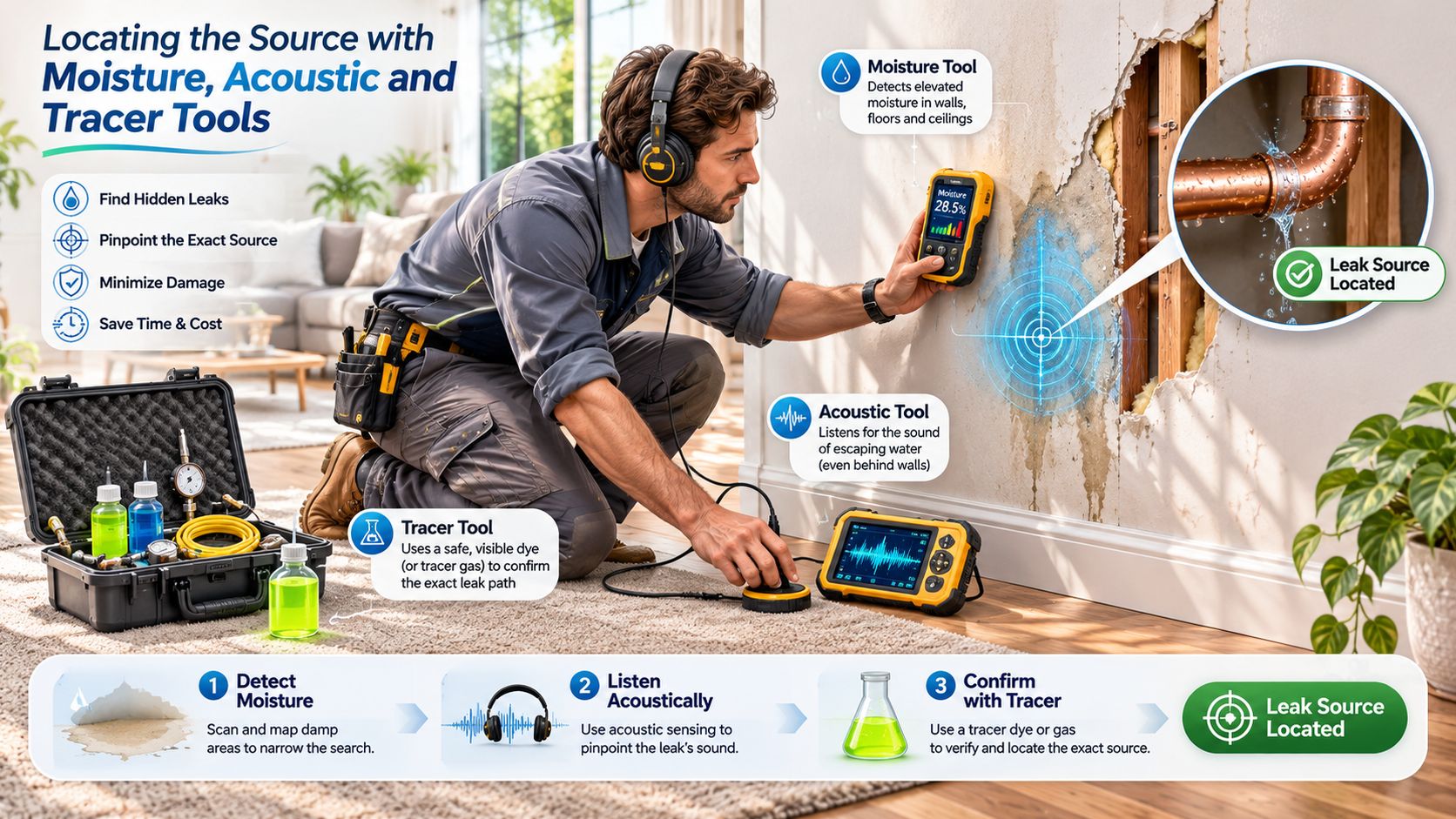
Locating the Source with Moisture, Acoustic and Tracer Tools
Confirming that water is moving through your plumbing only proves a leak exists. It doesn't tell you whether the breach sits behind the master shower valve, inside a guest-bath manifold, or six feet beneath your living room slab. Bridging the gap between "water is flowing" and "cut right here" takes targeted diagnostic instruments that measure different physical signals.
A technician rarely relies on one reading alone when tracing a concealed failure inside a finished home.
Mapping Hidden Moisture Before Opening a Wall
Infrared cameras and moisture meters are damage-mapping tools first, not pipe locators. When water saturates drywall or subflooring, evaporation cools the surface slightly, while a hot-water supply breach creates a faint warm plume. Scanning ceilings and walls with thermal imaging leak detection highlights those temperature anomalies without drilling a single test hole.
Thermal images can still fool an untrained eye. Missing batt insulation, cold air conditioning ducts, and exterior sun exposure also create temperature shifts on a camera screen. That's why technicians confirm every suspicious thermal shadow with a calibrated pin or pinless moisture meter, taking physical moisture readings across drywall, baseboards, and subfloors to outline the true damage footprint before setting up drying equipment.
Upper-story stains add another layer of guesswork because a leaking attic supply line and a storm-damaged roof penetration can leave nearly identical moisture patterns on a ceiling scan. When moisture tracks near eaves, valleys, or attic decking rather than pressurized pipe runs, reviewing exterior entry clues alongside Eagle Restoration 24/7 water damage response helps separate weather intrusion from plumbing failures before anyone removes interior finishes.
Acoustic Listening and Pressurized Tracer-Gas Testing
When water escapes a pressurized pipe, it creates high-frequency turbulence. Acoustic listening devices, including ground microphones and rigid contact probes paired with amplifiers, let a technician listen through concrete slabs and finished walls to follow that hiss to its loudest point. Real-world conditions still limit what sound can confirm:
- Pipe material: Rigid copper transmits acoustic vibration clearly, while plastic piping absorbs sound and shortens detection range.
- Ambient background noise: Running HVAC condensers, pool pumps, and nearby road traffic can mask faint pinhole leaks.
- Line pressure and access: Low static pressure reduces turbulence, and thick tile overlays or heavy cabinetry can block direct probe contact.
When acoustic signals are too quiet or muffled to pinpoint a concealed run, technicians turn to tracer-gas leak detection. The line or enclosure is isolated, drained, and pressurized with a safe, detectable gas mixture while a handheld probe sweeps accessible joints and floor surfaces. Escaping gas rises through microscopic pathways and builds a localized concentration gradient right above the breach.
Standardized helium testing outlined in ASTM F2391 demonstrates just how fine that sensitivity range gets across leak classes.
| Leak size | Sensitivity range (Pa·m³/s) |
|---|---|
| Large | 10^-2 to 10^-5 |
| Moderate | 10^-5 to 10^-7 |
| Fine | 10^-7 to 10^-9 |
| Ultra-fine | 10^-9 to 10^-11 |
Sensitivity isn't fixed in the field. Under ASTM E2024, thermal-conductivity leak detectors are standardized for pressurized-gas leaks of about 1 × 10^-5 Pa·m³/s or greater, yet real response shifts with tracer selection, background contamination, pressure differential, enclosure volume, probe response time, and room ventilation. Strong drafts, wide room volumes, or holding the probe too far from a joint can dilute gas below the alarm threshold, and switching tracer gases without recalibrating the detector materially skews readings. Because these procedures require pressurizing a sealed object, they fit isolated pipe runs far better than open, porous wall cavities.
The Field Workflow Technicians Follow
To get reliable results without wasting hours or tearing up sound finishes, restoration and leak technicians follow a disciplined four-step diagnostic sequence:
- Verify safe isolation and pressurization. Shut off connected fixtures and confirm the targeted plumbing loop can hold test pressure safely without damaging valves or appliances.
- Control drafts and establish a clean baseline. Close nearby doors, pause air handlers where feasible, and record ambient background readings before introducing gas or running acoustic sweeps.
- Scan systematically with repeated passes. Move the probe slowly along joints, slab penetrations, and floor seams, pausing for instrument stabilization and verifying every spike with a second pass.
- Document every test parameter. Log test pressure, gas mixture, instrument threshold, calibration status, and exact marked leak location alongside moisture-meter readings.
Diagnostic rule: A tracer-gas or acoustic signal identifies the escape pathway, while moisture-meter readings define the resulting damage footprint. You need both before opening concrete or calculating drying requirements.
How to Run a Two-Hour Meter Test for Hidden Leaks
Run this zero-cost check at your water meter first. The EPA's two-hour meter screening protocol confirms whether pressurized water is actively escaping somewhere in your plumbing system, even if the breach sits beneath a concrete slab, behind tile, or underground along your main service line.
The visual workflow below maps out the sequence to follow so your reading stays clean and repeatable.
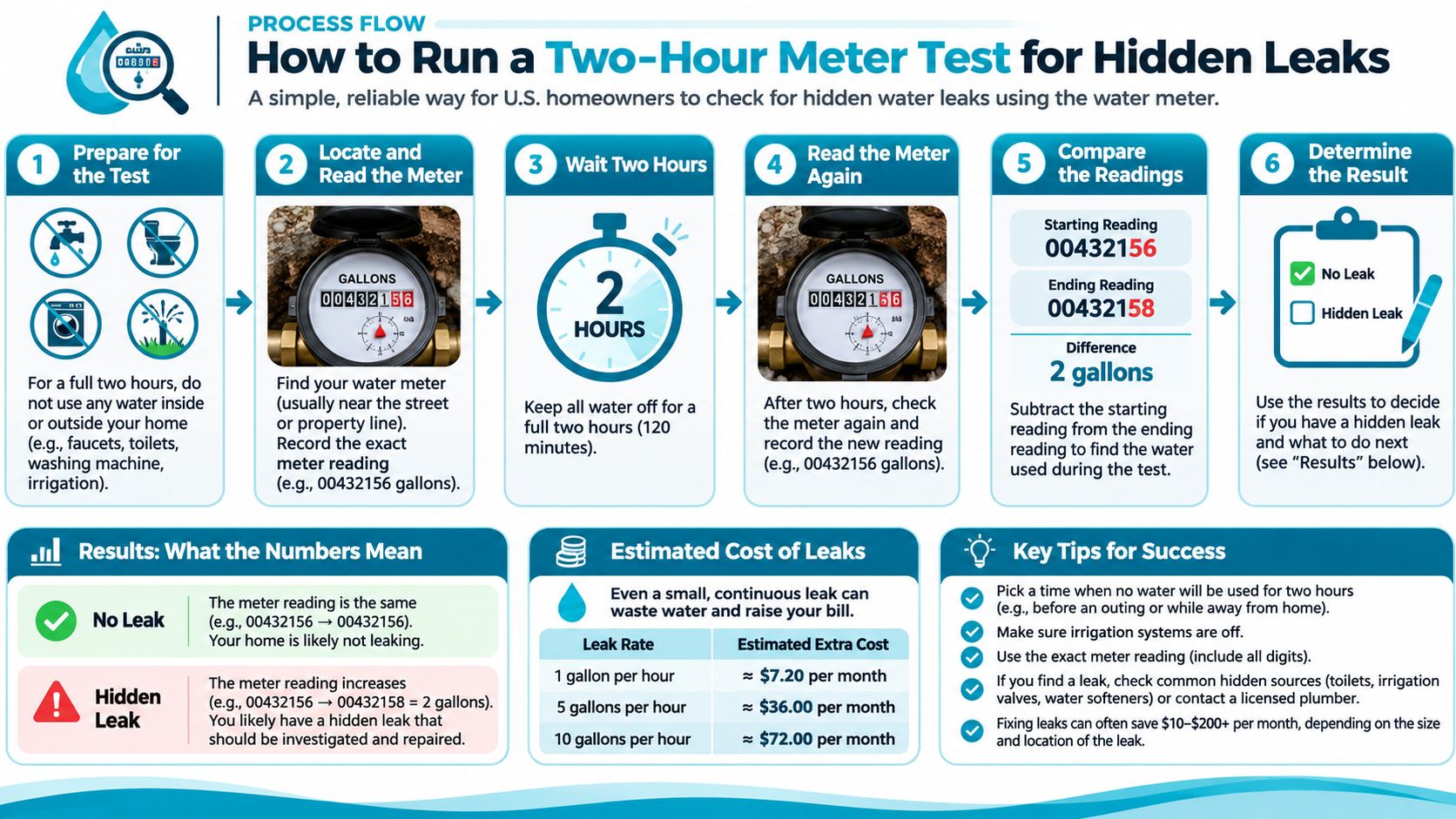
Follow these five steps in order:
- Shut off every water-using fixture and appliance. Turn off indoor faucets, showers, dishwashers, washing machines, automatic ice makers, and lawn irrigation zones. Tell everyone in the home not to flush a toilet or pour a glass of water. A single silent toilet refill or ice-maker cycle during the window will corrupt your reading and mimic an active pipe break.
- Find the water meter and record the exact baseline. On many Suncoast properties, the meter sits inside a concrete or plastic curb box near the street or sidewalk. Lift the lid carefully, wipe dust off the glass face, write down every digit on the register, note the position of the small triangular leak indicator, and log the start time.
- Wait two full hours with zero water use. Quick five-minute glances catch major bursts, not pinhole copper leaks or weeping shower valves. A full two-hour window gives low-rate losses enough time to accumulate into a readable change on the register.
- Read the meter again and compare. Return at the two-hour mark, write down the new digits, and check whether the leak indicator rotated even a fraction of a turn. Any movement proves water is moving past the meter while the house is idle.
- Log the change and document surrounding clues. Write down the volume difference, the start and end times, and whether the house was empty during the check. Take clear photos of cool floor tiles, damp baseboards, or faint ceiling rings while the evidence is fresh.
Common False Positives to Rule Out First
Meter movement doesn't automatically mean a slab pipe burst. Automated water users often run on background timers. Lawn irrigation controllers, water softener regeneration cycles, pool autofill valves, and refrigerator ice makers frequently trigger mid-test. On older multi-unit or duplex properties, a shared irrigation line or neighbor's branch supply can also nudge a meter dial.
If your first check shows tiny movement, shut off irrigation and appliance supply stops individually and repeat the two-hour window. If the dial still creeps forward with every appliance and irrigation valve isolated, you have confirmed active flow that deserves further locating work.
Remember the limit of this test: it confirms active flow, not the breach location. That distinction matters because a meter reading cannot tell you whether water is escaping at a toilet supply, a slab penetration, or an underground service line. Smart sensors and floor alarms only register water where the sensor sits, so they can miss a hidden line until damage reaches that spot. Meter notes give you the timing evidence needed before choosing moisture, acoustic, or tracer tools for the next step.
Keep your dated meter notes and photos handy, then move to targeted locating diagnostics or schedule free water leak detection with an experienced restoration team before hidden water spreads further.
Flow Monitors and What Unseen Leaks Cost
Say a homeowner leaves for a long weekend and a toilet fill valve sticks open at 3.0 gallons per minute. According to the EPA WaterSense leak loss breakdown, that single unseen fixture failure wastes roughly 4,300 gallons per day and can drive monthly water charges up to $1,400 per month without putting a drop of water on the bathroom floor.
That's why flow-monitoring leak detection equipment exists. Rather than waiting for standing water to reach a floor sensor, flow monitors track consumption patterns continuously, compare real-time usage against expected household baselines, and alert you when water keeps running past normal shutoff windows. The loss rates below show why monitoring systems must catch both slow drips and major ruptures.
| Leak type | Flow rate | Water lost | Cost impact |
|---|---|---|---|
| Worn toilet flapper | 0.02 gallons per minute | About 860 gallons per month | Set by local municipal water and sewer rate |
| Medium toilet leak | 0.2 gallons per minute | About 8,600 gallons per month | Set by local municipal water and sewer rate |
| Stuck toilet fill valve | 3.0 gallons per minute | About 4,300 gallons per day | Up to $1,400 per month |
| Broken distribution line | 15 gallons per minute | 21,600 gallons per day; 648,000 per month | Immediate shutoff threshold plus repair and drying costs |
| Leaking irrigation system | 1 gallon per minute | About 43,200 gallons per month | About $5,700 per year |
Even minor household fixtures add up fast. The same EPA WaterSense figures show a worn toilet flapper leaking at 0.02 gallons per minute wastes about 860 gallons per month, while a medium toilet leak at 0.2 gallons per minute loses roughly 8,600 gallons per month. At the severe end, a broken distribution line flowing at 15 gallons per minute dumps 21,600 gallons in one day, 151,200 gallons in one week, and 648,000 gallons in one month.
Toilets deserve special attention because the EPA leak and flow fact sheet reports that roughly 20% of toilets leak, and a leaking irrigation system at 1 gallon per minute can waste about $5,700 per year in water charges. The agency draws a clear line between in-line flow-monitoring devices installed on one high-risk end use (such as a toilet supply or irrigation zone) and whole-home monitors mounted on the main incoming line to guard overall property consumption.
Understanding how point-of-contact sensors differ from line-mounted flow monitors makes it much easier to avoid coverage blind spots.
Commercial Flow Monitoring and Unseen Facility Losses
For offices, schools, retail plazas, and hospitality properties across Tampa Bay and Sarasota, unseen water loss scales even faster. According to the EPA WaterSense commercial facility guide, leaks can account for more than 6% of a commercial building's total water consumption. Its commercial loss table shows a 1-gallon-per-minute drip-irrigation failure wastes 43,200 gallons per month (up to $5,700 per year), while a 5-gallon-per-minute cooling-tower float-valve malfunction wastes 216,000 gallons per month and costs roughly $29,000 per year.
Visual walkthroughs rarely catch a failed float valve on a roof or a weeping restroom valve inside a locked chase. Commercial property managers get far better protection from continuous submetering, off-hours flow alerts, and data logging tied directly into a building-management system.
A Simple Triage Rule for Abnormal Flow
When a flow monitor or meter check flags abnormal consumption, let the flow rate set your urgency:
- High-rate sustained flow (3 gallons per minute or higher, up to broken-line rates): Close the main water shutoff valve immediately, isolate the affected zone, and call for professional moisture mapping and extraction. Knowing how fast water damage spreads in walls makes clear why waiting until morning turns a localized plumbing repair into multi-room drywall and flooring removal.
- Low-rate continuous or intermittent flow (under 1 gallon per minute): Run a two-hour meter check, test toilet tanks with food coloring to catch silent flappers, and maintain a dated log of consumption spikes so a technician can isolate the exact branch line quickly.
What Leak Detection Equipment Misses in Florida Homes
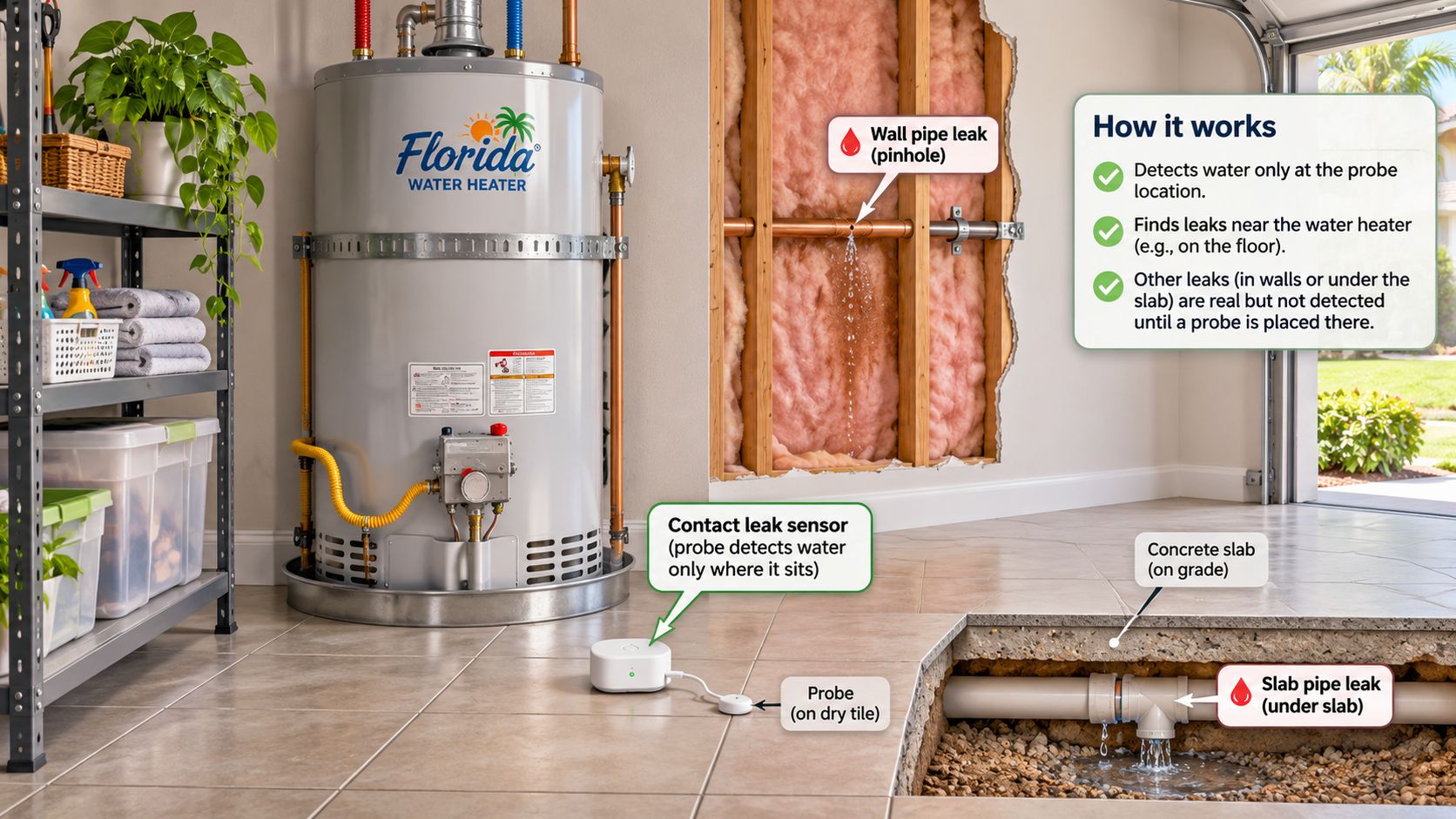
A sensor alarm can tell you that water reached a probe. It cannot tell you where the water entered the home, which pipe failed, or how far moisture has traveled inside a wall. That gap matters in Florida houses, where a supply-line leak, a roof intrusion, and an air-conditioning condensate issue can all leave damp material behind.
Scattering consumer water pucks across a house does not equal full-property protection. More sensors can help, but placement, thresholds, backup power, alerts, and shutoff design decide whether the system gives usable information. A probe under a sink may catch a braided supply failure. The same probe will miss a pinhole leak behind drywall until water has already damaged the cavity.
Multi-sensor setups work better when they combine different signals, such as flow, pressure, humidity, and listening data. Each device still answers a narrow question. Flow data shows that water is moving when it should not be. Pressure isolation helps separate one branch from another. Acoustic listening and tracer gas help identify a hidden breach. Humidity or contact sensors only confirm wetness where they sit.
Florida homes face several distinct water-entry paths, and each one requires a different confirming method.

Matching Each Florida Leak Scenario to the Confirming Tool
Buying gadgets at random creates false confidence. Match the risk inside the home to the tool that confirms the source:
- Slab leaks: Under-slab hot or cold supply lines require acoustic ground listening paired with pressure isolation or tracer-gas verification. Watching for early signs of a slab leak, such as warm floor tiles, low hot-water pressure, or continuous meter creep, tells you when to call for slab diagnostics before water undermines flooring adhesives.
- Pinhole plumbing leaks inside walls: Pressurized micro-sprays inside closed framing rarely trigger a floor puck until drywall fails. Infrared scanning locates the cool moisture plume, and a pin or pinless moisture meter measures saturation height across studs and drywall.
- Appliance failures: Point moisture sensors in water-heater pans, under kitchen sinks, and behind washing machines react fast to sudden discharge, especially when paired with an automatic shutoff valve.
- Roof or storm intrusion: Whole-home plumbing flow monitors stay silent during a roof leak because rainwater never crosses the water meter. Confirming storm entry takes thermal scanning along ceilings, moisture-meter mapping in attic framing, and an exterior roof check.
- Hidden moisture behind walls and cabinetry: Non-invasive moisture meters and infrared scans identify damp backing boards and wet insulation before paint bubbles or vanity toe-kicks swell.
- Vacant or seasonal properties: Coastal rentals and homes left empty for long stretches need a whole-home flow monitor tied to an automatic shutoff valve and battery-backed or cellular notifications. An audible local beep helps nobody when no one is inside.
Why Gulf Coast Humidity Trips Consumer Alarms
Coastal humidity can leave condensation on cold supply lines, toilet tanks, and uninsulated garage air handlers. A contact probe tucked under a cold tank may alarm even though every connection is intact. That is a moisture reading, not proof of a plumbing failure.
Summer squalls push wind-driven rain around window flashing, stucco cracks, and soffit vents. The result can be damp drywall or attic framing with no relationship to the pressurized plumbing system. Lawn irrigation schedules and normal HVAC condensate discharge can also trigger alerts when thresholds are set too tightly.
A device alert is never the same thing as locating the breach, confirming the water source, or assessing mold risk inside a closed wall cavity. I would treat an alarm as a prompt to narrow the question, then use the right diagnostic tool to answer it.
Three Questions to Ask Before Buying Any Device
Before spending money on consumer leak detection equipment, walk through three checks:
- Where will each sensor sit? Place contact probes at real low points, drip pans, and braided supply risers, not in the middle of a sloped laundry floor where water bypasses the contacts.
- Which water source does it confirm? Be honest about whether you're guarding against pressurized pipe ruptures, slow fixture wear, or wind-driven storm water.
- Who responds when you're away? A smartphone alert only limits damage if an automatic valve closes the main line or a local property manager or restoration crew can get inside quickly.
The practical goal is to stop buying equipment that cannot answer the question you have. If the question is whether water is escaping, use flow monitoring. If the question is where the breach sits, use acoustic, pressure, tracer, thermal, and moisture tools that confirm the path. If walls stay damp, a professional assessment should evaluate the extent of penetration and moisture levels before drying begins.
Frequently Asked Questions About Leak Detection Equipment
Can a meter test confirm a hidden leak?
Yes, but only as a yes-or-no verdict. A no-use meter check proves pressurized water is escaping somewhere past your main supply, yet it says nothing about which pipe or room is losing it. Run the two-hour meter test for hidden leaks first, then decide whether locating diagnostics are worth booking.
Do leak sensors catch slab leaks?
Not at the source. A floor puck sits above the concrete, so it only alarms after water has migrated up through the slab and pooled at the probe, which can be days after saturation begins below. Under-slab confirmation requires flow monitoring paired with acoustic listening or tracer gas, covered in locating the source with moisture, acoustic and tracer tools.
Are leak detection devices worth it for a rental or vacant home?
They are, provided the sensor is paired with an automatic shutoff valve and alerts reach someone who can physically respond. A notification sent to an empty inbox protects nothing, because a failed supply line in a vacant property runs unchecked until a neighbor or tenant reports visible damage. The dollar figures behind that trade-off appear in flow monitors and what unseen leaks cost.
Why did my sensor alarm when nothing seems wrong?
Because the sensor found water where it sits, not a leak in your plumbing. Alarm placement is everything: a probe resting near a cold supply line in humid air reads condensation exactly the same way it reads a burst fitting. Before assuming a hidden breach, check whether the spot where the probe sits collects drips from any non-plumbing source, then move or remount it.
Can leak detection equipment find mold?
No. Plumbing sensors and moisture meters track water movement and wet building materials, and even a saturated reading only shows mold-friendly conditions rather than growth itself. Confirming mold requires a dedicated mold inspection, which uses advanced detection methods to find both hidden and visible colonies, including growth behind surfaces a moisture reading can only hint at.
Does insurance cover professional leak detection?
It depends on the cause of loss. A burst washing machine hose that floods a laundry room overnight is the kind of sudden, accidental failure carriers typically cover, while a supply line that seeped behind a cabinet for months is usually classified as gradual damage from neglected maintenance and denied. Document meter readings and photos the day you suspect a problem, because that timeline evidence often decides which category your claim lands in. The free inspection process explains what to have ready before professionals arrive.
Book a Free Leak Inspection Before Damage Spreads
If your water meter crept forward during a two-hour no-use window, a moisture probe alarmed, or you've spotted staining, swollen baseboards, or cool damp tile, stop guessing. AMPM Restoration offers a free inspection and estimate, and the team is available 24/7 across Florida's Suncoast.
Having three quick details ready before you call speeds up triage from the very first minute:
- Meter readings and timestamps: Note the start and end numbers from your no-use check so technicians can gauge approximate flow rate immediately.
- Photos of visible clues: Capture ceiling rings, damp cabinet floors, or buckled laminate before mopping or running household fans.
- Main shutoff location: Knowing where your main valve sits lets you kill pressurized flow fast if a line worsens before the crew arrives.
That third point matters more than the other two combined. A sensor alarm tells you water reached the sensor. It says nothing about which pipe, fitting, or fixture is feeding it, and every minute of pressurized flow widens the saturated area. Consumer devices earn their place as early warnings, but confirming the actual source takes professional diagnostics.
Our crew serves homeowners and commercial properties across Bradenton, Sarasota, Palmetto, St. Petersburg, and the greater Tampa Bay area. During water damage assessments, we use professional leak detection equipment and advanced diagnostic tools to accurately gauge moisture levels, identify the water source, and map every saturated wall or floor cavity before extraction with high-powered pumps and industrial drying begin. Moisture levels are monitored through the drying phase so every part of the structure reaches acceptable dryness standards, and structural inspections catch secondary damage like weakened supports, compromised drywall, and damaged insulation. If interior diagnostics rule out pressurized plumbing and point to storm-driven water entering through the roof assembly, scheduling a certified roof inspection ensures the exterior breach is sealed before interior reconstruction starts.
Whether you're searching for a responsive water leak detection company near me or need water damage restoration, mold removal and remediation, fire damage restoration, storm and flood damage restoration, commercial restoration, or full reconstruction, AMPM Restoration handles every stage for homes, offices, schools, and government facilities. The team coordinates directly with your insurance carrier to simplify claims documentation, and financing options are available so drying and repairs don't get delayed. Contact AMPM Restoration today to schedule your free inspection and protect your property before hidden moisture spreads.
