

The fans are still running, your baseboards are off, and the insurer's letter says there's no payment coming. If you've searched for “water damage claim denied” from a damp kitchen in Bradenton or a rental property in Sarasota, the immediate question is practical: who pays for the work that can't wait?
Start with what the insurer decided. A zero check can mean excluded damage, an estimate below your deductible, missing documentation, or a payment limit. Those are different problems, and each needs a different response. Insurers aren't always wrong, but you shouldn't accept a conclusion you can't reconcile with the policy and the physical evidence.
Read the Denial Label Before You Argue It
Set the denial letter beside your declarations page and the adjuster's estimate. Identify whether the insurer denied coverage, accepted damage but calculated no payment, or closed the file before completing its review. The label matters: a zero check can reflect a repair estimate below the deductible, a sublimit, or a flood classification, and each points to different records.
Florida's hurricane claim data illustrates how different those outcomes can be. During Milton, insurers received 343,789 claims across property, auto, private flood, and business-interruption lines and had closed 121,985 without payment by February 28, according to Insurance Business's account of Florida insurance data. In the same account, 41% of Milton claims closed without payment involved damage below deductibles, 4% involved flood damage, and nearly 23% involved other coverage reasons. For Helene's 46,656 claims closed without payment, the corresponding below-deductible and flood-exclusion shares were 33.2% and 20.3%. These storm-wide figures do not describe the outcome of household plumbing claims.
Match the label to the missing document
| Denial label | What it usually means | First document to request |
|---|---|---|
| Damage below deductible | The insurer's repair estimate does not exceed the applicable deductible | Adjuster's line-item estimate and deductible calculation |
| Flood exclusion | The insurer classified the water as flood or excluded outside water | Water-source evidence and the policy's flood exclusion wording |
| Sewer or drain backup | The policy lacks an applicable backup endorsement | Declarations page and endorsement list |
| Gradual damage or seepage | The insurer attributes the loss to long-term leakage or deterioration | Plumber or leak-detection report and moisture map |
| Sublimit or water cap | A special limit restricts payment below the repair cost | Declarations page and endorsement showing the cap |
| Administrative or communication closure | The file closed because paperwork or a response was missing | Claim correspondence log and closure notice |
A partial payment also needs review. The insurer may accept damaged drywall while rejecting flooring, plumbing access, or another part of the repair scope.
Practical rule: Before arguing that the insurer owes more, identify whether the dispute concerns cause, repair scope, deductible, policy limit, or missing information.
Put your request in writing. Ask the insurer to identify the exact policy provision supporting its decision and the inspection findings used to apply it. A general statement that water damage is not covered does not show which part of the claim was rejected or why.
Sorting Sudden Leaks, Slow Seepage and Flood Losses
Where did the water originate, and how did it travel? A wet floor doesn't answer either question. The same swollen cabinet can follow a broken supply line, repeated leakage behind a dishwasher, or rising stormwater entering through a doorway.
The Florida Department of Financial Services homeowners insurance toolkit explains that most homeowners policies exclude flood damage, while accidental discharge or overflow of water or steam may be included. The policy language and actual water pathway matter more than how dramatic the damage looks.

| Loss mechanism | Evidence that supports it | Coverage question |
|---|---|---|
| Sudden accidental discharge | Burst supply line, failed fitting, shutoff and discovery times | Was the event sudden and accidental? |
| Gradual seepage or repeated leakage | Maintenance history, repeated staining, moisture history | Did the damage develop over time? |
| Rising, surface or storm water | Water-entry evidence, storm timing, flood policy and effective date | Does the flood exclusion apply, and was flood coverage in force? |
Separate the event from its appearance
For a sudden leak, preserve the failed connection and establish when someone discovered and stopped the flow. For alleged gradual seepage, gather maintenance records and earlier photographs rather than trying to date the damage from staining alone. Moisture distribution can support an investigation, but a meter reading by itself doesn't establish when leakage began.
Along Sarasota Bay and the Tampa Bay coast, separate wind-driven rain entering through a damaged roof from rising water entering at ground level. Don't label every storm-related intrusion as flood, and don't assume every indoor puddle came from plumbing. Our explanation of water damage versus flood damage helps organize those distinctions.
Flood coverage also depends on timing. The Florida flood disaster FAQs describe a general 30-day waiting period, no waiting period for qualifying loan-related purchases, and a possible one-day waiting period for purchases during the 13-month period following a qualifying flood-map revision.
Buying coverage after water starts rising generally won't protect that existing loss. Check the effective date rather than relying on the purchase receipt.
Build a Claim File That Proves the Cause
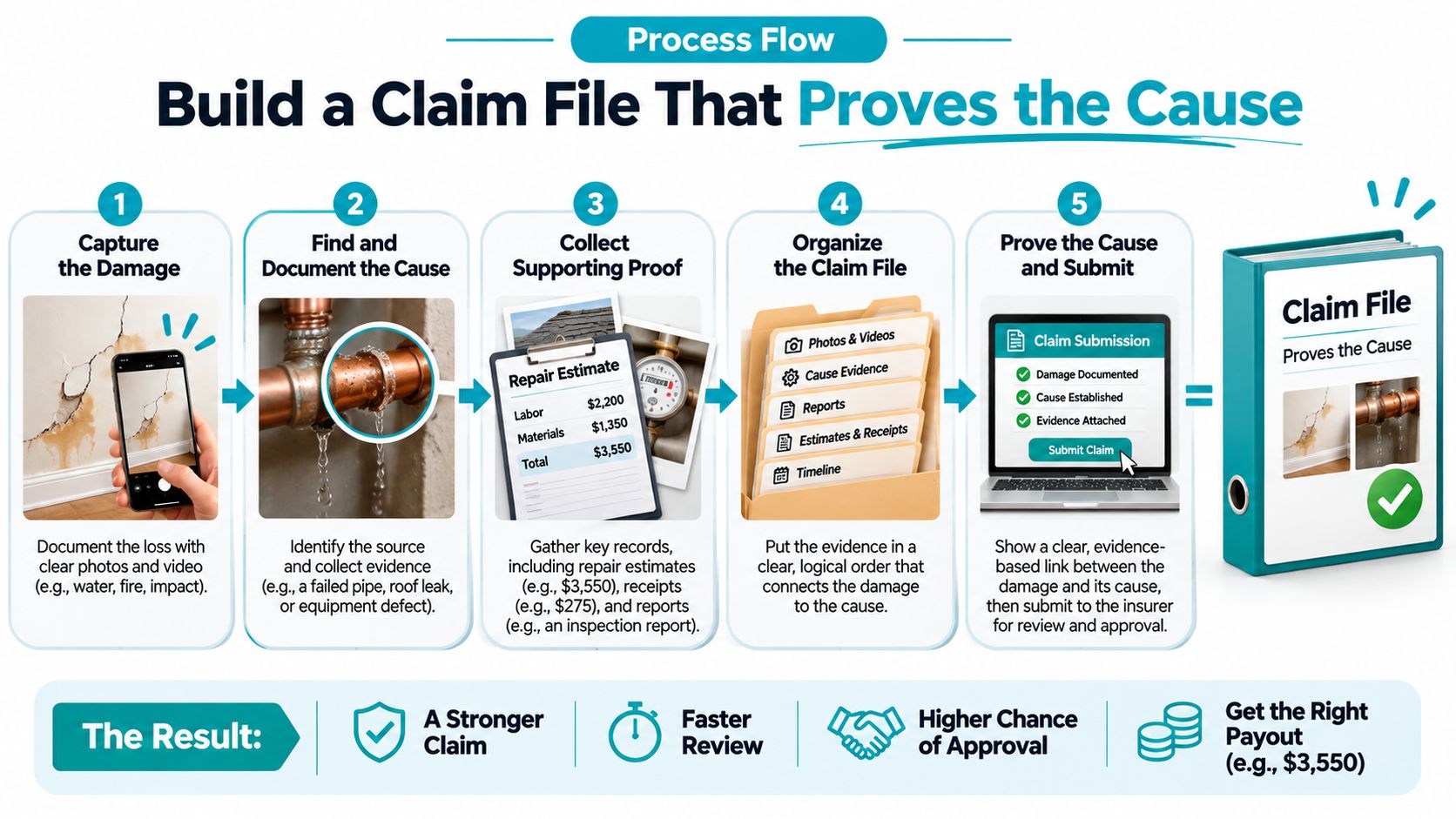
Build the file around what failed, where the water went, and what work was necessary. Photographs of damaged rooms establish consequences, but they don't necessarily establish the initiating event.
The Florida Department of Financial Services property-claim guide recommends photographs before and after emergency repairs, retained receipts, detailed damaged-property lists, and independent estimates after an unfavorable determination. Organize those materials so an adjuster can connect each cost to a location and task.
Preserve evidence while stopping further damage
Photograph the failed component in place. Capture the connection, surrounding materials, and water pathway before removal. Keep the component if it's safe, label its location, and ask the plumber not to discard it.
Write down discovery and shutoff times. Include who was present, what they observed, and what action they took. Distinguish facts you know from estimates about when the leak began.
Obtain a source-specific plumbing report. Ask the plumber or leak-detection technician to identify the component, observed failure, and testing performed. A repair invoice saying only “fixed leak” leaves important questions unanswered.
Map moisture before demolition. Record affected rooms, materials, reading locations, and meter settings, then repeat readings during drying. Our guide to moisture mapping explains how location-based records help define the affected area.
Retain receipts and the drying log. Keep equipment placement, operating dates, daily temperature and relative-humidity readings, moisture measurements, and completion readings together. These records explain why extraction and drying continued after the visible water disappeared.
List damaged belongings with identifying details. Include product descriptions, model information, photographs, and available purchase records. Separate building materials from movable contents so the estimates don't overlap.
Get an independent, itemized estimate after an unfavorable decision. Ask for quantities, affected locations, removal methods, and repair tasks. A higher total without supporting measurements gives the insurer little to reassess.
At AMPM Restoration Services, our assessment uses advanced diagnostic equipment to evaluate water penetration and identify the most affected areas. During drying, we monitor moisture levels against acceptable dryness standards throughout the affected home.
Know what the records can prove
A drying log supports the reasonableness of mitigation. It doesn't, by itself, prove that the original cause was covered. Pair it with the source report, timeline, and policy language.
Don't postpone necessary emergency work just to preserve an untouched room. Document conditions thoroughly, preserve useful components safely, and distinguish urgent mitigation from permanent reconstruction.
Teardown without documentation can destroy the failed fitting or obscure the water path. Your completed file should contain labeled photos, a timeline, source findings, moisture readings, invoices, estimates, correspondence, and the denial letter, with copies stored somewhere other than the damaged property.
Policy Limits That Cut Your Payment Even When Covered
Say the insurer accepts a leaking supply line as the cause but issues a much smaller payment than your contractor's estimate. Reconcile reasonable emergency mitigation, covered permanent repairs, and the net amount payable before treating the difference as a complete coverage denial.
These amounts aren't interchangeable. A contractor estimates necessary work; the insurer applies its coverage position, accepted scope, deductible, and applicable limits. Ask for that calculation in writing, including whether mitigation expenses share a limit with reconstruction.
A Sun Sentinel examination of Florida policy restrictions reported that seven of twelve insurers studied capped some burst-pipe and internal-water payments at $10,000. That finding doesn't establish your policy's limit, but it shows why the dwelling limit alone may not tell you what's available for a water loss.
Read the terms behind the calculation
| Policy term | Where to find it | Effect on the payment |
|---|---|---|
| Deductible | Declarations page and deductible provisions | Reduces the covered amount; an accepted estimate below it produces no payment |
| Water or special water limit | Declarations page or endorsement | Caps payment for specified water losses |
| Mold sublimit | Declarations page and mold endorsement | Can separately restrict testing and remediation |
| Actual cash value versus replacement cost | Declarations page and loss-settlement provisions | Determines depreciation treatment and conditions for recovering withheld depreciation |
| Ordinance or law coverage | Endorsement or additional-coverage provisions | May pay qualifying code-upgrade costs beyond ordinary repairs |
| Sewer, drain or sump-pump backup | Endorsement | Adds protection otherwise commonly excluded, subject to its terms |
The Florida natural disaster guide states that most homeowners policies exclude sewer, drain, and sump-pump backup damage unless coverage is added by endorsement. Ask your agent to confirm the endorsement, applicable limit, and deductible in writing.
Our water damage insurance coverage guide can help you organize the documents before discussing the calculation with the carrier.
Challenge the right part of the payment
Use targeted questions rather than a general demand for the full contractor total:
- Deductible application: Which deductible applies, and where is the calculation?
- Special limits: Which endorsement creates the water cap, and which expenses count toward it?
- Depreciation: What was withheld on materials or labor, and what conditions govern recovery?
- Missing scope: Which measured tasks were omitted or rejected, and why?
- Code work: What documentation is needed for required upgrades?
Landlords and commercial owners should also identify whether damaged items belong under building or contents coverage. Liability coverage addresses a different exposure and shouldn't be assumed to replace first-party property protection.
Answer the Insurer in Writing Within Florida's Timelines
Calendar the insurer's response dates today, but don't confuse them with your own notice, supplemental-claim, or lawsuit deadlines. A reconsideration email shouldn't be treated as an automatic extension of any legal deadline.
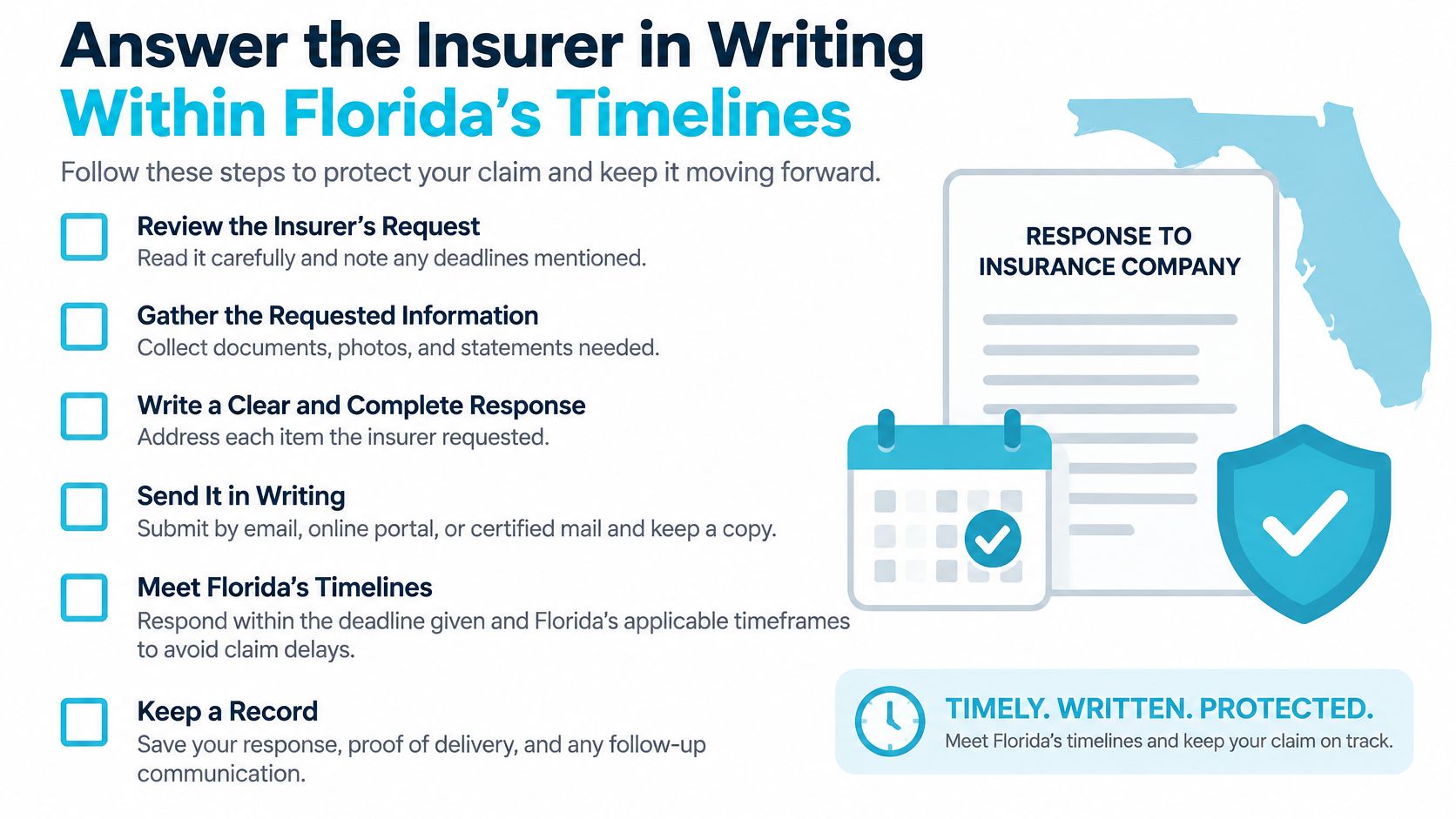
Florida's homeowners insurance consumer guidance says insurers generally must acknowledge a property claim within seven days and pay, partially pay, or deny it within sixty days, subject to applicable requirements and exceptions. Record when the carrier received your claim and preserve delivery confirmation.
Send a focused reconsideration request
Identify the decision you dispute. Include your claim number, property address, loss date, and the reason stated in the denial letter. Quote the letter accurately rather than paraphrasing it into a broader denial.
Request the supporting calculation and policy language. Ask for the line-item estimate and the specific provisions relied on. State whether you're challenging the cause finding, omitted repairs, deductible application, or special limit.
Attach evidence that addresses that issue. Use clearly named files and a short attachment index. Explain what each source report, photograph, or estimate adds instead of sending an unexplained bundle.
Request a defined next action. Ask for reconsideration, a reinspection, or review of a supplemental estimate. Send the request by a trackable method and retain the complete message with its attachments.
A closed file isn't necessarily beyond review. The Florida Office of Insurance Regulation's January 2024 report recorded 84,840 closed accidental discharge, overflow of water, or steam claims in calendar-year 2022, with 37,123 reopened, or 43.7%; it also describes the change from the former ninety-day decision period to sixty days under reforms enacted December 16, 2022.
Reopening doesn't guarantee payment. It does make a targeted request for additional review more useful than assuming closure ends the conversation.
Keep the written record complete
Your response should include:
- Claim identification: Claim number and insured property.
- Disputed finding: The denial reason and policy provision.
- Evidence index: A concise explanation of the attachments.
- Requested action: Reinspection, reconsideration, or supplemental review.
- Reply date: A requested response date, distinguished from a statutory deadline.
Keep a separate call log with names, dates, and promised actions. Our guidance on filing a water damage insurance claim helps organize the submission.
We work closely with insurance providers and supply restoration documentation. AMPM Restoration Services works with all insurance companies and handles restoration insurance claims, but the carrier determines coverage, and legal disputes require qualified legal advice.
Six Questions Homeowners Ask After a Denial
Can I appeal a denied water damage claim?
You can ask the carrier for written reconsideration and support the request with new or clarified evidence. Check the policy for required dispute steps, including whether appraisal applies. Appraisal can address the value of a loss without resolving every coverage dispute. Use these water damage insurance claim tips to organize a focused submission.
Should I hire a public adjuster or an attorney?
Consider professional help when the disputed amount is substantial, the cause is contested, or an endorsement is difficult to interpret. Before signing, compare fees, cancellation terms, and the work each professional proposes to do. A restoration contractor can document physical conditions and repair needs, but cannot replace legal advice.
Will flood insurance cover this damage?
A flood policy covers a loss only when it was in effect and the event meets that policy's terms. Send the flood carrier photographs showing where water entered, a storm timeline, and an inventory of damaged items. A homeowners policy denial does not establish that a separate flood policy covers the loss. Each carrier applies its own definitions and exclusions.
Is mold covered after a water loss?
Mold coverage can be limited by a separate policy cap and conditions tying the mold to a covered event. Review the declarations and endorsements, then request a written explanation of which inspection, testing, removal, and repair expenses are accepted. Mold's presence alone does not establish when the leak began or whether the policy covers the resulting work.
How long do I have to challenge the denial?
Ask a Florida insurance attorney to identify the deadlines that apply to your claim. Reporting, supplemental-claim, and lawsuit deadlines are not interchangeable, and reconsideration does not necessarily pause them. LegesGPT's AI for legal questions can help you organize questions for counsel, but use legal advice to confirm your filing deadline. See the timelines section for the distinction between claim-handling periods and other deadlines.
Do I still have to prevent further damage?
Yes. Take reasonable, safe steps to limit additional damage and follow your policy's mitigation duties. Keep emergency work separate from disputed permanent repairs, and save records explaining why the work was needed. The carrier still reviews mitigation expenses for coverage, so approval of emergency work does not guarantee payment of every invoice.
Confirm Your Next Step Before the Deadline
If the denial leaves the cause unresolved, the payment calculation unclear, or key evidence missing, act promptly. Ask the insurer for a written status explanation if it has not responded within the applicable decision period, and seek advice about available remedies. If water is still entering the property, address the ongoing damage while the claim is under review.
Bring the letter and ask direct questions
Have your denial letter, declarations page, source report, and current estimate ready. Ask the carrier:
- Documentation: What physical evidence and restoration records are still needed?
- Scope and payment: Which repairs are disputed, and how do the deductible or any endorsement affect the payment?
- Next deadline: What written action is due next, and who will confirm the legal deadline?
A zero payment can reflect different issues: the covered repair cost may fall below the deductible, a sublimit may cap payment, or the insurer may classify the loss as flooding. Each requires a different review of the policy language, damage records, and payment calculation.
AMPM Restoration Services is available 24/7 for water damage emergencies across Sarasota County and Manatee County. Its specialists assess the damage, develop a property-specific restoration plan, and work with the insurance provider by supplying necessary documentation. The company also offers a free inspection and estimate.
When you have a water damage claim denied, compare the denial reason with the documented cause, repair scope, and payment calculation. Then ask the insurer in writing to identify any remaining evidence it needs and confirm your next required action.
For a free inspection and estimate, contact AMPM Restoration Services. The company provides water damage restoration, mold removal and remediation, fire damage restoration, storm and flood restoration, commercial restoration, and leak detection.
