

Free Water Leak Detection In Tampa Bay
A high water bill, a damp baseboard, or a musty smell that won’t leave even with the AC running usually means the same thing. Water is getting out somewhere it shouldn’t. For homeowners on Florida’s Gulf Coast, Free Water Leak Detection is often the first thing they search for because they want answers fast, without turning a small concern into a major expense.
That instinct is reasonable. Some leak checks really are free and useful. But in Bradenton, Sarasota, Tampa Bay, Saint Petersburg, Lakewood Ranch, and nearby coastal communities, hidden leaks often sit under slabs, behind walls, or along service lines where a simple DIY check won’t reach. If you’re also sorting out coverage questions after stormwater intrusion or rising water, it helps to review understanding flood damage policies before you assume your homeowners policy handles everything.
Leaks also move faster than anticipated. If you’ve noticed discoloration, swelling drywall, or a soft floor, this guide on how fast water damage spreads in walls is worth reading early. It explains why waiting for “one more day” often becomes the expensive decision.
The Hidden Costs of Unseen Water Leaks in Florida Homes
Florida homes rarely announce a hidden leak with a dramatic burst pipe. More often, the warning signs are subtle. A hallway smells stale. Paint bubbles near a baseboard. Tile feels oddly warm in one spot. The water bill climbs, but every faucet looks fine.
That’s why free water leak detection matters. It gives homeowners a starting point before damage spreads into drywall, cabinetry, flooring, and indoor air quality. The problem is that “free” means very different things depending on where the leak is.
What homeowners usually catch first
Often, one notices one of these before ever seeing active dripping:
- A bill that doesn’t match normal use
- A persistent musty odor
- Peeling paint or swollen trim
- Mildew that returns after cleaning
- One room that feels more humid than the rest
In Florida, humidity muddies the picture. People often blame the weather, the AC, or an older home. Sometimes they’re right. Sometimes a hidden leak is feeding that damp environment every hour of the day.
Practical rule: If the smell keeps coming back after cleaning and drying, stop treating it like a housekeeping issue and start treating it like a leak problem.
Why hidden leaks get expensive fast
The leak itself is only part of the cost. Water moves into porous materials, feeds microbial growth, stains finishes, and can weaken subfloors or wall assemblies long before a homeowner sees visible pooling.
Free checks are helpful when the problem is obvious, like a toilet flapper, faucet drip, or appliance connection. They’re less reliable when the water is traveling under a slab, through a wall cavity, or along an underground line. That’s where people lose time, and time is what drives restoration costs up.
Telltale Signs You Have a Hidden Water Leak
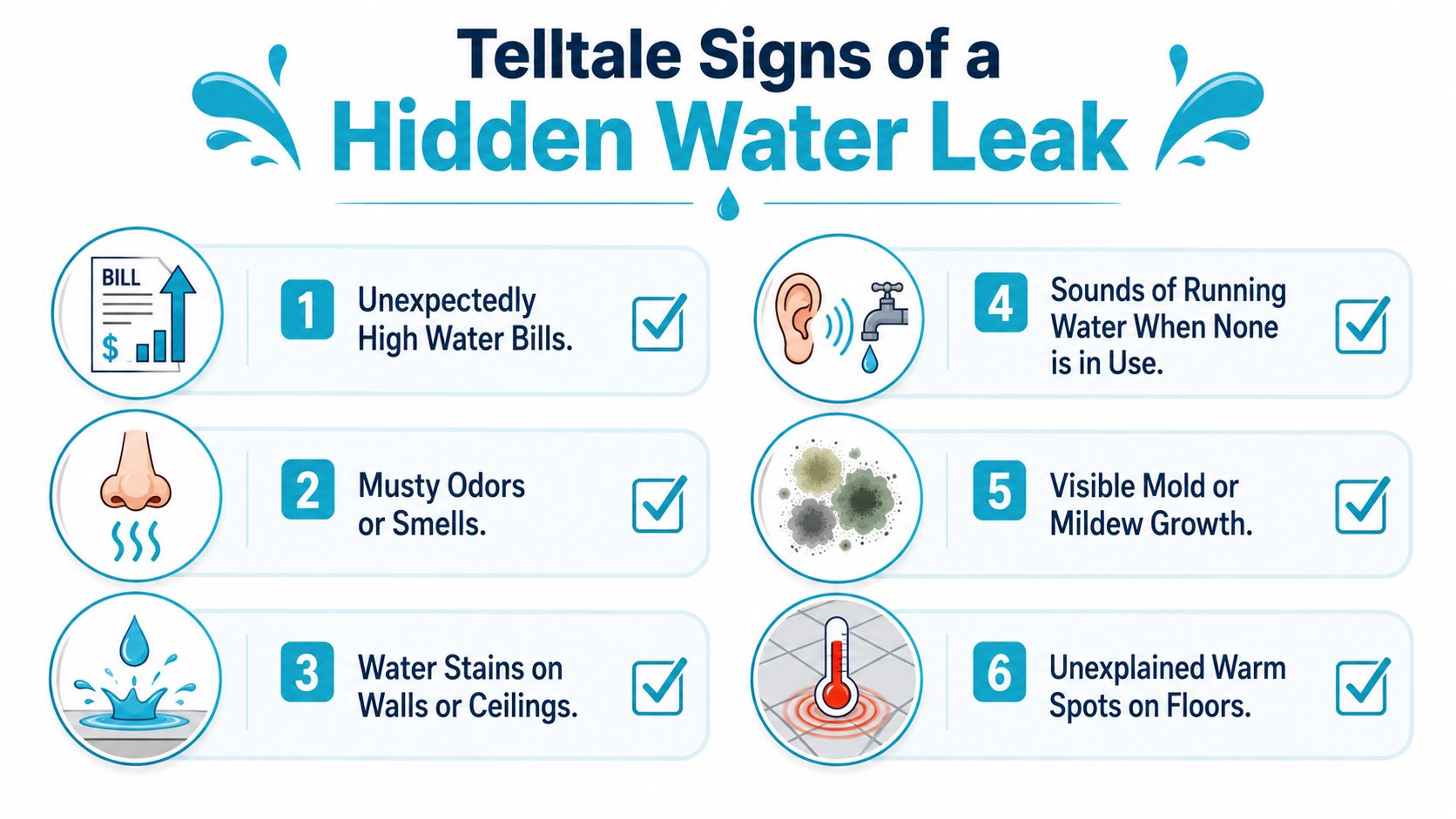
If you’re trying to decide whether you have a real problem or just a one-off oddity, use a checklist approach. Hidden leaks usually leave more than one clue.
Visual clues inside and outside
Some signs are easy to dismiss until you see them together.
- Water stains on ceilings or walls often show up as yellowing, rings, or blotchy discoloration.
- Peeling paint or bubbling texture can mean moisture is trapped behind the finished surface.
- Warped flooring or lifting laminate edges points to water moving below the surface.
- Visible mold or mildew growth around baseboards, under sinks, or near HVAC areas suggests ongoing moisture.
- Soggy patches in the yard can indicate an exterior line or irrigation leak.
Warm spots on the floor matter too, especially in homes with plumbing below the slab. They don’t prove a leak by themselves, but they should never be ignored.
Sounds and smells that matter
A hidden leak doesn’t have to be loud. Sometimes it’s a faint hiss, a running-water sound when all fixtures are off, or a drip you can’t quite locate.
Musty odors are just as important. In Florida homes, that smell often gets blamed on humidity alone. But when the odor stays concentrated in one room, closet, wall, or cabinet area, moisture intrusion becomes much more likely.
If you hear water when nobody is using water, trust that clue.
A local billing resource many homeowners miss
If you’re in Pinellas County and trying to confirm whether an unexplained usage spike points to a leak, the county offers an official Leak Detector Guide and Statement of Repaired Leak form. That resource also notes that notarized documentation of a repaired leak may help qualify for billing adjustments, and customer service is available at (727) 464-4000 to support leak diagnosis.
You can also compare what you’re seeing at home with these 5 signs of water damage in your home. Small cosmetic changes often point to a much bigger moisture problem behind the surface.
Quick DIY Water Leak Detection Checks You Can Do Today
Free water leak detection starts with the checks that cost nothing but a few minutes. These aren’t gimmicks. They’re solid first steps, especially when you need to decide whether the issue is obvious plumbing or something more hidden.

Try the water meter test
This is one of the simplest ways to catch a silent leak.
- Turn off all water use inside and outside the home. That includes ice makers, irrigation, hose bibs, dishwashers, and washing machines.
- Find your water meter and note the reading.
- Wait without using water for a period long enough to rule out normal fixture use.
- Check the meter again. If the reading changed, water is moving somewhere.
This test doesn’t tell you where the leak is. It only tells you that one may exist. That’s still valuable because it separates suspicion from evidence.
Test toilets with food coloring
Toilets are one of the best places to begin because they can develop subtle leaks.
- Remove the tank lid carefully.
- Add food coloring to the tank water.
- Wait without flushing.
- Look in the bowl. If color appears there, the toilet is leaking from the tank into the bowl.
This check is free, quick, and worth repeating if you have more than one bathroom.
Keep the result in context
DIY checks are good screening tools. They’re not full diagnostics. A meter change confirms movement, not source. A toilet test only addresses one fixture. A dry wall surface doesn’t rule out moisture deeper inside the assembly.
If you’re unsure whether what you found already qualifies as property damage, this page on water damage inspection and what counts as water damage helps sort out what deserves immediate attention.
DIY vs Professional Leak Detection for Florida Homes
The hard part isn’t deciding whether free water leak detection is useful. It is. The harder question is knowing when free checks stop being enough.
In Florida, that line comes sooner than many homeowners expect. Coastal moisture, slab construction, irrigation zones, and corrosion exposure make hidden leaks harder to find and riskier to ignore.

Where DIY works well
DIY methods are strongest when the leak is simple and exposed.
| Situation | DIY check | Good enough |
|---|---|---|
| Running toilet | Food coloring in tank | Often yes |
| Dripping faucet | Visual inspection | Usually yes |
| Under-sink connection | Hand check and flashlight | Often yes |
| Appliance hose issue | Visual inspection and isolation | Sometimes |
For visible plumbing, these checks can save time and help you act quickly.
Where DIY often fails in Florida homes
The gap shows up with concealed leaks. According to American Water’s leak detection guidance, free content often promotes the $0 dye-tablet toilet test but omits that 60–70% of underground leaks in coastal Florida are undetectable by DIY methods. The same source states that professional acoustic leak detection costs $250–$400, reduces repair time by 40%, and helps prevent secondary mold damage that can add $5,000–$15,000 to total costs.
That trade-off matters in Bradenton, Sarasota, and other Gulf Coast communities where leaks can hide under concrete slabs, in irrigation lines, or along buried service connections.
DIY checks are screening tools. They are not a reliable way to clear a slab leak, underground service line leak, or concealed wall leak.
A practical decision standard
Use this quick comparison:
- Stay with DIY when you’ve found an obvious fixture leak and the surrounding materials are still dry.
- Move to professional diagnostics when the meter changes but you can’t find the source.
- Skip the wait if you smell mustiness, see recurring staining, or suspect slab or underground leakage.
- Act faster in coastal homes because corrosion and persistent humidity raise the stakes.
If you’re tempted to keep opening walls or guessing at the source, read why you shouldn’t DIY water damage restoration before turning a leak search into demolition.
Advanced Leak Detection Technologies We Use
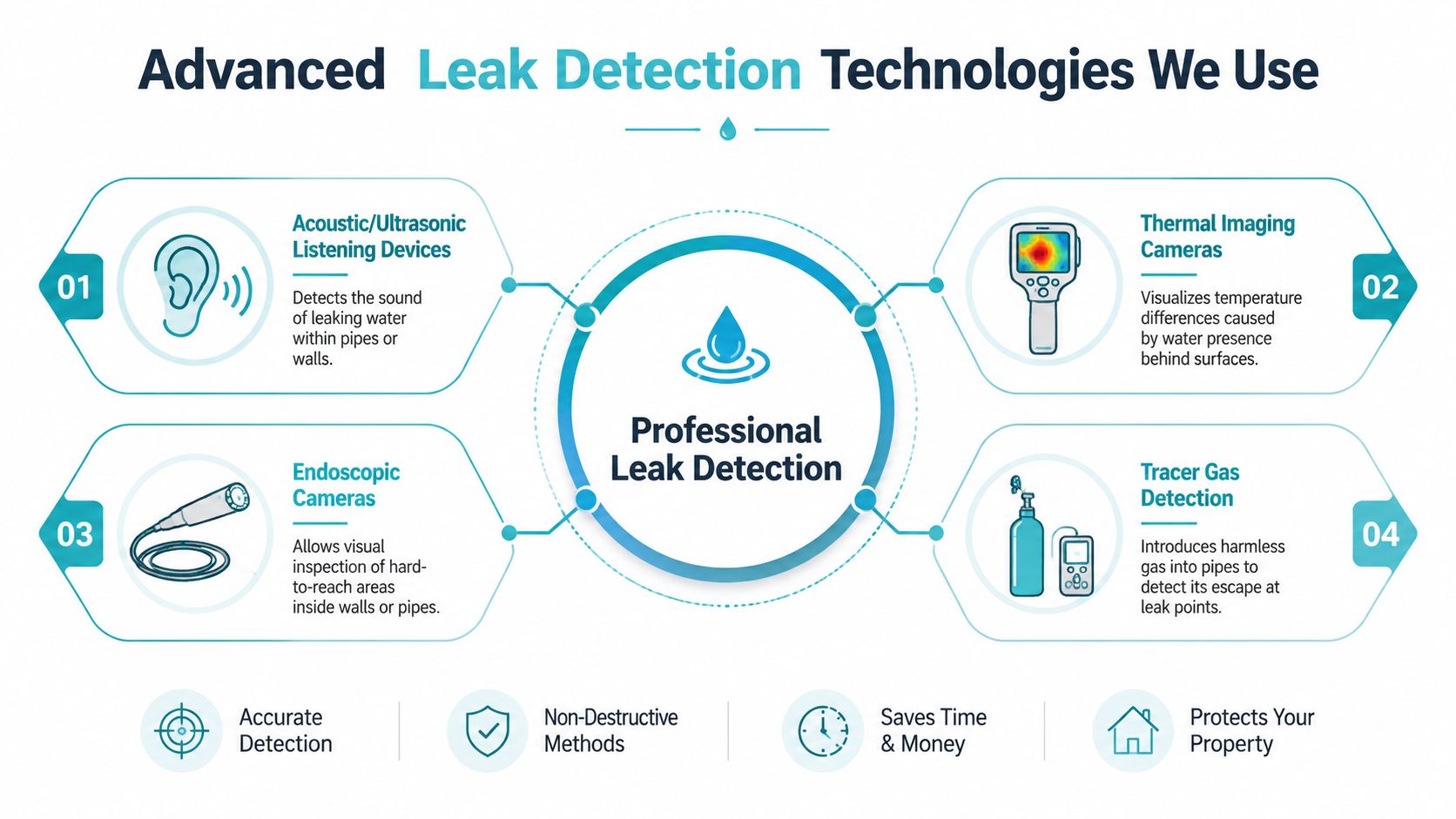
Professional leak detection isn’t guesswork with a flashlight. The goal is to narrow the search area before opening anything, and in many cases avoid destructive exploration altogether.
Acoustic listening devices
Pressurized leaks create vibration and sound as water escapes through a pipe defect. According to an OSTI technical reference on acoustic leak detection, acoustic methods rely on those high-frequency vibrations, and sensors can identify leaks as small as 0.026 gallons per minute in underground systems when background noise is low.
For homeowners, the practical takeaway is simple. Technicians can often “listen” for a leak through surfaces you can’t see through.
Thermal imaging cameras
Thermal imaging works like a visual map of temperature differences across surfaces. It doesn’t see through walls like a movie prop. What it does do is reveal suspicious hot or cool patterns that may point to moisture movement, missing insulation, or active plumbing issues.
That makes it especially useful around ceilings, wall cavities, showers, and slab-adjacent areas where moisture may be spreading behind finishes.
Thermal imaging is best used as a direction finder. It helps narrow the target before any opening or repair work begins.
Endoscopic cameras and tracer methods
When a technician needs eyes inside a tight cavity, an endoscopic camera can inspect areas behind walls or inside access points with minimal disruption.
Tracer-based methods are also useful for stubborn leak paths, especially when other indicators conflict. For homeowners trying to understand the broader challenge of buried line problems, this guide on finding underground water leaks offers a practical outside perspective on why underground diagnosis is rarely straightforward.
Why non-destructive tools matter
Every unnecessary hole creates more repair work. Good diagnostics reduce that. They help separate the actual leak location from the area where water traveled and showed itself.
That distinction is important in restoration. The visible stain is often not the source.
Your Free Inspection with AMPM Restoration What to Expect
When you call for free water leak detection help, most homeowners want three things. A fast response, a clear answer, and a plan that doesn’t make the situation more chaotic.
AMPM Restoration is a 24/7 emergency restoration company based at 4301 32nd St W b18, Bradenton, FL 34205, serving Bradenton, Sarasota, Tampa Bay, Saint Petersburg, Lakewood Ranch, and surrounding Gulf Coast communities. The company handles water damage restoration, mold inspection and mold removal, fire and smoke damage restoration, storm and flood damage restoration, commercial restoration services, and full reconstruction solutions.
What the visit usually looks like
The process starts with a call and a fast dispatch. The technician arrives, listens to what you’ve noticed, and checks the most likely source areas first. That usually includes visible plumbing, moisture patterns, affected materials, and the spaces where hidden water tends to travel.
If the leak appears concealed, the inspection shifts to non-invasive diagnostics. That’s the point of bringing tools instead of assumptions.
Why that matters before repairs begin
A targeted inspection protects your property from unnecessary tear-out. It also helps create cleaner documentation if the leak has already caused secondary damage.
According to American Leak Detection’s Fort Lauderdale page, non-invasive leak detection methods have demonstrated a 95% success rate in identifying underground pipe leaks without requiring excavation, which significantly reduces property damage and repair costs.
That’s the standard homeowners should expect from a serious inspection process.
What happens after the leak is confirmed
Once the source and affected areas are identified, you should get a straightforward explanation of what’s damaged, what needs to dry, and what needs repair or replacement. If insurance may be involved, documentation starts early. If mitigation is needed, the next steps should be clear before any major work begins.
For homeowners in Pinellas County looking for local service context, the company’s page for a free water damage inspection in Saint Petersburg shows how that response is structured nearby.
Frequently Asked Questions About Water Leaks
Is free water leak detection really free?
Basic leak inspections and estimates can be free, but that doesn’t mean every repair or specialty test is included. Ask what the inspection covers, whether advanced diagnostics are part of it, and what happens if hidden damage is found.
Will homeowners insurance cover water leak damage?
It depends on the cause of loss and the policy language. Sudden and accidental plumbing damage is often treated differently than long-term seepage or flood-related damage. Documentation matters, especially photos, moisture findings, and repair records.
How long does a leak inspection take?
That depends on whether the leak is visible or concealed. A simple fixture issue is faster to evaluate than a slab leak, wall leak, or underground line problem. The more hidden the source, the more important the diagnostic process becomes.
What if the inspection finds mold too?
That changes the scope. Water intrusion and mold often travel together, especially in Florida’s humid environment. The right response is to stop the moisture source first, then assess containment, removal, drying, and cleanup.
Should I wait if the leak seems minor?
No. Minor leaks rarely stay minor once water enters drywall, flooring, insulation, or cabinets. The cost of waiting usually shows up as broader damage, longer drying time, and more reconstruction.
Do financing options exist for restoration work?
Many restoration companies offer financing for qualified customers, especially when the needed work goes beyond emergency mitigation and into repairs or reconstruction. If cost is delaying action, ask about payment options before the damage spreads.
If you suspect a hidden leak, don’t wait for stained ceilings, warped floors, or mold odors to make the decision for you. AMPM Restoration Services provides 24/7 emergency response across Bradenton, Sarasota, Tampa Bay, Saint Petersburg, Lakewood Ranch, and nearby Gulf Coast communities. Call 941-946-7807 now for a free inspection and estimate. The team can help with insurance claim assistance, offers financing options, and handles the full process from leak detection and water damage restoration to mold cleanup and reconstruction.