

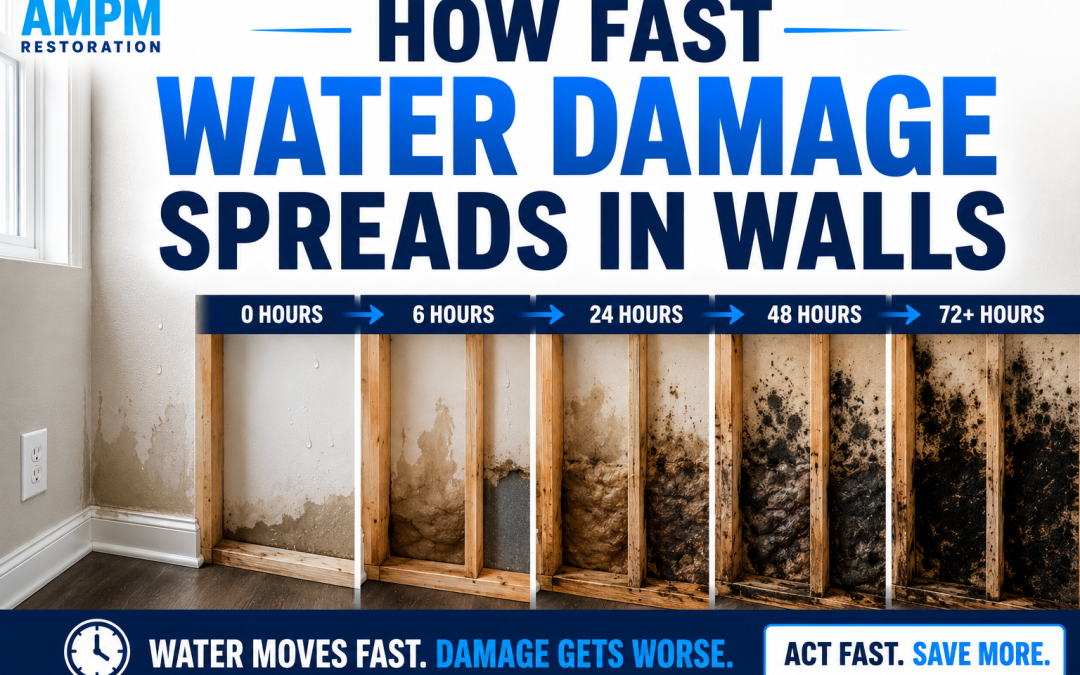
How Fast Water Damage Spreads in Walls
How fast water damage spreads in walls comes down to a short window. Wet wall materials should be dried within 24 to 48 hours to reduce mold risk, and water can begin moving deeper into wall assemblies within the first hour.
If you’re reading this in Bradenton, Sarasota, Lakewood Ranch, or anywhere along Florida’s Gulf Coast, there’s a good chance this question isn’t theoretical. Maybe your AC handler leaked overnight. Maybe wind-driven rain pushed water around a window frame. Maybe you noticed a soft baseboard after a storm and now you’re wondering if the stain on the paint is the whole problem.
Usually, it isn’t.
What makes wall damage stressful is that the visible mark is often the last thing to show up. Water doesn’t wait for a brown stain to appear before it starts soaking drywall, insulation, wood trim, and framing cavities. In Florida homes, where humidity slows drying and storm season adds repeat exposure, that hidden spread is exactly why small leaks can become much larger restoration jobs if they’re left alone.
The Unseen Race Against Time with Water Damage
A Florida homeowner might first notice something small. A faint musty odor near a bedroom wall. A little bubbling paint behind the couch. A baseboard that looks slightly swollen after a heavy afternoon storm. None of those signs look dramatic, which is why people often wait a day or two to see if the wall “dries out on its own.”
That delay is where the trouble starts.
Water damage in walls can begin as a hidden problem within just a few hours because moisture moves through porous materials like drywall, wood, and insulation before it’s visible on the surface. The restoration industry treats the first 24 to 48 hours as the critical window because mold spores can begin germinating during that period once moisture is present, and visible colonies may appear within a week if wet materials aren’t dried promptly, according to industry guidance on how fast water damage spreads.
Why Florida homes make this harder
On the Suncoast, water intrusion often doesn’t come from one dramatic event. It can come from repeated humidity, AC condensation issues, roof leaks during storm season, or wind-driven rain entering around windows and doors. In concrete block homes, people sometimes assume the structure itself makes them safe from hidden wall moisture. It doesn’t.
Interior finishes still absorb water. Drywall still wicks. Baseboards still swell. Insulation can still hold moisture where you can’t see it.
Practical rule: If a wall got wet today, treat it like an active problem today, not a cosmetic issue for the weekend.
That’s why homeowners in Bradenton, Sarasota, Saint Petersburg, and nearby communities usually need more than a visual check. The question isn’t just whether the paint looks damaged. The question is how far the moisture has already traveled behind it.
A Minute-by-Minute Timeline of Water Spreading in Walls
The speed of how fast water damage spreads in walls becomes easier to understand when you think about a paper towel touching a spilled drink. The wetness doesn’t stay in one dot. It climbs, spreads sideways, and soaks deeper. Walls behave in a similar way when porous materials are involved.

What happens first
Drywall can start wicking water upward from a wet floor within minutes, and in practice the first hour is often enough for water to move deeper into wall assemblies if extraction doesn’t begin immediately, as explained in this water spread timeline for wall materials.
Wicking confuses a lot of homeowners. They expect water to spread only downward because of gravity. But porous materials act more like a sponge than a slab. Water can climb upward into the bottom of drywall, spread into trim, and move into insulation even when the surface stain still looks small.
A practical timeline
- Within minutes: Drywall and base materials begin absorbing water at the point of contact.
- Within the first hour: Moisture can move upward and inward behind the wall surface.
- Within a few hours: Wet areas may extend beyond the visible mark, especially around baseboards, framing cavities, and insulation pockets.
- By the first day: Materials may feel soft, swollen, or cool to the touch, even if the paint only shows minor change.
- By the second day: The urgency shifts from simple wetting to secondary damage risk if drying hasn’t started.
If you want a fuller breakdown of what homeowners should prioritize during that response window, AMPM has a useful guide on emergency water damage repair in the first 24 hours.
Water absorption speed in common wall materials
| Wall Material | Absorption Speed | Primary Risk |
|---|---|---|
| Drywall | Fast | Wicking, swelling, softening |
| Insulation | Fast once exposed | Hidden moisture retention inside cavities |
| Wood trim and baseboards | Moderate to fast | Expansion, distortion, concealed dampness |
| Concrete block | Slower at the finish surface, but can retain moisture in connected materials | Moisture lingering in adjacent finishes and wall components |
A common mistake is assuming concrete block means the wall system is “waterproof.” In Florida, many homes have block exterior walls but still rely on interior drywall finishes, furring strips, trim, and insulation details that can trap moisture.
A wall can look only slightly stained while moisture has already spread across framing cavities, baseboards, and insulation.
Key Factors That Accelerate Wall Damage in Florida
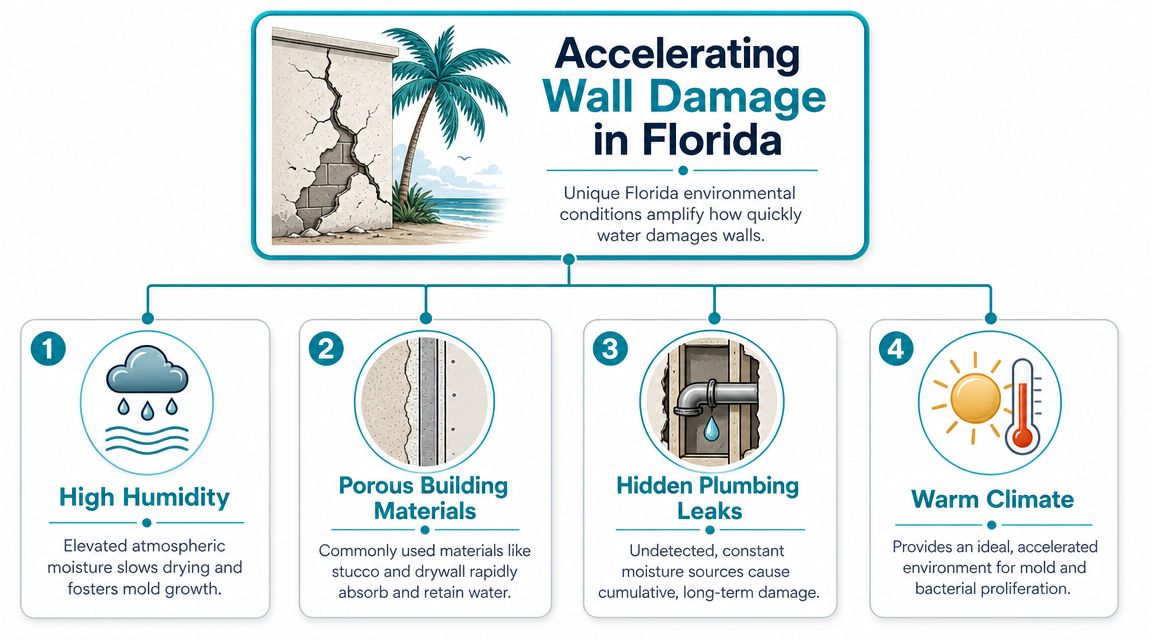
Florida changes the equation. The same leak that might dry more easily in a cooler, drier climate can linger here because the air already holds more moisture and the building envelope often takes repeated weather exposure.
Humidity slows the escape route
Drying depends on moisture leaving the material and moving into the air. In a humid Florida house, that process slows down. The wall may stop looking actively wet, but it doesn’t mean the moisture has fully left the assembly.
Warm weather makes that hidden moisture more troublesome. It supports the kind of conditions where biological growth can take hold faster once materials stay damp.
Common materials hold water differently
Florida homes often combine concrete block, drywall, textured finishes, wood trim, and insulated cavities. Those materials don’t dry at the same rate. One section may feel normal while another section just inches away is still wet behind the surface.
That mismatch is why spot drying often fails. A fan aimed at the room helps the room. It doesn’t automatically dry the cavity.
Hidden plumbing and AC leaks stay active longer
A storm is obvious. A slow pipe drip or AC-related leak isn’t. If water enters a wall gradually, homeowners may not see clear staining until the problem has already spread behind the finish layer.
Florida mold conditions change the urgency
Once moisture lingers, Florida’s climate raises the stakes. That’s one reason local homeowners often end up dealing with both water restoration and microbial concerns at the same time. AMPM covers that connection in this guide on why so many Florida homes have mold.
How to Spot Water Damage From Hidden to Obvious Signs
Water damage is often expected to announce itself with a dark stain. Sometimes it does. Often, the early signs are quieter.
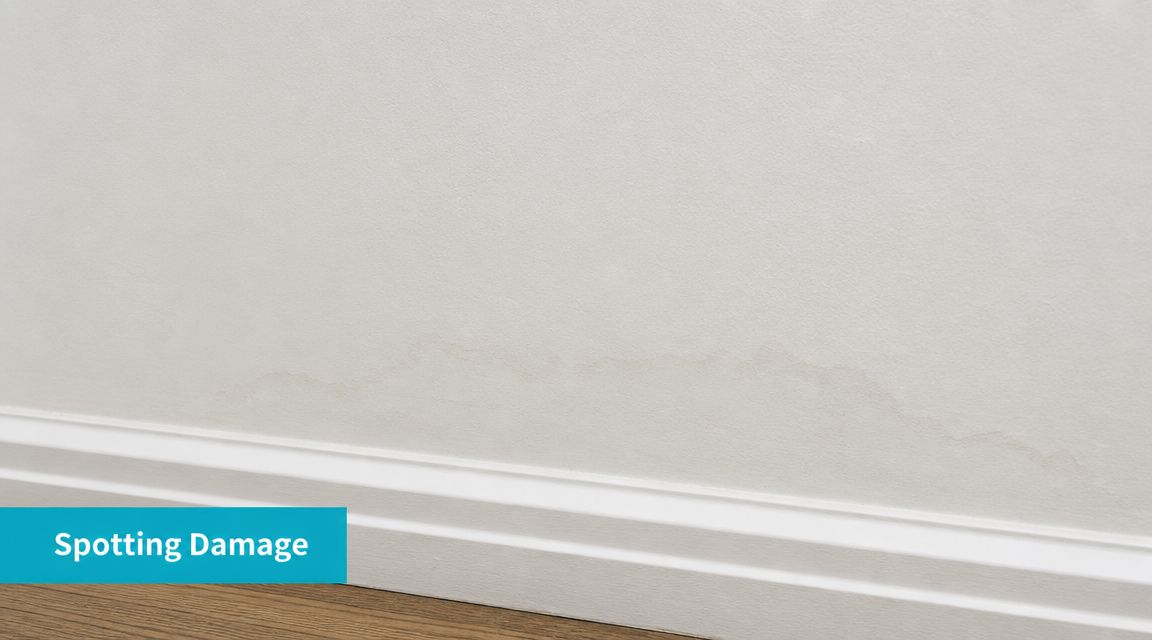
Subtle signs homeowners miss
A hidden wall leak often shows up first through texture, smell, or touch.
- Paint changes: Slight bubbling, hairline peeling, or a patch that looks duller than the surrounding wall.
- Baseboard movement: Trim that separates a little from the wall or looks puffed at the bottom edge.
- Surface feel: Drywall that feels cool, soft, or slightly spongy.
- Odor: A musty smell in one corner of a room, closet, or hallway.
- Floor-edge clues: The wall looks normal, but the flooring nearby feels damp or the caulk line darkens.
These signs confuse homeowners because none of them looks severe on its own.
Obvious signs usually mean the spread is already wider
Once you see stronger symptoms, the moisture problem has often been active longer than you thought.
- Brown or yellow staining
- Bulging drywall
- Warped trim
- Persistent musty odor
- Visible mold growth
- Cracking joint tape or soft wall corners
The most important concept is this: visible damage and actual moisture spread are not the same thing. As noted in this explanation of hidden moisture behind walls, the absence of visible staining does not mean the wall is dry. It may mean the leak has already spread behind the finish layer.
When the stain is small, homeowners often assume the damage is small. In wall systems, that assumption is risky.
That’s where professional inspection tools matter. A moisture meter can help confirm whether the wall is still wet. Infrared imaging can help identify temperature differences that suggest hidden moisture patterns. If you’re trying to compare symptoms before scheduling an inspection, this page on signs of hidden water damage behind drywall is a helpful reference.
Your Immediate Action Plan and When to Call AMPM Restoration
When water gets into a wall, the first goal is safety. The second goal is limiting spread. Homeowners can help at the start, but there’s a point where waiting or trying to handle it alone usually increases the damage.
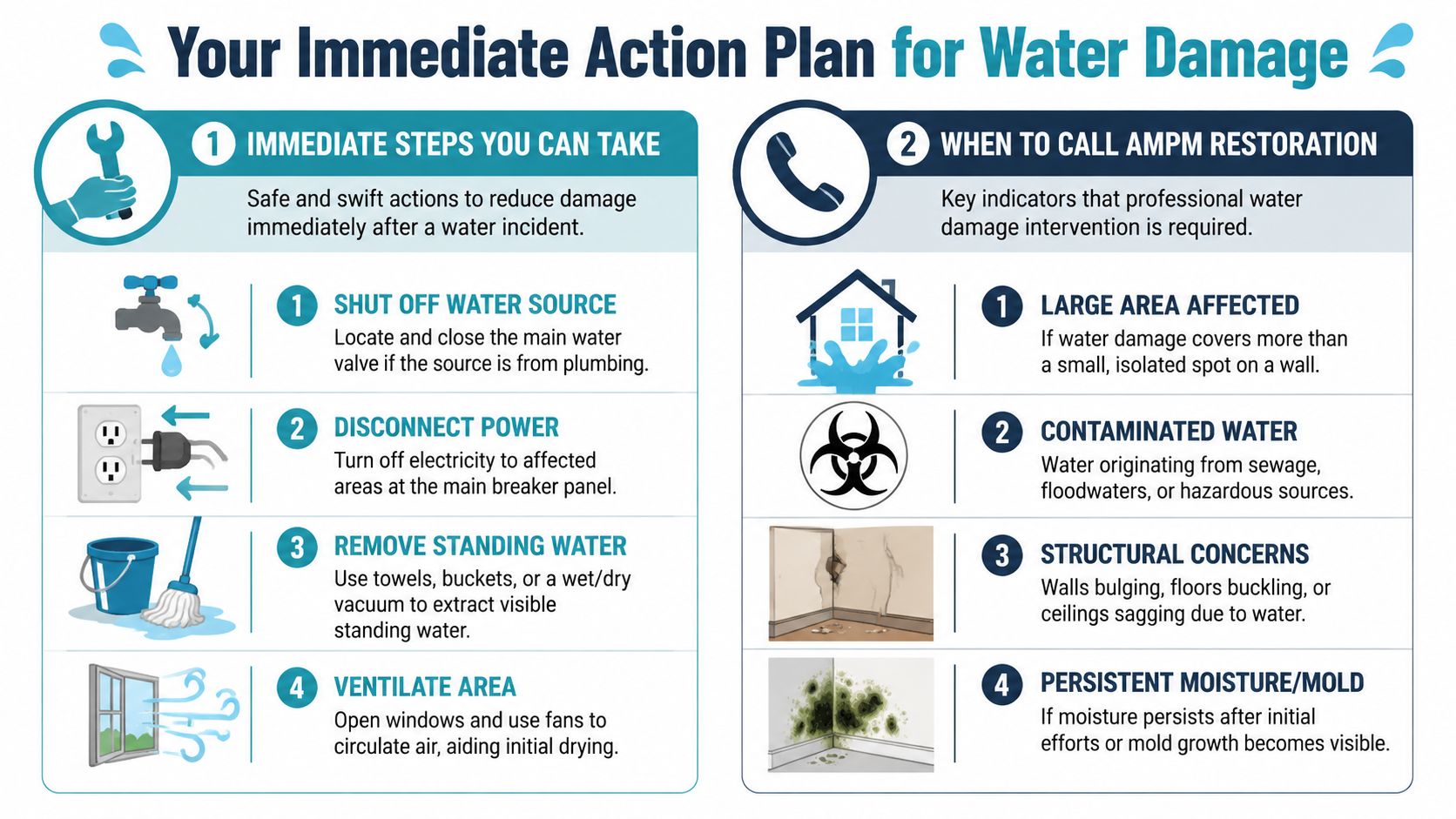
What you should do right away
- Stop the source if you can. Shut off the water supply if the problem comes from plumbing or an appliance line.
- Cut power to the affected area if there’s any electrical risk. If water is near outlets or wiring, use caution and don’t touch wet electrical components.
- Move nearby belongings. Pull furniture, rugs, electronics, and paper items away from the damp area.
- Remove visible water. Towels, mops, or a wet vacuum can help with surface water.
- Promote airflow. Open windows if weather allows and use fans to move air through the room.
If the leak happened during a storm-related outage or electrical problem, homeowners may also need outside help with power safety. This overview of emergency power restoration services offers useful context on what to do when water and electrical interruptions overlap.
Clear triggers for professional help
A widely cited moisture-control benchmark is that wet building materials should be dried within 24 to 48 hours to reduce mold risk. One industry source notes that moisture levels above 15% in walls typically indicate water damage, and professional assessment is recommended when affected mold-contamination areas exceed 10 square feet, according to this mold and water damage timing guide.
Call for professional restoration if any of these apply:
- The wall stayed wet beyond the first response period
- You suspect moisture inside the wall cavity
- The damaged area is larger than a small isolated spot
- You can smell mustiness even after surface drying
- The affected mold-contamination area exceeds 10 square feet
- The water came from flooding, sewage, or another contaminated source
One available option for this stage is emergency water removal for flooding and burst pipes, which focuses on extraction, moisture tracking, and drying when hidden wall moisture is likely.
Protect Your Suncoast Property from Water Damage
The answer to how fast water damage spreads in walls is uncomfortable but simple. It starts faster than most homeowners expect, often before the wall looks damaged, and the decision window for limiting secondary problems is short.
That matters even more on Florida’s Suncoast. Between humidity, storm exposure, AC-related moisture issues, and mixed wall assemblies that hide dampness, a small leak can become a much wider wall problem if nobody checks beyond the paint surface. Homeowners often judge by what they can see. Restoration professionals judge by where the moisture has traveled.
Insurance questions also come up quickly after storms and leaks. If you rent rather than own, this guide to renters insurance hurricane coverage can help you understand what kinds of storm-related losses may fall under a policy and where limits may apply.
If you’re in Bradenton, Sarasota, Tampa Bay, Saint Petersburg, Lakewood Ranch, or nearby Gulf Coast communities, AMPM Restoration is available around the clock to inspect water intrusion, map hidden moisture, assist with insurance claims, and discuss financing options. If you suspect water behind a wall, don’t wait for a bigger stain. Call 941-946-7807 for a free inspection and estimate.
Frequently Asked Questions About Water Damage in Walls
How long should I wait before worrying about a wet wall?
Don’t wait to “see what happens.” If a wall got wet, the concern starts immediately because moisture can move deeper before damage shows on the surface. Early inspection is the safest choice.
Can a wall dry on its own?
Sometimes surface moisture evaporates, but that doesn’t mean the wall assembly is dry. Drywall, insulation, trim, and framing can hold hidden moisture. That’s why people often think the problem is gone, then notice odor, staining, or material failure later.
Is a small stain always a small problem?
No. A small stain can be the visible edge of a larger hidden moisture path. Water may have traveled along the bottom plate, behind baseboards, or into insulation before the finish layer changed color.
Do I need a professional if I already used fans?
Fans help with air movement, but they don’t confirm whether the wall cavity is dry. A proper inspection checks the moisture level inside the material, not just whether the room feels less damp. For more general guidance, AMPM has additional water damage frequently asked questions.
Will insurance cover water damage in walls?
Coverage depends on the source of the loss and the details of your policy. Sudden accidental events are handled differently from long-term neglected leaks. This is one reason documentation matters. Take photos, note when you discovered the problem, and keep records of any emergency mitigation. AMPM Restoration can guide homeowners through the insurance claim process and communicate the mitigation scope clearly.
When is mold removal part of the job instead of simple drying?
If moisture wasn’t addressed quickly, or if microbial growth is visible or suspected inside the wall system, the response may shift from drying alone to containment and remediation. The exact scope depends on what inspection tools find, how long the materials stayed wet, and whether the affected area is limited or more widespread.
If you think a wall leak may be spreading behind the surface, AMPM Restoration can inspect the damage, explain what’s wet, help with insurance documentation, and outline next steps clearly. Call 941-946-7807 for a free inspection and estimate. We serve Bradenton, Sarasota, Tampa Bay, Saint Petersburg, Lakewood Ranch, and surrounding Gulf Coast communities, and we also offer insurance claim assistance and financing options to make urgent restoration easier to manage.
If you need help right now, AMPM Restoration Services is available 24/7 for water damage restoration, mold inspection, mold removal, storm cleanup, and reconstruction across Florida’s Suncoast. Call 941-946-7807 for your free inspection and estimate, and ask about insurance claim assistance and financing options.