


A Bradenton homeowner sees the water bill rise, but the floors are dry and no dripping is audible. Leak detection can help with hidden or continuous leaks when the method fits the suspected leak and field conditions. Treat a signal as a clue, not proof, and confirm it before opening walls or slabs.
The distinction matters: detection can flag unusual water use, confirmation can establish that a leak is present, and pinpointing can guide a repair. One test may not do all three. With household leaks wasting about 180 gallons a week on average, checking unexplained use can be worthwhile, even when there is no visible puddle.
Does Leak Detection Work? The Short Answer
A Bradenton homeowner sees a water bill rise, yet the floors are dry and there is no obvious dripping. Leak detection can help when a leak is concealed or continuous and the test matches the symptom. The result still needs interpretation: a signal can point to a problem without proving its source or showing that it has been repaired.
Yes, leak detection works, but different tools answer different questions. A flow monitor can flag unusual water use. A moisture meter can confirm wet building materials. Neither result alone identifies a failed fitting, and a false alarm can send an investigation in the wrong direction.
Leak detection methods at a glance
| Method | What It Senses | Best Used For | Main Limit |
|---|---|---|---|
| Acoustic listening | Sound of pressurized water escaping | Buried or concealed pressurized pipes | Pipe material, noise, and multiple leaks reduce reliability |
| Infrared thermal imaging | Surface temperature differences | Hot-water lines beneath floors and moisture patterns | Needs temperature contrast; cold-water leaks may not show |
| Tracer gas | Test gas escaping from a pressurized line | Slab and underground pressurized lines | Needs pressurization and access points |
| Moisture mapping | Moisture in drywall, subfloor, and other materials | Measuring the extent of water damage | Shows where water is, not necessarily its source |
| Flow monitoring | Water volume and timing | Continuous or abnormal consumption | Flags suspicious flow without locating the failure |
These methods are not interchangeable. Acoustic listening and tracer gas test for clues around pressurized pipes, while infrared imaging detects temperature patterns at a surface. Moisture mapping measures how far dampness has spread, much like tracing a stain on paper, but the wettest spot may not sit directly above the leak.
Detection, confirmation, and repair are separate outcomes. Finding a likely leak does not fix it, and arranging a repair does not establish that the original diagnosis was right. A professional plumbing leak repair service is a separate step from testing, so ask what evidence supports the diagnosis before approving work.
Practical rule: Ask what the test establishes, what remains uncertain, and how the finding will be confirmed before authorizing an opening in a wall or floor.
Three Results a Detector Can Give You
A flow monitor may show water moving when the home should be idle. That is evidence of abnormal water use, not proof of a leak or its location. A running appliance, irrigation, or another expected use can also explain the reading, so the next step is to check what was operating.
A confirmed leak requires evidence that water is escaping from a system or wetting materials, rather than an unexplained flow alert alone. Inspection can help distinguish plumbing leakage from rain intrusion, drainage issues, or condensation. A water damage inspection assesses wet materials and possible causes, but moisture by itself does not prove a plumbing defect.
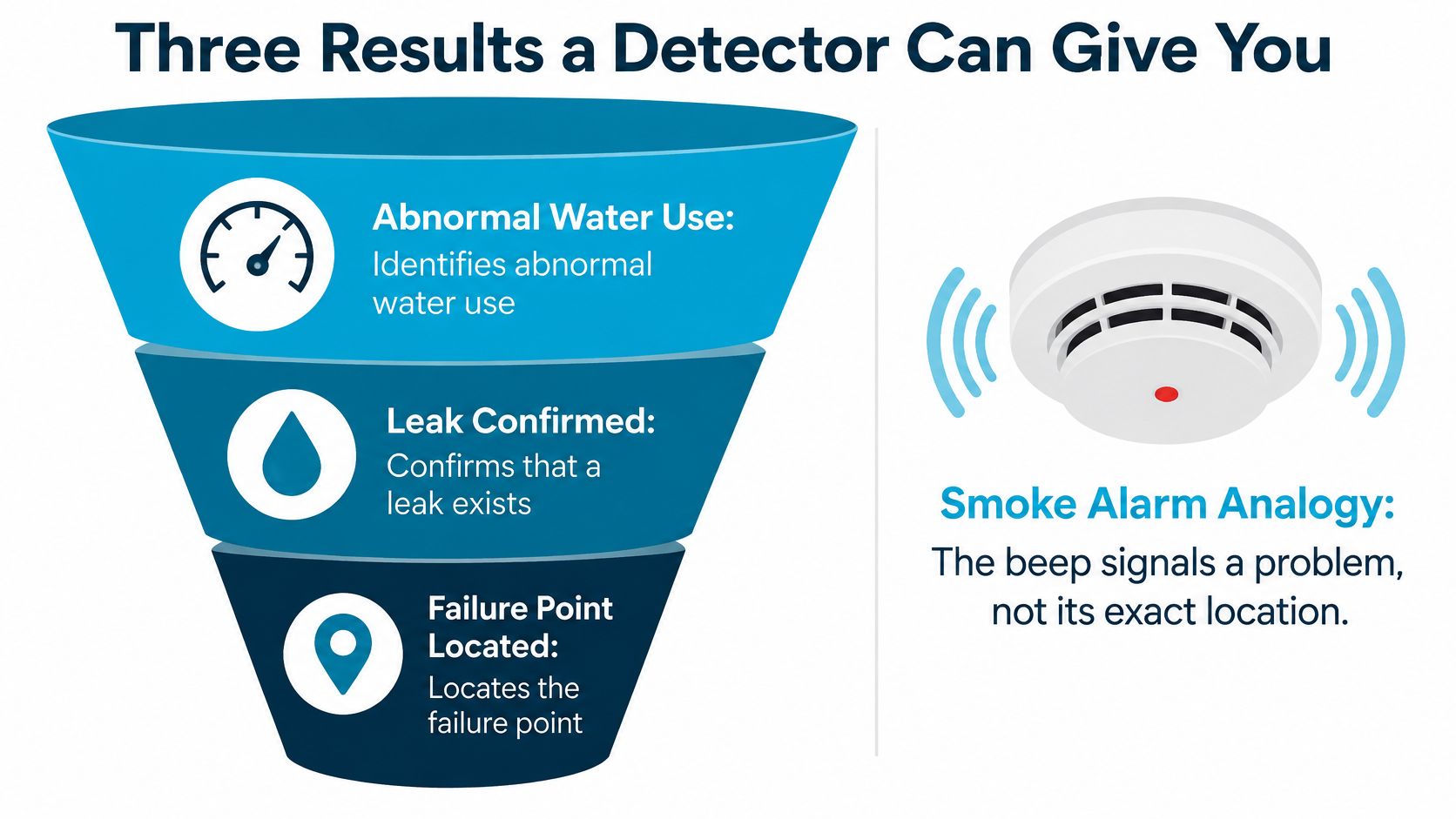
A located failure point is a more specific finding: inspection or targeted testing has narrowed the leak to a particular pipe or area. Flow monitoring alone cannot do that. Acoustic listening, thermal imaging, or tracer gas may help locate a concealed leak, depending on the pipe and conditions. The Colorado leak detection and repair resource notes that water-use comparisons can identify some leaks while offering limited help with their exact location. An alert is not evidence enough to justify cutting concrete at a guess.
False alarms and incomplete findings matter. A temporary flow event can trigger an alert, while an intermittent leak may stop before inspection. Ask a provider which evidence supports each level, what test will confirm the suspected leak, and what separate method will locate the failure before any opening or repair is authorized. Detection, confirmation, location, repair, and verification are distinct steps.
How Moisture Sensors and Flow Monitors Differ
A moisture sensor is like a doorbell for one room: it responds only when water reaches its position. A flow monitor is more like a utility meter that notices the house is using water when nobody expects it to.
The EPA's leak-detection device guide explains that moisture sensors use electrodes or prongs to detect changes in electrical conductivity. Flow monitors measure water movement and flag unusually long flow or departures from normal consumption patterns.
Placement determines coverage
A point-of-entry monitor on the main supply watches overall downstream use. Point-of-use sensors beside toilets, beneath water heaters, or behind washing machines watch particular vulnerable locations.
Neither arrangement covers every problem. A floor sensor won't respond to water that never reaches it, and a supply-line flow monitor doesn't establish whether a ceiling stain came from rain.
The value of combining monitoring with maintenance appears in a Los Angeles multifamily pilot covering 44 buildings and 857 apartments. Mainline monitors flagged significant continuous flows, while toilet monitors helped identify affected units; water attributed to leaks fell from 22% to 2.16% during the first three months of active remediation, then rose to 7.8% when maintenance resources declined.
For property managers, useful records include:
- Night flow: Consumption during periods when little use is expected.
- Response time: How long staff take to investigate.
- Confirmed leaks per alert: Whether notifications produce actionable findings.
- Post-repair flow: Whether corrective work reduced unexplained use.
How Acoustic, Infrared and Tracer Gas Pinpoint Hidden Leaks
A technician should narrow the search before choosing an opening point. The following is a possible diagnostic sequence, not a promise that every property needs every tool.

From suspicious flow to a smaller search area
Start with flow evidence. In a hypothetical Sarasota slab-leak investigation, unexplained meter movement establishes that water is moving through the supply system. Think of this as confirming that someone is using a hallway, not identifying which door they entered.
Use infrared to narrow the area. A warm band near the bathroom might suggest a hot-water route beneath tile. The camera reads surface temperatures, like a weather map, rather than seeing through concrete; cold-water leaks and thick coverings may offer little useful contrast. A thermal imaging leak detection assessment therefore needs interpretation alongside other findings.
Refine the location acoustically. Listening equipment works somewhat like a stethoscope. Sensors detect escaping-water sounds, and a correlator compares their arrival at different positions to estimate the source.
A Sydney water-main study using vibro-acoustic loggers reported 94.63% to 98.51% leak/no-leak classification accuracy for its strongest model, with approximately 70% of detected leaks hidden. Pipe material, diameter, burial conditions, pressure, and background noise affect those results, so the strongest sound isn't automatically the failure point.
Consider tracer gas where appropriate. A technician introduces a hydrogen-nitrogen test blend into the isolated line and checks for gas reaching the surface. Like following a scent trail, this can help refine a buried-line location, but it requires suitable access and test conditions.
In the Sarasota example, the warm band, acoustic evidence, and gas finding would be cross-checks, not independent guarantees. Before cutting, seek agreement between complementary methods or equivalent confirmatory testing.
Moisture Mapping Shows How Far the Water Went
After a Gulf Coast storm, a ceiling stain may appear far from the entry point. Water can travel along framing and insulation before reaching the visible surface, so the stain alone is a poor guide to the full affected area.
Moisture mapping records the wet footprint. Pin meters use electrodes inserted into suitable materials, while pinless instruments assess moisture through the surface; technicians compare readings with an appropriate dry reference rather than treating every high reading as proof of a plumbing leak.
A wet-material map, not a pipe locator
The map helps crews decide where drying equipment belongs and whether concealed spaces need further examination. Homeowners comparing signs of hidden water damage behind drywall should remember that appearance and moisture extent don't necessarily match.
A reading is also a snapshot. A previously wet area may have dried, and Florida humidity can complicate interpretation of damp materials.
A useful inspection record should include:
- Date and location: When and where the technician measured.
- Material readings: Results tied to specific surfaces and instrument settings.
- Dry reference: A suitable comparison value.
- Wet boundary: A sketch showing the affected footprint.
A moisture map answers where materials are wet. It doesn't, by itself, identify which pipe failed.
That distinction prevents a drying plan from being mistaken for a source diagnosis. Both are necessary when water has entered building materials.
Reading Accuracy Claims Without Being Misled
Perfect detection in a test isn't perfect detection in your house. A review of nondestructive pipe-inspection methods describes a Correlux test with 100% detection, no false positives, and localization within 1 meter for leaks flowing at 4 to 30 liters per minute. The same review reports field reliability below 20% with multiple leaks and sensor separations up to 15 meters.
Those results aren't interchangeable. A claim may describe recognizing a leak, estimating its location, or performing under varied field conditions.
Reported accuracy and what each figure leaves out
| Study Setting | Reported Result | What the Number Leaves Out |
|---|---|---|
| Sydney water mains, vibro-acoustic loggers, best CNN model | High leak/no-leak classification accuracy, as detailed earlier | Utility-network conditions and location-to-location variation |
| Correlux test, controlled leak flows | Perfect detection and close localization in that setup | Varied field conditions |
| Same review, multiple leaks and wider sensor spacing | Substantially lower field reliability | Complexity that a single-leak test doesn't reproduce |
| Digitalized water network with high demand swings | Small leaks detected and search areas narrowed | Network-scale monitoring isn't a single-home installation |
| Water-pipeline machine-learning study | Perfect scores for selected models and leak classes | Selected models and classes aren't field-wide performance |
A water-pipeline machine-learning study reported 100% accuracy, precision, recall, and F1 scores across three leak classes for selected models. Those measurements don't establish universal residential reliability.
False alarms deserve equal attention
Research discussed in digitalized water-network detection reported detecting leaks as small as 0.4 liters per second despite demand fluctuations, narrowing search areas to 10% to 40% for certain leak sizes. The research also discusses noise-related false alarms: domain-knowledge machine learning reduced those alarms by about 99.6%, while an acoustic classifier detected more than 70% of leaks with false alarms below 5%.
Sensitivity has a practical cost if residents repeatedly dismiss notifications. Ask vendors:
- Slow leaks: Does the device detect them, or mainly substantial flow?
- False alarms: What happens in occupied homes with changing demand?
- Sensor health: How does it distinguish a failed sensor from a genuine no-leak result?
A useful system must produce alerts people can investigate, not just an impressive headline percentage.
Where Leak Detection Pays Off in Florida Homes
Consider these illustrative situations, not documented customer cases. Each begins with a different clue, so each calls for a different first check.
A Bradenton family finds a ceiling stain after a summer storm. Mapping and infrared assessment could reveal the affected area, while investigation may point toward roof flashing rather than plumbing. A Lakewood Ranch homeowner with an unexplained bill increase needs a supply-flow check instead.
Florida situations, first checks and expected outcomes
| Florida Situation | First Check | Detection Method That Fits | Expected Outcome |
|---|---|---|---|
| Ceiling stain after a storm | Moisture mapping of ceiling, attic, and walls | Moisture mapping with infrared scan | Wet area mapped and drying plan developed |
| Bill climbs with no visible water | Meter test with no water use | Flow monitoring with acoustic correlation | Unexplained flow assessed and search zone narrowed |
| Vacant home with meter still moving | Read meter and check main shutoff | Flow monitor with automatic shutoff | Alert and automatic isolation when configured and triggered |
| Wet patch after irrigation runs | Zone-by-zone shutoff test | Acoustic detection with flow monitoring | Irrigation line distinguished from main supply |
For a Sarasota condo left vacant seasonally, remote monitoring and automatic shutoff can help address the delay before someone discovers a supply leak. That protection still depends on installation, configuration, and someone responding to the notification.
At a Palmetto property, a wet patch appearing only during irrigation suggests a different investigation. Isolating irrigation zones helps determine whether the sprinkler system or another supply line needs attention.
Choose by symptom: A storm stain, unexplained meter movement, and an irrigation wet patch shouldn't receive identical investigations.
A water leak detection and repair assessment should connect the initial clue to a testable explanation. The first useful outcome is often a narrowed zone and an appropriate repair plan, not an instant finished diagnosis.
Run Two Tests Before You Book a Free Inspection
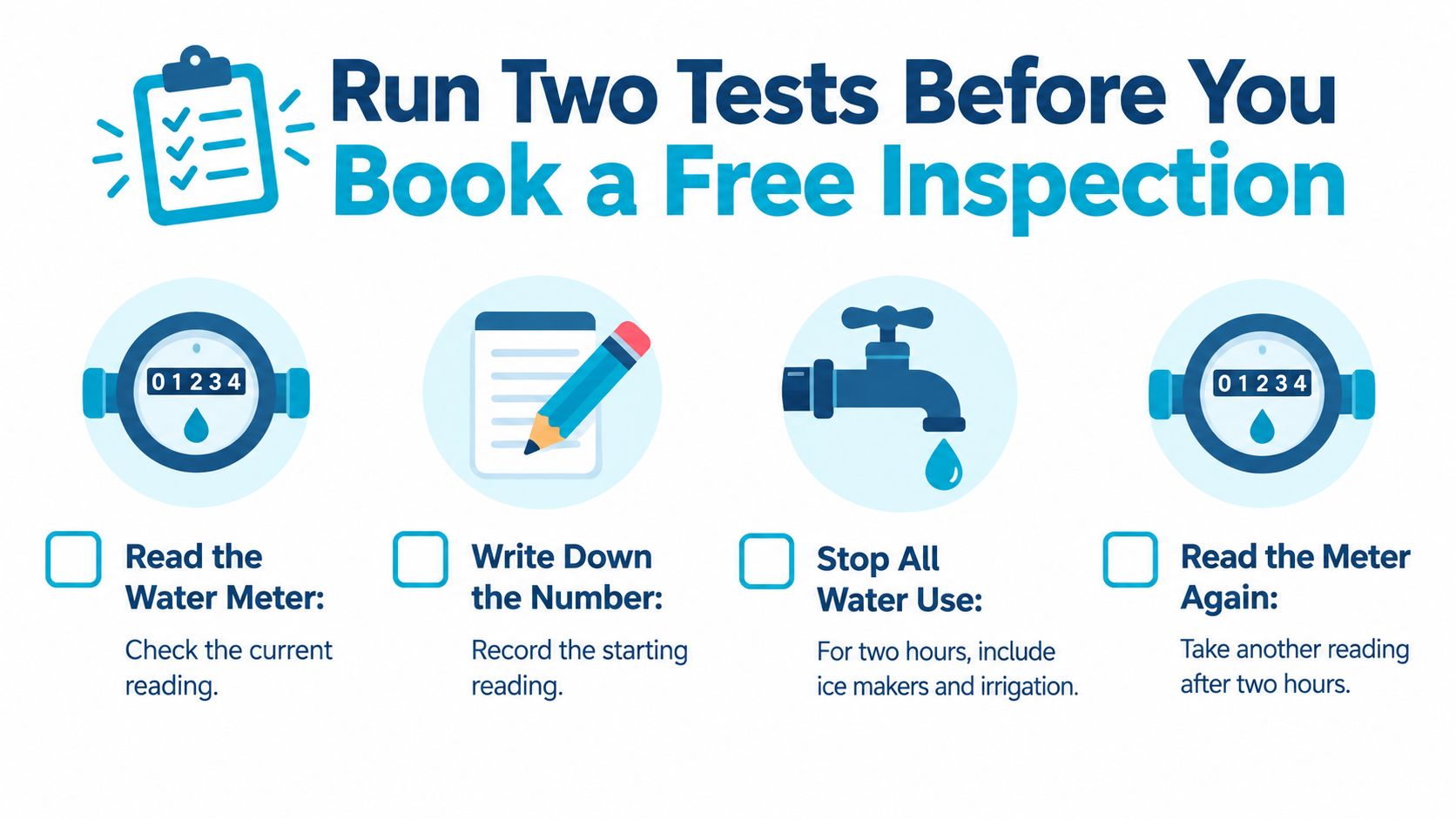
A rising bill or a damp patch may point to a leak, but neither proves where water is escaping. If water is actively flooding the property, skip home tests and seek emergency help. Otherwise, two simple checks can give an inspector useful starting evidence. They can suggest leakage, not confirm a hidden pipe's location or complete the repair.
- Check the water meter. Record its reading, stop all water use, including irrigation and automatic appliances, then compare the reading after two hours. A change suggests water is moving somewhere in the system. Follow EPA's meter-test guidance and this guide to checking your water meter for leaks. A moving meter is a clue, not a map of the leak.
- Test toilet tanks with dye. Add food coloring, wait 10 minutes without flushing, and check whether color appears in the bowl. That points to water leaking from the tank into the bowl. The EPA's fixture-testing fact sheet also describes winter consumption above 12,000 gallons monthly for a family of four as a possible warning of a serious leak.
Prepare the evidence before calling
Gather the bill and billing dates, when you noticed the change, which fixtures or irrigation zones you checked, photos of stains, and whether water is still running. These details help an inspector choose targeted tests and document findings for an insurance review. Detection narrows the search; confirmation identifies the source, and repair addresses it.
A study of 2,306 Flo by Moen-equipped homes, summarized in this 2020 LexisNexis Risk Solutions research resource, reported a correlation with 96% fewer escape-of-water claims and 72% lower claim severity. These findings concern one vendor's users and do not prove that automatic shutoff will produce the same results in other homes.
For properties in Bradenton, Sarasota, and Lakewood Ranch, contact AMPM Restoration at 941-946-7807 about a free water leak detection inspection and estimate. Insurance claim assistance and financing options are available.
Six Questions About Whether Leak Detection Works
Does leak detection actually work?
Yes, especially when the method matches a concealed or continuous leak. The important distinction is whether the finding identifies suspicious use, confirms leakage, or supports a specific repair location.
How accurate is acoustic leak detection?
The Sydney research discussed earlier achieved strong leak/no-leak classification results in a particular water-main setting. Your property's pipe material, burial conditions, pressure, and background noise can change performance, so those results aren't a household guarantee.
Can a detector find a leak behind a wall?
Complementary instruments can narrow the location before a technician recommends an opening. If the evidence points toward rain entry instead of plumbing, a professional roof inspection from a provider such as America Roofing may be the appropriate next investigation.
How do I know a leak is gone after repair?
Repeat the no-use meter check described earlier and compare subsequent flow with the pre-repair findings. Ask the technician to verify the repaired source separately from the drying of materials, because those are different outcomes.
Does a flow monitor replace a professional inspection?
No. A monitor supplies an alert or consumption record, while an inspection investigates the source, checks affected materials, and documents what the evidence supports.
Will insurance cover leak detection and repair?
Coverage depends on your policy, the cause of loss, and the insurer's determination; don't assume detection, plumbing repair, and resulting damage receive identical treatment. AMPM Restoration offers insurance claim assistance and financing options for homeowners in Bradenton, Sarasota, and Tampa Bay.
Does leak detection work for your property's symptoms? Visit AMPM Restoration Services or call 941-946-7807 for a free inspection and estimate, with insurance claim assistance and financing options available. Based at 4301 32nd St W b18, Bradenton, FL 34205, the company provides 24/7 emergency restoration across Bradenton, Sarasota, Tampa Bay, Saint Petersburg, Lakewood Ranch, and surrounding Gulf Coast communities, including professional water damage restoration, mold inspection and mold removal, fire and smoke damage restoration, storm and flood damage restoration, commercial restoration services, and full reconstruction solutions.