

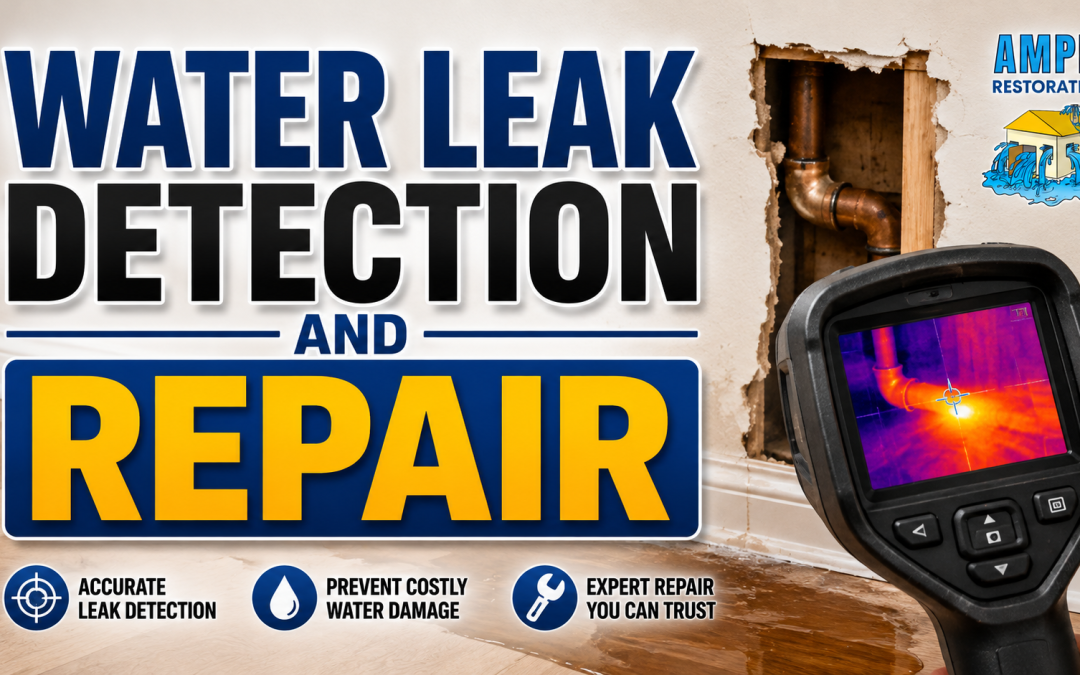
You spot the first clue in the middle of a normal day, a faint musty smell near the hallway, a tile that feels warmer than the rest, or a water bill that doesn’t make sense. In a Florida home, that’s often how hidden leaks announce themselves, before they turn into swollen baseboards, damaged drywall, or a slab problem that’s already been working for weeks. For homeowners in Bradenton, Sarasota, Tampa Bay, Saint Petersburg, and Lakewood Ranch, water leak detection and repair isn’t just about stopping water, it’s about stopping the damage chain before it spreads.
Why Water Leaks Demand Immediate Attention
A hidden leak rarely looks dramatic at first. A homeowner notices a slight bill increase, a soft spot in tile, or a faint odor that seems to come and go, and it’s easy to dismiss it as humidity or everyday condensation. In Florida, that delay is expensive because slab-built homes, humid air, and older plumbing systems can hide the source long enough for the damage to move from cosmetic to structural.
The scale of wasted water explains why this work matters so much. The EPA’s WaterSense program says the average household leak can waste more than 10,000 gallons of water every year, and household leaks nationwide waste more than 1 trillion gallons annually, roughly the annual water use of more than 11 million homes. WaterSense also reports that 10% of homes have leaks that waste 90 gallons or more per day, which is why small leaks deserve immediate attention, not a wait-and-see approach. EPA WaterSense leak facts
Why Florida homes are harder to read
Slab construction hides supply lines and creates fewer visible clues. A leak under concrete can show up as a warm floor, a persistent damp smell, or subtle moisture around trim long before water appears on the surface. Once water gets into drywall or framing, mold and material breakdown can follow fast in a humid climate, and that’s where documentation and fast mitigation start to matter for both repairs and insurance.
Practical rule: if the leak isn’t visible, don’t assume it’s minor. Hidden leaks often cost more because the real damage happens before anyone sees standing water.
A leak also complicates claims when homeowners wait too long. Insurers look closely at whether the damage was sudden or whether it reflects ongoing deterioration, so the clock starts ticking the moment symptoms appear. If you want a deeper look at how quickly water can move through wall cavities, see how fast water damage spreads in walls.
Professional water leak detection and repair is usually the most cost-effective route because it narrows the source before demolition starts. That matters in Florida, where guessing wrong means more drywall cuts, more flooring removal, and more disruption than the leak itself may have caused.
Recognizing the Early Warning Signs of Hidden Leaks
The first signs of a hidden leak are often small enough to ignore. A bill that climbs without a clear reason, a faint running-water sound when no fixture is on, or a patch of flooring that feels warmer than the rest all point toward water moving where it shouldn’t. In Florida properties, humidity can blur the picture, so the job is to separate normal moisture from a true plumbing failure.
Signs that usually point to a leak
Start with the clues you can verify without opening walls. These are the ones that show up most often in homes, rentals, and commercial properties where water use varies from room to room.
- Unexpected water use: If usage keeps rising across several billing cycles, that’s a stronger warning than a single odd bill.
- Audible flow: Running water, hissing, or faint trickling when fixtures are off can point to a supply line or toilet issue.
- Surface changes: Peeling paint, bubbled wallpaper, soft drywall, warped baseboards, or stains that return after drying are classic hidden moisture clues.
- Odor changes: Musty smells that stick around after cleaning often mean moisture is trapped behind finishes.
- Floor temperature shifts: Warm or damp tile can suggest a slab or hot-water line issue.
- Unexpected mold growth: Mold showing up in a place that doesn’t normally stay wet deserves immediate attention.
- Foundation or slab-adjacent cracking: Cracks alone don’t prove a leak, but cracks paired with moisture signs need a closer look.
For a practical checklist on wall moisture symptoms, what to do about water in walls is a useful reference. If the leak is behind finishes, signs of hidden water damage behind drywall can help you compare what you’re seeing to a typical hidden-damage pattern.
What different signs can mean
A slab leak often shows up as warm flooring, uneven moisture, or a sound that never quite goes away. A supply line leak tends to create persistent wetness, pressure-related noise, or bill changes that don’t match the household pattern. A drain leak can be harder to catch because it may only leak during use, which means the damage shows up around tubs, showers, sinks, or wall cavities after someone runs water.
If you can smell moisture but can’t see it, don’t wait for a stain to appear. By the time drywall shows a mark, the leak has usually been active long enough to spread.
The hardest part in Florida is misreading condensation as plumbing failure. Condensation usually appears on cold surfaces in predictable weather patterns, while a true leak tends to repeat in the same spot and worsen with use. If the pattern is unclear, professional water leak detection and repair tools can separate surface moisture from active intrusion much faster than guesswork.

Professional Detection Technologies Explained
The right detection tool depends on the property, the pipe type, and how much damage you can tolerate during the search. In Florida, concrete slabs and saturated soils make visual tracing unreliable, so technicians usually combine methods instead of betting on one device. That approach reduces unnecessary demolition and gives a clearer map of where to open the structure.
What each tool does well
Acoustic sensors listen for the vibration pattern created by pressurized water escaping a pipe. They’re especially useful on active supply lines and buried service lines because a leak often makes a consistent sound signature before it ever surfaces. Their weakness is context, nearby machinery, pumps, or noisy interiors can make interpretation harder.
Thermal imaging cameras help reveal temperature differences behind surfaces. They’re useful when a leak changes the temperature of a wall, ceiling, or floor, but they don’t “see water” directly. They read patterns, which means a technician still has to confirm what caused the temperature shift.
Moisture meters help verify whether a suspect area is wet. They’re practical for drywall, trim, and flooring checks, but they only sample where they touch. That makes them confirmation tools, not full-location tools.
Tracer gas is valuable when the leak path is concealed and the pipe system can be isolated. Gas escapes at the leak point and gives technicians a way to narrow the source without opening large sections of the building.
Ground-penetrating radar is useful for buried conditions and slab-adjacent problems where excavation would be disruptive. It can help identify anomalies below the surface, though it’s usually part of a broader search rather than the only answer.
A good technician doesn’t ask, “Which tool do I like?” The better question is, “Which combination finds the leak with the least damage to the property?”
That mindset matches the utility-side workflow described in the IWA guidance on leak detection and repair, which emphasizes segmenting the system, tracking flow, and narrowing the search before digging or cutting. For property owners, the same logic applies, isolate the area, verify the moisture pattern, then confirm the source before any demolition.
What to ask when a technician arrives
Ask which tools they’ll use, how they’ll confirm the source, and whether they expect to open drywall, flooring, or slab-adjacent finishes. If they only describe one method, that’s a red flag. A solid leak search should fit the building, not force the building to fit the tool.
For roof-related moisture, shows how the same principle applies above the ceiling line, isolate, confirm, then repair. On the Florida side, the same philosophy is why AMPM’s leak detection service focuses on locating the source before damage spreads.
Emergency Steps to Take Before Help Arrives
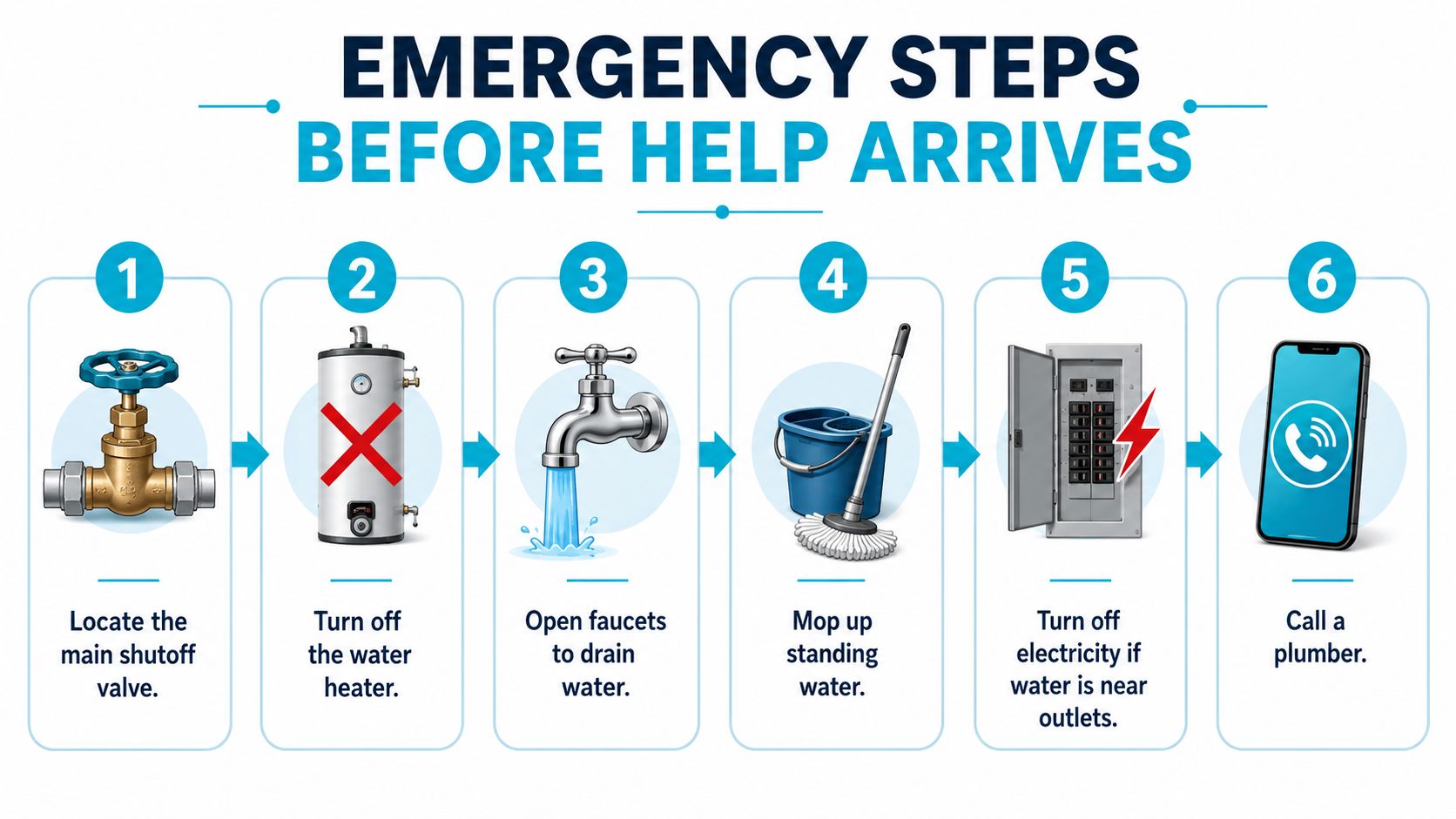
The first move is simple, stop the water if you can do it safely. Find the main shutoff valve, turn it off, and then shut down the water heater so it isn’t trying to heat an empty or partially drained system. After that, open nearby faucets to relieve pressure and move anything valuable away from the affected area.
If water is near outlets, switches, or appliances, stay out of the area until power is safe. Electricity and standing water are a bad combination, and trying to dry around live circuits is not a homeowner job. Document everything with photos and short notes, because insurance adjusters care about what was damaged, where it happened, and how fast you acted.
The next step is containment, not cleanup theater. Mop what you can safely reach, but don’t use household vacuums on standing water and don’t keep testing the area by running fixtures again and again. A “small” leak can still soak insulation, cabinets, or subflooring before it becomes visible, especially in Florida where moisture lingers.
Don’t wait for visible mold before calling. In humid conditions, the window for safe drying is shorter than most people expect.
That’s why a 24/7 response matters. The first day is usually about stopping the source and limiting spread, and the next step is moisture mapping and drying before secondary damage takes hold. For a clear rundown of what the first day should look like, see the first 24 hours of water damage repair.

If the leak is active and you can’t isolate it, call emergency restoration immediately. Fast action protects finishes, limits mold risk, and preserves the evidence needed for the insurance claim.
Repair Approaches and What They Cost
Repair choice depends on where the leak sits, how much of the line is affected, and how much disruption the building can absorb. A visible pinhole in an accessible supply line is a different job from a leak under slab or inside a buried service run. The goal is not just to stop water, it’s to stop it with the least damage to the structure around it.
Common repair paths
A spot repair is the least invasive option when the problem is isolated and the pipe around it is still in usable shape. That might mean replacing a short section of line, tightening a joint, or addressing a fitting failure at one point.
A supply line replacement makes more sense when the line is old, corroded, or showing repeated failures. If the pipe material is near the end of its service life, patching one failure often just delays the next one.
Pipe rerouting works when access to the damaged section is poor or when the original route would require too much demolition. It moves the water path to a more serviceable location and can reduce future repair disruption.
Trenchless pipe lining can be more cost-effective than excavation when the buried line is suitable for lining and the surrounding structure would be expensive to disturb. It isn’t the answer for every system, but it’s often worth comparing against open-cut repair when the line runs under finished areas.
Slab leak repair sits in its own category because the concrete changes the repair equation. Some jobs are localized and can be opened directly, while others are better handled by rerouting to avoid repeated slab disturbance.
The U.S. Bureau of Reclamation notes that leaks through cracks or joints can sometimes be stopped with polyurethane materials, including high-volume leaks under some conditions, after controlling the water first and then injecting resin to seal the leak. That sequence matters, control first, seal second.
How to compare quotes
A real estimate should describe the leak location, the access plan, the repair method, restoration work, and any follow-up drying or verification. If two quotes look different, check whether one includes opening, drying, and closeout while the other only covers the pipe work. You’re not comparing apples to apples unless the scope is equally clear.
The table below is a practical way to evaluate common choices.
| Repair Method | Best For | Typical Cost Range | Invasiveness |
|---|---|---|---|
| Spot repair | Isolated leak points | Varies by access and damage | Low |
| Supply line replacement | Aging or recurring failures | Varies by length and access | Moderate |
| Pipe rerouting | Hard-to-reach damaged runs | Varies by route complexity | Moderate to high |
| Trenchless pipe lining | Suitable buried lines with minimal surface disruption | Varies by system condition | Low to moderate |
| Slab leak repair | Leaks under or near concrete slabs | Varies by location and access | Moderate to high |
Older Florida homes with galvanized or polybutylene piping often need a broader conversation than one repair. A repeated leak pattern can make repiping the more practical long-term decision, especially when the system has multiple vulnerable points.
Navigating Insurance Claims for Water Damage
Insurance disputes usually start when the documentation is thin. A homeowner calls in after a leak, but the photos are incomplete, the moisture source isn't clearly identified, and there's no clean record showing what happened first. That leaves room for the insurer to argue about cause, timing, and scope.
Florida policies often distinguish between sudden and accidental damage and gradual deterioration. Sudden breaks, failed fittings, or a pipe that gives out unexpectedly are easier to present than long-term seepage that was never addressed. That distinction is why fast reporting and clear evidence matter more than people realize.
What strengthens a claim
Take photos before anything is moved, and keep them organized by room and time. Save receipts, written notes, and any plumber or restoration reports that show where the leak started and what was affected. Moisture mapping and professional documentation help because they show the spread pattern, not just the visible stain.
Adjusters respond better to a clear trail than a general complaint. The more specific the loss record, the fewer delays you're likely to face.
That's also where a restoration company can help. AMPM Restoration coordinates with carriers, documents the affected areas, and prepares industry-standard estimates that support the claim file. For homeowners trying to understand the paperwork side, how to file an insurance claim for water damage is a useful starting point.
What slows claims down
Delays usually come from waiting too long, cleaning up before documenting, or assuming the insurer will connect the dots from a short description. If there's any chance the water traveled behind walls, into flooring, or under cabinets, the claim should reflect that hidden spread. The more complete the evidence, the easier it is to show what the leak damaged and why the repair scope is larger than a surface stain.
Professional water leak detection and repair supports the claim by identifying the source, proving the extent, and documenting the mitigation. That's especially important for landlords, property managers, and commercial owners who need fewer disputes and faster restoration timelines.
Frequently Asked Questions About Leak Detection
How long does leak detection usually take
It depends on access, the building layout, and whether the leak is visible or concealed. A simple fixture problem is quicker than a slab-adjacent or buried line issue, especially when the technician needs to combine acoustic, thermal, and moisture readings.
Does homeowners insurance cover slab leaks
Sometimes, but the policy language matters. Coverage is usually easier to argue when the leak is sudden and accidental, while long-term deterioration is more likely to be disputed. The best move is to document the source and damage immediately, then let the claim file reflect the full scope.
What's the difference between leak detection and leak repair
Leak detection finds the source and maps the damage path. Leak repair stops the water and restores the affected system or structure. You need both, because fixing the pipe without understanding the spread can leave hidden moisture behind.
How can Florida homeowners prevent future leaks
Stay alert to small bill changes, keep an eye on hidden moisture clues, and have suspicious areas checked before they turn into major repairs. In slab-built homes, watch for warm floors, recurring odors, or moisture that doesn't match daily use. Prevention is mostly about catching patterns early.
What makes AMPM Restoration different for this kind of work
AMPM Restoration handles leak detection, water damage restoration, mold remediation, and reconstruction under one roof, which helps when a leak has already spread beyond the pipe itself. The team serves Bradenton, Sarasota, Tampa Bay, Saint Petersburg, Lakewood Ranch, and surrounding Gulf Coast communities, and it's set up for 24/7 emergency response when the leak can't wait.
Should I call a plumber or a restoration company first
If water is actively spreading, call for emergency help first, then coordinate the plumbing fix and drying work. The fastest path is usually the one that stops the source, documents the damage, and begins mitigation before secondary problems set in.
If you're dealing with a suspected leak in Bradenton, Sarasota, Tampa Bay, Saint Petersburg, Lakewood Ranch, or anywhere along the Gulf Coast, AMPM Restoration Services can help with water leak detection and repair, emergency drying, mold prevention, and full restoration. Visit AMPM Restoration Services to request a free inspection and estimate, and ask about insurance claim assistance and financing options when you call 941-946-7807.