


Expert Contents Restoration Service for Your Valuables
A soaked sofa in the living room, a box of family photos on the floor, and that sharp smoke smell that won’t leave the air, that’s the moment most Florida homeowners realize the damage isn’t just on the walls. Belongings reveal the story of a home, and once water, fire, smoke, or mold gets into them, the clock starts working against you. A professional contents restoration service gives those items a fighting chance by documenting, cleaning, drying, deodorizing, storing, and returning them in a controlled way instead of treating everything like trash.
Why Contents Restoration Service Matters in Florida
A storm rolls through the Suncoast, the power flickers out, and by morning you’re staring at wet upholstery, damp paperwork, and a closet that smells musty. That’s a common Florida reality, especially when moisture lingers long enough for secondary damage to set in. If you’re in that position, the first call often goes to a local team that can inspect fast, explain what can be saved, and separate true losses from salvageable items.
AMPM Restoration is located at 4301 32nd St W, Suite B18, Bradenton, FL 34205 and operates 24/7 to serve Bradenton, Sarasota, Palmetto, and St. Petersburg (HomeAdvisor listing). That local footprint matters because contents work is time-sensitive, especially after water exposure. Florida’s humidity can turn a small loss into a much bigger one if items sit too long, which is why homeowners often look for immediate help and clear next steps, not just a cleanup crew.
Practical rule: protect the items first, then worry about the room around them.
When contents are handled early, you preserve more than property. You preserve photos, records, furniture, and the things that make a house feel lived in. If humidity is part of the problem, this guide pairs well with how humidity causes mold in Florida homes, because the same damp conditions that damage drywall can also ruin what’s inside the home.
Understanding Contents Restoration Service
A contents restoration service is not just “cleaning stuff after a disaster.” It’s a structured recovery process for personal property, and in 2024 the Restoration Industry Association asked federal authorities to create a new NAICS category that listed contents processing alongside moisture inspection, structural drying, odor control, fire and smoke damage restoration, and mold remediation (RIA filing). That proposal matters because it shows contents work had become a recognized part of emergency restoration, not an afterthought.
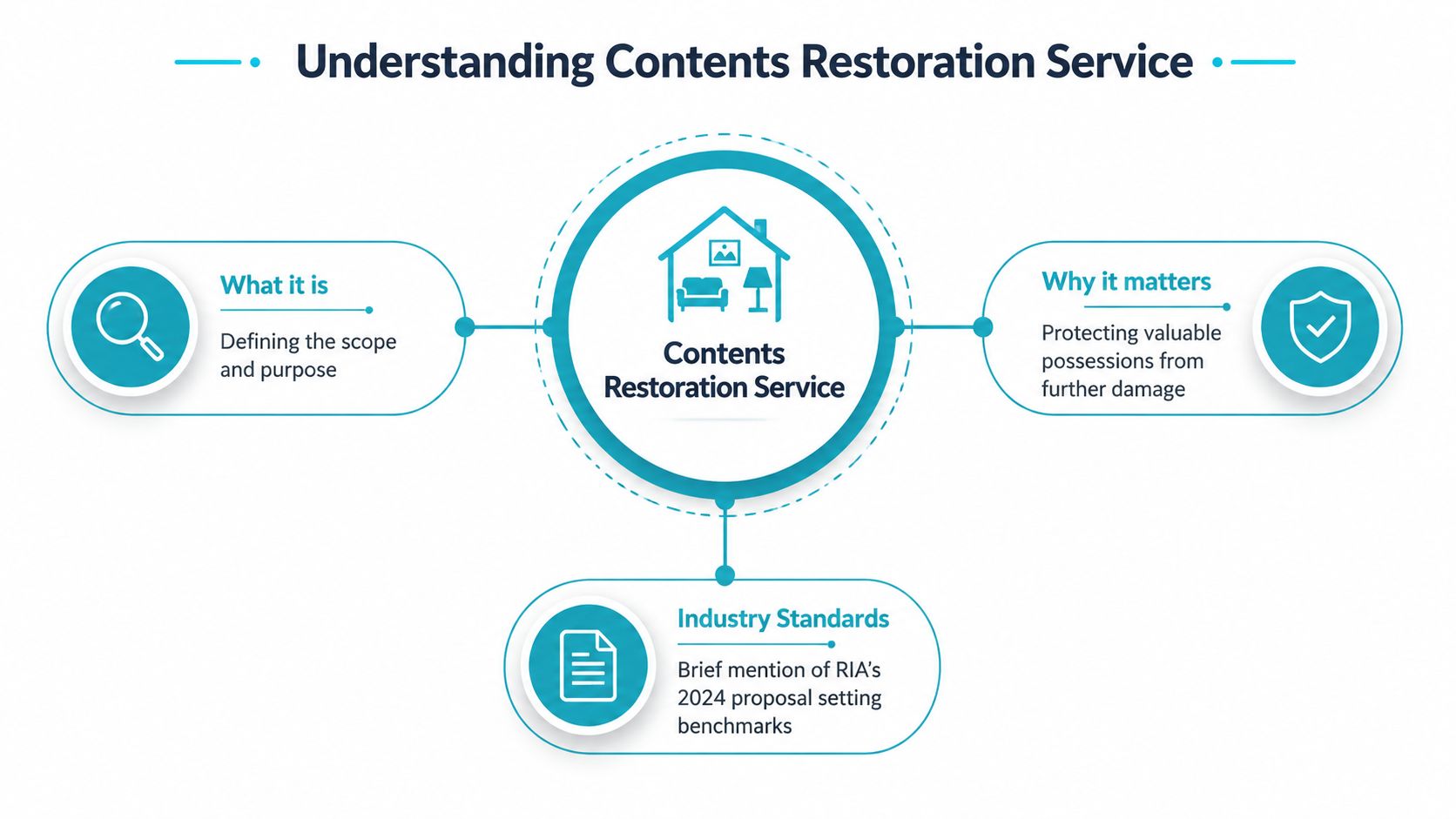
The scale is also real. One industry tracker reported $3.4 billion in U.S. contents restoration and management revenues in 2023, while broader restoration-market estimates point to a much larger recovery economy (industry revenue estimates). Even without turning that into hype, the takeaway is simple, contents restoration sits inside a serious, established market built around disaster recovery.
What it includes
Contents restoration usually covers documentation, pack-out, cleaning, deodorizing, storage, and reinstallation. In practice, that means items can be treated by material and damage type instead of being judged as a pile of “wet things.” That distinction is what keeps heirlooms, electronics, textiles, and paper records from being thrown away too early.
If you want a plain-language overview of what a restoration company does beyond the contents room, this restoration-company guide helps put the process in context. For a related local example of how damage assessment works in another part of the home, water damage assessment and repair shows how condition, material, and timing shape the decision.
Navigating Contents Restoration Service Workflow
The cleanest way to think about contents recovery is like hospital triage. Not every item gets the same treatment, and not every item can wait. First, technicians sort items by condition, then they document what’s there, then they move the belongings into controlled treatment spaces where the right process can be applied to the right material.

A rigorous workflow begins with item-level triage, photography, barcoding, and inventory before belongings move to controlled facilities for ultrasonic cleaning, freeze-drying, or humidity-regulated drying chambers under IICRC protocols (workflow reference). That sequence protects chain of custody and reduces cross-contamination, which is especially important when fire residue, floodwater, or mold are part of the loss.
Step 1 to Step 2
Emergency response is about stabilizing the scene and preventing more damage. Pack-out is the next move, where items get photographed and inventoried before they leave the property. Homeowners usually see boxes, labels, and careful handling, while the restoration crew is building the record that insurance and reinstallation depend on.
Step 3 to Step 5
Specialized cleaning depends on material. Hard goods may go through ultrasonic cleaning, documents can be freeze-dried, and water-saturated textiles often need controlled drying. After that, items go into secure storage until the home is ready, then they’re brought back and checked again before pack-back.
The goal isn’t to make everything look new. The goal is to save what can safely and economically be saved.
For a closer look at structural drying after a water event, this step-by-step flooded-home guide gives useful context for why contents and structure have to be managed together.
Estimating Timelines and Costs for Contents Restoration Service
A flooded sofa, a box of family photos, and a stack of books do not follow the same recovery path. That is why homeowners usually ask two questions first, how long will this take, and is it worth restoring at all. The answer depends on the item itself, the type of contamination, and how quickly the loss is handled. Dry books on a shelf may only need careful cleaning and monitoring, while smoke-damaged upholstery or soaked paper records often require a different decision altogether.
A practical restore-versus-replace framework helps make that choice without guesswork. For a clear overview of that approach. The rule is straightforward. Restore items that are high-value, hard to replace, or emotionally important, especially when the damage is light and the structure is still sound. Replace items that are inexpensive, widely available, heavily contaminated, or extensively damaged that cleaning would leave hidden odor, staining, or safety concerns. For Florida homeowners, that distinction matters because moisture, smoke, and mold can turn a minor problem into a bigger one if the wrong item stays in service.
Typical contents restoration cost and timeline estimates
| Item Category | Restore if… | Replace if… | What usually affects timing |
|---|---|---|---|
| Textiles | The fabric is sentimental, specialty-made, or lightly affected, and the fibers can still be cleaned and deodorized. | The item is low-cost, badly saturated, contaminated, or likely to keep odor after treatment. | Fabric type, drying method, and how quickly the item is stabilized. |
| Furniture | The piece is solid, high-value, antique, custom-built, or part of a matching set worth preserving. | The frame is warped, veneer is failing, contamination reached deep into cushions or joints, or the item is mass-produced and easy to replace. | Material, structural damage, and whether cleaning must be paired with odor removal or refinishing. |
| Electronics | The device is expensive enough to justify specialist evaluation and was exposed briefly, with no obvious deep contamination. | The device took major water intrusion, corrosion is visible, or repair costs would exceed the value of the unit. | Drying speed, corrosion risk, and the need for testing before reuse. |
| Documents and photos | The papers are irreplaceable, legal, historical, or sentimental, and can be stabilized before further deterioration. | The contents are duplicates, routine records, or too deteriorated to recover legibly. | Paper type, saturation level, and whether freeze-drying or flattening is needed. |
The table is less about exact price tags and more about the logic behind the decision. That is the part many homeowners need first. Restoration usually becomes more practical when the item has high replacement cost, special meaning, or a durable structure that can withstand cleaning. Replacement usually makes more sense when the item is common, cheaply replaced, or compromised in a way that would make future use unreliable.
Timing follows the same logic. Fast pack-out and prompt drying often improve salvage potential because they limit mold growth, staining, and warping. Delays work against books, papers, fabrics, and wood because moisture keeps moving through the material, much like a spill left on a countertop spreads farther if it is not wiped up quickly. A seasoned water damage restoration company can help you decide which belongings should be stabilized first and which ones are better off being written off early, before more labor is spent on items that will not fully recover.
If you are weighing recovery options after a loss, the water-damage restoration company guide is a helpful companion because it shows how urgency shapes the entire contents process.
Coordinating Insurance Claims with Contents Restoration Service
Insurance gets easier when the documentation is solid from the beginning. A good contents crew takes photos, records item condition, and creates an inventory that a claims adjuster can follow. That paperwork matters because the adjuster needs a defensible record, not a vague list of “damaged household items.”
The most useful habit is to separate what's clearly salvageable from what's clearly not, then keep that logic consistent in the file. If smoke, mold, or moisture created mixed damage, the contents team can note which items need specialized treatment and which items should be replaced. That kind of clarity reduces back-and-forth and helps the claim move with less friction.
A homeowner should also ask early about pre-authorization requirements, especially if the policy may question storage, deodorization, or repeated cleaning passes. If there's a coverage gap, financing can sometimes help bridge the period while the claim is being reviewed, but the policy language still drives the final outcome.
For a broader claim-process reference, this guide to filing a water-damage insurance claim can help you understand the sequence insurers usually expect. The key is simple, document first, communicate often, and don't let undocumented items get mixed into the salvage pile.
How to Choose a Contents Restoration Service Provider
A Florida homeowner standing in a wet, smoky, or mold-affected room needs more than a crew with trucks. The right provider should be able to explain how each item will be handled, how it will be tracked, and how the team decides whether an item should be restored or replaced. That decision matters because a chair, television, family document, or keepsake may carry very different value from what a store receipt would suggest.

The best companies usually show their work before the first box is packed. Look for IICRC certifications, emergency availability, a local presence, documented chain-of-custody methods, and plain-language answers about what can still be saved. Independent business listings describe AMPM Restoration as locally owned and serving the Suncoast for over a decade, which gives homeowners a sense of the kind of continuity they may want in a restoration partner (service-areas page). The same careful screening used for restoration work also helps when hiring adjacent services, like TLC Moving advice on insured movers, because valuables should be protected at every handoff.
Questions worth asking
- How is chain of custody tracked? Ask whether items are photographed, tagged, and inventoried before pack-out.
- Where are belongings stored? Climate control and security should be easy for the provider to describe.
- How is smoke odor verified? Visual cleaning alone is not enough for odor-heavy losses.
- What happens if an item can't be restored? You want a clear explanation and proper documentation.
- What support is available for emergency scheduling? In a loss event, availability is part of service quality, not a bonus.
A simple restore-versus-replace framework helps homeowners make faster, smarter choices. Hard goods like metal furniture, solid wood pieces, and many electronics often justify restoration review because cleaning and deodorizing may cost less than buying new, especially if the item is structurally sound. Porous items, such as heavily smoke-soaked upholstery or saturated paper goods, may be harder to save, so the provider should explain the likely return on effort before work starts.
Documents, photos, and family records deserve a different standard than everyday household goods. Even when the replacement value is low, the personal value may be high, so a provider should explain whether drying, flattening, digitizing, or controlled cleaning can preserve them. That same careful judgment applies to items with layered damage, where a surface may look fine but hidden moisture, soot, or odor still makes replacement the cleaner long-term choice.
If a provider cannot explain the path from pack-out to pack-back, keep looking.
For readers comparing providers, the FAQs on hardwood floor refinishing are a useful reminder of a broader principle, good restoration work is always about process, not just promises.
Conclusion and Next Steps
Contents restoration is about saving the items that make a loss personal, not just repairing the room around them. In Florida, where water, smoke, and humidity can all turn a small problem into a bigger one, speed and documentation matter. If belongings need professional evaluation, the safest next move is to get a prompt inspection and make a restore-versus-replace decision before secondary damage spreads.
AMPM Restoration's emergency-restoration content directs readers to call 941-946-7807 for a free inspection and estimate, supporting 24/7 service delivery (emergency restoration page). If you're dealing with contents loss right now, don't wait for odors, mold, or hidden moisture to settle in. Call now, get the inspection on the calendar, and protect what can still be saved.
Contents Restoration Service FAQs
What should I do with electronics after water or smoke damage?
Unplug them if it is safe, then leave them off and out of humid rooms. Electronics can look fine on the outside while corrosion or soot residue keeps working inside, the way moisture can hide under a closed cabinet door until the wood swells. A specialist should inspect them before anyone tries a test run, because a quick power-on can turn a restorable item into a lost one.
How is mold work different in contents restoration?
Contents mold work focuses on the belongings themselves, while structural mold work addresses walls, floors, and other parts of the building. The first job is to separate affected items fast, keep contamination from spreading, and decide whether cleaning, drying, or disposal is the safest path. Porous items with mold often need a different answer than hard surfaces, because fabric, paper, and padding hold contamination in a way that smooth materials do not.
How long are items usually stored during restoration?
Storage lasts until the structure is ready and the items are safe to return. The timeline depends on the damage, the scope of repairs, and whether the contents need extra cleaning or odor treatment. A good provider should give clear updates along the way, so you are not left wondering whether your belongings are still in treatment, still in storage, or ready to come back.
What should I do before the pack-out team arrives?
Make a short list of the highest-priority items, secure medications and personal documents if you can reach them safely, and avoid moving damaged belongings around the house. Do not start cleaning soaked or smoky items yourself unless a technician says that is appropriate. The less the items are handled before documentation, the cleaner the inventory record will be, and that record often becomes the map for deciding what to restore and what to replace.
What items are often harder to restore?
Porous items, heavily contaminated textiles, and materials with lingering odor or structural damage are harder to bring back. That is why restore-versus-replace decisions should be made item by item instead of in bulk. The best providers explain why one piece is worth treatment and another is not, much like a technician sorting a salvageable photo album from a waterlogged box that has already started to break down.
Can I read more before deciding whether to restore or replace items?
Yes. If you are also weighing other home-recovery projects, FAQs about hardwood floor refinishing show how homeowners can use expert FAQs to understand repair choices before spending money. A similar question-by-question approach helps with contents too, especially when you are trying to decide whether a cabinet, chair, book, or appliance has a realistic path back to use.
A CTA for AMPM Restoration Services. Call 941-946-7807 now for a free inspection and estimate, ask about insurance claim assistance and financing options, and get a fast, local response before damage to your contents gets worse.