

Is Mold Dangerous to Breathe Long-Term?
You wake up in Bradenton or Sarasota with a scratchy throat, a cough that won’t quit, and a headache that seems to fade when you leave the house. You clean the bathroom. You wipe the vent. You spray the corner by the window. The musty smell still comes back. If you’re asking is Mold dangerous to breathe long-term, the short answer is yes. Not in a movie-monster way, but in a real building-health way that can keep irritating your lungs and make existing breathing problems worse.
On Florida’s Gulf Coast, this problem shows up fast. A roof leak after a storm, a slow plumbing drip behind a cabinet, AC condensation, or a flood that “looked dry” after cleanup can all leave enough moisture behind for mold to take hold. Once that happens, you’re not just dealing with an ugly stain. You’re dealing with contaminated indoor air and a moisture problem that won’t fix itself.
I’m going to be blunt. If you smell mold, see recurring discoloration, or feel worse inside your home than outside it, treat that as a warning sign. Don’t wait for the patch to grow across the wall before you act. Florida humidity gives mold a head start, and delay is what turns a manageable issue into a bigger remediation job.
Introduction Is Your Florida Home Making You Sick
A lot of homeowners call only after months of second-guessing themselves. They’ve had a leak under the sink. A ceiling stain after heavy rain. An AC closet that always smells damp. Then someone in the house starts coughing more, or their asthma gets touchier, or they wake up congested every morning and blame pollen.
That pattern matters. In a humid place like Lakewood Ranch, Saint Petersburg, or Tampa Bay, indoor moisture problems are common, and mold doesn’t need a dramatic flood to become a problem. It just needs damp material, stale air, and time.
What I tell homeowners: If your home smells earthy, feels damp, and your symptoms ease when you leave, stop treating it like a cleaning issue. Start treating it like a hidden water-damage issue.
The risk isn’t just the visible patch on drywall. It’s the hidden growth behind baseboards, inside wall cavities, around air handlers, under flooring, or behind cabinets where moisture sat too long. That’s why the question isn’t only “Do I see mold?” It’s “What am I breathing every day in this house?”
Florida homeowners need a clear answer, not internet myths. You don’t need panic. You need inspection, moisture detection, and proper containment if remediation is needed.
Understanding How Mold Affects Your Indoor Air
Mold acts like an invasive weed in a damp garden. Once it finds moisture, it spreads across the surface and releases tiny particles into the air. You don’t have to touch it for it to affect your indoor environment. Breathing the air in that room can be enough to irritate sensitive airways.
What actually gets into the air
Those particles can circulate through normal air movement, foot traffic, and your HVAC system. That’s why a mold problem in one room can affect the feel of the whole house, especially in tightly closed Florida homes running air conditioning most of the year.

The important nuance is this: mold doesn’t affect everybody the same way. The health effects of mold vary by dose, duration, species, and individual sensitivity. Some people have no symptoms, while others develop allergy-like or asthma-like reactions. Long-term exposure is linked to respiratory symptoms and asthma worsening, while the evidence is stronger for symptom aggravation than for claims of universal toxicity or the idea that “black mold” is uniquely dangerous according to Healthline’s review of mold exposure timing and symptoms.
Why the black mold conversation confuses people
Homeowners get hung up on species names. That’s a mistake. From a restoration standpoint, the bigger issue is indoor growth plus moisture plus ongoing exposure. I don’t need a homeowner to memorize mold names to know there’s a problem. If mold is active indoors, the air quality is compromised, and that deserves attention.
Here’s the practical way to consider it:
- Visible growth means active conditions: If mold is showing on drywall, trim, vents, or contents, moisture has already supported growth.
- Hidden growth is often worse: A small stain can be the tip of a much larger problem behind the surface.
- Air movement spreads contamination: Opening a wall, running fans, or scrubbing aggressively can spread particles if the area isn’t contained.
Indoor air quality matters here. If you want a broader homeowner-friendly explanation of how household contaminants affect breathing air, Platinum Heating & Cooling’s air quality insights are a useful supplemental read. If you suspect mold specifically, professional air quality testing for mold helps determine whether contamination is affecting the indoor environment beyond what you can see.
The Documented Long-Term Health Risks of Mold Exposure
Yes, mold is dangerous to breathe long-term because the strongest evidence ties chronic exposure in damp indoor environments to breathing-related symptoms and asthma problems. This is not guesswork. A major milestone came from the 2004 Institute of Medicine review, which found sufficient evidence of an association between damp indoor environments or mold and upper respiratory tract symptoms, cough, wheeze, and asthma symptoms in sensitized people, along with hypersensitivity pneumonitis in susceptible individuals, as summarized by the EPA’s mold and health guidance.
That finding shaped how public-health agencies talk about mold today. Serious people stopped treating it like a cosmetic nuisance and started treating it as an exposure problem tied to damp buildings.
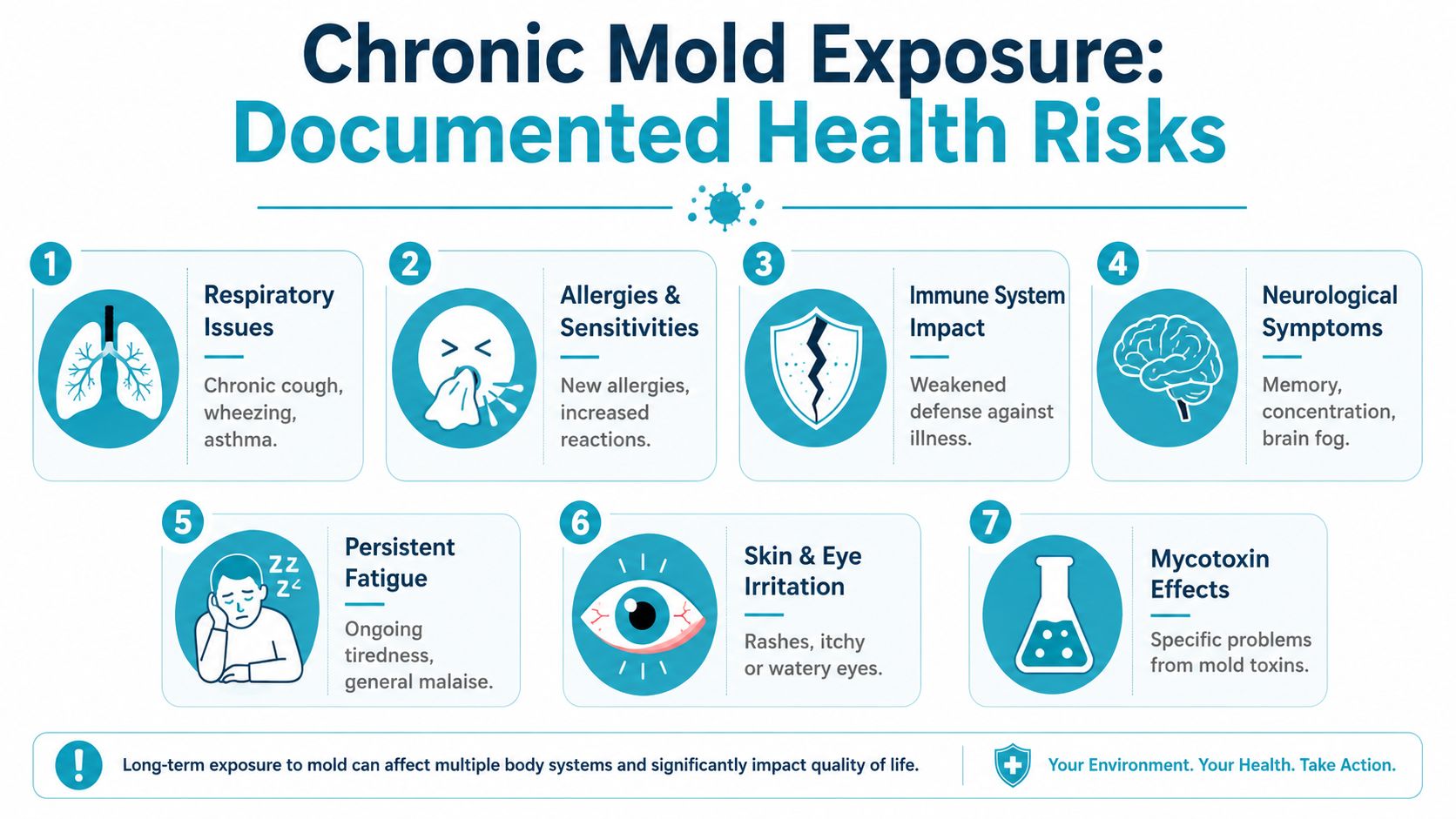
Respiratory symptoms are the clearest concern
If you live with mold long enough, the most common problems usually show up in your nose, throat, and lungs first.
- Chronic irritation: Stuffy nose, sore throat, coughing, and wheezing can keep coming back when the source remains in the home.
- Asthma flare-ups: People who already have asthma often react sooner and harder.
- Ongoing airway stress: Repeated inhalation in a damp building can keep sensitive airways inflamed.
That last point is where homeowners get burned. They assume that because they’re not “severely sick,” the mold must be harmless. That’s not how this works. A home can keep aggravating your respiratory system without producing some dramatic, one-time event.
Living with mold for months doesn’t have to produce a medical emergency to be damaging. Repeated irritation is enough reason to act.
Some people develop stronger reactions
Public-health guidance also links mold exposure to burning eyes and skin rash. Those symptoms matter because they tell you the exposure isn’t limited to one body system. Your home environment may be irritating multiple parts of the body at once.
There’s also an important category that homeowners rarely know by name: hypersensitivity pneumonitis in susceptible individuals. You don’t need to diagnose that yourself. You need to understand what it means in practical terms. For vulnerable people, repeated exposure can provoke more serious lung-related reactions than a simple “allergy.”
Don’t confuse uncertainty with safety
There’s nuance here. Mold science does not support the idea that every person exposed will develop severe disease, and it also doesn’t support internet claims that every dark-colored mold is a unique poison. But that nuance should not make you complacent.
Use this standard instead:
| Concern | What it means in real life |
|---|---|
| Repeated exposure | You keep breathing contaminated indoor air over time |
| Damp building conditions | The source is still active, so symptoms can continue |
| Sensitive occupants | Children, older adults, and people with asthma may react more strongly |
| Hidden contamination | The mold you see may be only part of the problem |
If you’re connecting your symptoms to a damp home, that’s enough to take seriously. For a deeper look at symptom patterns homeowners often miss, see 10 health effects of mold exposure.
Who Is Most Vulnerable to Mold-Related Illness
Not everyone in the same house reacts the same way. One person can feel fine while another keeps coughing, wheezing, or dealing with irritated eyes. That doesn’t mean the mold isn’t a problem. It means sensitivity varies.

The people I worry about most in a moldy house
Children are high on the list. Their bodies are still developing, and they spend a lot of time close to floors, carpets, soft furniture, and other places where moisture and dust can collect. If a child has recurring congestion, coughing at night, or increased breathing issues at home, I don’t brush that off.
Older adults also deserve extra caution. Many already have respiratory or health challenges that make indoor contaminants harder to tolerate. What feels like a mild irritation to one person can be a major trigger to someone with less respiratory reserve.
Then there are people with asthma, mold sensitivity, chronic lung conditions, or weakened immune systems. For them, a “minor” mold issue often isn’t minor at all.
Why vulnerability changes the urgency
When a vulnerable person lives in the home, your threshold for action should be lower. You shouldn’t wait for more visible growth. You shouldn’t rely on bleach and hope. You shouldn’t assume the smell is normal because you live in Florida.
Use this quick lens:
- Children in the home: Act faster because exposure can be harder on developing systems.
- Seniors in the home: Treat musty odors and damp rooms as a health concern, not a housekeeping issue.
- Asthma or allergy history: Expect mold to worsen symptoms, not improve on its own.
- Immune or lung conditions: Get the home assessed promptly.
If you’re concerned about younger family members specifically, this overview of the effects that mold has on children is worth reading.
Mold Prevention in Florida’s Humid Climate
Florida gives mold exactly what it wants. Warm air. High humidity. Frequent rain. Storm-driven leaks. Condensation around HVAC equipment. That means prevention here has to be more disciplined than it would be in a drier climate.
The biggest mistake I see is homeowners treating moisture as temporary. A damp baseboard, a wet closet wall, or a musty AC area isn’t “probably fine.” It’s a warning that the building is holding moisture longer than it should.
The moisture rules that matter
The CDC recommends keeping indoor humidity at no higher than 50% all day long, and Harvard Health advises an ideal indoor range of 30% to 50%. That same guidance also notes that mold can grow after water damage if materials aren’t dried within 24–48 hours. You can read that in Harvard Health’s mold in the home review.
That’s the rule Florida homeowners need to remember. If water sits, mold gets an opening.
Practical rule: If drywall, insulation, flooring, cabinets, or baseboards stay wet beyond the drying window, stop guessing and start drying or opening materials properly.
What smart prevention looks like on the Gulf Coast
You don’t need complicated theory. You need consistent moisture control.
- Watch indoor humidity: If your home feels sticky indoors, your air is too wet for comfort and likely too wet for safe building conditions.
- Inspect after storms: Check ceilings, window perimeters, exterior walls, and attic-adjacent areas after hard rain.
- Pay attention to AC closets and handlers: Condensation and drainage issues are common mold starters in Florida homes.
- Don’t ignore musty smells: Odor often shows up before visible growth.
- Dry fast after leaks: Water cleanup has to be immediate and thorough, not casual.
For homeowners dealing with chronic moisture, this guide on how humidity causes mold in Florida homes connects the climate problem to the hidden building damage that often follows.

Why Professional Mold Remediation Is Not a DIY
A homeowner can wipe a countertop. That doesn’t mean they can remediate a mold problem. Those are different jobs.
DIY cleanup fails for one of two reasons. Either the person only cleans what they can see and leaves hidden contamination behind, or they disturb the growth and spread particles into clean areas. I’ve seen both. A bathroom issue turns into a hallway issue. A cabinet issue turns into HVAC contamination because someone started scrubbing without containment.
What a proper remediation job includes
A real mold remediation project isn’t just “removal.” It’s a controlled process.
-
Inspection and moisture mapping
The first job is finding the source and the scope. If you don’t solve the moisture problem, the mold comes back. -
Containment of the affected area
Pros isolate the work zone so contamination doesn’t spread through the house during demolition and cleaning. -
Removal of affected materials
Porous materials that are contaminated often need to be removed, not just sprayed. -
HEPA filtration and air scrubbing
Cleaning the air during work matters. Disturbed particles don’t just disappear. -
Detailed cleaning and verification
The goal is a dry, clean, controlled environment, not a temporary visual improvement.
Why homeowners should stop at suspicion, not demolition
If you suspect mold behind a wall, your job is not to start tearing into it with no plan. Your job is to document what you see, reduce exposure, and get the area evaluated. One option for that evaluation is when professional mold removal is needed, which outlines the warning signs that move a problem out of DIY territory.
For homeowners in Bradenton, Sarasota, and surrounding Gulf Coast communities, AMPM Restoration Services handles inspection, containment, remediation, and reconstruction when needed. That’s the right sequence. Find the moisture. control the spread. remove what’s compromised. verify the space is safe to occupy.
Frequently Asked Questions About Long-Term Mold Exposure
| Question | Answer |
|---|---|
| Can a small amount of mold make you sick over time? | It can, especially if the mold keeps coming back, sits in a poorly ventilated area, or affects someone who is already sensitive. The real issue isn’t just patch size. It’s whether active moisture is feeding ongoing exposure. |
| Is mold worse in Florida than in other places? | Florida homes face more year-round moisture pressure from humidity, storms, condensation, and heavy AC use. That doesn’t make every home moldy, but it does mean homeowners here have to take dampness more seriously and respond faster. |
| What’s the difference between mold and mildew? | Homeowners often use the terms interchangeably, but neither should be ignored indoors. If you’re seeing recurring growth, staining, or odor, the practical question is whether moisture is still present and whether the contamination is surface-level or deeper in building materials. |
| Does the smell of mold mean it’s dangerous? | A musty odor is a warning sign, not proof by itself of the full scope. But it often means there’s hidden moisture or growth somewhere in the building. If the smell keeps returning, don’t cover it up with fragrance. Find the source. |
| What if I suspect mold but can’t see it? | That’s common. Hidden mold can sit behind walls, under flooring, around windows, inside cabinetry, or near HVAC components. If there’s been a leak, persistent odor, staining, or unexplained indoor symptoms, schedule an inspection instead of waiting for visible growth. |
| Will mold go away if the area dries out now? | Drying is critical, but once contamination has taken hold, drying alone usually doesn’t solve the whole problem. The source moisture must be corrected, and affected materials may still need cleaning, removal, or professional remediation depending on the extent. |
The bottom line is simple. If you're asking whether is Mold dangerous to breathe long-term, you're already asking the right question. Long-term exposure in a damp home is not something to ignore, especially in Florida where humidity and water intrusion are constant risks. If you smell mustiness, see staining, or notice symptoms that seem tied to time spent at home, don't wait for certainty before you act. Get the property inspected.
If you suspect hidden mold or ongoing moisture in your home, call AMPM Restoration Services at 941-946-7807 for a free inspection and estimate. We help homeowners across Bradenton, Sarasota, Tampa Bay, Saint Petersburg, Lakewood Ranch, and nearby Gulf Coast communities identify the source, explain the next steps clearly, and handle professional remediation when needed. We also provide insurance claim assistance and financing options, so you can move quickly without adding more stress to the situation.