

Stormwater Cleanup Services in Sarasota
A Sarasota storm often ends the same way for homeowners. The rain stops, but the stress starts. Water is still sitting along the curb, leaves and grit are packed into the drain, and you’re watching damp spots creep closer to the house, garage, or first-floor baseboards.
That’s when stormwater cleanup services in Sarasota stop sounding like a public works term and start feeling personal. You need to know what the county handles, what you need to handle on your property, and how to keep a drainage problem from turning into water damage, contamination, or mold inside the home.
If you’re dealing with storm runoff after a Gulf Coast weather event, act fast but stay calm. The right next step depends on where the water is, what it touched, and whether the problem is in the public drainage system, on your lot, or already inside your home.
After the Storm Your Guide to Stormwater Cleanup Services in Sarasota
The most common Sarasota storm scene isn’t dramatic. It’s deceptively ordinary. The street looks flooded but passable. A swale is full. Water is circling a storm drain instead of disappearing into it. Then you notice the side yard is saturated, the lanai is taking on water, or the garage threshold is no longer holding.
For many homeowners, the confusion starts right there. Is this the county’s problem because the drain is blocked? Or is it now your problem because water has crossed onto private property? In real life, it can be both. Public crews may clear infrastructure in the right of way, while a restoration team handles extraction, drying, sanitation, and repair inside the house.
That distinction matters because time matters. Standing water outside can become wet drywall, swollen flooring, damaged insulation, and indoor humidity problems fast in Florida conditions. If water has already entered the structure, you may need flood cleanup services in Sarasota even while a public drainage issue is still being addressed elsewhere.
Practical rule: If the water is in the street, ditch, swale, or public drain, report the blockage. If the water is inside your home, against your slab, or soaking building materials, call a restoration professional right away.
Stormwater cleanup isn’t one job. It’s a chain of decisions. First, protect people. Next, identify whether the blockage is public or private. Then remove water, dry the structure, and document everything so you’re not left guessing later.
Understanding Sarasota’s Stormwater System
Many homeowners assume the City of Sarasota handles every drain inside city limits. That isn’t how it works. The city states that maintenance, cleaning, and repair of most stormwater systems within city limits are the responsibility of Sarasota County, with service requests directed to the county’s Stormwater Utility through the city’s stormwater public works page.
Public drainage and private property aren’t the same thing
A simple way to think about it is this. The public stormwater network is like the main road system. It includes inlets, pipes, ditches, canals, and other conveyance features that move runoff through the county system. Your lot is like the driveway and sidewalk leading to that road. If either side is blocked, water won’t move the way it should.
That’s why a county crew clearing a roadside inlet won’t also remove soaked carpet from a bedroom. Public stormwater work is about keeping water moving through the larger drainage path. Private restoration work is about protecting the building and the people in it.
Sarasota’s setup also tells you something important about local conditions. Stormwater cleanup here isn’t just occasional debris pickup. It’s part of an ongoing countywide maintenance system, and the county maintains a GIS layer for completed maintenance actions on pipes, ditches, and swales, as noted on the same city public works resource.
What homeowners often get wrong
The most common misunderstanding is assuming that visible street flooding automatically explains all water on the property. Sometimes it does. Sometimes it doesn’t. A clogged downspout extension, blocked yard drain, low grading near the slab, or debris at a private inlet can push water back toward the home even when the larger system is functioning. It’s not Sarasota-specific, but it helps explain why yard drainage, surface grading, and obstruction points matter so much after storms.
Here’s the practical split:
- Public issue: Water is ponding at the street, a ditch is overgrown, or a roadside drain appears blocked.
- Private issue: Water is backing up around your foundation, entering the garage, pooling on the lanai, or soaking interior materials.
- Mixed issue: A public blockage starts the problem, but your immediate risk is now inside the home.
When homeowners understand that split, they make faster calls and avoid losing time waiting for the wrong party.
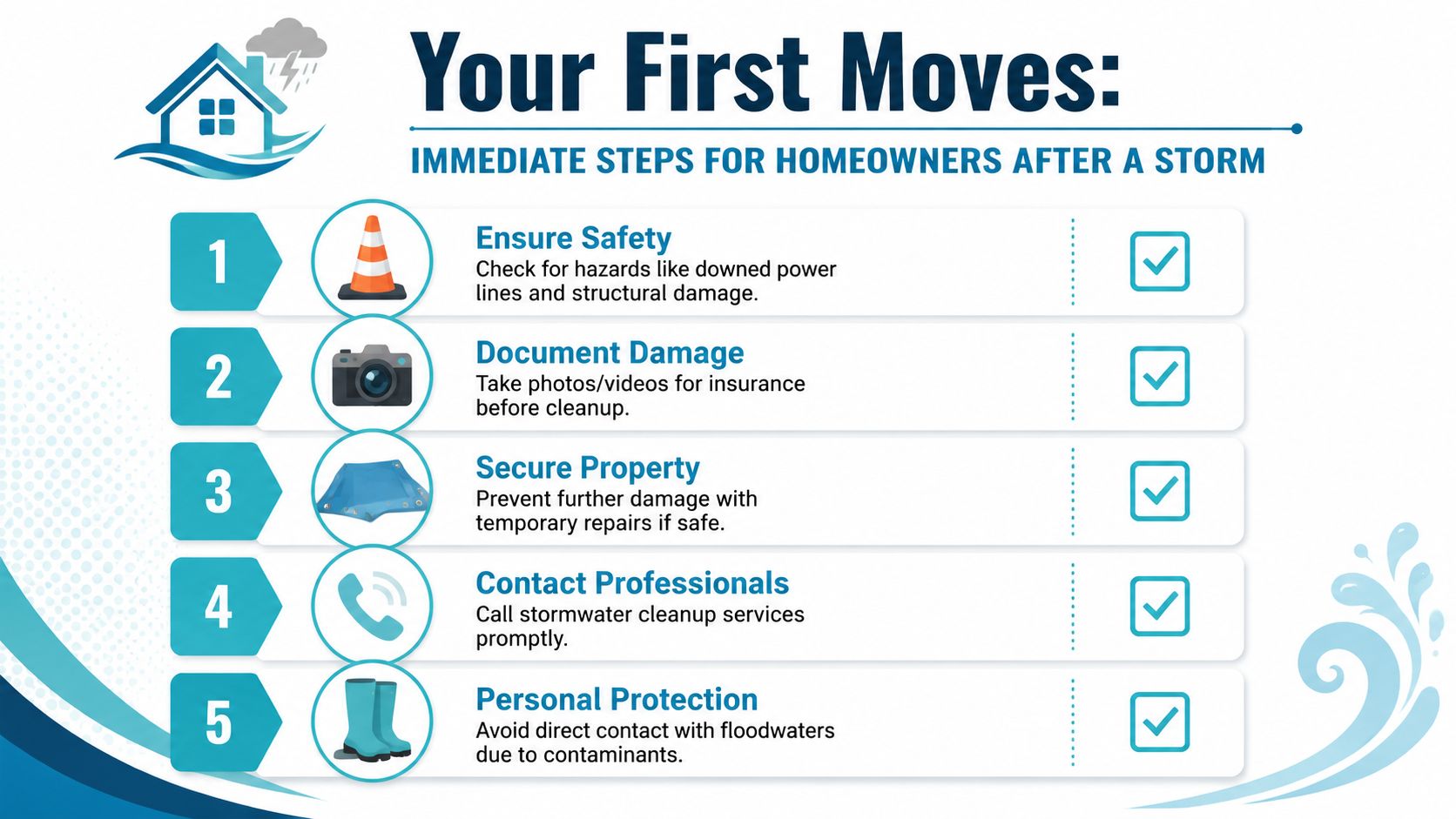
Your First Moves: Immediate Steps for Homeowners
When stormwater reaches your property, your first job isn’t cleanup. It’s control. You’re trying to keep a bad situation from getting bigger while preserving evidence for insurance and avoiding contamination risks.

What to do first
Use this order:
- Check safety before entering affected areas. Watch for electrical hazards, unstable ceilings, slippery flooring, and water near outlets or appliances.
- Treat stormwater as potentially contaminated. Don’t let children or pets walk through it. Wear boots and avoid direct contact when possible.
- Document before moving things. Take wide shots, close-ups, and videos of all affected rooms, exterior ponding, damaged contents, and visible entry paths.
- Stop additional damage if you can do it safely. Move lightweight belongings, place foil or blocks under furniture legs, and keep foot traffic limited.
- Report public drainage problems. Sarasota County directs residents to report standing water, blocked drains, and overgrown ditches through 311Connect, as noted in this county stormwater video guidance.
- Call for interior water damage help. If water entered the structure, don’t wait for materials to “air out” on their own. Florida humidity works against you.
If your roof may have been compromised during the same storm, a separate storm damage roof inspection can help identify hidden entry points that keep feeding the problem.
What not to do
People often create extra damage trying to be helpful. Avoid these mistakes:
- Don’t use household fans blindly. Air movement can help in some situations, but it can also spread contamination or blow moisture into wall cavities.
- Don’t tear out materials too early. Improper demolition can complicate insurance documentation.
- Don’t assume clear water stayed clean. Once storm runoff moves across streets, yards, or drains, it may carry contaminants.
- Don’t delay the first 24 hours. This is when inspection, extraction, and drying plans matter most. A good overview of that early response window is this page on emergency water damage repair in the first 24 hours.
If water touched drywall, baseboards, flooring, cabinets, or insulation, think in terms of moisture migration, not just puddles. What you can see is rarely the full footprint.
The Professional Cleanup and Restoration Process
Professional stormwater cleanup services in Sarasota follow a sequence for a reason. Each stage supports the next. If one step is skipped, the entire recovery can stall. Water removal without drying leaves hidden moisture. Drying without sanitation can leave contamination concerns. Repairs without documentation can create insurance problems later.

Emergency assessment and containment
The first step is a site assessment. Technicians identify where water entered, which materials are affected, and whether the water presents a contamination concern. They also look for secondary problems such as trapped moisture under flooring, wet insulation, or seepage into wall cavities.
Containment may be needed if water affected only part of the structure or if there’s a concern about spreading contamination to clean areas. This helps keep cleanup controlled instead of turning the whole house into a work zone.
Water extraction and removal
Standing water has to leave fast. That usually means commercial extraction equipment, not a shop vacuum and crossed fingers. The goal is to remove bulk water from floors, carpet, padding, garages, and low-lying interior areas before it keeps wicking into nearby materials.
This is also where the public and private sides of cleanup can overlap. Outside the structure, blocked inlets and storm drains may need mechanical clearing. For technical cleanup execution, high-velocity water jetting is a standard method because it can dislodge sediments, sludge, rocks, concrete, grease, and other debris that ordinary vacuuming or hand removal may leave behind, especially in catch basins and storm drains, as described in this overview of storm drain cleaning services.
Drying and dehumidification
After extraction, the property still isn’t dry. Wet framing, subfloors, drywall edges, trim, and contents continue releasing moisture into the air. In Sarasota’s humid environment, that moisture doesn’t disappear on its own very efficiently.
That’s why professionals use structural drying equipment such as air movers and commercial dehumidifiers in a planned layout. The equipment isn’t placed randomly. It’s used to create airflow across wet surfaces while pulling moisture out of the indoor air so materials can release trapped water.
A restoration provider may also monitor moisture levels during the job to decide when drying goals have been reached. This is one reason professional service is more than “water removal.” It’s a controlled drying process.
Cleaning and sanitizing
If stormwater entered from outside, the job may require more than drying. Floors, lower wall surfaces, contents, and hard-to-reach areas may need cleaning and sanitation. The exact scope depends on what the water contacted and whether runoff carried debris or contaminants with it.
Stormwater damage isn’t always a simple wet-floor problem. It can be a hygiene problem, an odor problem, and later, an indoor-air problem if it’s not handled correctly.
Repairs and reconstruction
Only after the property is dry and clean should repair decisions be finalized. That might include baseboards, drywall sections, flooring materials, insulation, cabinetry components, or paint systems. Some companies handle only mitigation. Others also handle repairs and reconstruction.
One option homeowners often review during this phase is water damage restoration services, especially when they want one team to coordinate mitigation and the work needed to return the space to pre-loss condition.
Choosing a Qualified Contractor in Sarasota
Choosing a restoration contractor after a storm is difficult because you’re making decisions under pressure. Trucks are busy, phones are ringing, and everyone promises fast help. The safer approach is to use a short checklist and stick to it.
A practical reason to move quickly is that public systems can be under pressure after major weather. A 2024 analysis reported that for more than two years, one out of every five positions in the Sarasota County Stormwater Field Services unit was vacant, implying a vacancy rate of roughly 20%, according to this report on Sarasota’s stormwater staffing pressure. That doesn’t mean public crews aren’t working. It means homeowners shouldn’t assume public response timelines will solve private interior damage.
What to verify before you hire
Use these filters:
- 24/7 availability: Storm damage doesn’t wait for business hours.
- Proper Florida licensing and insurance: Ask directly. Don’t assume.
- IICRC-certified technicians: That tells you the crew works from recognized restoration standards.
- Local experience with Sarasota and the Gulf Coast: Coastal weather, humidity, and mixed flood conditions require judgment.
- Insurance-claim familiarity: The contractor should know how to document drying, demolition, and mitigation steps clearly.
- Clear scope of work: You should understand what’s included now and what may be a later repair item.
Questions worth asking on the first call
Instead of asking “How much will it cost?” start with these:
| Question | Why it matters |
|---|---|
| Can you inspect today? | Response time affects damage spread. |
| Do you handle extraction, drying, sanitation, and repairs? | It tells you whether coordination will be simple or fragmented. |
| How do you document moisture and job progress? | Insurance and quality control both depend on records. |
| Have you worked with storm-related water intrusion in Sarasota homes? | Local conditions matter. |
If you want a starting point for comparing local providers, this page on water damage restoration companies near me can help you think through what to ask and what to look for.
Navigating Insurance Costs and Future Prevention
Insurance questions usually arrive once the adrenaline drops. You’ve stopped the immediate spread, but now you want to know what gets covered, what must be documented, and how to avoid going through this again.
The first thing to understand is that insurers care about cause, scope, and response. They want a clear record of what happened, what was affected, and what was done to prevent further damage. That’s especially important when stormwater sits long enough to create a moisture and mold concern.
A key issue in this area is the lack of data-driven guidance on when stormwater cleanup should be treated as a contamination and mold-prevention problem rather than simple water removal. Insurers want documentation showing that delayed drying, which increases mold risk in Florida humidity, was properly addressed by professionals, as noted on our Sarasota storm cleanup and moisture guidance page.
What to document for insurance
Keep the file simple and thorough:
- Photos and video: Capture exterior ponding, entry points, room conditions, and damaged contents.
- Timeline notes: Write down when you discovered the damage, who you called, and when crews arrived.
- Mitigation records: Save invoices, work authorizations, equipment logs, and drying notes.
- Communication records: Keep emails, claim numbers, and adjuster contact details in one place.
For homeowners trying to understand the claims side better, these water damage insurance claim tips can help organize the process.
Prevention that actually helps
No home can be made storm-proof, but some steps reduce repeat problems:
- Keep gutters and downspouts clear: Roof runoff should move away from the foundation.
- Watch grading near the house: Soil and hardscape should direct water away, not trap it.
- Check yard drains and private inlets: Debris buildup can subtly block flow.
- Trim back overgrowth around drainage paths: Water needs a clear route.
- Review low spots after every storm: The pattern usually repeats.
If cost is the barrier, ask early about payment options. Some restoration companies, including AMPM Restoration Services, also assist with insurance claim coordination and offer financing options, which can make emergency mitigation more manageable while the claim process unfolds.
Frequently Asked Questions About Stormwater Cleanup
Is stormwater cleanup the same as flood cleanup?
Not always. Stormwater cleanup can refer to clearing drainage paths, removing debris, and restoring water movement outside. Flood cleanup usually refers to property damage after water has already entered a structure. In Sarasota, homeowners often deal with both at the same time.
Who do I call if the drain on my street is blocked?
If the issue involves standing water, blocked drains, or overgrown ditches in the public system, report it through Sarasota County’s 311Connect, as noted earlier. If water is already affecting your home, call a restoration contractor for the private property side at the same time.
Can I clean up stormwater inside the house myself?
Minor surface water might look manageable, but stormwater can carry contaminants and can soak into hidden building materials. DIY cleanup often misses moisture under floors, inside wall cavities, or behind trim. That’s where odor, material damage, and mold problems can start.
How do I know if the water is contaminated?
You often won’t know just by looking. If runoff came from outside, crossed pavement or planted zones, backed up near drains, or sat for a while, it should be treated cautiously. Wear protective gear, avoid direct contact, and get professional guidance before assuming it’s harmless.
Why is drying so urgent in Sarasota?
Florida humidity slows natural drying. Even when the visible water is gone, moisture can remain in drywall, wood, insulation, and subfloors. Fast extraction and controlled drying reduce the chance that damp materials turn into a bigger restoration project.
What should I expect from a qualified restoration company?
A solid contractor should inspect the damage, explain the scope clearly, remove standing water, set up drying equipment, document the work, and tell you what materials can be saved versus replaced. You should also expect help communicating the mitigation side of the job to your insurer.
If you need stormwater cleanup services in Sarasota, AMPM Restoration Services is available 24/7 to inspect storm, flood, and water damage, explain your next steps clearly, and help protect your property from further loss. Call 941-946-7807 for a free inspection and estimate. We also provide insurance claim assistance and financing options so you can move forward faster with less stress.