


How to Identify Signs of Mold in Walls Before It’s Too Late
You’ve just come home after a heavy Gulf Coast rainstorm. The room looks normal, but a faint musty smell lingers near the baseboard. Then you notice a small brown mark, bubbling paint, or a single dark speck on the drywall. Those subtle changes can be early signs of mold in walls, especially in homes around Bradenton, Sarasota, Tampa Bay, Saint Petersburg, and Lakewood Ranch.
Mold doesn’t always announce itself with a large, obvious patch. It can remain behind drywall, wallpaper, paneling, insulation, or trim while moisture continues moving through the wall assembly. Learning how to rank visual clues, odors, humidity, and meter readings helps you decide whether to monitor the area, investigate further, or call a professional before damage spreads.
Introduction to Signs of Mold in Walls
The first mistake many homeowners make is treating one small stain as a cosmetic issue. A yellow mark may be old water damage, but it can also show that moisture traveled behind the painted surface. Bubbling paint may reflect trapped dampness. A musty odor may point to growth that you can’t see at all.
The most reliable approach is to combine clues rather than depend on appearance alone. Start with what you can observe safely, then look for a pattern:
- Visual changes: Check for discoloration, brown or yellow staining, peeling paint, bubbling finishes, warped drywall, and separating baseboards.
- Odor changes: Notice whether a damp, earthy smell persists after cleaning or becomes stronger near a particular wall, floor area, or HVAC vent.
- Moisture changes: Use a hygrometer and moisture meter to determine whether the environment or building materials remain damp.
- Location clues: Pay close attention to exterior walls, plumbing walls, window openings, bathrooms, laundry rooms, and areas affected by roof or storm leaks.
Inspector’s rule: A wall doesn’t need to look soaked to deserve investigation. Moisture can hide inside the cavity while the finished surface appears nearly normal.
Early action matters because mold growth depends on moisture, temperature, and time. It can also affect indoor comfort and health. The CDC’s guidance on mold and health connects dampness and mold exposure with respiratory symptoms, asthma, allergic rhinitis, bronchitis, and other health concerns. If you’re seeing multiple warning signs, don’t wait for a larger colony to appear.
Understanding Mold Growth in Walls
Mold inside a wall needs more than a single dramatic leak. The basic concept map is simple: moisture supplies the favorable condition, temperature affects how readily growth can continue, and food sources such as drywall paper, wood, dust, and insulation provide material to colonize. In Florida, warm conditions and moisture cycles can keep this combination active in places that never look visibly flooded.

Moisture starts the process
Water may enter through a plumbing leak, roof penetration, poorly sealed window, storm damage, condensation, or high indoor humidity. A wall cavity can stay damp even after the original leak stops, particularly when insulation, paper-faced drywall, or framing slows evaporation.
The EPA’s mold and moisture guidance recommends drying water-damaged materials within 24–48 hours after a leak or spill. It also recommends keeping indoor relative humidity below 60%, ideally between 30% and 50%, to reduce growth risk. Those targets matter in Bradenton and other Gulf Coast communities because outdoor humidity can make indoor moisture control harder.
Temperature and time determine persistence
Warm, mild conditions can support continued growth when moisture remains available. The issue often develops cumulatively, through repeated condensation or wetting and drying cycles rather than one obvious event.
A field study reported mold growth on walls with moisture content below 2%, which shows that lightly damp surfaces can still develop visible mold when favorable conditions persist over time. Read the wall moisture and mold-growth study for the technical background.
If the moisture source is an active pipe or fixture, prompt water leak repair services can stop additional water from entering the assembly. You can also review how humidity causes mold in Florida homes to understand why indoor air control matters even when there’s no visible leak.
Identifying Visual Signs of Mold
Visible changes are useful, but they’re not equally diagnostic. A dark speck alone doesn’t prove the wall cavity contains mold. A stain paired with soft drywall, a musty odor, or a concentrated moisture reading deserves much more attention.
Look across the entire area instead of examining one mark in isolation. Check the lower wall near baseboards, corners, window frames, plumbing fixtures, and places where furniture may restrict airflow. The signs of water damage in walls can help you compare surface changes with likely moisture movement.
| Visual Sign | Likely Cause | Urgency |
|---|---|---|
| Dark, green, gray, or fuzzy spots | Possible surface mold, persistent dampness, or contamination on a porous finish | High, avoid disturbing it |
| Yellow or brown tide marks | Water migration from a leak, roof issue, window opening, or plumbing line | High, investigate the source |
| Bubbling or blistering paint | Moisture trapped behind the finish layer | High, verify with moisture mapping |
| Peeling wallpaper or cracked drywall tape | Repeated dampness or movement in the wall assembly | High, inspect the cavity |
| Warped, swollen, or soft drywall | Prolonged wetting and material deterioration | Immediate professional evaluation |
| Baseboard separation | Moisture moving along the lower wall or floor edge | High, check adjacent framing and flooring |
Discoloration often appears before a major colony becomes obvious. Yellow and brown marks can trace the path of water as it moves downward or outward behind the finish. A stain that expands, darkens, or returns after cleaning indicates that the moisture source may still be active.
Bubbling paint and peeling finishes deserve special caution. When drywall paper or paint separates from the substrate, moisture may already be trapped behind it. Don't scrape aggressively or sand the area, because disturbing suspect material can spread particles through the room.
Warping and swelling are stronger physical clues than color alone. Drywall that feels soft, bows outward, or has a rippled paper surface has likely experienced moisture intrusion. If the affected wall is near a bathroom, laundry area, window, roofline, or plumbing chase, call for an inspection rather than covering the damage with fresh paint.
Recognizing Odor and Moisture Indicators
A persistent odor can be more informative than a tiny visible spot. Hidden mold may produce a musty, earthy, or stale smell that remains after the room is cleaned. The odor may concentrate near one wall, along the floor, behind furniture, or around an HVAC supply or return.
Use your nose to locate a pattern, not to identify a species. Odor alone doesn't prove the exact source or extent of contamination, but it becomes a strong reason to investigate when it aligns with wall damage or high readings.
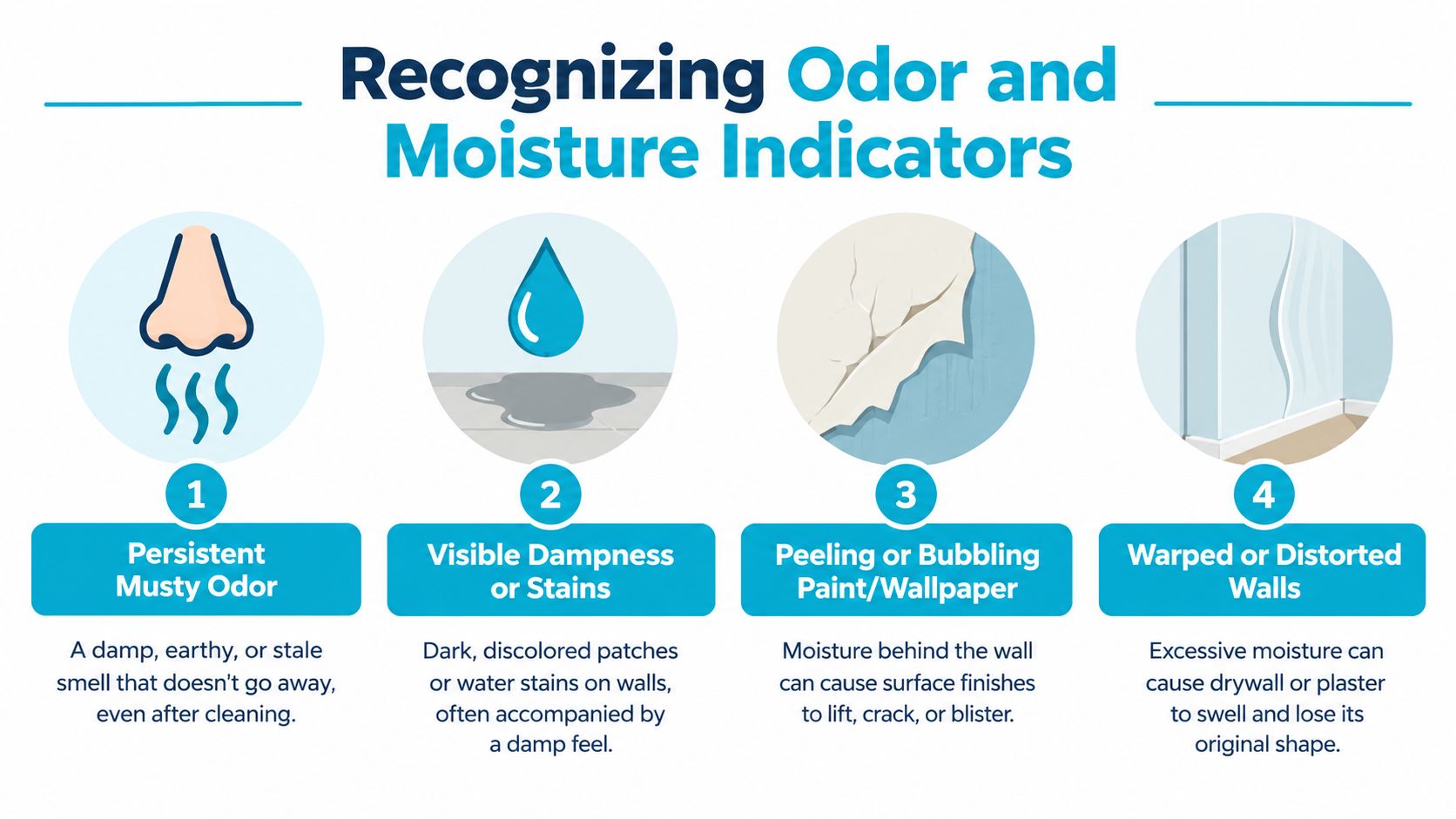
Rank clues by diagnostic value
A localized moisture pattern is usually the most useful starting point. Scan several areas, including a visibly unaffected section for comparison. A concentrated higher reading near a stain, baseboard, window, or plumbing wall provides a practical direction for further inspection.
Sustained ambient relative humidity at or above 75% creates favorable conditions for mold growth, while drywall readings above 17% warrant further investigation. The moisture-testing guidance from Tramex explains why humidity and material readings should be interpreted together rather than treated as isolated proof.
A musty odor ranks next because it can reveal hidden growth behind intact finishes. Visual damage ranks highly when it shows active moisture movement, especially bubbling paint, soft drywall, or recurring stains. A single unexplained mark is weaker evidence, but several matching clues can justify opening a wall or calling a professional.
When a wall should be opened
You shouldn't cut into drywall merely because you see one speck. Consider professional evaluation when a persistent smell comes from one wall and a meter shows high moisture, when stains keep returning, or when the drywall is soft, swollen, or separating from trim.
The EPA explains that hidden mold can occur behind drywall, wallpaper, and paneling where moisture isn't obvious. You can also review signs of hidden water damage behind drywall before deciding whether a targeted investigation is appropriate.
When and How to Test for Mold Behind Walls
Testing works best as a sequence, not as one magic device. A home test kit, air sample, thermal camera, or borescope can provide useful information, but each tool answers a different question. None alone proves the full size of a hidden colony.
Start with non-invasive checks
First, map moisture. Use a non-invasive moisture meter to compare the suspicious area with nearby dry sections. Record where readings rise and fall. The pattern can help identify whether moisture is concentrated around a pipe, window, baseboard, ceiling, or exterior wall.
Next, use thermal imaging. An infrared camera may reveal temperature patterns associated with damp materials or airflow differences. It doesn't see mold directly, and a cool area isn't automatically wet, so an experienced inspector must interpret the image alongside moisture readings and construction details.

Use sampling and limited openings strategically
Air sampling can help determine whether airborne spores are at heightened concentrations in a particular area, while surface sampling can help characterize material from a visible location. These tests can support an assessment, but they don't replace moisture mapping or a building inspection.
A borescope inserted through a small access point can provide direct visual information with limited disruption. If the evidence is strong, a controlled test cut may be more informative than repeated general sampling. The recommended progression is moisture mapping, thermal imaging, air or surface sampling, then borescope or test cuts, as explained in this guide to hidden mold behind walls.
Call a qualified professional when the smell persists without a visible source, moisture readings remain high, the wall contains insulation, the affected area follows a plumbing or roof path, or cutting into the wall could disturb contaminated materials. A professional can document conditions and coordinate the next step. For more detail, see whether a mold inspection can detect hidden mold behind walls.
Taking Next Steps for Mold Remediation
Once inspection confirms hidden mold or ongoing moisture, cleaning the visible surface isn't enough. The moisture source must be corrected, affected porous materials must be evaluated, and the work area must be controlled so particles don't spread into clean rooms.
A sound remediation process generally follows this order:
- Stop the source: Repair the plumbing, roof, window, drainage, condensation, or HVAC issue feeding the wall.
- Contain the area: Separate the affected space from occupied areas and manage airflow during removal.
- Filter the air: Use appropriate HEPA filtration and protective controls while disturbing contaminated materials.
- Remove damaged materials: Take out unsalvageable drywall, insulation, or other porous components according to the assessment.
- Clean and treat remaining surfaces: HEPA vacuuming, cleaning, drying, and appropriate antimicrobial treatment may be used for salvageable materials.
- Rebuild the wall: Replace removed components only after the cavity is dry and the source has been addressed.
The EPA recommends drying wet materials within 24–48 hours after water damage, as described in its mold and moisture recommendations. If a wall has remained damp longer, don't assume drying the paint surface resolves the cavity.
AMPM Restoration Services is a local option for homeowners and property managers needing mold inspection, mold removal, water damage restoration, fire and smoke restoration, storm and flood cleanup, and reconstruction across Bradenton, Sarasota, Tampa Bay, Saint Petersburg, Lakewood Ranch, and nearby Gulf Coast communities. The company operates 24/7 from 4301 32nd St W b18, Bradenton, FL 34205, offers insurance claim assistance and financing options, and provides free inspections and estimates. Review its mold remediation process before authorizing work.
Mold in Walls FAQs
How long can mold take to appear behind a wall?
Mold can begin developing within 24–48 hours after materials stay wet, according to industry moisture guidance at this mold moisture meter resource. Hidden growth may continue when the wall experiences repeated dampness, condensation, or slow drying. After any leak, dry the area promptly and inspect for recurring odor, staining, or soft materials.
How should I use a moisture meter at home?
Take several readings around the suspicious area instead of relying on one spot. Compare the wall with a nearby section that appears dry, mark the locations, and note whether readings are higher near the floor, a window, plumbing, or a ceiling. A meter helps locate a moisture pattern, but it doesn't identify mold by itself. AMPM Restoration offers a free inspection if the readings remain high or conflict with what you can see.
What should I do before filing an insurance claim?
Photograph stains, damaged finishes, standing water, and affected belongings before making unnecessary repairs. Keep records of when you noticed the problem, what caused the water intrusion if known, and which emergency steps you took. Coverage depends on the policy and cause of damage, so contact your insurer promptly and ask whether the restoration contractor can assist with claim documentation. AMPM can provide insurance claim assistance and a free inspection.
Are renters responsible for mold in a wall?
Responsibility depends on the lease, the cause of the moisture, and whether the tenant reported the issue promptly. Notify the landlord or property manager in writing, include photos, and avoid cutting into the wall or applying aggressive chemicals. If you're unsure whether professional evaluation is appropriate, this resource on when to get a specialized mold test can clarify the difference between a general inspection and targeted testing.
Can pets indicate hidden mold risk?
Pets may react to unusual odors or changes in indoor air, but their behavior doesn't diagnose mold. A pet avoiding one room, sneezing, or acting uncomfortable should prompt you to check for moisture and consult a veterinarian if symptoms continue. Combine that observation with wall staining, odor, humidity, or meter readings rather than treating it as proof.
How does financing work with AMPM Restoration?
Ask for the available financing options during the inspection and estimate process. The team can explain what documentation is needed, which work is included, and how payment arrangements relate to the proposed restoration scope. AMPM also offers free inspections, estimates, and insurance claim assistance, so call before opening a concealed wall yourself.
Call 941-946-7807 to request a free inspection and estimate for suspected signs of mold in walls, water damage, or hidden moisture. AMPM Restoration provides 24/7 mold inspection, remediation, drying, repairs, and reconstruction across Bradenton and Florida's Gulf Coast, with insurance claim assistance and financing options available. You can also visit AMPM Restoration Services to schedule help.