

HVAC Mold Removal Cost Explained
HVAC mold removal cost typically runs $3,000 to $10,000 per system, while simpler duct-only work can start around $600 to $2,000 when contamination is limited. A homeowner in Florida may pay far more when mold has reached coils, plenums, insulation, flexible ductwork, or the moisture source feeding the problem.
A musty odor that appears every time the air conditioner starts is easy to dismiss as a seasonal nuisance. In Bradenton, Sarasota, and other Gulf Coast communities, however, warm humid air and recurring condensation can create conditions where mold develops inside the equipment that distributes air throughout the home. The right question is not just what duct cleaning costs. It’s what the system needs to become clean, dry, and safe to operate again.
When Musty Smells Signal Costly HVAC Mold Problems
A homeowner in Bradenton notices a stale, earthy smell when the AC kicks on. At first, the odor seems minor. Then family members begin mentioning congestion, irritated eyes, headaches, or unexplained allergy symptoms that ease when they leave the house. The smell returns whenever the blower runs, carrying air from the air handler and duct network into bedrooms, living areas, and hallways.
That pattern deserves attention. Mold inside an HVAC system isn’t just a spot on a visible vent cover. If contaminated equipment continues operating, it can distribute spores through the building. The EPA’s mold remediation guidance recommends shutting down a contaminated HVAC system during remediation because operation can spread mold throughout the building.

Why Florida homes face a distinct risk
Air-conditioning systems remove moisture as they cool indoor air. When drain pans, coils, insulation, or duct surfaces stay damp, mold can grow in areas that homeowners can’t see without opening the system. Gulf Coast properties also face storm moisture, flooding, roof leaks, and humidity infiltration, so the HVAC unit may be part of a larger water problem.
A musty odor doesn’t prove that mold is present, and headaches or allergy symptoms can have many causes. It does mean the system needs a professional assessment, particularly when the smell is persistent, returns after basic cleaning, or appears alongside visible spotting, condensation, water staining, or repeated drain-pan overflow.
Practical rule: Don’t keep running an HVAC system suspected of contamination while waiting for an inspection. The system can move affected air into clean rooms.
A qualified inspection should identify where growth is located, whether moisture remains active, and which components can be cleaned safely. Air quality testing for mold may be useful when the source isn’t obvious or when occupants and property managers need additional information before deciding on remediation.
That inspection also frames the financial decision. A small amount of mold on accessible metal is a very different project from contamination inside lined ducts or an air handler. The final HVAC mold removal cost follows the scope, not the odor alone.
Key Factors That Drive Your HVAC Mold Remediation Cost
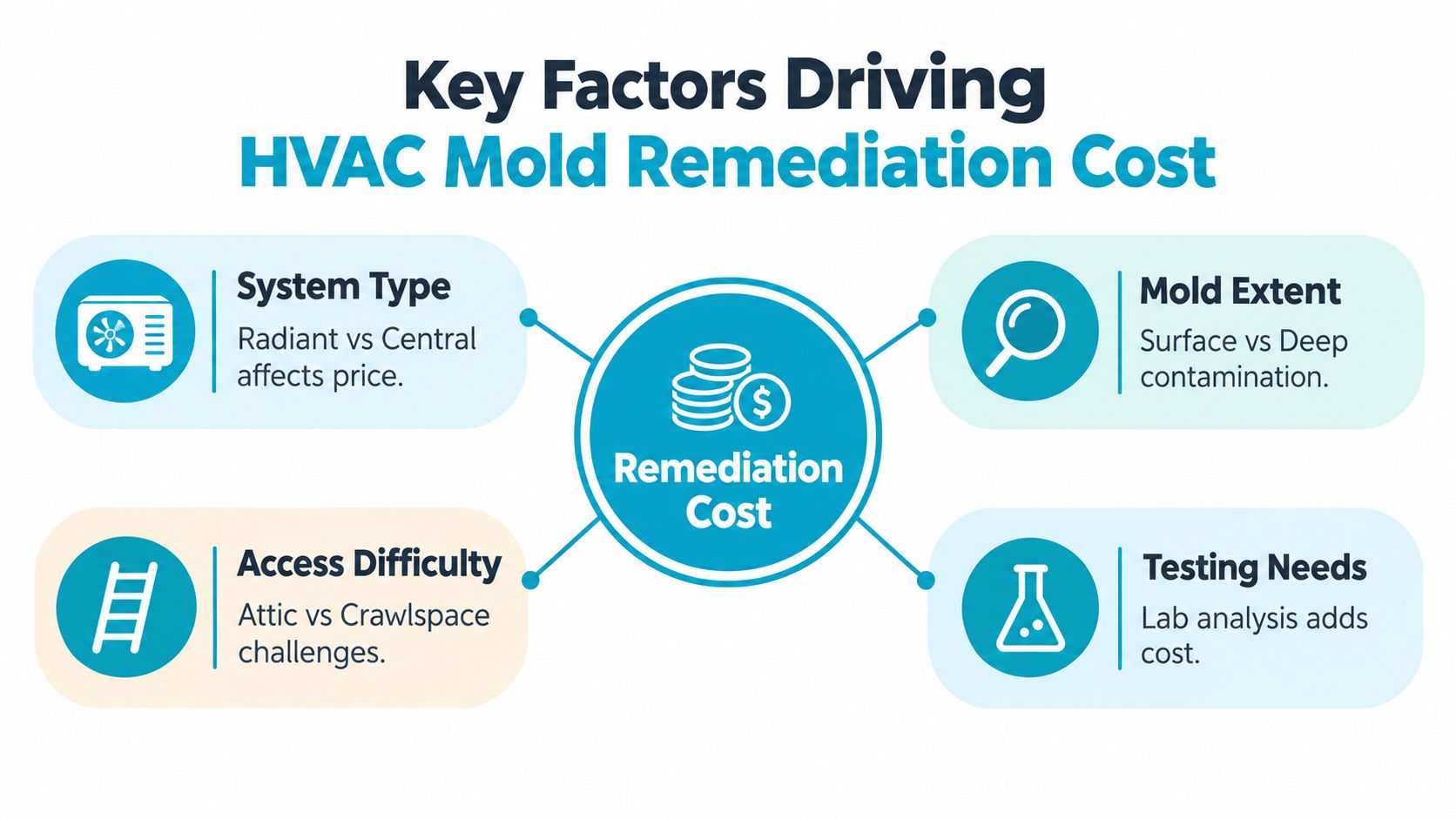
A quote becomes easier to judge when it shows how the contractor reached the price. The main variables are system design, contamination depth, moisture control, access, and verification needs. A company that gives one unexplained figure may be leaving important work outside the agreement.
System design changes the labor
Radiant heating systems generally have fewer duct pathways than central cooling systems. Furnace and air-handler arrangements vary by property, while Florida central AC systems often include coils, drain pans, plenums, supply runs, return runs, and concealed sections. The more components technicians must isolate, open, clean, dry, and inspect, the more labor the project requires.
Mold location matters more than the visible spot
Surface growth on an accessible sheet-metal duct may be manageable with HEPA vacuuming and appropriate cleaning. Mold inside porous insulation is different. The EPA’s technical guidance for HVAC systems explains that wet or moldy internal duct insulation should be removed and replaced because it can’t be cleaned effectively. It also notes that there are no EPA-approved antimicrobial products for lined ductwork.
That distinction is one of the largest hidden cost drivers. A contractor may clean the visible register while leaving contaminated insulation or flexible ductwork in place. The odor may return because the source was never removed.
Moisture correction is separate work
Cleaning doesn’t solve a leaking drain pan, blocked condensate line, failed insulation, or persistent condensation problem. Technicians may need to inspect the coil, pan, drain system, surrounding insulation, and nearby building materials. If the moisture source remains, a clean system can become contaminated again.
Access affects time and equipment
An air handler in an open utility room is easier to reach than one in a cramped attic or crawlspace. Long concealed duct runs, tight access panels, high ceilings, and occupied commercial spaces can require additional containment, protection, and labor. Florida homes with attached garages, attic air handlers, and compact mechanical closets often present very different working conditions.
Before accepting a proposal, ask whether it includes the air handler, coils, drain pan, plenums, accessible duct runs, porous material removal, moisture correction, and final verification. A detailed scope is more useful than a low headline price. For local guidance on duct-related work, homeowners can review HVAC duct cleaning services near Florida communities.
Cost Differences Across HVAC System Types in Florida Homes
System type sets the starting point, but contamination severity, access, and component replacement usually determine the final invoice. The following ranges, documented in the HVAC mold remediation cost guide from Bob Vila, are market benchmarks, not guaranteed bids. A property inspection is still required before a contractor can price the actual work.
| System type | Typical remediation range | Why the cost differs |
|---|---|---|
| Radiant heating system | $1,500 to $5,000 | Fewer duct pathways and a simpler contamination profile in many installations |
| Furnace and air-handler system | $3,000 to $5,000 | Moderate equipment and duct complexity, with cleaning or replacement needs varying by layout |
| Central air-conditioning system | $3,000 to $10,000 | More moisture exposure, vents, tubes, ducts, coils, drain pans, and concealed components |
Radiant heating often falls near the lower end because it may not have the extensive air-distribution network found in central cooling. The work can still expand if moisture has affected insulation, adjacent building materials, or concealed areas.
Why central AC usually creates the widest range
Central air conditioning produces moisture during normal cooling. In an accessible system with limited contamination, technicians may treat affected metal surfaces, coils, and related components without replacing large sections. Severe growth can require work across duct runs, plenums, insulation, drain components, and other enclosed areas.
“Central AC remediation” can describe either a limited cleaning project or a full-system intervention. Duct cleaning by itself may not address mold on coils, air handlers, or lined ductwork. It also does not correct the moisture condition that allowed growth to develop.
For general duct cleaning, the EPA gives a related baseline of about $450 to $1,000 per heating and cooling system, while noting that accessibility, system size, region, and contamination affect the price. The EPA’s duct-cleaning guidance makes clear that this figure is not a complete mold-remediation budget.
Once mold is involved, the scope may include containment, HEPA vacuuming, detergent cleaning, antimicrobial treatment on suitable surfaces, and replacement of porous components. Homeowners comparing HVAC duct cleaning services near Florida communities should confirm whether the proposal covers those tasks, rather than assuming a duct-cleaning price includes the entire HVAC system.
Understanding the Professional Mold Remediation Process Step by Step
A complete HVAC mold-remediation project follows a set sequence. Skipping a stage may lower the first invoice while leaving contamination, moisture, or damaged components in place.
1. Inspection and scope definition
The technician examines the equipment, accessible ductwork, insulation, drain system, nearby building materials, and areas with odor or staining. Visual inspection and moisture readings help show whether growth is active and whether a leak, condensation problem, or drainage issue extends beyond the HVAC cabinet.
2. Shutdown and containment
The HVAC system is turned off before contaminated areas are disturbed. Containment separates the work zone from occupied rooms, while air-control equipment limits particle movement. The EPA’s mold remediation guidance advises keeping contaminated HVAC systems off until remediation is complete, since operation can distribute mold through the building.
3. Filtration and cleanable-surface treatment
Technicians use HEPA-filtered equipment to capture particles and clean suitable hard surfaces, following the EPA’s guidance on HEPA vacuuming and surface cleaning. Sheet-metal components may be vacuumed, wiped with a moist cloth and detergent solution, and treated according to the material and written remediation plan. Antimicrobial products do not replace removal of contaminated porous materials.
4. Removal of porous components
Moldy insulation, flexible duct sections, and other porous materials may require removal instead of coating or deodorizing. Bagging and removal limit spread during disposal, while cleanable materials can be HEPA-vacuumed or wiped with detergent when their condition allows cleaning.
5. Moisture correction and restoration
The crew may restore a drain pan, clear blocked drainage, correct condensation, repair damaged insulation, or address a nearby leak. Replacement ductwork, insulation, coils, or other HVAC components can change the budget substantially. Leaving the moisture source unresolved creates a direct risk of recurring growth.
6. Final verification
After cleaning and drying, the work area and equipment should be inspected before normal operation resumes. Depending on the project, the owner may request clearance testing or other documentation. Property managers should retain the scope, photographs, moisture findings, disposal records, and verification results in the maintenance file. A detailed mold remediation timeline helps occupants understand why inspection, containment, removal, drying, and verification cannot be rushed.
Why the Lowest Quote Is Often the Most Expensive Choice
The cheapest estimate often covers only the easiest visible task. It may include vacuuming a few registers while excluding the air handler, coils, drain pan, flexible ductwork, moisture repair, containment, or post-remediation verification. That isn’t a bargain if contaminated materials remain in the system.
What low bids commonly leave out
Flexible duct replacement can add $2,000 to $5,000 or more in some cases, according to current HVAC cost guidance. Other commonly separated items include diagnostics, coil cleaning, drain-pan restoration, moisture-source repairs, disposal, and repairs to areas opened during remediation.
The EPA’s duct-cleaning guidance also emphasizes that pricing varies with accessibility and contamination severity. A contractor who quotes from a phone description can’t know whether the work involves accessible metal or concealed porous material.
A low quote is only useful when it describes the same scope as the higher quotes.
Compare proposals line by line. Look for these warning signs:
- No system inventory: The estimate doesn’t identify the air handler, coils, pan, plenums, or duct sections included.
- No moisture plan: The contractor promises cleaning but doesn’t investigate why the system became damp.
- No porous-material policy: The bid says “treat all mold” without explaining what happens to contaminated insulation or flexible duct.
- No containment or shutdown procedure: The proposal ignores how technicians will prevent distribution during the work.
- No final documentation: The contractor can’t explain how the owner will know the system is ready to operate.
A thorough company may cost more initially because it includes the work needed to prevent recurrence. Homeowners comparing mold remediation experts should ask for written exclusions as well as inclusions. An honest estimate makes uncertainty visible instead of turning it into surprise charges later.
Smart Budgeting Tips for Florida Homeowners Facing Mold Remediation
Start with the system category, then prepare for the possibility that the inspection will uncover hidden work. A limited duct-only project may be manageable, while contaminated insulation, component replacement, or active moisture can move the project into a much broader range.
Use this decision checklist before signing:
- Request a written scope: Confirm which ducts, coils, air handler, pan, plenums, insulation, and adjacent materials are included.
- Ask about moisture: Find out whether condensate drainage, condensation, leaks, and insulation will be inspected and corrected.
- Separate cleaning from replacement: Make sure the proposal identifies materials that can be cleaned and those that must be removed.
- Confirm verification: Ask what inspection, documentation, or clearance process follows the cleaning.
- Check qualifications: Verify licensing, insurance, relevant experience, and IICRC certification where applicable.
- Compare equal scopes: Obtain more than one inspection, but don’t compare a full remediation plan with a register-cleaning quote.
Insurance coverage depends on the policy and the cause of the loss. Mold connected to covered water damage may be treated differently from long-term maintenance or excluded conditions, so review whether mold remediation may be covered by insurance and document the original leak, storm, overflow, or water event.
AMPM Restoration Services provides mold inspection, mold removal, HVAC-related cleaning, water damage restoration, and reconstruction support across Bradenton, Sarasota, Tampa Bay, Saint Petersburg, Lakewood Ranch, and surrounding Gulf Coast communities. The company also offers insurance claim assistance and financing options, which can help property owners organize necessary work without choosing an incomplete shortcut.
For a 24/7 response, call 941-946-7807 to request a free inspection and estimate for suspected HVAC mold, with insurance claim assistance and financing options available. Visit AMPM Restoration Services to connect with a local team serving Bradenton, Sarasota, Tampa Bay, Saint Petersburg, Lakewood Ranch, and nearby Florida communities.