


How to Identify Signs of Mold in Walls Before It’s Too Late
A fire can be out, cigarette smoke can be gone, and wildfire haze can have cleared from the neighborhood, yet your Bradenton or Sarasota home may still smell sour and acrid. You may have wiped down the walls, opened the windows, and run an air freshener, only to notice the odor return when the air conditioner starts.
Professional smoke smell removal addresses the material carrying the odor, not just the air you notice. Smoke deposits toxic chemicals and fine particles in fabrics, drywall, cabinetry, insulation, contents, and HVAC systems, so a lasting solution usually combines source removal, detailed cleaning, filtration, deodorization, and sometimes duct treatment. This guide explains why odor persists, which commercial methods target different reservoirs, what service looks like, how costs and timing are determined, and how Suncoast homeowners can evaluate a restoration contractor.
Introduction to Professional Smoke Smell Removal in Florida Homes
A home can look clean while still holding a smoke problem. After a small kitchen fire, a cigarette odor, or smoke infiltration from a wildfire, the visible residue may be limited, but odor molecules can remain in upholstery, curtains, carpet, wood, wall surfaces, and the air-conditioning system. In Florida, homes rely heavily on HVAC circulation, and warm, humid conditions can make persistent odor more noticeable as contaminated materials release compounds back into the air.
That’s why professional smoke smell removal isn’t a single spray, scented product, or machine left running in an empty room. A qualified restoration team first identifies the source, separates airborne contamination from embedded reservoirs, cleans affected materials, and then selects filtration or deodorization equipment for what remains. EPA indoor-air guidance emphasizes source control and ventilation as core indoor-air measures, which supports the practical restoration sequence of removing contamination before trying to improve the air.
Homeowners often start with the wrong question: “What will cover the smell?” The better question is, “Where is the smell stored?” If the source is in a return-air grille, a fabric sofa, dusty insulation, or smoke-affected drywall, an air freshener only adds another scent. A restoration plan must reach the reservoir.
Practical rule: If the odor returns after the room has been aired out, assume the home still contains a source that needs to be located and cleaned.
For local guidance on the first signs that a property needs help, review what to do when a house smells of smoke. The same principle applies across Bradenton, Sarasota, Tampa Bay, Saint Petersburg, Lakewood Ranch, and nearby Gulf Coast communities. The goal isn’t merely a pleasant-smelling room. It’s a property with smoke residue addressed in the places that continue to affect indoor air.
Why Smoke Odor Lingers Long After the Smoke Clears
Smoke isn’t just a smell. The National Institute of Environmental Health Sciences explains that smoke from combustion sources such as cigarettes, cookstoves, and wildfires can contain toxic chemicals including formaldehyde and lead, along with fine particles. Those particles and chemicals travel with smoke and settle on or inside materials throughout a building.
Think of smoke residue as an invisible, contaminated sponge. A hard countertop may release some residue with careful cleaning, but porous materials absorb and hold it. Carpet fibers, curtains, upholstery, unfinished wood, insulation, cabinetry, and drywall can retain compounds that slowly move back into the indoor air. That process is called off-gassing, and it explains why a room can smell clean immediately after wiping surfaces but smell smoky again later.
Airborne odor and reservoir odor are different problems
Airborne odor is what your nose detects in the room at a given moment. An air scrubber can reduce airborne particles and some gaseous compounds while it operates. Reservoir odor is stored in materials and dust, then released as temperature, humidity, or air movement changes.
Professional smoke odor work must account for both. Smoke-related chemical classes can include PAHs, aldehydes, phenols, and VOCs, and these contaminants may reach cavities, HVAC components, and porous contents, not only visible surfaces. A surface wipe can improve the room while leaving the deeper reservoir intact.
That’s also why the HVAC system deserves attention. If contaminated dust or residue remains in ductwork, air-handler components, filters, or nearby insulation, normal air circulation can redistribute odor into cleaned rooms. A restoration professional may need to inspect the system and determine whether cleaning, filtration, or specialized duct treatment belongs in the scope.

Why ventilation alone has limits
Ventilation and source control have been the foundation of air purification for millennia, before modern filtration became available. Opening windows and increasing air exchange can help reduce what’s airborne, but it can’t extract residue embedded in a sofa, inside dusty carpet, or on a porous wall.
Research on indoor smoke VOCs found that surface cleaning removed contaminant reservoirs more effectively and more persistently than portable air cleaners or window opening in a controlled house study, as reported by Science Advances. That finding gives homeowners a useful answer to a common frustration: an air scrubber may help the air, but it won’t replace physical cleaning where the contamination is stored.
For a broader understanding of how fire losses move from assessment through restoration, see this fire damage restoration process guide. The sequence matters because deodorization performed before source removal often treats the symptom while leaving the cause behind.
Commercial Grade Methods That Actually Remove Smoke Odor
Commercial equipment isn’t interchangeable. Each method addresses a different part of the smoke problem, and the strongest plans combine tools only after the technician understands the material and contamination level.
Thermal fogging creates a heated deodorizing fog designed to reach spaces and porous surfaces that ordinary wiping can’t fully access. It can be useful for odor held in furnishings and hard-to-reach areas, but it doesn’t eliminate the need for cleaning soot and residue first.
Ozone and hydroxyl oxidation work through chemical reaction. Ozone and hydroxyl treatments can oxidize odor molecules, breaking carbon-carbon bonds and reducing odor-causing VOCs rather than covering them with fragrance. Ozone is not a universal solution, however. Professional guidance identifies it as a supplemental step that doesn’t substitute for mechanical or chemical cleaning and may not penetrate dense substrates, wall cavities, subfloors, or HVAC insulation, as explained by smoke odor removal specialists.
HEPA air scrubbing and negative air focus on airborne particles and containment. HEPA filtration captures fine particulate matter, while negative air helps keep contaminated air from moving into unaffected areas. These systems are valuable during cleaning, but they can’t remove residue that remains attached to a wall or absorbed into fabric.
Activated carbon adsorption targets gaseous compounds. Carbon attracts and holds odor-causing VOCs within its pore structure. Its performance depends on air chemistry and pre-cleaning. Research indexed by PubMed reports that ozone can shorten activated carbon breakthrough time and irreversibly damage activated charcoal’s pore structure, so professionals generally clean first and use carbon filtration in a controlled sequence.
The practical distinction is simple: scrubbers treat moving air, carbon treats gaseous compounds, oxidation changes odor chemistry, and cleaning removes the reservoir.

Which professional method targets which smoke reservoir
| Method | How It Works | Best For |
|---|---|---|
| Thermal fogging | Delivers a fine heated deodorizing fog into difficult areas and porous materials | Persistent odor in furnishings and hard-to-reach spaces |
| Ozone or hydroxyl oxidation | Oxidizes odor molecules and reduces odor-causing VOCs | Selected controlled treatments after source cleaning |
| HEPA air scrubbing and negative air | Captures airborne particles and supports containment | Airborne soot, work-zone control, and post-cleaning filtration |
| Activated carbon adsorption | Adsorbs gaseous VOCs and odor compounds | Odor in circulating air after cleaning |
| Contents cleaning | Removes smoke residue from movable belongings and fabrics | Furniture, textiles, personal property, and décor |
| HVAC treatment | Addresses contamination connected to filters, ducts, and air-handling components | Odor that returns when the air conditioner operates |
| Sealing and encapsulation | Locks residual contamination behind a compatible coating after cleaning | Selected structural materials that retain odor |
Homeowners comparing approaches can also consult Renue Systems Four Points odor solutions for general odor-control context. The right professional plan still depends on inspection, material compatibility, and the location of the reservoir.
Wood deserves special care because smoke can enter grain and joints. A targeted guide to removing smoke odor from wood can help explain why refinishing or sealing before cleaning often traps the problem rather than solving it.
What to Expect During Professional Smoke Smell Removal Service
The first stage is assessment, not deodorization. A technician identifies the smoke source, tracks how air and residue moved through the property, checks porous contents and structural surfaces, and considers whether the HVAC system has redistributed contamination. This evaluation determines whether the project needs light cleaning, contents treatment, air scrubbing, duct work, oxidation, or sealing.
Before treatment begins, occupants, pets, and sensitive materials may need to leave the affected area. Technicians isolate work zones, protect contents that will remain, and remove loose debris or heavily contaminated items when appropriate. Source removal matters because no machine can compensate for a material that continues releasing odor.
Preparation and cleaning come first
Professional crews commonly begin with dry removal methods, HEPA vacuuming, specialized cleaning agents, and material-specific procedures for walls, ceilings, floors, furniture, and contents. Cleaning soot before oxidation also protects the performance of activated carbon equipment, since ozone can damage carbon's pore structure and shorten its useful breakthrough time, according to the PubMed research cited earlier. The crew should explain which items can be restored and which may require replacement.
Movable belongings often need their own treatment plan. Textiles, upholstered furniture, books, cabinetry, and décor can hold odor even after the room's air improves. A contents-focused service may combine HEPA vacuuming, laundering, specialty cleaning, controlled deodorization, and drying based on the material.

Treatment and re-entry require control
Once surfaces and contents have been addressed, the team may use activated carbon, HEPA air scrubbing, thermal fogging, hydroxyl equipment, or a carefully controlled ozone treatment. Ozone can create a burst of contaminants during operation, so occupants and pets must remain out, sensitive materials need consideration, and the property must be ventilated before re-entry. Recent indoor-air research has also examined chemical changes on smoke-affected surfaces, including ozone-aging effects that can form larger particles, reinforcing why oxidation should be managed as a controlled treatment rather than a casual do-it-yourself shortcut. This chemistry is discussed in Lawrence Berkeley National Laboratory's ozone guidance.
A complete closeout includes an odor assessment, review of cleaned areas, equipment removal, ventilation, and HVAC attention. For light smoke, soot, and ash damage with odor but no visible soot or ash, FEMA guidance includes aerating the home, installing a new MERV 11 or higher HVAC filter and running the fan continuously, using activated charcoal containers, and cleaning soft goods with a HEPA-filtered vacuum, as summarized by FEMA-based restoration guidance. Heavier contamination needs a broader professional scope.
For belongings that need separate evaluation, explore contents restoration services. A clean room isn't a finished project if contaminated contents continue releasing odor into it.
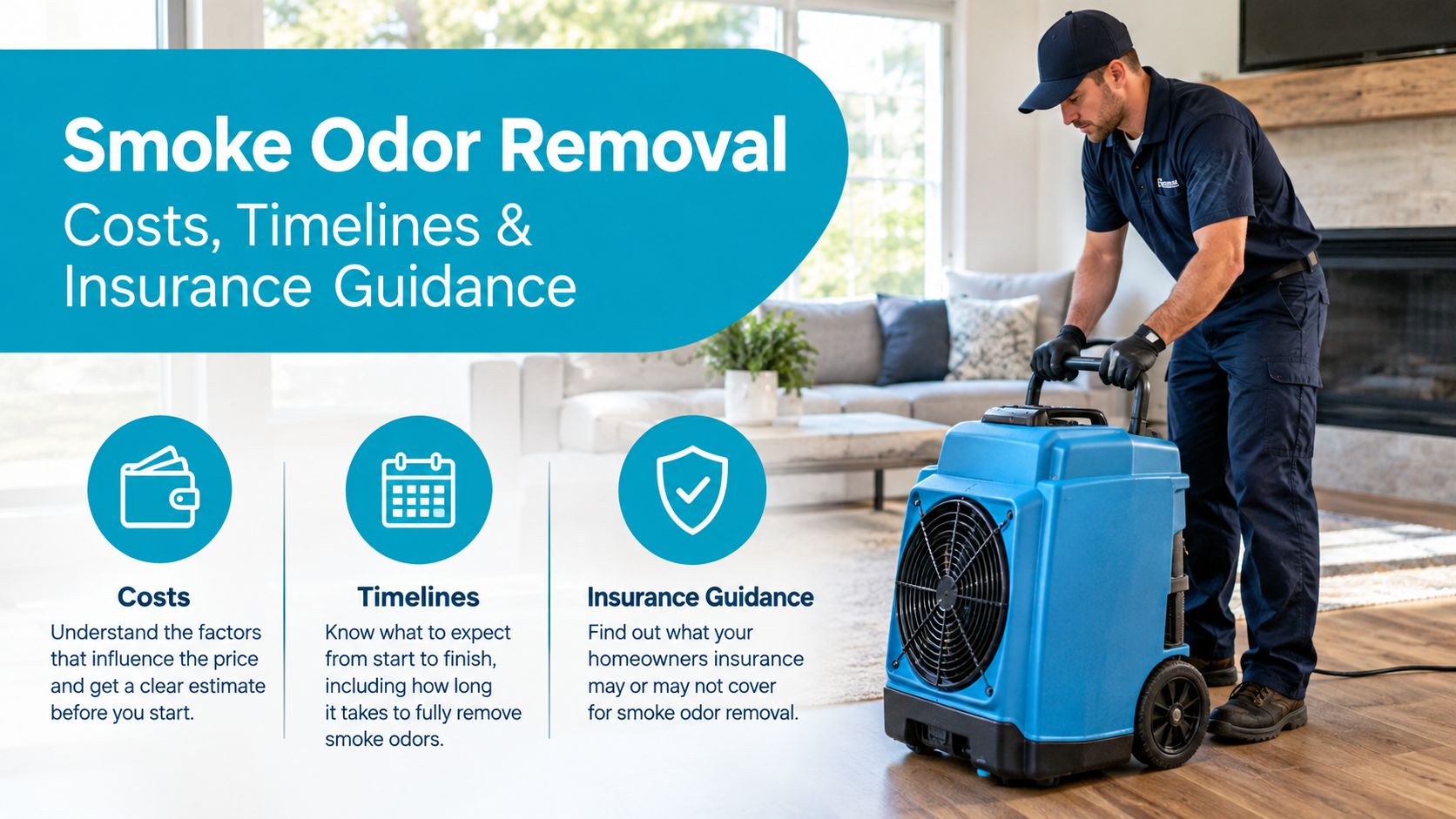
Costs Timelines and Insurance Guidance for Smoke Odor Removal
Smoke odor removal doesn't have one reliable flat price because the work depends on what must be cleaned and how far contamination traveled. A small odor-only problem in one area may need a focused scope, while a fire loss with soot, affected contents, structural residue, and HVAC contamination requires more labor and more specialized equipment.
What changes the cost
The main cost drivers include:
- Property size: More rooms and greater square footage require more inspection, cleaning, equipment placement, and monitoring.
- Contamination severity: Light odor differs from oily soot, visible residue, or smoke that migrated through several areas.
- Contents volume: Upholstered furniture, clothing, books, drapery, and cabinetry add handling and treatment time.
- HVAC involvement: Ducts, filters, air handlers, and insulation may require inspection or specialized treatment.
- Method selection: Cleaning, carbon filtration, thermal fogging, hydroxyl treatment, ozone, sealing, and reconstruction each address different conditions.
The timeline follows the same logic. Cleaning and drying can extend the project, while oxidation dwell time, ventilation, re-entry requirements, contents handling, and repairs can add separate phases. A contractor should provide a written scope that explains what will happen, which materials are included, and what conditions could change the plan.
For a minor odor-only case, FEMA's practical measures may be appropriate, including MERV 11 or higher filtration, activated charcoal, ventilation, and HEPA vacuuming. If odor returns, visible soot is present, multiple rooms are affected, or the HVAC system carries the smell, request a professional assessment instead of repeatedly buying air fresheners or consumer machines.
Document the loss with photographs, videos, an inventory of affected belongings, and notes about when the odor appears. For homeowners reviewing coverage questions, this overview of dwelling fire insurance in Florida offers useful insurance context. AMPM Restoration Services can also provide insurance claim assistance and discuss financing options. Learn more about insurance restoration services and what homeowners should know before authorizing work.
How to Choose the Right Smoke Odor Removal Contractor on the Suncoast
A contractor should be able to explain the reservoir, not just name a machine. Ask whether the team will inspect porous contents, wall surfaces, cavities, HVAC components, and areas outside the room where the odor is strongest. A credible plan should identify what will be cleaned first and why filtration or oxidation follows.
Questions worth asking before work begins
- Credentials: Is the company IICRC-certified, licensed, bonded, and insured?
- Response: Does it offer 24/7 emergency service and a one-hour arrival time?
- Sequencing: Will technicians remove soot and residue before using ozone, hydroxyl, fogging, or carbon filtration?
- Safety: How will the crew protect occupants, pets, sensitive materials, and neighboring areas?
- HVAC scope: Will the team inspect filters, returns, ducts, and air-handling components?
- Verification: What ventilation, re-entry guidance, odor checks, and completion documentation will be provided?
- Insurance: Will the contractor communicate directly with the carrier and help organize the claim documentation?
- Guarantee: Is the scope clear, and what does the stated satisfaction guarantee cover?
Local access matters on the Suncoast. AMPM Restoration is based at 4301 32nd St W b18, Bradenton, FL 34205, serves Bradenton, Sarasota, Tampa Bay, Saint Petersburg, Lakewood Ranch, Palmetto, and surrounding Gulf Coast communities, and offers 24/7 emergency response with a one-hour response time. Its IICRC-certified team handles fire and smoke restoration, water damage, mold services, storm and flood cleanup, commercial restoration, and reconstruction, allowing one provider to coordinate mitigation and repairs when a smoke loss extends beyond odor.
A free inspection and estimate can clarify whether you need focused cleaning or a broader restoration scope. Look for clear communication, direct insurance coordination, financing availability, and a written explanation of how the proposed methods match the contaminated materials.
Restore Your Home and Peace of Mind With AMPM Restoration
Professional smoke smell removal works when the treatment follows the contamination. Cleaning removes the reservoir, HEPA equipment manages airborne particles, activated carbon adsorbs gaseous compounds, controlled oxidation addresses selected odor chemistry, and HVAC treatment prevents recirculation. No single machine can replace that reasoning.
For Florida homeowners, the right response also includes safe re-entry planning, contents evaluation, insurance documentation, and repairs when smoke has affected structural materials. AMPM Restoration Services is a locally based, licensed, bonded, and insured restoration company offering 24/7 response, free inspections and estimates, insurance claim assistance, financing options, and a 100% satisfaction guarantee. Its IICRC-certified team serves Bradenton, Sarasota, Tampa Bay, Saint Petersburg, Lakewood Ranch, and surrounding Gulf Coast communities.
Call 941-946-7807 for a free inspection and estimate. Ask the team to identify the smoke reservoir, explain the cleaning and deodorization sequence, review HVAC concerns, and outline the insurance and financing options available for your property.
Frequently asked questions
Can an air scrubber remove all smoke odor?
An air scrubber can reduce airborne particles and help improve circulating air, but it won't remove smoke residue embedded in drywall, fabrics, carpet, cabinetry, dust, or HVAC materials. Surface cleaning removes contaminant reservoirs more persistently than portable air cleaning or window opening in the controlled study discussed by Science Advances.
Is ozone safe to use while people and pets are at home?
No treatment plan should assume occupants or pets can remain during ozone operation. Ozone can create a burst of contaminants during treatment, and the property needs controlled ventilation and an appropriate wait period before re-entry. A qualified contractor should explain the isolation, ventilation, and clearance process before using it.
Why does smoke odor return when the air conditioner turns on?
The HVAC system may be moving odor from contaminated filters, returns, ducts, air-handler components, or nearby insulation into other rooms. A technician should inspect the system rather than assume the source is limited to the room where the odor is strongest.
What should I do for light smoke odor without visible soot?
For light smoke, soot, and ash damage without visible soot or ash, FEMA-based guidance includes aeration, a new MERV 11 or higher HVAC filter with constant fan operation, activated charcoal containers, and HEPA-filtered vacuuming of soft goods, as summarized by Upper Restoration's FEMA guidance. If the smell persists, arrange a professional assessment.
Does professional smoke smell removal include furniture and clothing?
It can, but contents should be evaluated separately because materials respond differently to cleaning and deodorization. Upholstery, textiles, books, wood, and cabinetry may need specialized cleaning, controlled treatment, drying, or replacement based on their condition.
How should I choose a contractor after a house fire?
Choose a licensed, bonded, insured company with IICRC-certified technicians, documented safety procedures, clear method sequencing, HVAC awareness, insurance coordination, and written re-entry guidance. Ask for a free inspection and estimate so the scope reflects the actual contamination instead of a generic machine-based package.
AMPM Restoration Services offers 24/7 fire and smoke damage restoration, contents cleaning, HVAC-related odor assessment, insurance claim assistance, and financing options for homes and businesses across the Gulf Coast. Call 941-946-7807 for a free inspection and estimate, or visit AMPM Restoration Services to request help restoring your property and peace of mind.