

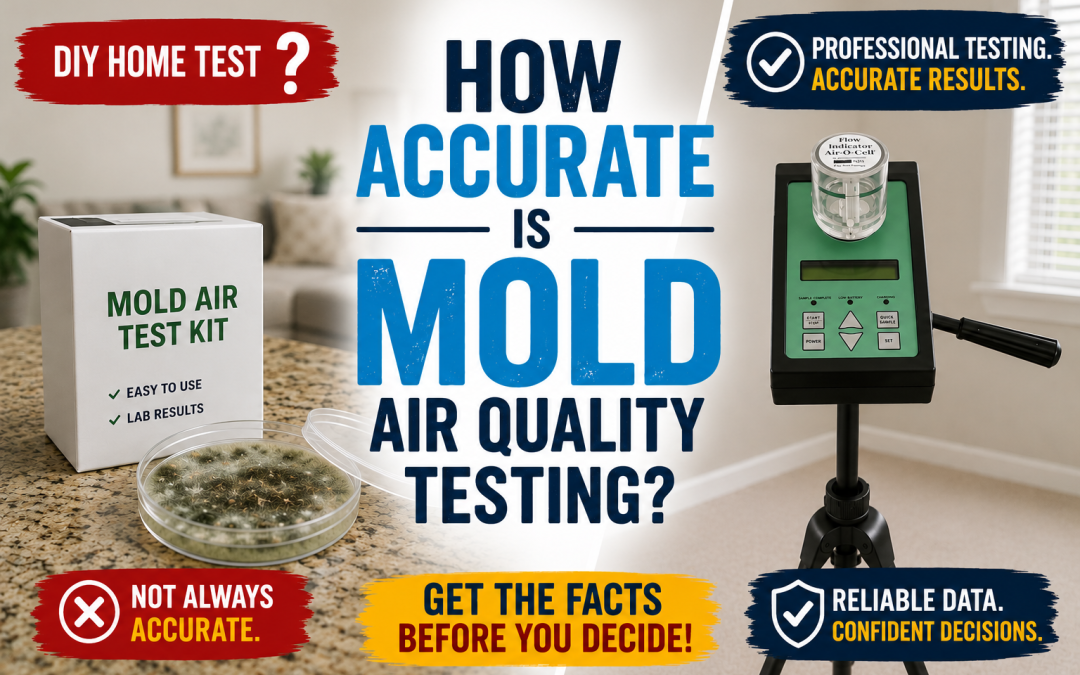
How Accurate Is Mold Air Quality Testing?
Most homeowners start with the wrong assumption. They think mold air quality testing gives a simple yes-or-no answer, like a pregnancy test for the house. It doesn’t.
If you’re asking how accurate is mold air quality testing, the honest answer is that it can be very useful, but only when it’s done correctly and interpreted in context. That matters even more in humid Florida communities like Bradenton and Sarasota, where outdoor spores, indoor humidity, air conditioning patterns, and hidden moisture can all affect what shows up in a sample.
The Misunderstood Role of Mold Air Testing
The biggest misconception is that one air test can prove a home is mold-free. That idea sounds comforting, but it isn’t how mold investigation works in reality.
Government agencies take a cautious position for a reason. The CDC, OSHA, and EPA do not generally recommend routine mold air testing as a standalone tool, because short-term samples can miss spores and a negative result does not reliably prove there’s no mold problem. They say testing should be part of a broader assessment that includes visual inspection and moisture mapping, not a one-step diagnosis, as explained in this guidance on mold air test accuracy.
Accuracy depends on the process, not the gadget
A homeowner will often call after seeing an online ad that promises “instant certainty” from a single cassette sample. That’s not how a careful inspector thinks. The core question isn’t just whether spores were captured. It’s whether the sample was taken in the right place, under the right conditions, and compared against what’s happening elsewhere in the home.
That’s why a proper assessment usually starts with the building itself. Where is moisture entering. Is there visible staining. Is there a musty odor near an air handler, closet wall, or baseboard. Has the home had a roof leak, plumbing issue, or repeated condensation problem.
Practical rule: Air testing is strongest when it answers a specific question inside a larger investigation.
In Gulf Coast homes, that distinction matters. High humidity, storm exposure, and long cooling seasons create conditions where mold can grow behind drywall, around windows, under flooring, or inside cavities without releasing enough airborne spores at the exact moment you test.
For homeowners trying to understand what a professional investigation should include, this overview of air quality testing for mold is a helpful starting point. The key point is simple. Air testing has value, but only when it’s used as one diagnostic tool among several.
Why a Single Air Sample Tells an Incomplete Story
An air sample is a snapshot. It records what was floating in the air at that moment and in that location. That’s useful, but it’s also the built-in limitation.
According to this explanation of professional mold air testing limits, professional testing is substantially more accurate than DIY methods when it uses a calibrated pump, indoor-outdoor comparison samples, and accredited laboratory analysis. Even then, it only captures airborne spores at a single point in time. It can miss dormant mold or hidden growth behind walls or under flooring, and there are no federal health-based standards for interpreting spore counts as definitive health risk thresholds.
What changes the sample
In Florida homes, air conditions change fast. Open a door. Run the AC harder in the afternoon. Move boxes in a closet. Turn on a bathroom exhaust fan. Each of those can alter what becomes airborne and what stays settled.
A “clean” sample can happen in a house that still has a mold problem. A “busy” sample can happen because spores were disturbed, even if the source is limited. That’s why one isolated number on a lab sheet doesn’t tell the whole story.
Here’s what a single sample can’t do well on its own:
- Prove absence: A low spore count doesn’t confirm there’s no hidden mold.
- Locate the source: Air data may suggest a problem, but it rarely pinpoints the exact wall, ceiling cavity, or flooring area.
- Define health safety: Without federal health-based thresholds, the report can’t tell you that a certain count is universally “safe” or “unsafe.”
- Replace inspection: Numbers without moisture evidence and visual findings are easy to misread.
Context is what makes the result usable
A reliable interpretation usually compares indoor air to outdoor baseline conditions and checks whether the mold types and levels indoors look unusual for that home. Then those findings have to be matched against what the inspector sees and measures in the structure.
A report without building context is just lab data. It’s not a diagnosis.
If you’ve been trying to figure out how to test air for mold at home, that’s the part most do-it-yourself advice leaves out. The sample itself isn’t the whole answer. The conditions around the sample are what give it meaning.
Professional Testing vs DIY Kits A Clear Comparison
Store-bought mold kits appeal to homeowners because they feel quick and inexpensive. The problem is that they often answer the wrong question poorly.
Most DIY kits don’t recreate the sampling conditions professionals control for. They also don’t come with a trained interpretation of what the result means in relation to the home’s moisture history, visible conditions, or exterior baseline. That’s where people get misled.

Side-by-side comparison
| Method | What it does well | Where it falls short |
|---|---|---|
| Professional air testing | Uses calibrated equipment, structured sampling, and lab analysis | Still needs inspection context to be meaningful |
| DIY petri dish kit | Easy to buy and simple to set out | Doesn’t measure airborne concentration in a scientifically useful way |
| DIY swab or tape sample | Can show that material on a surface is mold-like | Doesn’t tell you what’s happening in the air or behind materials |
The quality gap comes down to procedure. The IAC2-based sampling methodology described here requires closed-building conditions, at least one indoor sample per room of concern, placement roughly 3 to 5 feet from supply registers, a pump run for exactly 10 minutes under normal conditions, shorter runs under high dust activity, and airflow stability held within a 5% variance. If that standard isn't met, the sample may need to be taken again.
Why DIY often creates confusion
DIY kits usually miss the variables that matter most:
- Sampling control: Professionals use a calibrated pump and controlled run time. Most consumer kits don't.
- Placement strategy: A random kitchen counter or bedroom dresser isn't a sampling plan.
- Comparison logic: Indoor data means more when it's compared with outdoor conditions and the rooms of concern.
- Interpretation: A homeowner sees mold growth in a dish and assumes danger. In reality, mold exists naturally in many environments.
A passive petri dish left open on a table often tells you that spores landed in a dish. That's not the same as measuring active airborne spore concentration in a way that helps determine whether the home has an abnormal indoor mold condition.
Field reality: DIY kits can raise suspicion, but they rarely settle the issue.
If you're weighing your options in Bradenton, Lakewood Ranch, or St. Petersburg, a professional mold inspection service gives you something a kit can't. A defensible interpretation tied to the actual building.
The Professional Process for an Accurate Mold Assessment
Accurate mold assessment doesn't start with a cassette. It starts with the structure, the moisture, and the history of the problem.

The EPA states in this mold sampling guidance from the US EPA that in most cases where visible mold growth is present, sampling is unnecessary. It also notes that no federal limits have been set for mold or mold spores, so sampling can't be used to check a building's compliance with federal standards. That's why good inspectors don't test just to test.
What a sound assessment usually includes
A professional process tends to follow a clear sequence:
-
Interview and problem history
The inspector asks about leaks, storms, prior remediation, HVAC issues, musty odors, and rooms where symptoms or odors appear strongest. -
Visual inspection
This includes checking baseboards, window perimeters, closets, ceilings, under sinks, supply and return areas, and any spots with staining or material damage. -
Moisture mapping
Moisture meters and related tools help identify wet or previously wet building materials. This often matters more than the air sample itself because mold needs moisture to grow. -
Targeted sampling if needed
Air, surface, or material sampling is chosen based on what the inspection finds. Testing is used to clarify uncertainty, not replace judgment.
When testing helps most
Sampling tends to be most useful when:
- There's a musty odor but no visible growth
- Hidden mold is suspected after a leak
- Multiple rooms need to be compared
- Post-remediation verification is needed
- Documentation is needed for a transaction or claim
In Sarasota and Tampa Bay homes, that targeted approach matters. A beachside condo with chronic humidity issues needs a different testing strategy than a Bradenton home with one isolated plumbing leak.
For homeowners who want a region-specific overview, this page on mold inspection in Tampa, Florida reflects the kind of conditions that make local expertise important.
How to Interpret Your Mold Test Report Correctly
Lab reports intimidate people because they look scientific enough to feel final. They aren't final. They're interpretive documents.

The Minnesota Department of Health explains in its mold testing guidance that it remains unknown what level of mold is “safe” or how much is necessary to cause health problems. Because no regulatory thresholds exist, most mold testing can't definitively prove the absence of a problem on its own.
What the report is actually telling you
Most air sample reports identify spore types and provide a concentration figure. Homeowners often focus on the number first. That's understandable, but it's not always the smartest place to start.
Look at these questions instead:
- Is the indoor sample materially different from the outdoor sample?
- Do the spore types fit the home's moisture history?
- Was the sample taken in a problem room or just a convenient room?
- Do the findings match the inspection evidence?
A report showing common outdoor-type spores indoors may be less concerning than a report showing water-damage-associated patterns in a room with increased moisture and odor. Context controls the meaning.
Terms that need interpretation
A few report terms confuse homeowners all the time:
- Spore count per cubic meter: A concentration measure, not a health diagnosis.
- Aspergillus/Penicillium-like: A grouping often used because spores in that family can look similar under the analysis method.
- Stachybotrys: A mold name many people recognize, but presence or absence on an air report still has to be interpreted with building evidence.
Don't read a mold report the way you'd read a blood test. There is no federal “normal range” that settles the matter.
If your report seems unclear, a free mold inspection can help you determine whether the data points toward cleanup, further investigation, or moisture prevention. The best reading of any report combines the lab sheet with what's happening in the structure.
Frequently Asked Questions About Mold Testing Accuracy
Is mold air testing accurate enough to trust
Yes, when a trained professional uses it as part of a larger investigation. No, when it's treated as a standalone yes-or-no answer. Air testing can help identify abnormal indoor conditions, but its value depends on inspection findings, moisture evidence, and proper interpretation.
Can a negative mold air test still mean there's mold in the house
Yes. Hidden mold behind drywall, under flooring, inside cabinets, or around HVAC components may not release enough spores during the short sampling window to appear on the report. That's why odor, moisture damage, and visible signs should never be ignored just because one air sample looks quiet.
Are DIY mold test kits worth using
They can be useful for raising suspicion, but they aren't conclusive. If a homeowner just wants a rough signal that something might be present, a kit may prompt the next step. If the goal is a dependable answer that can guide remediation, insurance discussions, or a real property decision, DIY testing usually falls short.
If I can see mold, should I still pay for testing
Not always. If visible growth is already present, the practical issue is usually confirming the moisture source, defining the extent of contamination, and planning proper cleanup. Testing can still have a role in some situations, but visible mold already tells you there's a condition that needs attention.
What makes one professional mold test more reliable than another
Method matters. Better testing uses calibrated equipment, controlled conditions, thoughtful sample placement, and comparison with the rest of the home. Better inspectors also know when not to test. A company that automatically sells air samples in every room without first examining moisture and visible evidence is often collecting data before establishing the core question.
How should Florida homeowners decide when to call a professional
Call when any of these are true:
- You smell mustiness repeatedly and can't identify the source.
- You've had a leak or flooding event and materials didn't dry properly.
- You see staining, bubbling paint, or warped materials in humid rooms.
- Symptoms seem tied to one area of the house and there's a moisture history.
- You need documentation for a home purchase, tenant issue, or remediation check.
Florida homes face a tougher moisture environment than many other regions. Long cooling seasons, wind-driven rain, high ambient humidity, and concealed building cavities all make hidden mold more plausible. In Bradenton, Sarasota, Saint Petersburg, Lakewood Ranch, and across the Gulf Coast, the safest approach is to treat air testing as one tool inside a professional diagnostic process.
If you remember one thing, remember this. How accurate is mold air quality testing? Accurate enough to be valuable when it's done correctly, and misleading when it's done casually. The test doesn't replace the inspection. The inspection gives the test meaning.
AMPM Restoration is a 24/7 emergency restoration company based at 4301 32nd St W b18, Bradenton, FL 34205, serving Bradenton, Sarasota, Tampa Bay, Saint Petersburg, Lakewood Ranch, and surrounding Gulf Coast communities with water damage restoration, mold inspection and mold removal, fire and smoke damage restoration, storm and flood damage restoration, commercial restoration services, and full reconstruction solutions. If you need a real answer about mold, don't rely on guesswork or a store-bought kit. Call AMPM Restoration Services at 941-946-7807 for a free inspection and estimate. The team can also help with insurance claim assistance and financing options so you can move forward faster and with less stress.