

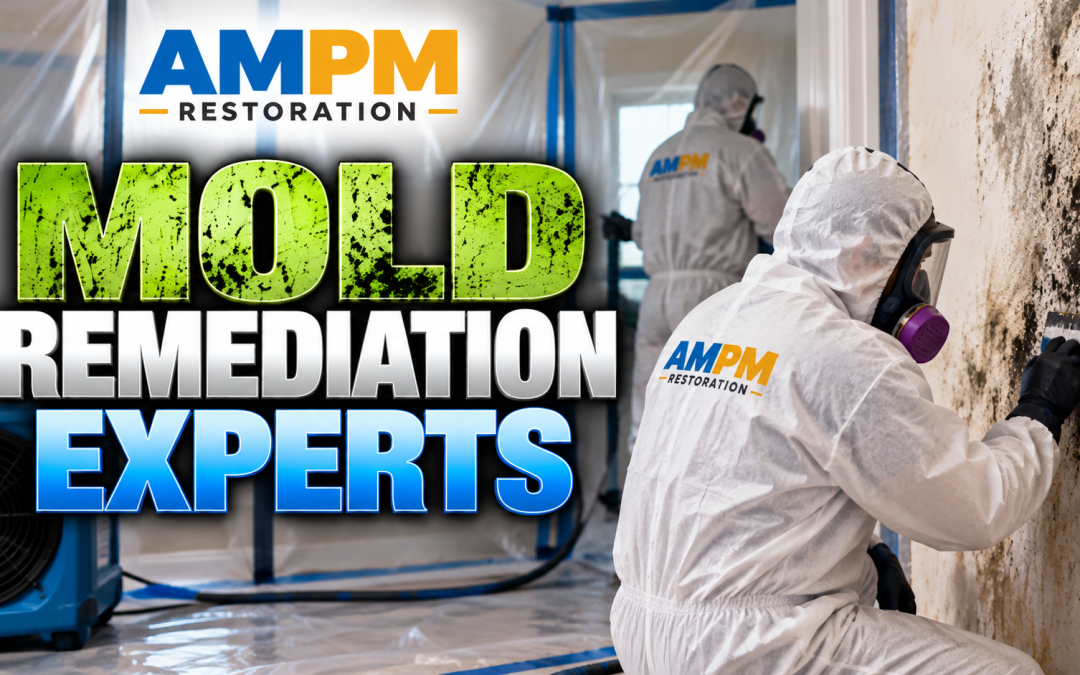
How to Hire Mold Remediation Experts
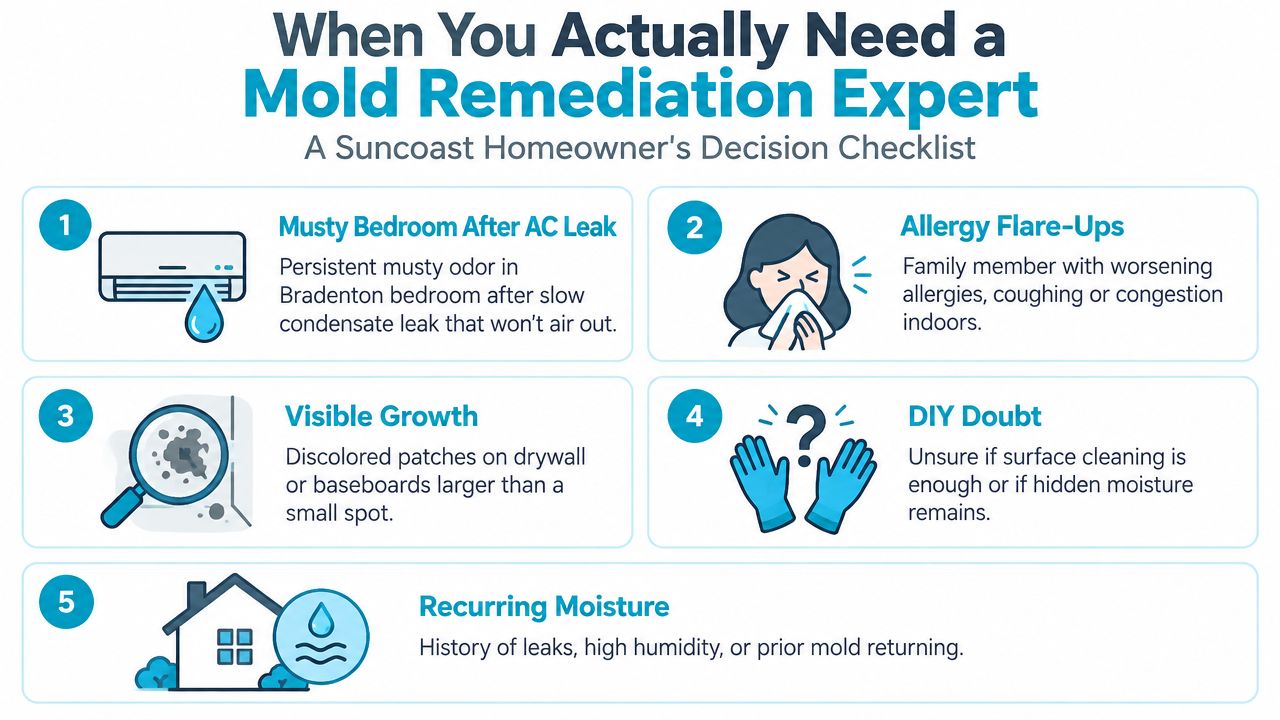
A mold remediation expert usually becomes the right call when the affected area is more than about 10 square feet, when moisture keeps coming back, or when the room’s smell and symptoms improve as soon as the family leaves. In a Bradenton home, that often starts with a musty bedroom after a slow AC condensate leak, and the question isn’t whether to wipe the surface, it’s whether hidden moisture has already turned this into a remediation job.
A lot of homeowners try to solve that uncertainty with bleach, paint, or a quick drywall patch. That rarely answers the bigger problem, because the problem is usually behind the wall, under the baseboard, or tied to a moisture source that never got fixed.
When You Actually Need a Mold Remediation Expert
A Suncoast call usually starts the same way. A bedroom smells off after a slow AC condensate leak, a child’s allergies are acting up, and the homeowner is staring at a patch of discoloration wondering if they can handle it with a scrub brush and a fan. That’s the point where the decision matters, because surface cleaning and true remediation are not the same job.
The EPA’s practical DIY line is around 10 square feet. If the visible area is smaller than that, many homeowners can usually handle cleanup themselves, but once the problem grows past that rough threshold, or keeps returning after drying, it’s time to bring in mold remediation experts who can diagnose the source and contain the work properly. The same is true when symptoms ease outside the room, because that usually points to a room-specific moisture problem rather than a harmless cosmetic issue.
The decision is really about moisture, not just stain removal
Visible growth on drywall is only one clue. I’ve walked into plenty of Bradenton and Sarasota homes where the wall looked “cleaned” but the baseboard stayed damp, the closet smelled worse after every rain, or the air handler line had been leaking long enough to feed hidden growth behind finish material.
Practical rule: If the smell comes back after drying, the source probably wasn’t fixed.
That’s why a real expert starts with the moisture story. If the leak path is still active, mold can return no matter how much product gets sprayed on the surface. The right resource mindset matters here too, and a homeowner comparing roof, attic, and interior moisture issues can use the mold inspection guide for Broward to understand how different moisture sources get traced in practice.
A quick home-cleaning job also stops making sense when mold is tied to hidden materials. That’s common in drywall cavities, behind baseboards, and inside duct-adjacent spaces where the visible stain is only the edge of the problem. If you’re trying to decide whether your own home needs inspection or full remediation, AMPM Restoration’s five signs of mold damage in homes is a useful local reference point for the warning signs that usually push a job past simple DIY cleanup.
What Makes a Mold Remediation Expert Different
Homeowners usually call two kinds of crews: the ones who show up with a sprayer, and the ones who can explain why the mold showed up in the first place. The difference starts with process. The IICRC’s S520 established mold remediation as a procedure-based trade, and the current ANSI/IICRC S520-2024 still treats the work as inspection, containment, removal, cleaning, drying, and clearance verification, not a quick wipe-down. That matters on Suncoast jobs, because insurers and adjusters tend to look for the same paper trail when a claim gets questioned.
A true remediation company starts with the moisture source, then builds the job around it. The crew should set containment, run negative-air pressure with HEPA filtration, remove contaminated porous materials, clean the remaining surfaces, dry the structure, and verify the result before closing walls back up. A general cleaner often starts with visible staining and tries to substitute chemicals for demolition, which leaves contamination behind in places the eye cannot see.
Certifications are part of the story, not the whole story
Homeowners hear a lot of loose certification talk, but the paperwork should connect to field practice. AMRT means Applied Microbial Remediation Technician, and WRT means Water Damage Restoration Technician. Those credentials matter because they sit inside a workflow that covers moisture control, containment, drying, and structural recovery, not just surface treatment.
A certificate on the wall helps, but the decisive test is whether the crew can show moisture logs, containment photos, and a clear scope before demolition starts.
The easiest way to compare companies is to ask how they document the job. A contractor that follows a real remediation process will talk about readings, isolation, removal, and clearance. A sanitizer talks mostly about odor, spray, and finish. The difference shows up fast once you ask for records.
| Capability | True Remediation Expert | General Contractor/Cleaner |
|---|---|---|
| Source identification | Traces the moisture path before demo | Often treats visible mold first |
| Containment | Sets sealed work area and pressure control | May use basic plastic with little control |
| Filtration | Uses HEPA equipment | May rely on shop vacs or surface wipes |
| Material removal | Removes contaminated porous materials | Tries to clean everything in place |
| Verification | Coordinates clearance and documentation | Stops after visible cleaning |
| Job records | Keeps moisture readings and drying logs | Often provides only photos and invoice language |
If you are checking credentials, ask for the technician's certification details and proof that the company follows a documented remediation process. You should also ask whether they can show the kind of IICRC documentation described on the AMPM Restoration IICRC-certified restoration company page. That is the kind of evidence a homeowner can compare before signing.
How a Professional Mold Remediation Project Actually Unfolds
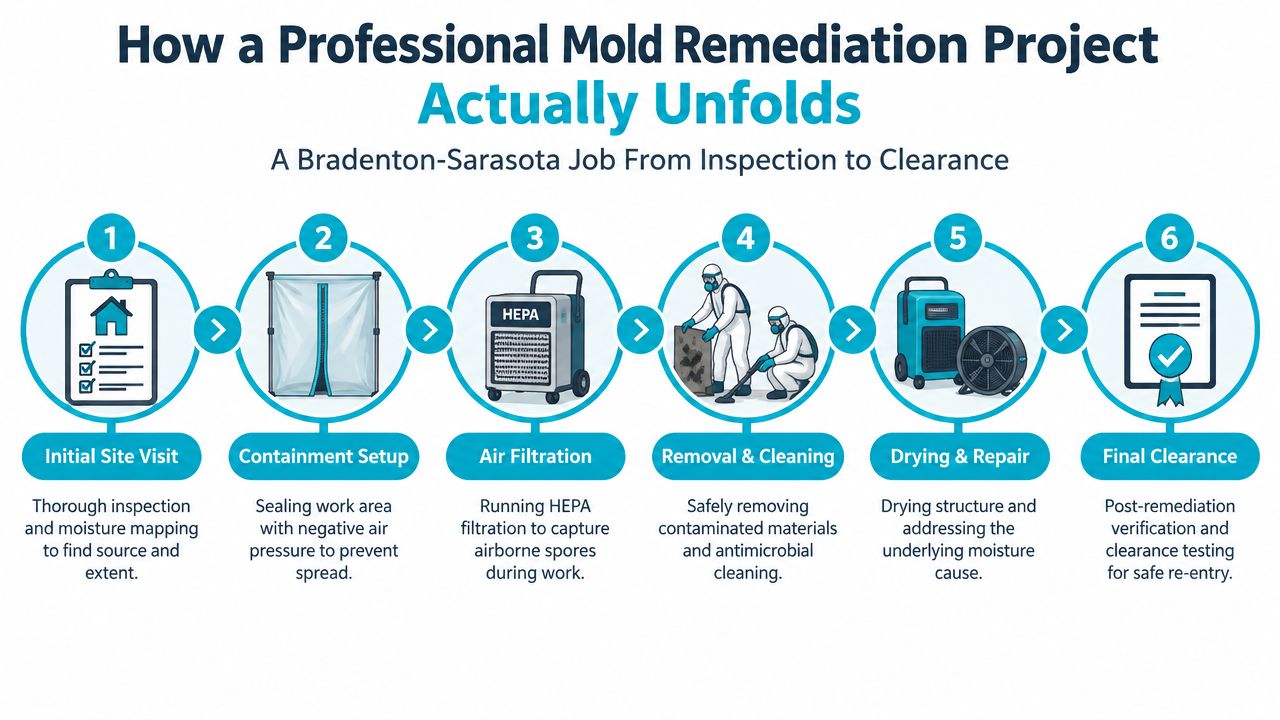
A solid Bradenton-Sarasota project usually begins before anyone touches the drywall. On the first visit, the project lead maps moisture with a thermal camera and pin or pinless meter, traces the leak path, and figures out whether the damage started in a bath, attic, closet air handler, or ceiling assembly. That initial diagnosis is what keeps the crew from chasing stains instead of fixing the source.
The homeowner should get a written scope before demo begins. If the work area is going to open up, the plan should explain how the crew will isolate the zone, what material comes out, what stays, and who is responsible for drying and verification after the debris is gone. That kind of communication keeps the job from turning into a surprise demolition.
Containment, removal, drying, verification
Once the scope is set, the crew seals the space with 6-mil polyethylene, sets up a negative-air machine, and runs HEPA filtration while the work is underway. Porous material that's contaminated gets removed, then the remaining framing or structural surfaces are HEPA-vacuumed and damp-wiped, with antimicrobial use as a supplement rather than the cure. That sequence matters because the standard is about physical control and removal, not just making the room smell better.
Drying comes next, and it should be measured against the original moisture readings, not just guessed at by feel. Dehumidifiers and air movers should stay in place until the structure is back to a dry condition, and the lead should be telling the homeowner what's happening each day, what's been opened, and what still needs attention.
Clearance isn't just “it looks fine.” It means a third-party inspector verifies the area is ready for re-entry based on the completed work and the condition of the space.
If you want a deeper look at how the sequence fits together, AMPM Restoration's mold remediation timeline gives a practical frame for the inspection-to-clearance process. In a good job, that timeline is visible to the homeowner the whole way through, not hidden behind vague updates and a final invoice.
Costs, Insurance, and What to Expect on Your Estimate
A defensible mold estimate in Florida should read like a scope of work, not a vague promise. Price is usually driven by how much material has to come out, how hard the source is to reach, how much containment is needed, and whether the moisture issue includes repair work, not by a flat number pulled from the air. If a quote doesn't break out labor, materials, containment, drying, and testing, you're not looking at a professional estimate, you're looking at a guess.
Insurance changes the math. Carriers are much more likely to look at sudden water events than long-term leaks or deferred maintenance, so the job documentation has to show what happened, when it happened, and how the damage was discovered. Moisture maps, photo logs, and third-party results help establish that the problem was addressed as a loss event rather than a maintenance issue that sat unreported.
What the estimate should show
A clean estimate should make it easy to see what's being done and why. If it doesn't, push for clarification before signing.
| Estimate Line Item | Typical Suncoast Cost | Insurance Treatment |
|---|---|---|
| Inspection and moisture mapping | Varies by scope | Often supported when tied to a covered event |
| Containment setup | Varies by size of affected area | Commonly reviewed as part of mitigation |
| Material removal | Varies by demolition needs | More likely covered when linked to sudden loss |
| Drying equipment | Varies by duration | Often included when the loss is covered |
| Post-remediation clearance | Varies by testing needs | Helpful documentation, coverage depends on policy |
The pushback usually comes from vague causation language, not from the existence of mold itself. An adjuster can accept the work was necessary and still dispute whether the cause is covered, so the job file needs to show the moisture source, the affected materials, and the professional process used to stop recurrence.
If you're comparing bids, AMPM Restoration's mold removal cost 2026 guide is a useful local reference for reading an estimate line by line. The key is to look for missing containment scope, missing testing, or any quote that treats cleanup and source repair as if they're the same thing.
Questions Worth Asking Before You Sign a Contract
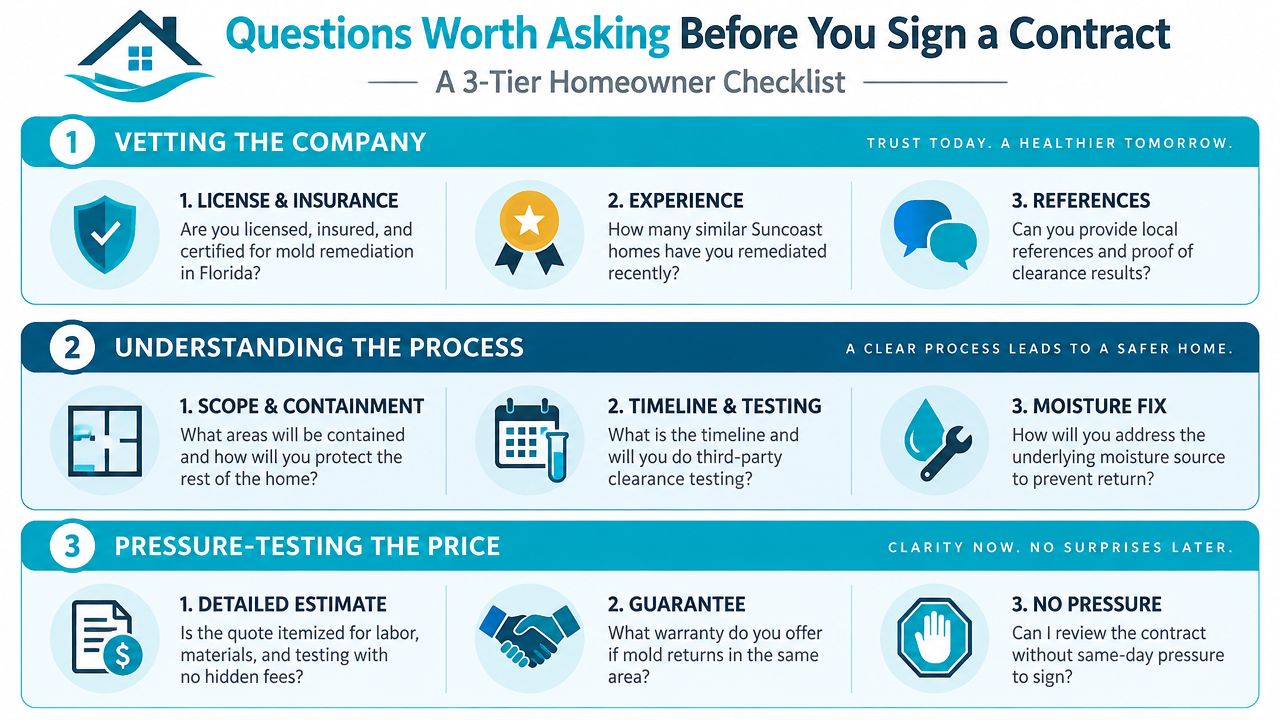
The fastest way to separate a remediation expert from a spray-and-pray crew is to ask direct questions and listen for process, not sales talk. A company that follows IICRC S520 should be comfortable explaining how it will document the job, who is responsible for each phase, and what happens if hidden moisture shows up after demo starts. If the answers stay fuzzy, keep looking.
Vet the company first
Start with proof, not promises. Ask for technician certification numbers, not just a logo on a website, and ask whether the company carries the right licensing, insurance, and mold-related documentation for Florida work. The question about local references matters too, because Suncoast homes often share the same problems, including closet air handlers, slab-adjacent moisture, and post-storm leaks.
Press on the process
Ask how the company will build containment, what it uses for pressure control, and who performs the third-party clearance check. If they say a shop vac, a fogger, or a deodorizer is the main answer, that's a red flag. You want to hear about source control, HEPA filtration, and a clear plan for the materials that can't be saved.
Make the price explain itself
The estimate should tell you what's included, what changes cost more, and how warranty terms work if mold returns in the same area. A contractor who wants a same-day signature without giving you time to review the paperwork is asking you to buy uncertainty, not remediation.
If you want one more local resource before you take a call, AMPM Restoration's licensed restoration company page is worth reviewing alongside the estimate. The right questions make the conversation calmer, because a legitimate company should welcome them.
Why Florida Homes Need Local Remediation Expertise
Florida humidity is not a background detail, it changes how a job gets scoped. On the Suncoast, year-round moisture, storm surge, roof losses, and AC condensate failures create repeatable conditions that national playbooks often underplay. Older block homes add another wrinkle, because moisture can hide in furring strips, wall assemblies, and air pathways that don't behave like dry-climate construction.
A local expert reads those conditions differently. A closet air handler in Sarasota doesn't get the same drying strategy as a basement loss in a colder state, and a storm-battered Bradenton home needs containment and recurrence prevention shaped by Florida's building habits, not generic cleanup language. That's why fly-by-night post-storm crews are such a problem here, they often chase volume instead of verifying the moisture path and the finish condition.
Suncoast homeowners also need a company that understands how quickly a repair can become an insurance file. When the documentation is thin, the job gets harder to defend, and the homeowner is left explaining what happened without the records that should have been captured on day one.
Local expertise shows up in the small things, like how a crew sets dehumidification, protects adjacent rooms, and checks the hidden cavities that Florida construction likes to hide.
A remediation company fluent in Florida moisture behavior is less likely to over-demolish, under-dry, or miss the cause the first time. That's the difference between a contained project and a recurring headache.
Take the Next Step With Confidence
A real mold remediation expert gives you more than cleanup. You get a source diagnosis, proper containment, documented drying, and third-party verification that the space is ready to use again. That's the standard that matters on the Suncoast, especially when the issue touches insurance, hidden moisture, or a room your family needs back quickly.
AMPM Restoration handles mold inspection, mold removal, water damage restoration, and full reconstruction for Bradenton, Sarasota, Tampa Bay, Saint Petersburg, Lakewood Ranch, and surrounding Gulf Coast communities. If you want a no-pressure conversation about your home, call 941-946-7807 for a free inspection and estimate, and ask about insurance claim assistance and financing options while you're on the phone.
If you're dealing with a musty room, a leak that won't quit, or a quote that doesn't quite make sense, AMPM Restoration Services can inspect the problem, document the moisture source, and build a clear remediation plan. Visit AMPM Restoration Services to get started, then call 941-946-7807 for a free inspection and estimate with insurance claim assistance and financing options available.