

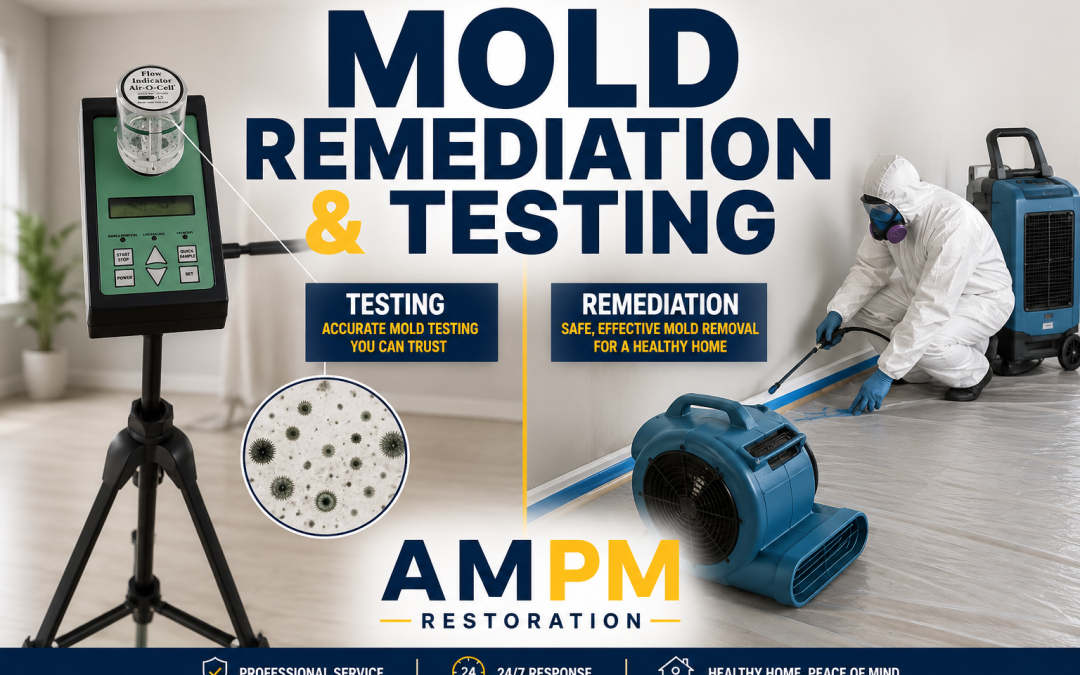
Mold Remediation and Testing In Tampa Bay
If you’ve just found a musty spot after a roof leak, a burst pipe, or a storm that pushed water where it didn’t belong, the first question usually isn’t technical. It’s personal. Is this a quick cleanup, or are you looking at a real mold problem that’s already spread behind the drywall, under the flooring, or into the insulation?
In Florida, that question matters because moisture doesn’t sit still for long. Public-health guidance from the U.S. EPA says mold can begin growing on damp materials within 24 to 48 hours, which is why speed, drying, and source control matter more than scrubbing what you can see on the surface. Mold remediation and testing work best as one moisture-first workflow, not as a guess-and-clean routine, especially in humid Gulf Coast homes where a small leak can turn into a bigger repair fast. If you’re also trying to figure out whether the leak is still active, resources like leak detection tips can help you think about the source before anyone starts tearing into finished material.

The practical reality is simple. If moisture is still feeding the problem, mold comes back. If the source is fixed, damaged material is removed correctly, and the space is dried and verified, the odds of a repeat problem drop sharply.
Why Mold Remediation and Testing Matter in Florida Homes
A Sarasota homeowner opens a guest-room closet after a heavy rain and catches a sharp, earthy smell. The baseboard looks fine at first glance, but the drywall near the corner feels soft, and a small stain near the ceiling has grown since the last storm. That’s the moment the search for mold remediation and testing begins, because the problem is no longer cosmetic, it’s a moisture event with a timeline.
Florida homes face a tougher starting point than houses in drier states. Warm air, frequent rain, plumbing leaks, and air conditioning systems all create conditions where moisture lingers, and lingering moisture is what mold needs. The EPA’s guidance is blunt about that relationship, and it’s why professional crews don’t begin with bleach, they begin with a moisture map, a source check, and a decision about what materials can be saved.
Practical rule: if a material stayed wet long enough to support growth, the question isn’t whether it looks bad enough to replace. The question is whether it can be dried, cleaned, and verified without trapping contamination inside the assembly.
That’s also why testing can matter so much in a Florida home. Mold testing often comes up after a water-loss event, a tenant complaint, a pre-renovation inspection, or a room that smells wrong even when the surface looks clean. The U.S. housing data in the brief show the scale of the issue, with a synthesis reporting about 47% of homes affected by dampness or mold and the 2021 American Housing Survey recording more than 1.6 million households reporting mold in the prior year. Those numbers explain why homeowners, landlords, and insurers treat this as a risk-management issue, not a housekeeping issue.

For a Florida homeowner, the goal is not panic. It’s fast, correct diagnosis. A small leak handled early can stay a contained repair. A leak ignored for days can become a remediation job, a reconstruction job, and sometimes an insurance claim all at once.
Understanding Mold Testing Methods and When to Use Them
A wet wall, a musty bedroom, and an insurance adjuster asking for proof all point to the same need, a moisture-first diagnosis before anyone starts talking about sampling. Mold testing is a diagnostic tool, not a cleanup tool. It helps answer a narrower set of questions, where contamination is likely, how far moisture moved through the structure, and whether the cleanup held. In Florida homes, that order matters because high humidity can keep materials damp long after the obvious leak is fixed, and air testing alone rarely gives the full picture. For that reason, the process usually starts with inspection, moisture mapping, and, when the situation calls for it, professional mold testing services.
Air sampling, surface sampling, and bulk sampling
Air sampling captures microscopic spores that are circulating in the air. It helps when growth is hidden, when a cleanup is being checked, or when an indoor result needs to be compared with outdoor conditions. It does not work like a health score, and federal guidance says there are no health-based indoor air standards for mold, so a spore count alone cannot tell you whether a room is safe.
Surface sampling checks a specific spot. A swab or tape lift can confirm that visible growth is mold and document what is present on a particular material. That matters when a homeowner, adjuster, or inspector needs evidence tied to one location instead of a room-wide average.
Bulk sampling removes a piece of material for lab analysis. It is the most direct way to evaluate a suspect section of drywall, insulation, or flooring when the question is about what the material contains, not just what is floating above it. In practice, this is often the better option when a material is already scheduled for removal and the crew needs to confirm the scope before demolition starts.
The right method depends on the decision at hand. If mold is obvious, testing may not add much, and a good inspector may spend more time on moisture, extent, and affected materials than on lab work. If the job has already been cleaned and the owner wants a cleaner handoff, testing can support post-remediation verification. If the problem is hidden, testing can help confirm where the moisture path went and whether adjacent areas were affected.
A useful test answers one question. A bad test creates three more.
For Florida homeowners, that means asking practical questions before paying for samples. What problem is the test meant to solve? What action changes based on the result? If contamination shows up, what material needs to come out, and what still can be dried and saved? That approach keeps the focus on the source of the moisture, not on lab results that do not change the repair plan. It also helps with insurance coordination, since adjusters usually need a clear explanation of what was tested, why it was tested, and how the findings relate to the damage in the home.
The Professional Mold Remediation Process Explained
Professional mold remediation and testing is a controlled process, not a glorified cleaning visit. ANSI/IICRC S520 defines remediation as a source-removal process for mold-damaged structures, contents, and building systems, which means the job is about eliminating the conditions that let mold exist in the first place. If the water source stays active, the work doesn’t hold.
The Army housing fact sheet tied to industry practice is clear about how crews keep contamination from spreading. Work areas are isolated with double layers of 6-mil fire-retardant polyethylene, openings are sealed, and HEPA-filtered exhaust is used to maintain negative pressure so disturbed spores don’t drift into clean spaces. That setup is there for a reason, because once you start disturbing moldy material, containment becomes part of the cleanup itself.

What a real crew does on site
The first step is inspection and moisture diagnosis. A technician looks for active leaks, hidden dampness, stained materials, and the path the water took through the structure. That’s where the work either gets scoped correctly or gets expensive later.
Next comes source control. The leak, intrusion, or condensation problem has to be corrected before removal starts. This is not optional, because remediation can’t outwork a continuing water problem.
Then the crew sets containment, removes affected materials that can’t be saved, and cleans the work area using procedures that fit the scope of damage. In practice, that may include demolition of saturated drywall, cleaning of framing, and dust control around the affected zone. After that, verification checks whether the space is dry enough and clean enough to move forward with reconstruction.
I’d rather see a crew spend time on containment and source control than rush straight to wiping visible growth. That’s where cheap jobs turn into repeat calls. In Bradenton, Sarasota, and the surrounding Gulf Coast, humidity makes rushed drying especially risky, because a surface can look dry before the assembly behind it is ready.
If you want to see how a local contractor structures the job, the process outline at how to remediate mold is a useful reference point. It should look a lot like the steps above, because the standard workflow isn’t fancy, it’s disciplined.
Mold Remediation Costs Timelines and DIY vs Professional Decisions
A wet ceiling after a storm, a musty closet wall, or damp carpet that never quite dries can all point to the same problem, moisture is still feeding the mold. The price of mold remediation and testing depends on what is wet, how far the moisture traveled, and whether hidden materials have to be opened and removed. A detailed breakdown of mold removal costs helps put the numbers in context. One 2026 industry compilation puts average professional mold removal at about $2,367, with typical ranges from roughly $1,223 to $3,754, and whole-house remediation can reach $10,000 to $30,000. For homeowners, that spread tells the story, early intervention is usually less expensive than major demolition.
| Mold Remediation Cost Factors at a Glance | Impact on Cost | Typical Range |
|---|---|---|
| Small, contained area | Lower labor and less demolition | Usually below major-structure pricing |
| Hidden moisture behind materials | More inspection and removal work | Costs rise with access difficulty |
| Structural material replacement | Adds reconstruction and disposal | Can push the job much higher |
| Whole-house contamination | Larger containment and cleanup scope | Can reach $10,000 to $30,000 |
Timeline follows the same pattern. A simple, contained issue can move quickly once the source is fixed and the affected area is opened up. A multi-room leak, a crawl space problem, or a job that needs demolition and drying takes longer because the structure has to be treated, dried, and verified before rebuild starts.
DIY has limits. Surface wiping can make sense for a tiny, non-porous item after the moisture source is corrected and the area never became structurally wet. But DIY falls apart once mold reaches drywall, insulation, carpet pad, or the back side of trim. At that point, the problem is no longer a cleaning task, it is a moisture and containment issue.
If the wall is soft, the smell lingers, or the source of water is still uncertain, don't treat it like a cleaning project.
Professional help usually makes sense when the damage is hidden, the affected area keeps coming back, or the house is occupied and you cannot risk spreading contamination. In Florida, that call often comes down to humidity as much as the visible damage. Materials can feel dry on the surface while the assembly behind them still holds enough moisture to restart growth. For homeowners comparing options, the right first move is to get an inspection, get the scope right, and then decide whether the fix is limited cleanup or a structured remediation. If you are also trying to sort out coverage, the paperwork side of the process is easier once you file a home insurance claim in Florida.
A good cost conversation also includes what not to do. Do not pay for repeated surface treatments when the source has not been corrected. Do not assume a stain shows the full extent of the problem. And do not wait for a small leak to become a full reconstruction job.
Navigating Insurance Claims for Mold Damage in Florida
Insurance gets confusing fast because the policy question usually isn't “is mold bad?” It's “what caused it?” In Florida, that distinction matters more than the stain itself. Sudden water events are treated differently from long-term neglect, and the more clearly the cause is documented, the easier it is to explain why the claim belongs in the water-loss category rather than the maintenance bucket.
That's where professional mold remediation and testing helps instead of hurts. Testing results, moisture readings, photos, and detailed remediation notes create a paper trail that shows what happened, where the moisture went, and what was done to correct it. Insurers respond better to a file that shows source control, containment, and verification than to a vague complaint about a smell in one room.
If you're trying to understand the claim process itself, file a home insurance claim in Florida is a useful general reference for the paperwork side of the conversation. Once the claim is open, documentation becomes the difference between a smooth adjustment and a stalled one.
AMPM Restoration also coordinates with carriers directly, and that matters because homeowners usually don't want to translate technical findings into insurance language while managing a wet house. The internal documentation should tie the event to the damage, show what materials were affected, and explain why remediation, drying, and replacement were necessary. That's especially important when an adjuster needs to separate immediate storm or plumbing damage from secondary mold growth.
For a homeowner, the smartest move is to keep the story consistent. Document the date you noticed the leak, when the smell started, what materials were wet, and who inspected the site. Then make sure the contractor's report matches the actual scope. If the claim file says one thing and the house says another, delays usually follow.
The internal guide on water damage insurance coverage is useful when you're trying to understand how the water-loss piece connects to the mold piece. In practice, the strongest claims are built on fast response, good records, and a contractor who knows how to communicate with the carrier.
Post-Remediation Verification and Long-Term Mold Prevention
A mold job isn't finished when the visible growth is gone. Post-remediation verification is the checkpoint that tells you whether the space is ready to live in again. EPA guidance says the moisture source has to be fully fixed, visible mold and odors should be gone, and if sampling is used, indoor results should make sense in context rather than exist as a standalone score.

What to ask for before the space is handed back
Request a written report that states what was removed, what was cleaned, what moisture source was corrected, and what areas were verified dry. If sampling was done, ask how it was interpreted and what question it answered. A simple “looks clean” isn't enough when the property has already had a moisture failure.
Then think about prevention in the same way. The best long-term control is routine moisture management, not repeated cleanup. In Florida, that means checking for leaks early, keeping indoor humidity in check through ventilation and dehumidification, and responding quickly when a room starts smelling damp.
Practical rule: if you can smell mold before you can see it, treat the odor as a warning, not background noise.
Homes in Bradenton, Sarasota, St. Petersburg, Lakewood Ranch, and the rest of the Gulf Coast need consistent attention because the climate keeps pressure on building materials year-round. That doesn't mean living in fear. It means watching the places that fail first, bathrooms, closets, attic spaces, under sinks, and around windows, then acting before a small moisture issue becomes a full remediation project.
When a crew documents the fix and the home stays dry, that's the outcome you want. When a space gets cleaned but the moisture source stays hidden, the recurrence is predictable. Good prevention is boring, and that's the point.
Your Next Steps for Mold Remediation and Testing in Bradenton
If you've got a musty room, a recent leak, or mold that keeps coming back, stop guessing and get the moisture checked first. Mold remediation and testing should be handled as one job, source, containment, removal, and verification, not as a series of disconnected fixes.
AMPM Restoration provides 24/7 emergency help across Bradenton, Sarasota, Tampa Bay, Saint Petersburg, Lakewood Ranch, and surrounding Gulf Coast communities. The team handles mold inspection, mold removal, water damage, storm cleanup, and full reconstruction, and the process can be coordinated with your insurance carrier from the start. If you want the scope confirmed before the damage spreads, a free inspection is the right next move.
The internal service page at mold and water damage remediation is a good place to see how those services fit together. If you're worried about a hidden leak or recurring moisture, don't wait for the problem to become obvious.
AMPM Restoration Services can inspect the problem, document the moisture source, and handle the cleanup and rebuild with one coordinated plan. If you need help with mold remediation and testing in Bradenton or anywhere on the Suncoast, visit AMPM Restoration Services or call 941-946-7807 for a free inspection and estimate. They also offer insurance claim assistance and financing options, so you can move forward without trying to manage the whole process alone.