


Emergency water mitigation on the Suncoast typically runs roughly $1,400 to $8,000 for most homes, with full project costs reaching $15,000 or more once drying, contents handling, and reconstruction are included. Your out-of-pocket cost depends less on a generic price-per-square-foot figure than on the water's source, what got wet, how quickly drying starts, and what your insurance policy covers.
A Bradenton homeowner might walk into a soggy living room, see water across the floor, and immediately wonder whether to call an insurer or a contractor first. The questions come fast: What's the minimum charge? How much per square foot? Could this turn into a major repair, and will insurance pay?
There isn't one reliable flat rate for every loss. A small plumbing leak caught early isn't the same job as stormwater reaching a condo, or a hidden leak soaking hardwood and wall cavities. The estimate should show what the crew will do now, what may need to be removed, and what repairs come after the structure is dry.
That distinction matters on the Suncoast, where humidity can make concealed moisture harder to manage. Water damage and freezing claims averaged about $15,400 in data summarized for 2019–2023, and the annual frequency was approximately one claim per 67 insured homes, according to Insurance Information Institute figures summarized in a water-damage claims overview. Those figures don't predict your bill, but they do show why a prompt, well-documented response matters.
What Homeowners on the Suncoast Really Want to Know
A homeowner in Bradenton finds water spreading from beneath a kitchen sink. The visible puddle looks manageable, but the cabinet base is damp and the flooring nearby feels soft. The first call is usually about price. The next is whether the crew can start before the damage spreads.
An honest estimate starts with inspection, not a guess from a room's square footage. A technician needs to identify the source, check affected materials, and look for moisture beyond the visible wet area. A dry-looking wall or floor can still hold water inside a cavity or beneath a finished surface.
The first estimate is a scope, not a promise
Homeowners often ask for a minimum and a maximum. The direct answer is that those numbers depend on what the inspection finds and whether the job is mitigation only or includes reconstruction. A written scope should explain extraction, drying equipment, monitoring, demolition if needed, and any work that belongs to a later repair phase.
Ask how the estimate handles hidden moisture, equipment monitoring, and removal of damaged materials. If a contractor gives a firm total before checking the affected areas, treat it as an initial ballpark, not a complete assessment.
The insurance question is just as important. A sudden internal pipe leak may be treated differently from floodwater entering from outside, and your deductible and policy terms affect what you pay. Don't assume that visible water means the same coverage applies to every cause.
Practical rule: Ask for the emergency work and the rebuild to be identified separately. That makes it easier to understand the immediate cost and compare later repair decisions.
The goal isn't to find the lowest number on a phone call. It's to get a clear account of what's wet, what needs attention now, and how the contractor will verify that drying is complete.
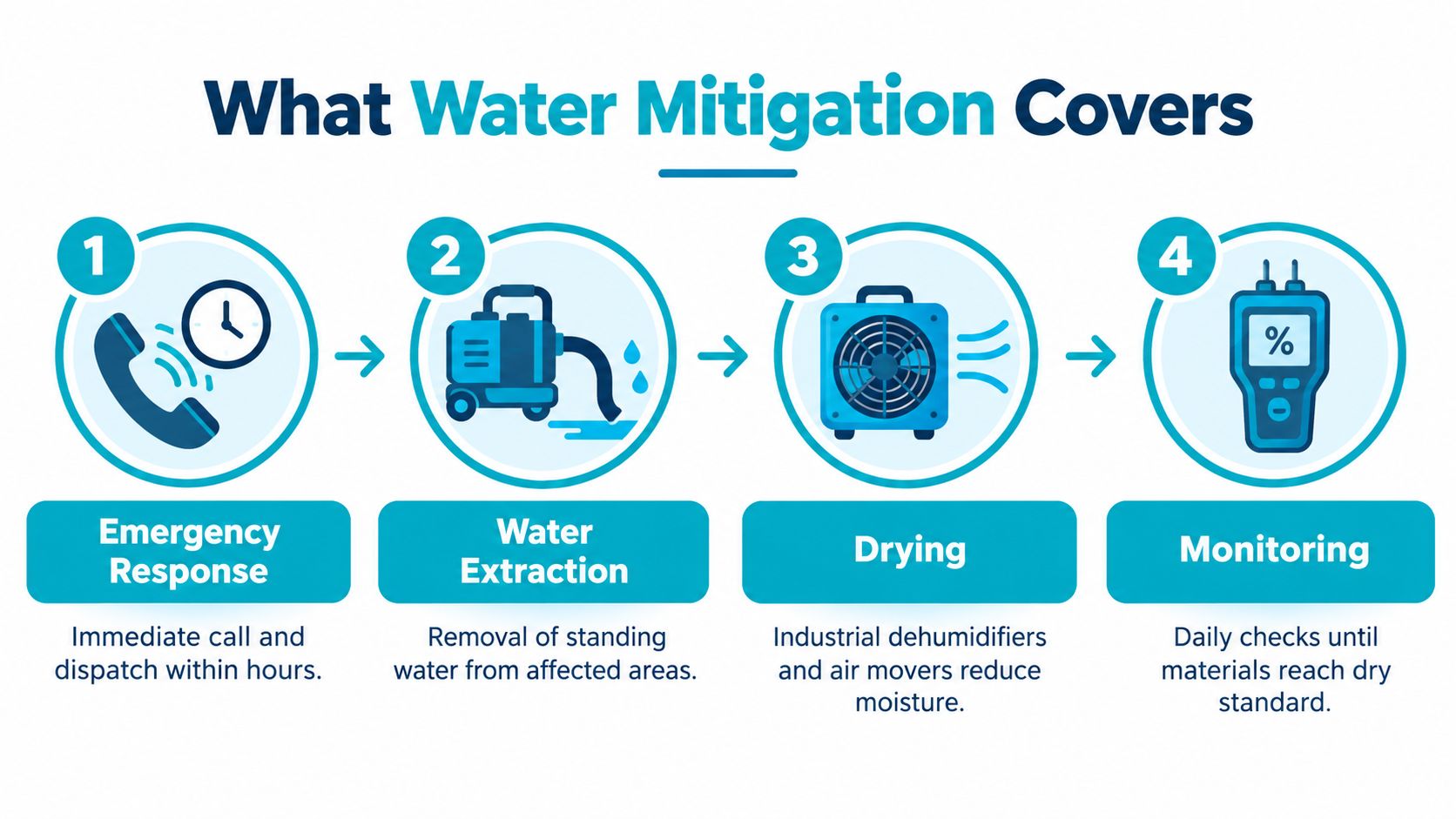
What Water Mitigation Actually Covers
Water mitigation is the emergency work that limits further damage and prepares the property for repair. Restoration includes returning the property to its previous condition, which may mean replacing drywall, flooring, cabinets, trim, or paint after drying is complete.
Consider a burst supply line in a Palmetto home. The crew first helps stop or isolate the source, then extracts standing water. Technicians map moisture in nearby walls and floors, place drying equipment where it can work effectively, and record readings as conditions change. If materials can't be dried or are contaminated, removal and disposal may be part of the mitigation scope.
The process is sequential, but the scope depends on the building materials and the water involved.
Emergency work and rebuild work are different
Drying equipment rental, water extraction, moisture checks, and some demolition belong to the mitigation phase. Replacing removed drywall, installing new flooring, repainting, or rebuilding cabinetry generally belongs to reconstruction. An estimate that combines both phases may still be valid, but it should make clear which charges cover immediate stabilization and which cover later repairs.
A restoration company's role in managing a property loss can include coordinating these steps and documenting the conditions for insurance review. That documentation is useful when the scope changes after technicians uncover concealed damage.
Some household contents need attention before repair work begins. If rugs are affected, this guide to protecting rugs from water damage offers a practical resource on handling them during a water event.
A 2024 peer-reviewed review identifies crawl spaces, basements, insulated attics, cooling rooms, and bathrooms as especially susceptible to water damage. It also recommends removing damaged materials when needed and drying the remaining moisture before restoration proceeds, as discussed in the review of water damage and building conditions.
The Biggest Cost Drivers Behind a Mitigation Bill
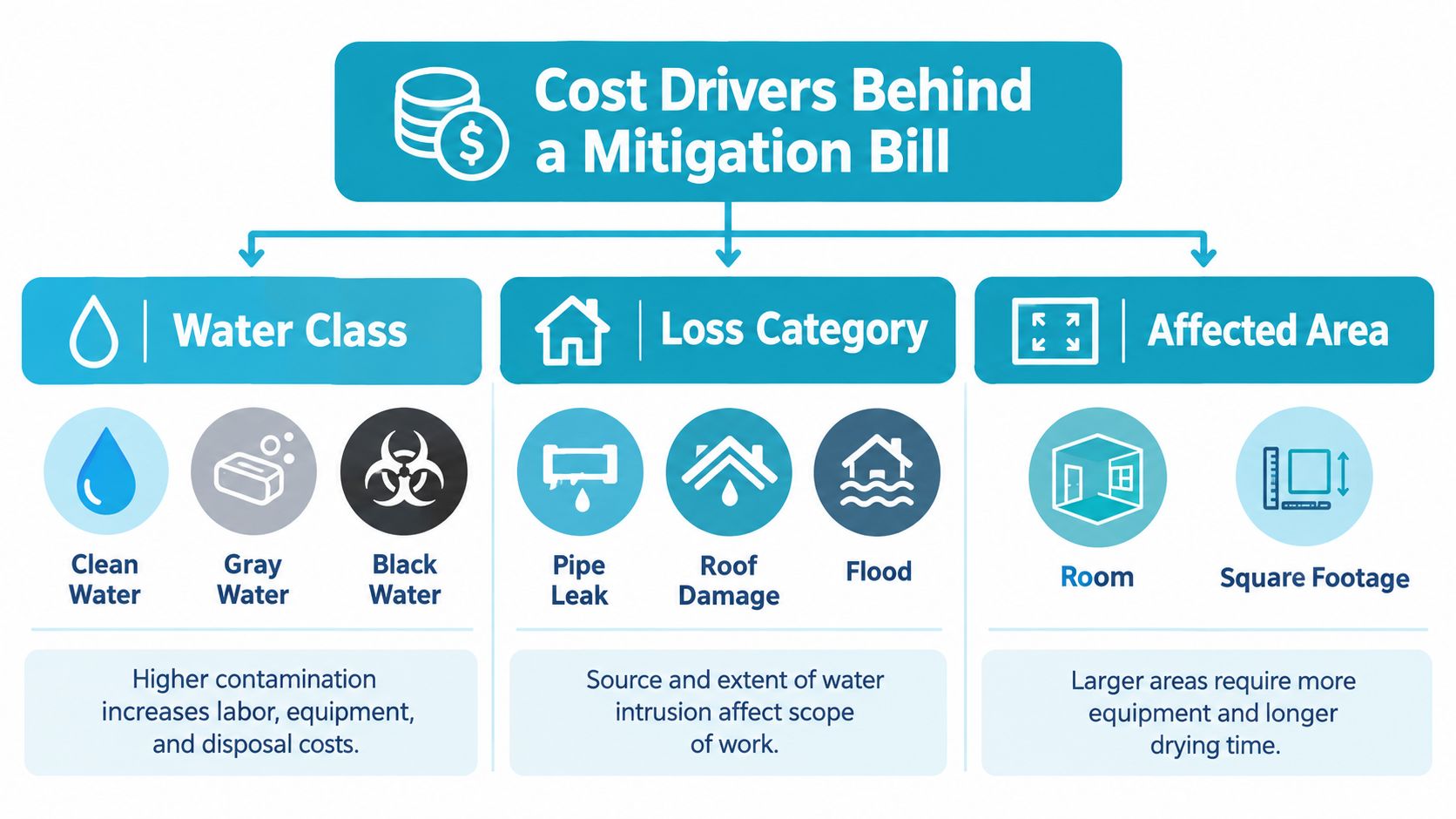
Two homes with similar floor plans can get very different estimates. The deciding factors are often the water's contamination level, where it traveled, which materials absorbed it, and how much drying work the assembly needs.
Water type, materials, and access
A clean-water supply-line leak is a different cleanup from sewage or floodwater. More contamination can mean more protective measures, sanitation, disposal, and contents handling. Ask the contractor to identify the water category and explain how that classification affects the work.
Materials matter too. Water on an open tile floor can be easier to address than moisture trapped beneath hardwood, inside insulated walls, or under a subfloor. A ceiling leak may wet insulation and drywall above the room, requiring access and removal before the area can dry properly. Concrete, plaster, and concealed assemblies may also hold moisture or release it slowly.
The affected area isn't just the visible puddle. A moisture meter and inspection of adjacent rooms help establish how far water traveled. In Florida's humid conditions, dehumidification and controlled airflow can be more useful than opening windows and relying on ventilation.
Equipment time and labor
The length of the drying phase affects labor, equipment rental, and monitoring. Experimental work by Fraunhofer IBP found that wall, floor, and ceiling assemblies may require drying periods lasting several weeks, and that alternating natural and assisted drying can work better than using one uniform approach in some configurations, according to its research on efficient drying methods.
That doesn't mean every job needs weeks of equipment. It means the crew should base the plan on measured moisture decline, material type, and affected volume, not an arbitrary rental schedule. Ask how often readings will be checked and what criteria will support removing equipment.
For concealed assemblies and specialized drying, compare the scope against the contractor's explanation of its structural drying services in Tampa Bay. A sound estimate should connect equipment placement and expected duration to the actual conditions, rather than adding machines without explaining their purpose.
Typical Price Ranges Florida Homeowners See
The ranges below are practical estimates for common Suncoast situations, not guaranteed quotes. The condition of the structure, water category, access, and drying results can move a job outside its tier. Get an inspection and a written scope before treating any online figure as your price.
| Tier | Typical range | Example scenario | Usually includes |
|---|---|---|---|
| Light mitigation | $1,400 to $3,500 | A small, early-detected clean-water loss from an upstairs supply line | Limited extraction, targeted drying, moisture checks, and minor material removal if needed |
| Moderate mitigation | $3,500 to $8,000 | A washing-machine overflow affecting more than one room, carpet, padding, or drywall | Broader extraction, drying equipment, monitoring, and some demolition or sanitation |
| Severe mitigation | $8,000 to $20,000 or more | Storm or flood-related water in a ground-level condo, or a large contaminated loss | Extensive extraction, protective measures, contents handling, demolition, drying, and microbial-control work where appropriate |
Why the tiers aren't a price list
A broken line caught quickly may stay within a smaller scope. The same water source can become more expensive if it reaches multiple rooms, sits under flooring, or wets wall cavities before anyone finds it. A water-heater failure in a garage conversion may also affect finished materials and contents that wouldn't be part of a basic utility-room cleanup.
The average claim is useful context, but it isn't an estimate for a particular home. The Insurance Information Institute figures cited earlier summarize insurance claims, not the exact cost of a mitigation contractor's work. Read the written scope for what it includes and what it excludes.
For commercial owners, the stakes can be much higher. Industry research cited in a water-damage insurance white paper estimated an average commercial water-damage loss of about $89,000 and reported that water claims costing more than $1 million had tripled since 2015, according to the water-damage and insurance implications white paper. Large properties may face contents handling, tenant coordination, lost occupancy, and repair work in addition to drying.
How the Source of Water Changes the Cost
The water's source can change both the cleanup method and the insurance conversation. A room that looks the same after drying may have had very different exposure if the water came from a clean supply line, an appliance overflow, or sewage backup.

Match the response to the water source
Supply-line break: Water from an internal pipe may be relatively straightforward to extract if the leak is found early and the affected materials can be dried. The crew still needs to check adjacent flooring and wall cavities. A leak may be harder to manage when it's hidden, so homeowners dealing with recurring dampness can consult a resource on trusted leak detection for your home.
Appliance overflow: A washing machine or dishwasher overflow can spread across flooring and reach cabinets, padding, or nearby rooms. The estimate may include additional cleaning or removal depending on the water's condition and the materials affected.
Sewage or outside floodwater: Contaminated water can require more protective equipment, removal of unsalvageable materials, sanitation, and careful handling of affected contents. For a sewage event, review the scope for the cleanup steps involved in sewage backup cleanup in Tampa Bay.
Standard homeowners policies generally cover certain sudden internal water losses, such as a broken pipe, but outside flooding typically requires separate flood insurance. Don't assume that a storm-related loss will be handled under the same coverage as a plumbing failure. The source should be documented and matched to the relevant policy before you decide what you'll owe.
What You Actually Pay Out of Pocket
A contractor's total invoice and your personal cost are not the same number. Your out-of-pocket amount depends on the covered scope, deductible, exclusions, depreciation terms, and whether later repair work is included or approved.
For a simple example, suppose a sudden pipe loss has $4,000 in eligible work and the policy has a $1,135 deductible. If the insurer approves the full amount as covered, the basic arithmetic leaves $2,865 after the deductible, before any policy limits, exclusions, depreciation, or other terms affect payment. Consumer Reports describes a typical homeowners-insurance deductible of $1,135, with about half of policyholders reporting deductibles between $500 and $1,499, in its home insurance coverage and deductible overview.
Read the coverage details, not just the estimate
Ask the adjuster how the policy treats emergency mitigation, contents handling, and repairs. Depreciation may affect what the insurer initially pays for replacement work, and recoverable depreciation may be available only after repairs are completed and documented. Code-required upgrades and temporary living expenses depend on policy terms, so confirm them directly rather than assuming they're included.
For a roof-related loss, homeowners can also look into Miami-Dade roof claim support as a resource when navigating claim questions. Keep your own dated photos, estimates, and work records, and review the policy's exclusions before authorizing non-emergency repairs.
Floodwater is a separate coverage issue. Standard homeowners insurance generally doesn't cover outside flooding. FEMA says a separate National Flood Insurance Program policy can generally provide up to $250,000 in building coverage for residential buildings and up to $100,000 for residential contents; a new NFIP policy typically has a 30-day waiting period before coverage starts, as explained in FEMA's flood insurance guidance. A policy usually can't be purchased after a flood begins to cover that loss.
Use a written estimate to separate covered emergency work from excluded damage and later repairs. This overview of water damage insurance coverage can also help you prepare questions for your insurer.
Practical Ways to Keep Mitigation Costs Down
You can't control every part of a water loss, but you can reduce avoidable delay, unclear billing, and unnecessary secondary damage. Take these steps as soon as it's safe.
Stop the source. Shut off the affected fixture or water supply if you can do so safely. Tell the contractor when you first noticed the problem and what you've already done.
Document before cleanup. Photograph and video the source, standing water, affected contents, and visible damage. Don't delay emergency work to build a perfect record, but capture what you can before materials are moved.
Ask for moisture mapping. Have the crew check beyond visible surfaces, including nearby walls, flooring, and concealed areas. A moisture map helps explain why equipment is placed in a particular room and how the drying plan is progressing.
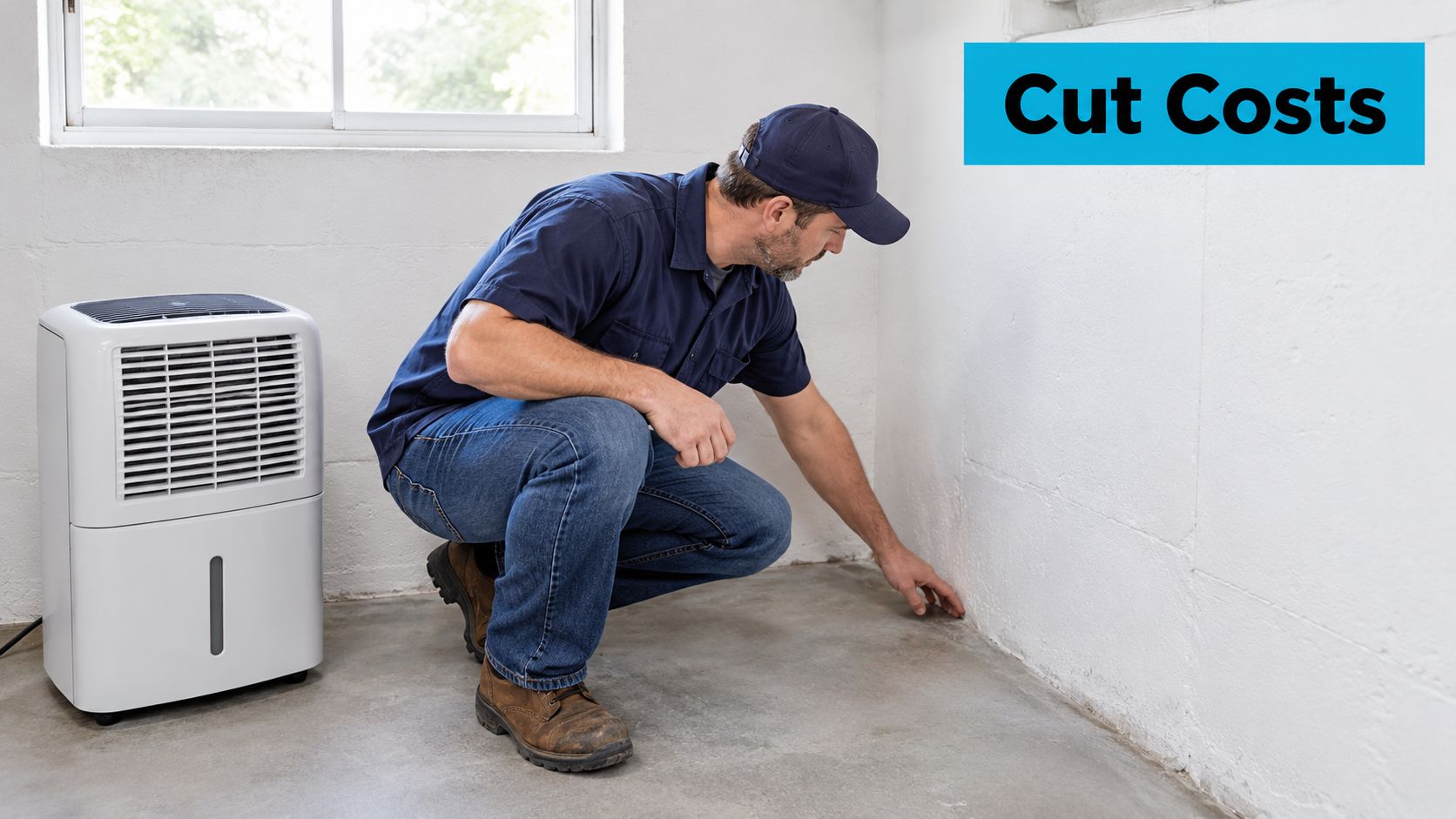
Don't remove equipment early. Ask the crew to explain the readings and the drying targets before equipment is taken away. Dry-looking surfaces alone aren't proof that concealed materials are ready for repair.
Separate emergency mitigation from reconstruction. Request an itemized scope, including extraction, equipment, monitoring, demolition, contents work, and later repairs. Labor and material prices can change between phases; Verisk's Q4 2025 analysis reported hourly billable labor costs rising 4.49% and material costs 2.19% from October 2024 to October 2025, as detailed in its reconstruction-cost analysis.
Review before signing. Ask what each line item covers, whether the contractor can coordinate with your insurer, and whether insurance-direct billing is available. Don't choose a scope solely because its first number is lower; confirm that drying, monitoring, and necessary removal are addressed.
A qualified restoration company can assess damage and document the work, while a handyman may not have the equipment or process needed for moisture mapping and structural drying. If you're considering handling the work yourself, read why DIY water damage restoration can create risks. For future prevention, consider leak sensors, automatic shutoff valves, and backflow protection suited to your property.
For a prompt assessment of your water mitigation cost, call AMPM Restoration at 941-946-7807 for a free inspection and estimate, with insurance claim assistance and financing options available. AMPM Restoration provides 24/7 emergency restoration across Bradenton, Sarasota, Tampa Bay, Saint Petersburg, Lakewood Ranch, and surrounding Gulf Coast communities, and you can reach the team through AMPM Restoration Services.