

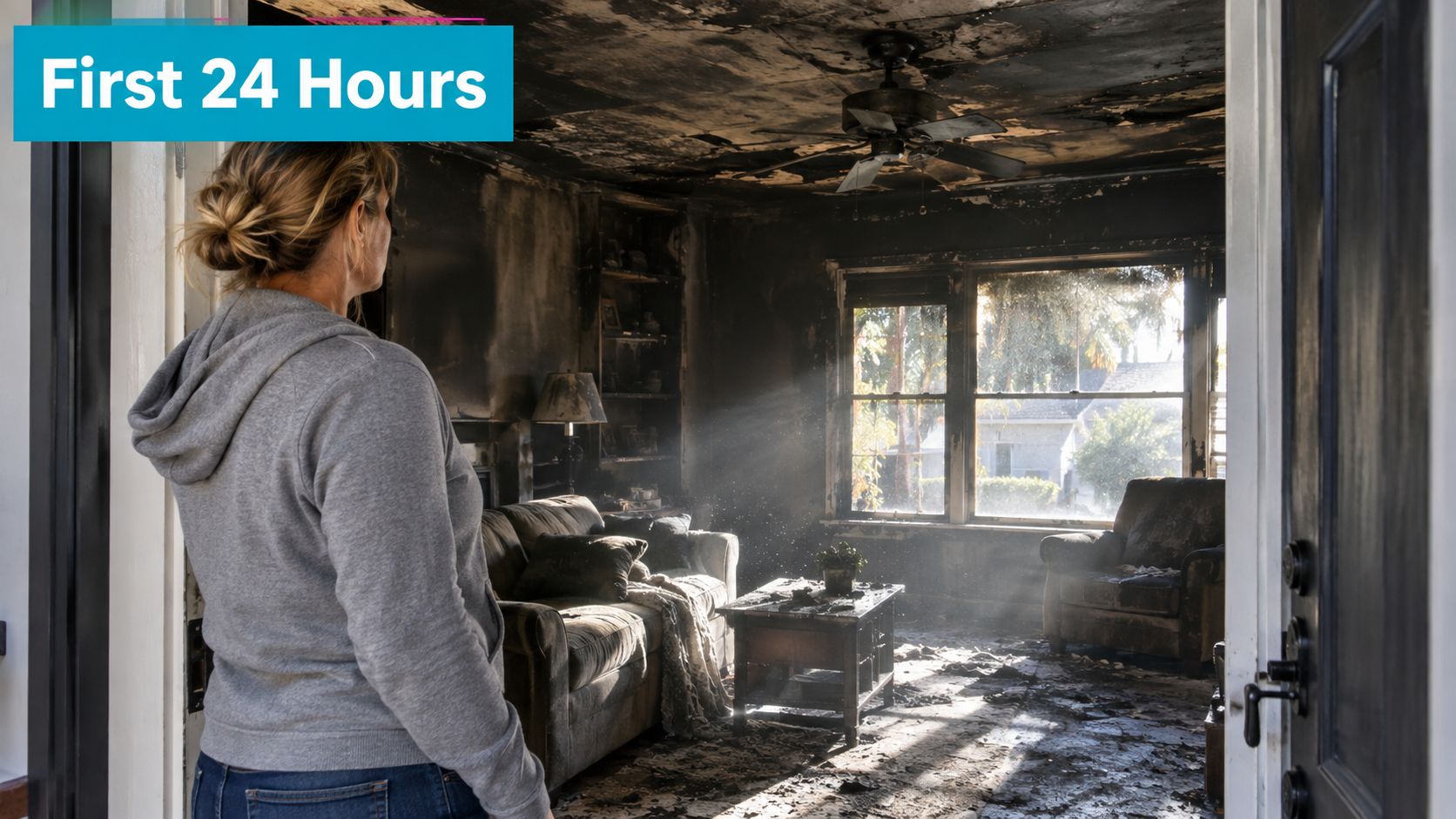
You're standing outside your Florida home, watching water run from the doorway while the smell of burned plastic and wet ash reaches you before the soot comes into view. The fire may have stayed in one room, but smoke, suppression water, heat, and corrosive residue may have traveled through the attic, walls, belongings, and HVAC system. That's why fire and smoke damage isn't a cosmetic cleaning project. It's a controlled recovery process that starts with safety, documentation, testing, and fast mitigation.
A large fire loss can overwhelm any homeowner. The U.S. Fire Administration reported 1,414,191 fires in 2024, resulting in 3,881 deaths, 13,027 injuries, and $21.3 billion in losses (U.S. Fire Administration fire statistics). On Florida's Suncoast, humidity and heavy rain add another problem. Charred materials absorb moisture, firefighting water sits inside assemblies, and mold risk rises while smoke residue continues to affect surfaces.
The First Hours After a Fire in Your Florida Home
You return after the fire department leaves. The front door may be boarded, the air feels damp, and the sharp odor hits before your eyes adjust to the damage. A blackened kitchen wall gets your attention, but the attic insulation, bedroom closets, return-air grilles, and electrical components may also be contaminated.
The first hours feel chaotic because they are. You're dealing with adrenaline, uncertain structural conditions, lingering heat, broken glass, unstable ceilings, and water from suppression efforts. Florida's humidity makes the situation less forgiving. Moisture can move into charred wood, drywall edges, insulation, flooring, and contents while residues begin reacting with metal and coatings.
Safety comes before cleanup
Don't start wiping walls, moving furniture, or washing clothing until fire officials release the structure and a qualified restoration professional evaluates it. A burned building can contain hidden hot spots, weakened framing, damaged wiring, contaminated water, and unstable debris.
Your immediate priorities are straightforward:
- Confirm official clearance: Re-enter only after the fire department or other responsible authorities say the structure is safe to enter.
- Shut down utilities: Have utility professionals address electricity, gas, and water rather than operating damaged systems yourself.
- Prevent re-ignition: Avoid candles, appliances, generators, smoking, and other ignition sources near damaged areas.
- Keep people out: Children, pets, and anyone with breathing or heart conditions shouldn't enter a contaminated structure without professional direction.
- Call for assessment: A fast inspection identifies smoke migration, water intrusion, structural concerns, and areas that need containment.
Practical rule: If flames stayed in one room, assume smoke reached farther until inspection proves otherwise.
Read what to do after a fire before touching damaged contents. The safest early action is usually documentation and stabilization, not scrubbing. Photograph every area from the doorway first, preserve damaged materials where possible, and let a professional establish the sequence.
What Fire and Smoke Damage Really Means
Homeowners often use “fire damage” to describe everything after a loss. Adjusters and restoration professionals need a more precise picture because different materials require different cleaning, removal, testing, and repair decisions.
Thermal damage comes from direct flame contact and intense heat. Blistered window frames, charred joists, melted wiring insulation, and burned cabinet surfaces fit this category. These materials may require removal or structural evaluation rather than surface cleaning.
Soot damage involves carbon-based particles deposited on surfaces. A black coating on painted walls, dark dust inside return-air grilles, or powdery residue on furniture can indicate soot migration. Wiping it with a wet cloth often spreads the residue and drives it deeper into porous materials.
Smoke residue damage comes from acidic, oily, and chemically active combustion byproducts. Yellow etching on metal hardware, tarnished fixtures, sticky cabinet film, and stained painted surfaces may remain even when the soot looks light. Research on fire residues describes corrosive effects that become more aggressive with moisture and humidity (fire residue corrosion research).
Heat damage can affect materials without direct burning. Flooring may warp outside the burn room, plastic components may deform, and finishes can fail because of heat exposure. Firefighting water creates a separate category of secondary damage, affecting drywall, insulation, flooring, contents, and metal components.

Why the categories matter for your claim
These conditions overlap, but they shouldn't be lumped into one vague line called “cleanup.” A burned wall, smoke-contaminated duct, corroded light fixture, warped flooring section, and water-damaged cabinet may each require separate documentation and treatment.
Smoke residues can become corrosive in humid conditions, especially when plastics, insulation, treated fabrics, or other synthetic materials burn. Fire-restoration chemistry guidance also explains that residue can become highly alkaline when mixed with water and humidity, with pH rising above 12 (fire-restoration chemistry guidance). That's why fast drying, humidity control, neutralization, and material-specific cleaning matter.
Why Smoke Damage Spreads Far Beyond the Burn Area
Smoke doesn't respect the boundaries of the room where the fire began. It moves through pressure changes, air currents, open doors, wall penetrations, plumbing chases, attic spaces, and HVAC returns. A contained kitchen fire can leave residue in bedrooms, closets, ceiling cavities, and ductwork.
The particles themselves explain much of the problem. Soot from incomplete combustion is commonly described in the approximate 0.1 to 2.5 micron range, with some sources reporting a broader 0.01 to 10 micron range (structure-fire smoke hazards). Particles at PM2.5 size and below can penetrate deeper into porous materials, HVAC systems, and the lower respiratory tract.
Air movement distributes contamination
Smoke enters return-air pathways and can be carried through supply ducts before settling on registers, insulation, carpeting, clothing, and upholstered furniture. When the HVAC system operates after a fire, it may redistribute residue into areas that initially look clean.
Soft materials act like reservoirs. Curtains, mattresses, rugs, unfinished wood, drywall paper, and insulation can absorb odor and particles. Painting over stained walls or running a fragrance machine doesn't remove those sources.
Combustion products from vinyl, foam, plastics, electronics, and treated fabrics can also leave oily or acidic films. Those films may stain surfaces and accelerate corrosion on metals when Florida moisture remains in the building. The visible burn area is therefore a poor measure of the total restoration scope.

Odor is evidence, not the whole diagnosis
Smoke odor can remain after particles have settled into hidden areas. It can also fade temporarily when air fresheners, ozone treatments, or ventilation change how the home smells. That doesn't establish that the structure or contents are clean.
The smoke odor removal guide is useful for understanding why odor treatment must follow source removal. A professional should inspect HVAC components, wall and ceiling surfaces, attic spaces, insulation, and contents before choosing deodorization equipment. If smoke reached multiple rooms, testing and documentation are more reliable than smell alone.
Emergency Steps Homeowners Should Take Right Away
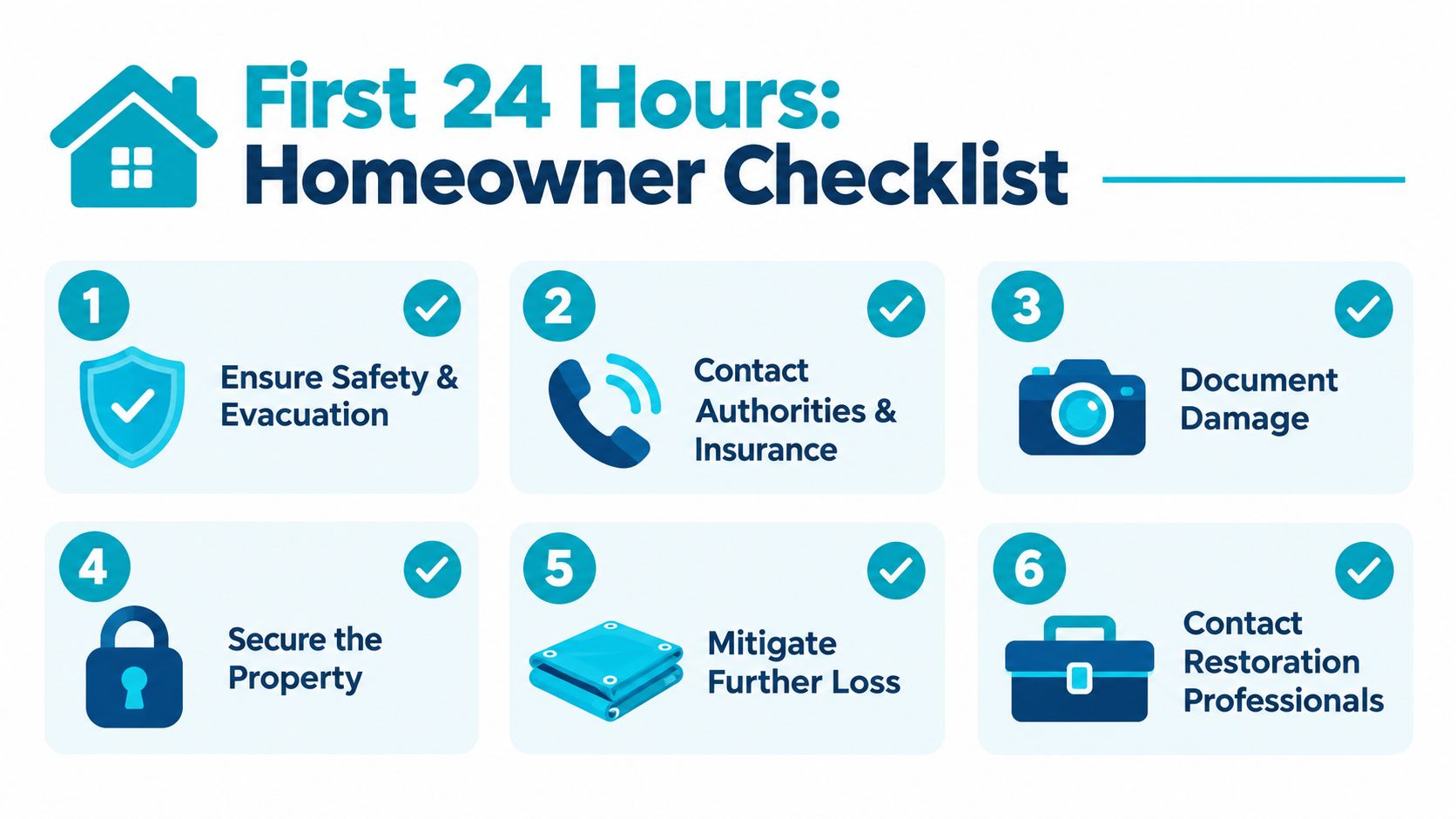
Use the first day to protect people, preserve evidence, and stop additional damage. Don't turn the cleanup into a second loss by spreading soot, disturbing unstable materials, or allowing Florida rain to enter through a damaged roof.
Follow this order
- Account for everyone: Confirm that family members, guests, pets, and essential medications are safe and accounted for.
- Wait for clearance: Don't enter until fire officials release the property and a professional identifies immediate hazards.
- Notify insurance: Report the loss promptly and record the claim number, representative's name, and date of every conversation.
- Document untouched conditions: Photograph and video walls, ceilings, floors, contents, cabinets, appliances, electrical panels, attic areas, and every HVAC register before moving items.
- Limit traffic: Keep people out of affected rooms so soot doesn't track into clean areas.
- Secure openings: Use professional board-up and roof-tarping services to block rain, wind, animals, and unauthorized entry.
What you shouldn't do yourself
Don't wipe soot with bare hands. Don't use household sprays, bleach, degreasers, or water on painted walls, ceilings, upholstery, or paper goods unless a professional tells you the material and residue can tolerate it. Cleaning products can smear oily soot, embed particles, damage finishes, or create chemical reactions.
Turn off HVAC operation if it's safe to do so, but don't remove filters or open ductwork until the system is evaluated. A filter change may be appropriate, but it can also disturb contamination or overlook residue inside the air handler and ducts.
Cover openings before the next storm, but use qualified emergency crews for unstable roofs, electrical hazards, and structural work. Keep receipts for boarding, tarping, utility shutoffs, emergency plumbing, transportation, meals, and temporary lodging. Your policy may reimburse reasonable mitigation and loss-of-use expenses, subject to its terms.
The Professional Fire and Smoke Restoration Process
Professional restoration works as a connected sequence. Skipping mitigation, contents cleaning, structural cleaning, or source-based deodorization usually creates a predictable result, lingering odor, stained surfaces, corrosion, or repairs that need to be opened again.
Mitigation stabilizes the property
The first stage addresses immediate threats. Crews secure the building, board openings, tarp damaged roof areas, remove standing water, extract moisture from affected materials, and begin drying. In Florida, moisture control matters because wet insulation, drywall, framing, and contents can support mold growth and secondary deterioration.
If suppression water entered the building, water mitigation must run alongside fire restoration. Crews may use extraction equipment, dehumidifiers, air movers, moisture meters, and containment barriers. They'll also determine which materials can be dried and which are too damaged or contaminated to save.
Contents cleaning separates salvage from disposal
Pack-out protects belongings from additional exposure and gives the team controlled space to clean them. Hard goods may receive specialized cleaning, including ultrasonic methods where appropriate. Clothing, curtains, bedding, and other soft items may be inventoried, cleaned, deodorized, and stored off-site.
Inventory needs to be detailed. Photograph each item, record its condition, and separate salvageable property from materials that require disposal. Never assume an expensive or sentimental item is lost because it smells smoky, and don't assume an item is safe because it looks clean.
Structural cleaning removes the source
Technicians match the method to the residue. Dry cleaning sponges, chemical sponges, HEPA vacuuming, controlled wet cleaning, and specialized detergents may be used on walls, ceilings, joists, cabinets, and other surfaces. HVAC components require particular attention because contaminated air can circulate after surface cleaning ends.
Deodorization and rebuilding come last
Thermal fogging, hydroxyl generators, and other equipment can address odor after residue removal. Charred framing, masonry, or other porous substrates may need sealing or encapsulation once cleaning is complete.
The final stage can include drywall replacement, painting, flooring, electrical work, trim, cabinetry, and HVAC recommissioning. New filters and documented duct-cleaning verification should be part of the closeout when the system was exposed. Learn how fire restoration progresses from damage to recovery before accepting a plan that jumps straight to paint.
Insurance Claims, Documentation, and Hidden Damage Coverage
Smoke contamination is not merely an unpleasant smell. It can be a covered physical loss when fire-related residues affect the dwelling or personal property, but your claim needs evidence that connects the contamination to the event and shows what treatment is necessary.
Florida homeowners policies commonly address fire, smoke, and soot under dwelling and personal-property coverage, while Additional Living Expense coverage may apply when the home is uninhabitable. Exact coverage depends on the policy, exclusions, endorsements, deductibles, and the adjuster's findings. Don't accept a verbal summary as the complete scope.
Build evidence before cleaning
Photographs and video should show the original condition, not only the cleaned room. Include close-ups of soot, staining, warped materials, corroded hardware, damaged contents, HVAC registers, insulation, ceilings, and areas where suppression water traveled.
For widespread odor or residue, consider independent evaluation by an industrial hygienist. Depending on the situation, documentation may include thermal imaging, air sampling, surface swabs, moisture readings, and HVAC inspection records. Testing doesn't replace visual documentation, but it can help establish hidden migration and support a disputed scope.
| Damage Category | Typical Coverage | Documentation Needed |
|---|---|---|
| Direct flame and heat damage | Dwelling or contents coverage may apply | Photos, structural assessment, repair scope, contents inventory |
| Soot and smoke residue | Fire-related cleaning and replacement may apply | Pre-cleaning images, room-by-room scope, cleaning methods |
| HVAC contamination | May require investigation and itemized remediation | Register photos, duct and air-handler inspection, sampling where appropriate |
| Firefighting water damage | Water mitigation may be included when caused by the covered fire | Moisture readings, extraction records, drying documentation |
| Temporary relocation | Additional Living Expense may apply when the home is uninhabitable | Hotel, rental, meal, transportation, and related receipts |
Challenge incomplete scopes
Ask for a line-by-line estimate from both the adjuster and restoration contractor. Request supplements for hidden HVAC contamination, duct cleaning, deodorization equipment rental, code-required upgrades, damaged insulation, and work discovered after demolition.
Keep a dedicated claim folder with dates, names, estimates, photographs, receipts, emails, and inspection reports. If the carrier underpays or omits necessary work, request a re-inspection and provide supporting documentation. Review how insurance restoration services work before signing off on a settlement that leaves odor or residue unresolved.
California's insurance regulator has explicitly stated that wildfire smoke inside a home is physical damage covered under fire and must be remediated, while a 2026 task-force report addresses gaps in inspection, testing, and restoration standards (California smoke claims and remediation report). The broader lesson applies to any disputed smoke loss. Document the contamination, don't reduce the issue to odor alone, and get the scope in writing.
Preventing Fires and Preparing Before Disaster Strikes
Florida homeowners face a mix of risks. Lightning, hurricane-related power disturbances, grilling, lithium-ion batteries, aging wiring, overloaded circuits, and dryer vents can all create trouble. Prevention works best when you combine maintenance with insurance readiness.
Schedule dryer-vent cleaning, test GFCI protection, inspect aging electrical components, and consider whole-home surge protection. Place smoke and carbon monoxide alarms according to applicable NFPA guidance, test them regularly, and replace units according to the manufacturer's instructions.
Make your records usable
Create a home inventory before a loss. Photograph rooms, serial numbers, major appliances, electronics, tools, jewelry, artwork, and furniture. Store the records somewhere outside the home, such as secure cloud storage or with a trusted person.
Keep these details in an emergency file:
- Utility information: Note the locations of electrical, gas, and water shutoffs.
- Insurance contacts: Save the carrier's claims phone number, policy information, and agent details.
- Property access: Record alarm codes, gate instructions, and contacts for a property manager or landlord.
- Restoration contacts: Keep a qualified emergency contractor's number available before a storm or fire.
- Family essentials: List medications, pet needs, identification documents, and temporary lodging options.
Use a weekend preparation checklist
Walk the home and test alarms. Look at the dryer vent, power strips, outlets, battery chargers, grill, attic, and electrical panel. Photograph valuable belongings and upload the inventory. Review Additional Living Expense coverage and confirm whether your policy has exclusions or special limits that matter to your property.
Preparation isn't paranoia. It reduces decision-making when the family is tired, the roof is open, and rain is moving toward damaged rooms.
Fire and Smoke Damage Questions Florida Homeowners Ask Most
How long does smoke odor last?
There's no reliable universal timeline. Odor lasts longer when smoke reaches porous materials, insulation, HVAC components, upholstery, or unfinished framing. Coastal humidity can make odors more noticeable and slow drying, so source removal must come before deodorization. See professional smoke smell removal options.
Is it safe to re-enter?
Only after fire officials release the structure and qualified professionals evaluate hazards. Heat damage, unstable ceilings, electrical problems, contaminated water, soot, and air-quality concerns can remain after flames are out. Follow local authority requirements and the restoration team's re-entry instructions.
Can belongings be salvaged?
Often, yes, but appearance isn't enough to decide. Hard goods, textiles, electronics, documents, and upholstered items each need separate evaluation. Pack-out and controlled cleaning protect salvageable property while preventing cross-contamination.
What does soot do to HVAC equipment?
Soot can enter return-air grilles, filters, air handlers, and ductwork. Running the system can redistribute particles and odor. Shut it down when safe, then have the system inspected before replacing filters or restarting it.
Does renters insurance cover fire and smoke damage?
Renters insurance generally addresses a tenant's personal property and qualifying additional living expenses, while the building itself is usually the landlord's responsibility. Coverage depends on the renter's policy, exclusions, limits, and cause of loss. Notify both the insurer and landlord promptly.
Can I clean light soot myself?
A homeowner may handle limited, clearly safe cleaning after documentation and professional guidance, but avoid aggressive scrubbing and household chemicals. Bare hands, wet wiping, and ordinary vacuums can spread or embed residue. If soot appears in several rooms, odor persists, or HVAC was operating, call a professional.
What health symptoms need attention?
Wildfire and structure-fire smoke contain fine particles that can irritate the eyes and respiratory system. The U.S. Environmental Protection Agency identifies symptoms such as burning eyes, runny nose, bronchitis, worsening asthma, heart failure exacerbation, and other serious effects from smoke exposure (EPA wildfire smoke health information). Leave the property and contact a healthcare professional if symptoms persist, worsen, or affect breathing, especially for children, older adults, and people with heart or lung conditions.
What should insurers receive?
Provide pre-cleaning photographs, videos, contents inventories, moisture readings, inspection findings, itemized estimates, receipts, temporary-lodging records, and communications. Add sampling or HVAC documentation when contamination extends beyond visible surfaces.
How long does restoration take?
The schedule depends on structural damage, suppression water, contents volume, material availability, inspections, insurance decisions, and Florida weather. A professional can establish phases after assessment. Don't accept a completion date that ignores drying, hidden contamination, HVAC verification, or required rebuilding.
Who can handle the whole recovery?
Look for a licensed, bonded, insured restoration contractor with appropriate technical credentials, emergency response capability, and experience coordinating with insurers. AMPM Restoration Services operates from 4301 32nd St W b18, Bradenton, FL 34205, serving Bradenton, Sarasota, Tampa Bay, Saint Petersburg, Lakewood Ranch, and nearby Gulf Coast communities with fire and smoke damage restoration, water mitigation, mold services, storm recovery, commercial restoration, and reconstruction.
AMPM Restoration Services can inspect your property, secure the structure, document hidden fire and smoke damage, coordinate mitigation and repairs, and assist with your insurance claim. Call 941-946-7807 for a free inspection and estimate, ask about insurance claim assistance and financing options, or visit AMPM Restoration Services to request help now.