

What Should I Do After a Fire? The Next Steps!
A fire leaves most homeowners in the same place for the first few hours. Shaken, exhausted, and trying to answer one urgent question: what should I do after a fire? If you’re standing outside your home in Bradenton, Sarasota, Lakewood Ranch, or anywhere around the Gulf Coast, you don’t need vague advice. You need a clear order of operations.
Start with this. Your job in the first 72 hours isn’t to clean up fast. It’s to protect people, protect the structure from getting worse, and protect your insurance claim. In Florida, that timeline matters even more because heat, humidity, and sudden storms can turn a bad fire loss into a bigger water, odor, and mold problem very quickly.
You’re also dealing with a situation that is dangerous. The American Red Cross says to call 9-1-1, give first aid if needed, and stay out of the fire-damaged home until fire authorities say it’s safe to re-enter. That caution isn’t overkill. The NFPA reports that U.S. home structure fires caused 2,890 civilian deaths in 2023, and during 2019–2023 there were an average of 65,000 home structure fires per year, causing 430 deaths and 1,530 injuries annually, according to the American Red Cross home fire recovery guidance.
If you’re trying to get your bearings, this guide gives you the order I’d follow on a real job. For an additional insurance-focused perspective, the NW Claims Management fire guide is also worth reviewing. If you need help understanding how professional cleanup starts, this overview of fire damage restoration in Tampa gives a practical local reference point.
Introduction: The First 72 Hours After a House Fire
At 2 a.m., the fire trucks leave, the house is wet, smoky, and unstable, and your phone is full of missed calls. You are tired, shaken, and under pressure to make decisions that affect your safety, your insurance claim, and how much worse the damage gets by tomorrow.
Focus on the first 72 hours.
Your job during that window is straightforward. Protect people first. Protect the property from additional damage. Protect the claim file before details get lost. In Florida, speed matters because humidity starts working against you right away, and an exposed roofline or broken window can turn into a much larger problem with one hard rain.
Here is the order I recommend:
- Immediate safety and controlled access
- Documentation and insurance setup
- Drying, board-up, and mitigation to stop secondary damage
That sequence keeps the situation from getting more expensive.
A fire loss rarely stops with burned materials. It usually includes water inside walls, wet insulation, soot on contents, and openings in the structure that let in humid air and storms. In Florida, that combination can lead to odor spread, material swelling, corrosion, and mold if cleanup and drying are delayed.
Keep your thinking simple. Do the next right thing, in the right order.
That usually means staying out until officials allow re-entry, starting a photo record as soon as it is safe, making your insurance call early, and arranging professional mitigation if the building has water intrusion or exposure. For a practical local reference, review this overview of fire damage restoration services in Tampa. If you want an insurance-focused outside perspective, the NW Claims Management fire guide is also useful.
One bad decision in the first day can create three more problems by the third. A disciplined first 72 hours gives you the best chance to control the damage, document the loss properly, and keep recovery moving.
Your First Priority Immediate Safety and Security
This is the essential part.
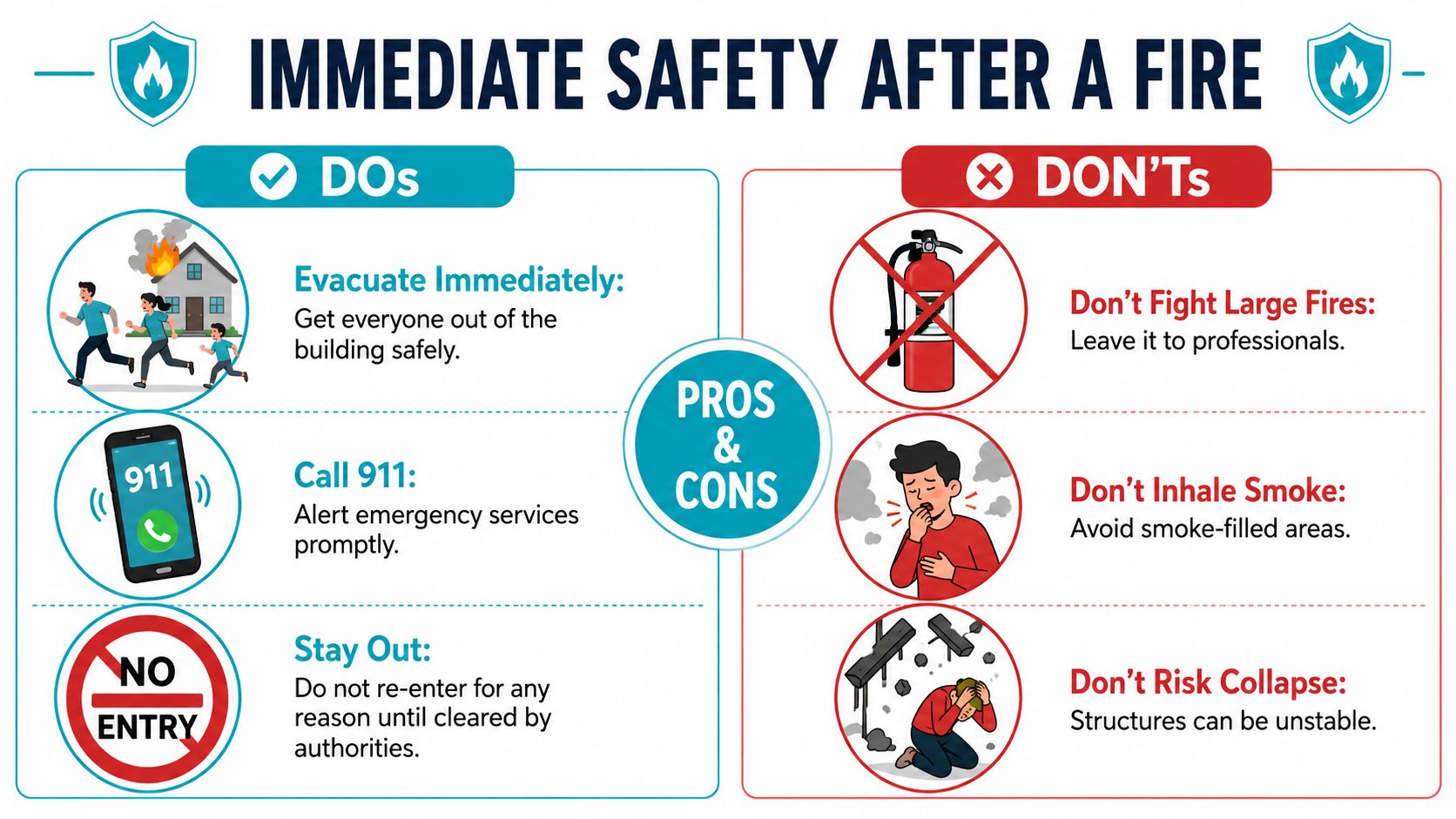
If the fire department hasn’t cleared the structure, don’t go back in. Not for your phone. Not for documents. Not for medications unless emergency personnel tell you it’s safe and retrieve them for you. FEMA guidance warns that post-fire hazards include weakened floors and walls, hidden hot spots, and unsafe utility systems, and firefighters may disconnect unsafe water, gas, or electricity before leaving. You should not turn utilities back on yourself, according to FEMA fire recovery guidance.
What to do in the first hour
Use this checklist:
-
Account for everyone
Make sure every person and pet is out and physically safe. If anyone is injured, get medical help immediately.
-
Listen to the fire officer on scene
Ask one question clearly: when, if at all, is limited re-entry allowed? Don’t guess.
-
Stay at a safe distance
A structure can look stable from the driveway and still be unsafe inside. Smoke residue, wet ceilings, and compromised framing aren’t obvious hazards to a homeowner.
-
Keep family members out
Children, elderly relatives, and anyone with breathing issues shouldn’t be near a smoke-damaged structure.
-
Accept temporary displacement early
If the house isn’t safe, make peace with leaving for the night. That’s not defeat. That’s the correct move.
What not to do
A lot of bad decisions happen because people want to “just grab a few things.”
- Don’t restore power yourself: If utilities were shut off, leave them off until qualified professionals and the utility provider say otherwise.
- Don’t touch charred materials: Some surfaces can collapse, splinter, or transfer soot and contaminants everywhere.
- Don’t start airing out the house on your own: Opening everything during humid Florida weather can make moisture control harder, not easier.
- Don’t allow casual visitors inside: Neighbors mean well. They don’t need to walk through a hazardous loss site.
If the building has fire damage, smoke damage, and water inside, it isn’t a cleanup project yet. It’s a hazard site.
Securing the property without taking risks
Your next safety job is controlled access. If doors, windows, or sections of the roof were damaged, the property may need emergency board-up or tarping. That’s especially important on the Gulf Coast, where rain bands and wind can turn an exposed fire loss into a much larger restoration problem overnight.
For immediate help with stabilization and emergency response, review 24/7 emergency restoration services. The key is simple. Secure the structure from the outside. Don’t reoccupy it from the inside.
Documenting Everything for Your Insurance Claim
Once everyone is safe, your next job is financial protection. Most homeowners underestimate this part. They remember to call the insurer, but they don’t build a clean record of the loss. That’s a mistake.
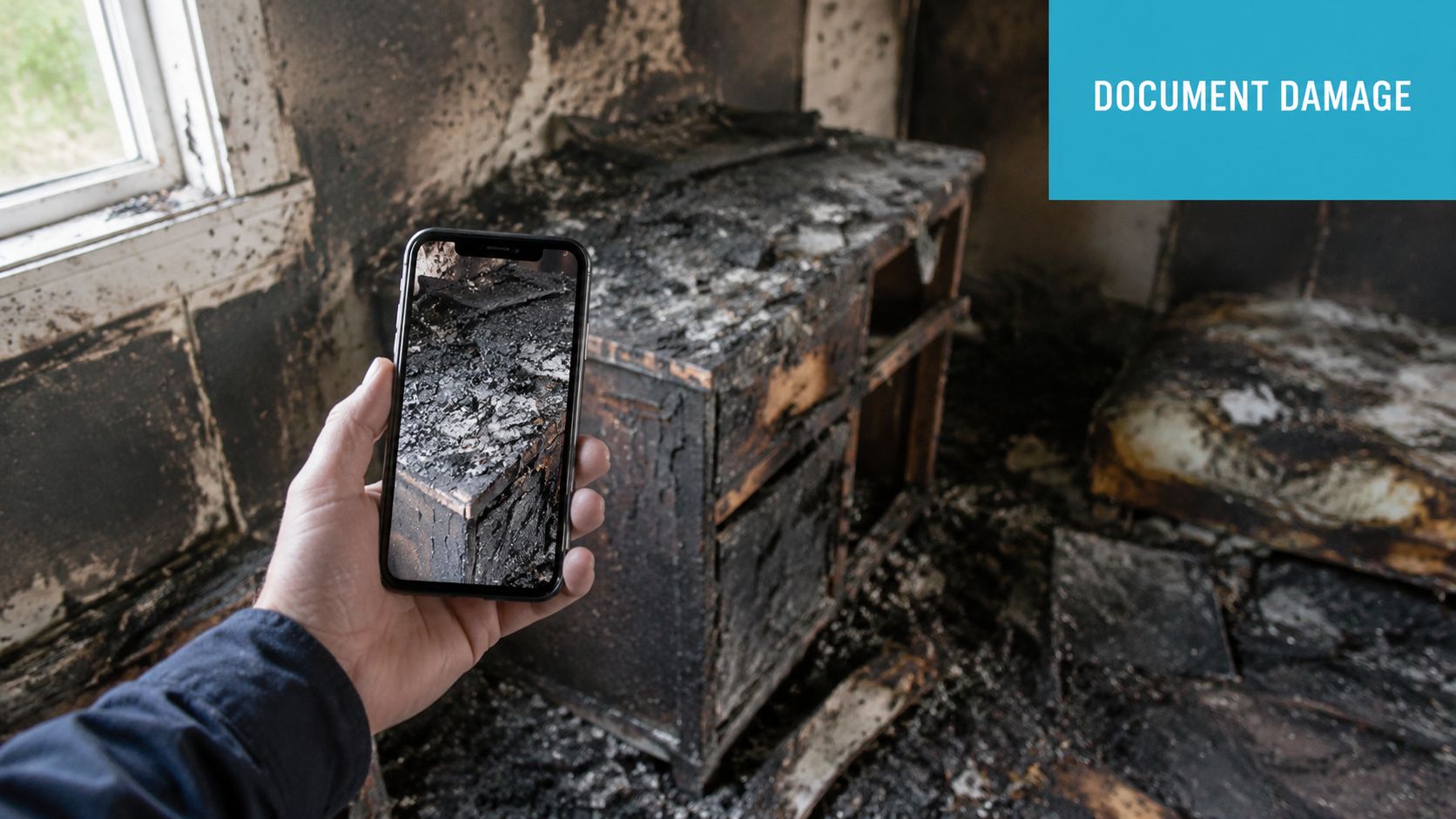
Authoritative recovery guides advise taking a room-by-room video and close-up photos, preserving damaged items until inventory is complete, and saving receipts for all emergency spending because insurers may require this evidence to validate losses and authorize restoration work, according to House Fire Solutions recovery steps.
What to photograph first
Don’t try to make it pretty. Make it complete.
Capture:
- Wide shots of each room: Show the full condition of walls, ceilings, floors, cabinets, and openings.
- Close-ups of damage: Burn patterns, soot deposits, melted fixtures, broken glass, and water saturation.
- Contents and belongings: Furniture, electronics, clothing, documents, appliances, and anything smoke affected.
- Exterior damage: Roof areas, windows, doors, siding, garage, lanai, and any visible storm exposure after the fire.
If the fire department allows limited access, move carefully and document before anything gets shifted.
What to keep and what not to throw away
Homeowners often start tossing ruined items too soon. Don’t.
Use this rule:
- Keep damaged items in place when possible
- Don’t discard contents until they’re photographed and logged
- Save every emergency receipt
That includes hotel costs, food, boarding for pets, temporary clothing, plywood, tarps, and other immediate protective expenses.
Your insurance company can’t evaluate what you no longer have evidence of.
Build a simple loss file
You don’t need fancy software. A notes app, spreadsheet, or paper notebook works if it’s organized. Create one file with:
- claim number
- adjuster contact information
- date and time of calls
- receipts
- photos and videos
- a running list of damaged rooms and major items
For a homeowner-friendly overview of the claims side, this page on insurance restoration services and what homeowners should know is useful.
If the claim process later gets contentious, understanding your broader legal options for denied accident claims can help you ask better questions and document disputes more effectively. You hope you won’t need that information. Keep it anyway.
Making Essential Calls to Start Your Recovery
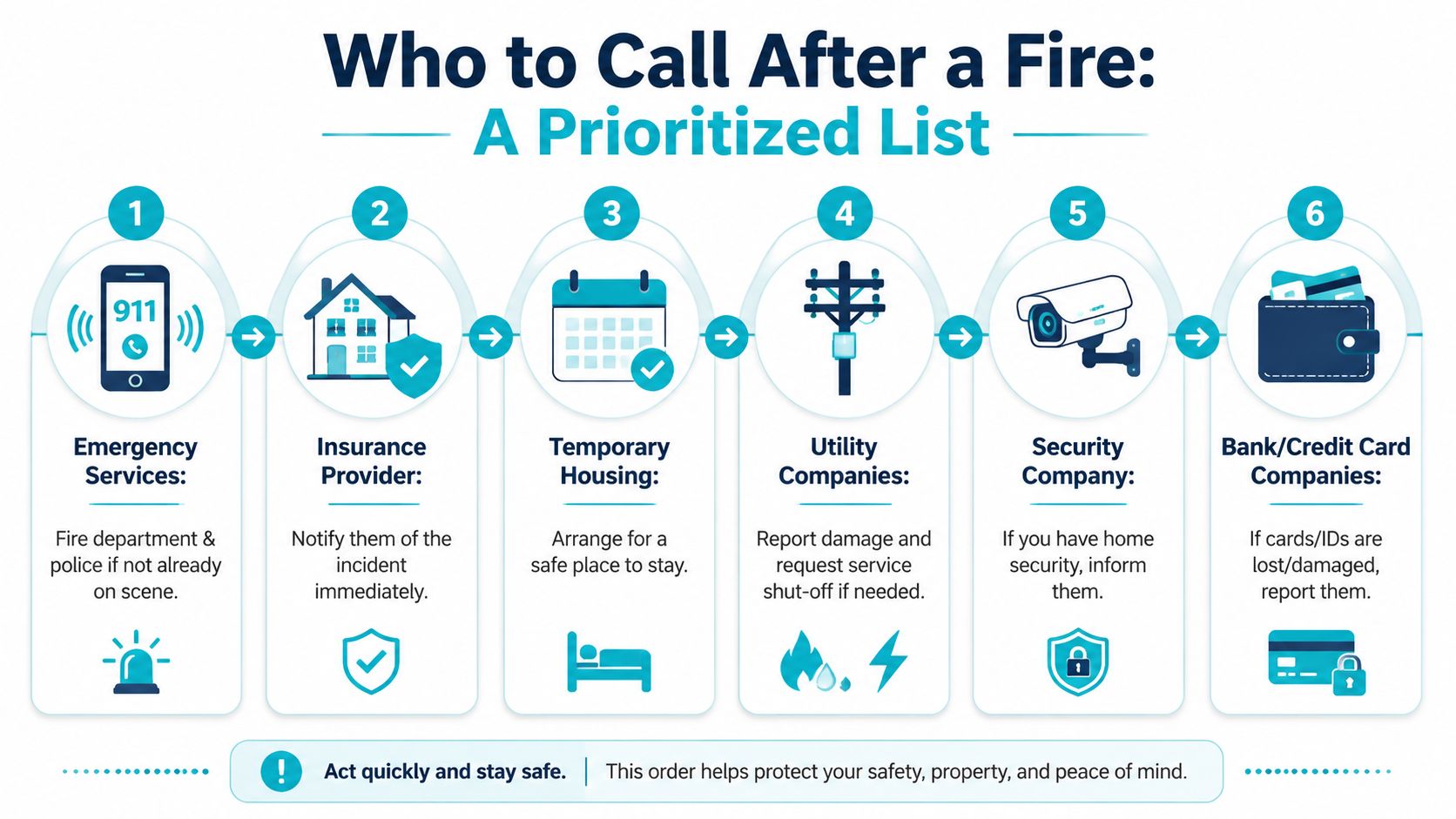
After the scene is safe and documented, stop reacting and start sequencing. The order of your calls affects how smoothly the next few days go.
FEMA-linked recovery guidance emphasizes starting the claim early and keeping records, and it also notes that federal aid may be available to evacuees and homeowners, with support tied to insurance settlement status in some cases. That’s why fire recovery is partly an administrative sequencing problem, as explained in this Frontline Wildfire post-fire recovery article.
The calls to make in the first 24 hours
-
Insurance carrier
Open the claim immediately. Ask what emergency services are authorized, where to send documentation, and how temporary housing reimbursement is handled.
-
Family, close friends, or your local support network
You need practical help. Rides, a place to stay, pet care, medication pickups, and help managing calls all matter.
-
Temporary housing contact
If you can’t stay in the home, don’t improvise for days. Lock in a short-term plan quickly. In some situations, logistics support matters too. If contents need to be packed out or moved into storage, even a general relocation reference like efficient Perth removals by Emmanuel Transport is a reminder of the kind of coordinated contents handling homeowners should look for from qualified local providers.
The calls that protect the property
These depend on the condition of the home.
| Priority | Who to call | Why it matters |
|---|---|---|
| High | Restoration contractor | Starts stabilization, drying, and smoke mitigation before conditions worsen |
| High | Landlord or property manager | Required if you rent or manage a unit |
| Medium | Mortgage lender | Important if major structural damage affects occupancy |
| Medium | Utility providers | Confirms shutoff status and next steps for safe reconnection |
| Medium | Police non-emergency | Useful if the property will sit vacant and unsecured |
Why Florida changes the timing
In Bradenton, Sarasota, St. Petersburg, and nearby coastal areas, delay carries extra risk. A fire-damaged home may have open roof sections, broken seals around windows, soaked drywall, and high interior humidity all at once. Add afternoon rain or salty air and the property can degrade fast.
The right phone call in the first day can prevent weeks of extra damage.
That's why your calls should lead to action, not just claim numbers.
Understanding the Fire Damage Restoration Process
Most homeowners see blackened surfaces and assume the job is “remove what's burned.” That's only part of it. A real fire loss usually includes fire damage, smoke contamination, soot residue, odor penetration, and water damage from suppression efforts. The restoration process has to address all of them together.

Fire-damage restoration costs can range from $3,107 to $51,243, depending on the extent of smoke, soot, and structural damage, according to the fire recovery summary hosted by Flint Hills Discovery Center. That same source notes the urgency of mitigation, and the NFPA data it cites shows operating equipment fires caused $3.7 billion in direct property damage annually on average.
What professionals do first
The first site visit is about control.
A qualified crew typically starts with:
- Safety assessment: Is the structure stable enough for limited work?
- Moisture and damage mapping: Where did firefighting water travel?
- Emergency stabilization: Board-up, tarp, or containment if needed
- Content triage: What can be cleaned, what should be packed out, and what is unsalvageable
Homeowners usually realize the fire wasn't confined to one room. Smoke moves. Soot settles into cabinets, HVAC pathways, closets, and soft goods. Water tracks to low points and hidden cavities.
The part people underestimate most
Odor and residue control.
Smoke isn't just a smell. It leaves acidic residue that can discolor finishes, stain surfaces, and continue damaging materials if it isn't cleaned correctly. Soot behaves differently depending on what burned, so cleaning methods need to match the residue, not just the visible mess.
A professional process may include:
- dry soot removal from appropriate surfaces
- controlled demolition of unsalvageable materials
- detailed cleaning of structure and contents
- deodorization
- drying equipment to address trapped moisture
For homeowners who want a closer look at the workflow, this guide on what to expect from professional fire damage restoration services outlines the sequence in practical terms.
Why full-service coordination matters
In Florida, you don't want one company doing emergency dry-out, another handling smoke cleanup, and a third trying to rebuild without understanding the original scope. Fragmented recovery creates missed details.
One option is AMPM Restoration Services, which handles fire damage cleanup, drying, repairs, and reconstruction as a single process. That's useful when the property has overlapping fire, smoke, and moisture issues and the homeowner wants one documented chain of work rather than separate handoffs.
The fastest cleanup isn't the goal. The right sequence is.
A rushed partial cleanup can lock in odor, miss hidden moisture, and complicate repairs later. Controlled mitigation first. Rebuild second.
Your Next Step Call AMPM Restoration for a Free Inspection
The first 72 hours decide whether this stays a fire loss or turns into a fire-and-mold loss.
Your next move is simple. Get a restoration contractor on site fast. In Florida, wet materials, trapped humidity, and afternoon storms can push smoke damage, water damage, and microbial growth in the wrong direction within days. Waiting costs money.
Keep the roles straight. Your insurance adjuster reviews the claim for the carrier. Your restoration contractor inspects the property, documents site conditions, identifies safety and moisture concerns, and starts the work that prevents added damage. Homeowners lose time when they wait for the adjuster before getting mitigation underway.
Use this phase to protect the house and your claim at the same time:
- Schedule an inspection as soon as the property is cleared for access.
- Ask for documented findings, including fire, smoke, soot, and water-related damage.
- Make sure the scope addresses Florida moisture exposure, not just the burned area.
- Get boarding, tarping, drying, and cleanup handled in the right order.
- Save every invoice, authorization, photo set, and email in one claim folder.
If you live in Bradenton, Sarasota, Tampa Bay, St. Petersburg, Lakewood Ranch, or nearby Gulf Coast communities, speed matters. A house with open roof lines, broken windows, soaked insulation, or heavy smoke residue does not stabilize on its own.
If you're ready to get the property inspected and stabilized, contact AMPM Restoration for a free inspection. The goal is not a rushed cleanup. The goal is a documented, controlled first 72 hours that protect your family, your structure, and your insurance claim.
Florida Fire Recovery FAQs
| Question | Answer |
|---|---|
| Can I sleep in my house the same night if the fire seems minor? | Not unless the fire department says it’s safe. Smoke contamination, hidden hot spots, damaged wiring, and wet building materials can make a home unsafe even when the visible burn area looks limited. |
| Should I open windows and run fans after a fire? | Usually, don’t do that on your own. In Florida, outdoor humidity can make drying harder and can push moisture into already damaged materials. Let a restoration professional decide how to ventilate and dry the structure. |
| What should I photograph if the damage is covered in soot? | Photograph the whole room first, then take close-ups of soot patterns, damaged contents, ceilings, cabinets, vents, appliances, and flooring. Also document any water damage from firefighting efforts. Keep the photos organized by room. |
| Do I need to keep burned items for insurance? | Yes, in many cases. Keep damaged items until your inventory is complete and your insurer or restoration team tells you what can be discarded. If something must be removed for safety, photograph it thoroughly first. |
| Who should I notify besides my insurance company? | Depending on your situation, notify your landlord or tenant, mortgage lender, utility providers, and anyone helping with temporary housing. If the property will be vacant, make sure access is controlled and the structure is secured. |
| Why is fire cleanup more urgent in Florida? | Because fire damage here often becomes a moisture problem fast. Humid air, rain exposure, and trapped water from suppression efforts can worsen odors, damage finishes, and increase the chance of mold growth if mitigation is delayed. |
If you need help with what should I do after a fire, call AMPM Restoration Services at 941-946-7807 for a free inspection and estimate. We help homeowners across Bradenton, Sarasota, Tampa Bay, Saint Petersburg, Lakewood Ranch, and surrounding Gulf Coast communities with fire and smoke damage restoration, emergency mitigation, cleanup, repairs, and reconstruction. We also provide insurance claim assistance and financing options so you can move quickly without carrying the whole burden alone.