

Duct Cleaning Services: Explained
The first sign is usually small. You lower the thermostat in a Bradenton house that’s been shut tight against another sticky Gulf Coast afternoon, the AC kicks on, and a little puff of dust comes out of a vent. Then the smell follows, faint at first, a stale, damp note that makes you wonder whether the problem is the air, the ductwork, or something bigger hiding behind the walls.
That’s where duct cleaning services enter the picture, but the right answer isn’t always as simple as “clean the ducts.” In Florida homes, humidity, storm moisture, and heavy AC use can turn a basic maintenance question into a timing question, a scope question, and sometimes a water or mold question. A homeowner who understands those differences is much less likely to waste money on a partial job or delay the fix that matters.
What Duct Cleaning Services Actually Do for Your Home
A lot of people picture one worker, one hose, and a dusty vent cover. Real duct cleaning services are more like a careful cleanup of the hidden airway system that moves air through the home, and the visible grille is only the front door. In a Suncoast house, that matters because the AC runs hard, the air stays damp, and any contamination inside the system can circulate again and again.
Think of the HVAC system as the home’s airway
The ducts carry supply air to rooms and pull return air back to the equipment. But the ducts are only one part of the path. A proper cleaning looks at the entire airstream, because dust, debris, and moisture problems don’t always start where the homeowner can see them.
Practical rule: If a company talks only about “the vents,” ask what they’re doing about the air handler and the rest of the system.
That broader scope is why duct cleaning feels different from a quick wipe-down. It’s closer to cleaning both ends of a straw, not just the middle. If you’re also wondering whether poor air quality might be tied to mold concerns, air quality testing for mold is the kind of separate step that can clarify what the HVAC system is carrying.
Florida homes get extra pressure from humidity, salt-laden air, and storm events that can push moisture where it doesn’t belong. Once water or debris gets into the system, the question stops being “Should I clean the ducts?” and becomes “What’s inside them, and why did it get there in the first place?”
What homeowners usually notice first
The warning signs are usually ordinary ones, not dramatic ones. Dust on furniture reappears faster than expected, the house smells musty when the system starts, or one room feels different from the rest. Those signs don’t prove the ducts are the only issue, but they do tell you the system deserves a closer look.
How Duct Cleaning Services Work From Start to Finish
A credible duct cleaning service starts with an inspection, not a sales pitch. The technician should look at the supply ducts, return ducts, air handler, coils, drain pans, registers, and grilles before touching anything, because contamination often sits in more than one place. NADCA-based guidance says a technically complete job should cover all accessible HVAC components in the airstream, not just the ducts themselves, since upstream and downstream surfaces can put debris back into the system after a partial cleaning duct cleaning checklist.
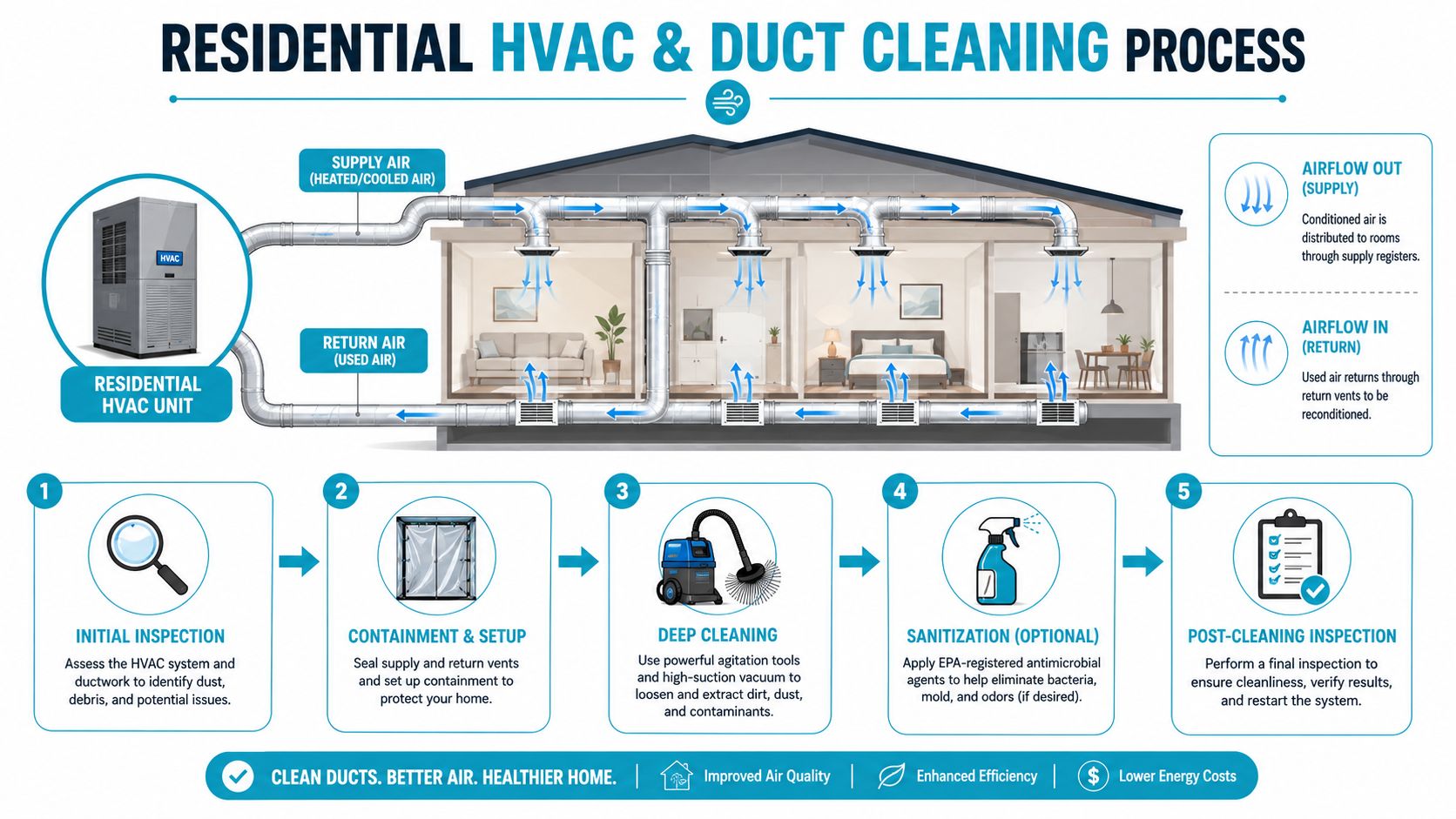
The system is cleaned as a connected path
A home’s HVAC system works like a set of connected airways. If one section is dirty, the rest of the route can still carry contamination through the house. That is why technicians should inspect the full path first, then clean the ducts and the connected components in order.
Federal HVAC cleaning standards reinforce that approach. UFGS 23 01 30.41 requires systems to be mechanically cleaned so they can pass NADCA Cleaning Verification Testings Standards, with vacuum devices kept under negative pressure and any indoor-exhausting vacuums fitted with HEPA filters of minimum efficiency UFGS 23 01 30.41. That means the work is about more than suction. It is about containment, filtration, and keeping loosened debris from being blown back into the home.
Cleaned ducts without cleaned equipment can be like mopping a floor while the muddy shoes stay on.
In a full-system job, the work usually follows a clear sequence. First comes inspection and setup, then containment, then agitation and extraction, then cleaning of the air handler and related components. Sanitization may be offered in some cases, but it should never be the only service a contractor sells. If mold is part of the problem, homeowners should also understand how to remove mold from air ducts before agreeing to any chemical treatment.
Homeowners should ask what is included before the crew starts. If the answer stops at “the ducts,” the scope is too narrow, because the system may still be recycling dust or moisture from the rest of the equipment.
Warning Signs That You Need Duct Cleaning Services
The U.S. EPA says routine air-duct cleaning is generally not recommended, but it becomes appropriate when there is substantial visible mold growth, ducts infested with vermin, or excessive dust and debris that is visibly released into occupied spaces from supply registers EPA guidance on air ducts. That’s a clear decision rule, and it helps cut through the marketing noise that makes every dusty home sound like an emergency.
What counts as a real trigger
If you’re seeing dust puff out when the AC starts, that’s not just a cosmetic nuisance. It means the system is actively moving debris into the living space. A musty odor is another clue, especially after a storm, leak, or stretch of heavy indoor humidity.
Florida makes those signs show up faster. Air conditioners run for long stretches, homes stay closed up, and a small moisture event can linger in hidden spaces longer than a homeowner expects.
The EPA also draws a line around when cleaning makes sense and when it probably won’t help. If none of the visible mold, vermin, or heavy debris conditions are present, cleaning is unlikely to provide measurable benefit. That’s why the smartest homeowners treat duct cleaning as a response to a condition, not a routine purchase pushed by every coupon ad.
If you’re trying to sort out whether your smell, dust, or allergy complaints may overlap with mold exposure, symptoms of mold exposure in a home can help you separate a likely HVAC issue from a broader indoor moisture problem.
A simple homeowner checklist
- Visible dust release: Check whether dust comes out of supply registers when the system turns on.
- Musty odor: Notice whether the smell appears only when the HVAC runs.
- Moisture history: Think back to leaks, flooding, or storm intrusion.
- Visible contamination: Look for signs of mold or pest activity around vents.
- Recent construction: Drywall dust and renovation debris often travel into the system.
If one of those boxes is checked, the system deserves a professional look. If none of them are, cleaning may be the wrong first move.
Partial Cleaning Versus a Full-System Duct Cleaning Service
A homeowner standing in a hot, humid Florida house can pay for a cheap duct-only visit and still end up with the same stale air problem a week later. The reason is simple. Duct cleaning services vary in scope, and a partial job can remove loose debris from a few visible runs while leaving the air handler, coils, drain pan, and return side dirty.
| Partial Versus Full-System Duct Cleaning Comparison | ||
|---|---|---|
| Scope | Partial Duct Cleaning | Full-System Duct Cleaning Service |
| Ducts | Cleans selected ducts or visible runs | Cleans accessible supply and return ducts |
| Air handler | Often skipped | Included |
| Coils and drain pans | Often skipped | Included when accessible |
| Registers and grilles | Sometimes cleaned | Cleaned as part of the job |
| Containment | May be limited | Uses negative pressure and filtered collection |
| Result | Short-term cosmetic improvement | More complete cleaning of the airstream |
Why the shortcut fails
Partial cleaning works like wiping one countertop in a kitchen after a burst pipe. The surface looks better, but the wet, dirty areas you did not reach still affect the room. In an HVAC system, dust and debris left in the air handler and connected parts can keep moving back into the ducts, so the same contamination shows up again.
That is why the estimate has to spell out scope. Homeowners should ask for written pricing, ask to see proof of contamination, and confirm licensing before agreeing to service, as Wirecutter’s homeowner guidance on duct cleaning explains. In practice, a very low quote often means the contractor plans to clean only part of the system, then rely on the homeowner not noticing what was left out.
Florida homeowners have another reason to be careful. A system that saw a leak, storm intrusion, or long periods of indoor humidity may need attention beyond the ducts themselves, because the contamination usually starts in the moisture-affected components and spreads from there. If the contractor cannot say whether the return side, air handler, and coil area are included, the quote is too vague to compare fairly.
Federal guidance points in the same direction. Mechanical cleaning under negative pressure, with HEPA filtration when the exhaust stays indoors, is the standard serious contractors follow, as outlined in UFGS 23 01 30.41. That kind of scope does not make the work fancy, it keeps the dust controlled while the system is opened and cleaned.
A homeowner should compare scope first, price second. If two quotes look similar but one includes the full air path and the other stops at selected ducts, they are not offering the same service.
What Happens During a Professional Duct Cleaning Appointment
A real appointment starts with a walk-through, not a vacuum hose in the doorway. The crew checks the system, protects floors and furnishings, and looks for the places where dust, debris, or moisture have collected. Good companies document what they find so the homeowner isn’t left guessing after the crew leaves.

What the crew actually does
The technician usually creates negative pressure with a truck-mounted or portable HEPA-filtered vacuum, then agitates the interior surfaces with brushes or air whips to loosen debris. Registers, grilles, the air handler, and the coil area are cleaned as part of the larger process, not as separate afterthoughts.
The time matters too. Most single-family homes need several hours, not the kind of thirty-minute visit some ads suggest. Wirecutter’s homeowner guidance also notes that a proper job may require truck-mounted vacuums and should include the air handler rather than only the ducts Wirecutter’s duct cleaning advice.
If the appointment feels rushed, the scope probably is.
A homeowner should expect some noise, a little disruption, and a final walkthrough that explains what was cleaned. The crew should leave the work area tidy, reassemble the system correctly, and tell you if anything they found changes the bigger moisture or mold picture.
What a good finish looks like
You don’t need jargon to judge the result. You should be able to ask what was cleaned, what was observed, and whether any damaged or wet materials need separate remediation. If the answers stay vague, the job probably was too.
A finished service should feel organized, not mysterious. The contractor should know the difference between dust removal and solving an active contamination source.
Typical Cost of Duct Cleaning Services in Florida
Florida pricing depends more on scope than on a single flat number. A house with one accessible system and light debris is a different job from a larger home with multiple systems, tight attic access, heavy contamination, or add-ons like coil cleaning and sanitizing. The reason ultra-low offers are risky is simple, they usually leave out part of the system or rush the labor.
What changes the price
Home size matters because more duct runs take more labor. Accessibility matters because cramped attics and tight mechanical closets slow the crew down. The condition of the system matters too, since heavy dust, post-renovation debris, or storm-related contamination takes more time to remove than routine buildup.
For a helpful comparison on how add-ons and HVAC-related upkeep can affect value, AC duct cleaning benefits is a relevant resource that frames why the equipment side matters, not just the ducts themselves.
Why quotes can look very different
A quote that sounds cheap may only cover the visible supply ducts. A more complete quote may include the air handler, return side, registers, and any necessary containment setup. Those differences change the labor time and the result, which is why homeowners should compare scope line by line rather than shop by headline price.
If mold remediation is part of the picture, the budget changes again. mold removal cost 2026 is a useful reference point when the issue is no longer simple dust removal but a broader moisture problem that has spread into building materials.
Financing can help when the home needs a larger, more complete service and the homeowner doesn’t want to delay a needed fix. That’s especially useful after a storm season, when several repairs can compete for the same household budget.
When Duct Cleaning Is Not the Right Fix
This is the point most sales pages skip. The EPA and NIH-linked guidance treat duct cleaning as a last resort, done only after the contamination source is identified and controlled NIH-linked HVAC duct cleaning fact sheet. That matters in Florida, where a leak, flood, or roof issue can keep feeding moisture into the same system you’re paying to clean.
Fix the source first
If water is still getting into the ducts, cleaning the ducts alone won’t solve the problem. The same goes for active mold growth, because the system can recontaminate itself if the moisture source stays in place. Wet or moldy fiberglass duct material often needs replacement, not just cleaning, and the same guidance warns against relying on biocides as a shortcut.
That’s where homeowners can save real frustration. If the smell started after a leak, storm intrusion, or visible water damage, the first question is not “Who can clean the ducts tomorrow?” It’s “Where is the moisture coming from, and has it been stopped?”
For homeowners trying to understand the larger restoration picture, when do I need professional mold removal helps frame when cleaning stops being enough and remediation has to take over. If you’re also budgeting other household prevention measures, pest control cost per month is a reminder that recurring indoor problems often need recurring oversight, not one-time surface treatment.
The rule that protects your budget
Fix the water problem. Confirm the contamination source. Then clean the system if cleaning still makes sense. That sequence avoids the common trap of paying for one service only to watch the same odor or debris come back.
Choosing a Trusted Duct Cleaning Contractor on the Suncoast
A trustworthy contractor doesn’t hide the scope. They explain what’s included, show evidence of contamination, and give you a written estimate before work starts. They also verify licensing and insurance, because a home’s HVAC system isn’t a place to experiment with the cheapest bidder.
Questions that separate real pros from sales crews
- What exactly is included: Ask whether the air handler, coils, drain pans, registers, grilles, and return side are part of the quote.
- What evidence do you have: Ask for visible proof of contamination before agreeing to cleaning.
- What equipment will you use: Negative-pressure containment and HEPA filtration are signs of a more serious setup.
- Who is responsible if there’s hidden water damage: If the answer is vague, the contractor may not be equipped for Florida moisture issues.
- Can you provide the estimate in writing: Clear paperwork helps prevent scope creep.
A good contractor answers scope questions without getting defensive.
That matters even more on the Suncoast, where duct cleaning often overlaps with water damage, mold inspection, and storm recovery. A company that understands those connections can tell the difference between a maintenance job and a remediation problem, which saves time and reduces repeat work.
If you need a local team that handles these issues with emergency response, insurance claim assistance, and financing options, AMPM Restoration serves Bradenton, Sarasota, Tampa Bay, Saint Petersburg, Lakewood Ranch, and surrounding Gulf Coast communities from 4301 32nd St W b18, Bradenton, FL 34205. Their 24/7 availability and restoration background make them a practical call when duct cleaning is tied to water, mold, or storm damage rather than simple dust alone.
If your vents are dusty, your AC smells musty, or a recent leak has you wondering whether the ductwork was affected, call AMPM Restoration Services for a free inspection and estimate at 941-946-7807. They can help you sort out whether you need duct cleaning services, mold remediation, or a broader restoration plan, and you can also visit AMPM Restoration Services to get started with insurance claim assistance and financing options.